

Governed Webhooks and Event Delivery For Enterprise Business Card Ordering
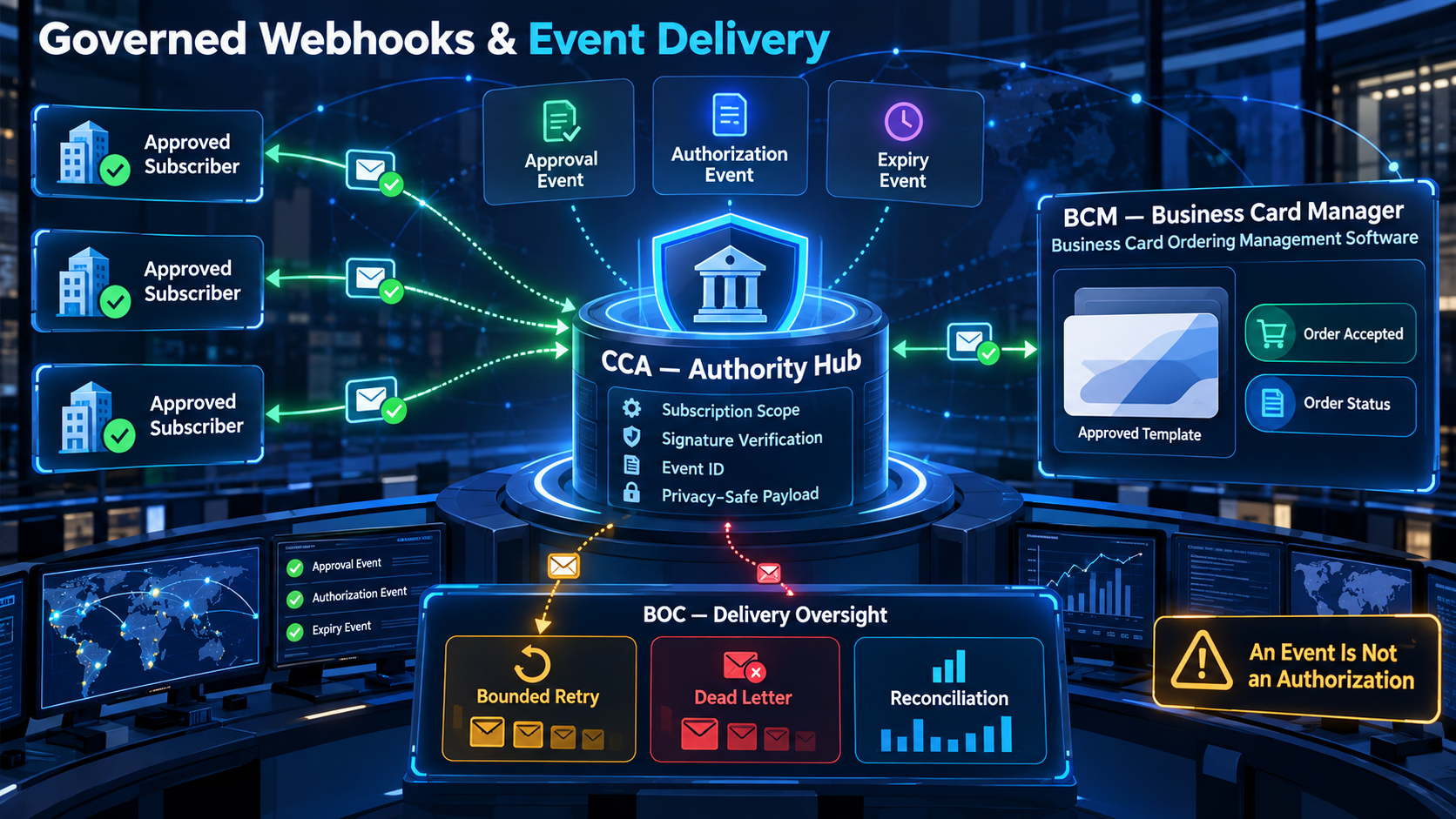
Distributing trusted lifecycle updates without weakening CCA authority. Authorize, publish, verify, deliver, reconcile.
Webhooks Extend CCA Governance Beyond the Request
Enterprise applications need timely updates after a business card request leaves the screen. Approval may be granted later, an authorization may expire, Business Card Manager may accept an order, or an operational exception may require attention. Webhooks can deliver these state changes quickly, but speed is useful only when the event is authentic, correctly scoped, privacy-safe, and tied to an authoritative record.
Color Card Administrator (CCA) remains the central administrative authority for enterprise business card programs. It governs eligibility, approved identity fields, templates, quantities, approval routes, destinations and ordering rights. Business Card Manager (BCM) is the business card ordering management system or software that accepts and manages valid CCA-authorized orders. Business Ops Center (BOC) oversees delivery failures, exceptions and reconciliation. A webhook reports a governed event; it does not create a new permission or replace the CCA record.
An Event Is Not an Authorization
A notification that an employee became eligible does not itself authorize an order. An approval-completed event does not permit a consumer to alter the approved payload. An order-status event does not allow the receiving application to rewrite BCM state. Each event should reference the authoritative resource and communicate the minimum state needed for the subscriber to take an allowed next step.
This boundary prevents event-driven convenience from becoming an alternate control plane. The subscriber may refresh its display, retrieve an authorized resource, stop a timer or open a support workflow. Any action that changes identity, template, quantity, approval or ordering rights returns to CCA for evaluation.
Define a Governed Event Catalog
| Event family | Authoritative meaning | Typical subscriber action | Authority owner |
|---|---|---|---|
| Decision updated | CCA produced a new governed outcome | Refresh safe decision status | CCA |
| Approval required | The request entered an approved workflow | Display pending state and stop submission | CCA |
| Approval completed | An authorized approver acted on a locked proposal | Retrieve the resulting CCA state | CCA |
| Authorization issued | CCA created a valid time-bound order authorization | Submit once to BCM under approved conditions | CCA |
| Authorization expired | The authorization can no longer be used | Stop submission and request reevaluation | CCA |
| Order accepted | BCM created a managed order | Store BCM order reference and stop creation retries | BCM |
| Order status changed | The managed order moved to a normalized state | Update display or downstream workflow | BCM |
| Exception opened | BOC created an operational case | Route accountable support action | BOC |
Govern Subscription Before Delivery
A webhook endpoint should be registered as part of an approved API consumer profile. Record the subscribing application, tenant, environment, business purpose, event families, endpoint ownership, support contact, data classification, and retirement trigger. Development, test, and production subscriptions must remain separate.
CCA should authorize subscriptions according to least privilege. A portal serving one enterprise entity should not receive events for another tenant, and a status dashboard should not automatically receive identity values. Subscription approval determines which event types and resource scopes may be delivered; it does not expand the consumer’s underlying business authority.
Verify Endpoint Ownership and Security
Before activation, verify that the endpoint belongs to the approved consumer and can receive a challenge without exposing sensitive content. Require transport encryption, supported protocols, and certificate validation. Bind the production subscription to the approved consumer identity and environment.
Sign every delivery with a managed signing key and include a timestamp plus unique event identifier. The receiver should validate the signature against the raw body, enforce an acceptable time window, and reject unsupported algorithms or unknown key identifiers. Rotate keys deliberately and allow a controlled overlap so valid in-flight deliveries remain verifiable.
Design a Stable Event Envelope
| Envelope field | Purpose | Governance requirement |
|---|---|---|
| Event ID | Uniquely identifies the business event | Stable across redelivery |
| Event type | Names the governed state change | Versioned and documented |
| Occurred at | Records when the authoritative change happened | Generated by the source record owner |
| Published at | Records when delivery became available | Supports delay measurement |
| Tenant reference | Constrains enterprise context | Opaque and scope validated |
| Resource reference | Links to the authoritative CCA or BCM record | Prefer reference over full payload |
| Correlation IDs | Connects request, decision, authorization, order or case | Consistent with Post 115 traceability model |
| Schema version | Defines the event contract | Backward-compatible policy required |
| Data classification | Signals handling expectations | Enforced by subscriber controls |
Minimize the Event Payload
Webhook payloads should contain the minimum data needed to identify the event, validate its scope, and retrieve an authorized resource. Avoid placing names, email addresses, phone numbers, postal addresses or complete business card management content in general-purpose notifications. A reference-and-fetch pattern allows CCA to apply current authorization when the subscriber retrieves details.
When a limited value must be included, document its purpose, classification, retention and subscriber access. The same event may need different projections for different subscriber classes. Data minimization reduces exposure in gateways, queues, support tickets and logs that often retain webhook bodies longer than expected.
Expect At Least Once Delivery
Most dependable webhook systems use at-least-once delivery. A receiver may process the same event more than once because an acknowledgement was lost or a retry was scheduled before the first response became visible. The consumer must treat the event ID as an idempotency key and record the processing outcome.
Deduplication should not suppress a genuinely new event for the same order. An order accepted event and a later order completed event require different event IDs. Redelivery of either event retains its original ID. This distinction lets the receiver ignore transport duplicates while preserving every governed lifecycle change.
Use Bounded Retry and Dead Letter Handling
| Delivery outcome | Publisher response | Subscriber obligation | BOC role |
|---|---|---|---|
| Success | Record acknowledgement and delivery time | Process idempotently | Monitor service health |
| Temporary failure | Retry with exponential delay and jitter | Recover within agreed window | Track prolonged delay |
| Rate limited | Respect retry guidance and subscription quota | Return clear capacity signal | Review recurring constraint |
| Permanent rejection | Stop unchanged retries after policy threshold | Correct endpoint or contract | Open accountable case |
| Signature failure | Do not treat as accepted delivery | Reject and alert security owner | Support investigation |
| Retry exhausted | Move to controlled dead-letter state | Remain queryable by event ID | Own recovery and reconciliation |
| Unknown acknowledgement | Query delivery record before replay | Do not infer event absence | Coordinate safe replay |
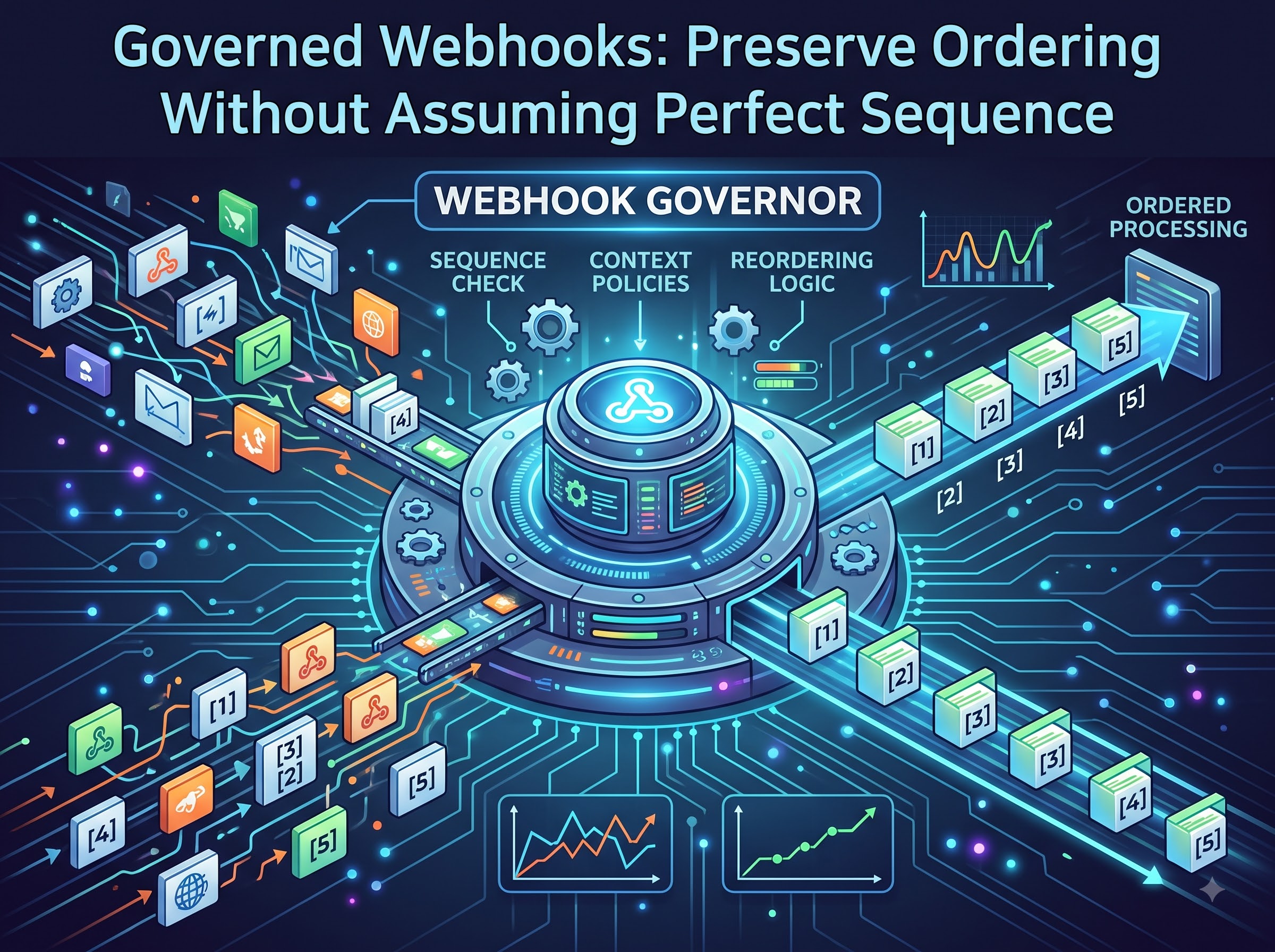
Preserve Ordering Without Assuming Perfect Sequence
Networks can delay or reorder deliveries. Include the authoritative occurrence time, resource version and state sequence where appropriate, but do not assume every subscriber receives events in perfect order. The receiver should compare versions and avoid moving a resource backward because an older delivery arrived late.
Some event families require strict sequencing; others only require current-state retrieval. Prefer a fetch of the authoritative resource after a change notification when the complete state matters. This reduces dependence on reconstructing business truth from a possibly incomplete event stream.
Connect CCA Events to BCM Order Management
CCA may publish business card approval and authorization events because it owns those decisions. Once Business Card Manager accepts a valid authorization, BCM becomes the authoritative owner of the managed order record and its normalized lifecycle status. The event model should make this ownership visible rather than presenting every update as if it came from one undifferentiated system.
BCM is the business card ordering management system or software, not an external print vendor. It may receive and normalize provider events, but subscribers should rely on the governed BCM order status exposed through the integration. Provider-specific messages should not bypass BCM or cause connected applications to invent their own order state.
Reconcile Delivery and Business State
| Reconciliation check | Risk detected | Governed response |
|---|---|---|
| Authorization event without BCM order | Subscriber failed or outcome is unknown | Query authorization and BCM before replay |
| BCM order without expected acceptance event | Notification gap or delayed delivery | Backfill event evidence without recreating order |
| Repeated event with different payload digest | Event immutability defect | Quarantine and investigate |
| Event delivered outside tenant scope | Authorization or routing failure | Contain exposure and revoke subscription |
| Dead-letter event still unresolved | Business process may be stale | Assign BOC owner and recover deliberately |
| Subscriber retired but deliveries continue | Incomplete offboarding | Disable subscription and investigate residual configuration |
Monitor the Webhook Service as a Control
| Measure | What it reveals | Target direction |
|---|---|---|
| Delivery success rate | Events acknowledged within the operating window | Increase |
| End-to-end delivery latency | Delay between authoritative change and receipt | Reduce within objective |
| Duplicate delivery rate | Transport retries reaching subscribers | Understand and control |
| Signature rejection rate | Key, clock or security problems | Reduce toward zero |
| Dead-letter age | Time unresolved events remain outside normal delivery | Reduce |
| Scope violation count | Events blocked for tenant or subscription mismatch | Maintain zero delivered violations |
| Reconciliation gap rate | Business records missing expected event evidence | Reduce toward zero |
Certify Subscriber Behavior
Webhook certification should prove signature validation, replay protection, tenant isolation, schema compatibility, idempotent processing, out-of-order handling, bounded failure responses and safe logging. Test expired signatures, unknown key IDs, duplicate events, delayed events, revoked subscriptions and payloads containing prohibited fields.
Certification should also verify the user experience. A delayed event must not imply that approval was denied or that no order exists. The connected application should offer a safe status refresh using CCA or BCM correlations rather than a button that creates another order.
Retire Subscriptions Cleanly
Retirement should identify in-flight deliveries, dead-letter records, unresolved BOC cases and business processes that depend on the event stream. Decide whether they will complete, transfer to another subscriber or close under an approved exception. Then disable the subscription, revoke secrets or signing relationships, remove endpoint access and retain evidence according to policy.
Continue monitoring attempted delivery or access after retirement. Residual traffic may reveal forgotten jobs, duplicated configuration or an incomplete environment separation. A subscription should not remain active merely because its endpoint still responds.
Implementation Roadmap
- Create an event catalog that names the authoritative owner and allowed subscriber action for every event family.
- Register subscriptions by consumer, tenant, environment, purpose, endpoint owner and retirement trigger.
- Apply least-privilege event and resource scopes before issuing delivery credentials.
- Verify endpoint ownership and implement signed, timestamped event delivery with managed key rotation.
- Adopt a stable envelope containing event ID, type, versions, correlations, and classification.
- Minimize payloads and use authorized reference-and-fetch patterns for sensitive details.
- Implement idempotent processing, version comparison, bounded retry, and controlled dead-letter recovery.
- Connect CCA authorization events to BCM managed-order events without bypassing either authority boundary.
- Reconcile event evidence with CCA, BCM, and BOC records and monitor delivery-control measures.
- Certify and periodically recertify subscribers, then retire subscriptions with complete evidence.
Frequently Asked Questions
What is a governed webhook?
A governed webhook is an authenticated, scoped, and traceable notification of an authoritative state change. It reports a permitted event without granting new business authority.
Can a webhook authorize a business card order?
No. CCA issues the authorization after policy and approval conditions are satisfied. A webhook may notify a subscriber that the authorization exists.
What is BCM in the webhook architecture?
Business Card Manager (BCM) is the business card ordering management system or software that accepts CCA-authorized orders and owns the managed-order lifecycle. It is not the external print vendor.
Why can the same event arrive more than once?
At-least-once delivery may repeat an event when acknowledgement is uncertain. The subscriber should deduplicate by the stable event ID.
Should webhook payloads contain complete card data?
Generally no. Use privacy-safe references and let an authorized consumer retrieve the current resource from CCA or BCM.
What happens after retries are exhausted?
The event enters a controlled dead-letter state with BOC ownership, preserved evidence and an authorized recovery path.
How should out-of-order events be handled?
Compare resource versions or retrieve the current authoritative state. Do not move a record backward because an older event arrived late.
When should a subscription be recertified?
When ownership, endpoint, scopes, tenant reach, event families, schema, security method, payload data or processing behavior materially changes.
The Strategic Outcome
Governed webhooks let enterprise applications respond quickly without turning every subscriber into an independent source of truth. CCA controls the meaning and scope of governance events, Business Card Manager controls the managed-order lifecycle, and BOC preserves operational accountability when delivery or business records diverge.
The result is an event-driven architecture that reinforces the purpose of the CCA website. Eligibility, identity, templates, approvals, quantities, and ordering rights remain centrally governed. Integrations receive timely, verifiable updates while evidence, privacy and authority stay intact.
Inventory every webhook that carries business card API lifecycle information. For each one, identify the authoritative event owner, approved subscriber, tenant scope, signing method, data classification, retry policy, dead-letter owner, reconciliation control and retirement trigger. Any subscription that cannot produce this evidence should enter controlled remediation before additional event volume is enabled.