

Business Card API Lifecycle Management
Why API Lifecycle Management Matters to the CCA Website Purpose
Enterprise business card integrations do not remain static. HCM platforms introduce new worker types, identity providers change claims, procurement systems revise accounting fields, portals adopt new interaction patterns, and print providers replace fulfillment endpoints. An API can continue returning successful responses while the business meaning behind those responses has drifted. That is why lifecycle management must protect more than technical availability.
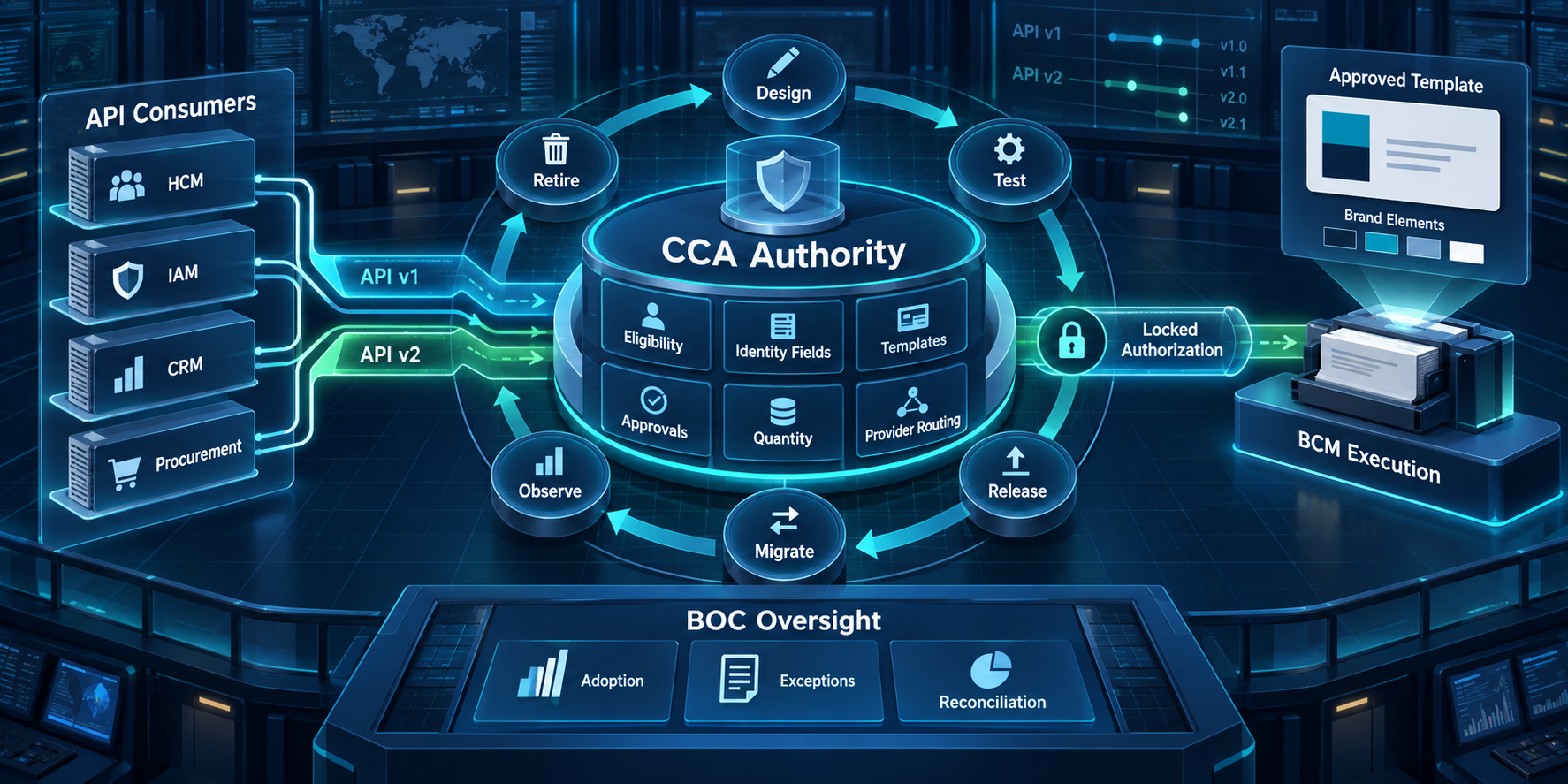
Color Card Administrator (CCA) is the enterprise authority for business card eligibility, approved identity fields, templates, quantities, approvals, destinations, provider routing, and exceptions. Its core website purpose is to centralize these decisions so connected systems do not create their own versions of business-card policy. API lifecycle management must therefore preserve the meaning and enforceability of CCA decisions through every contract change. Business Card Manager (BCM) executes the authorized transaction, while Business Ops Center (BOC) observes migrations, exceptions, and reconciliation evidence.
An API Version Is Not a Policy Version
A common governance failure is treating every kind of change as one release number. The external API contract, print vendor API integration mapping, CCA policy, card template, and provider adapter evolve for different reasons and on different schedules. An API may remain at version two while a quantity rule changes daily. A template may receive a new legal line without changing the request schema. A provider adapter may be replaced while the consumer contract remains stable.
Keeping these versions distinct makes the control model easier to explain. A transaction record should identify the API contract accepted, the mapping used, the CCA policy evaluated, the template released, and the provider adapter invoked. That evidence allows the enterprise to answer whether an incident came from an incompatible request, an incorrect transformation, a valid policy change, or an execution defect.
The Lifecycle Responsibility Model
| Responsibility | Primary owner | Required control | Evidence |
|---|---|---|---|
| Consumer contract | API product and integration owner | Documented schema semantics compatibility and support window | Contract version and consumer registration |
| Business authorization | CCA governance owner | Central eligibility identity template approval quantity and routing decisions | Decision ID reason and policy version |
| Mapping | Integration owner | Reviewed source-to-canonical mappings with provenance | Mapping version test result and deployment |
| Execution contract | BCM owner | Locked authorization intake and idempotent order behavior | Authorization hash order ID and state |
| Provider adaptation | Fulfillment integration owner | Normalized provider requests and lifecycle events | Adapter version acknowledgments and raw event reference |
| Migration oversight | BOC and service owner | Adoption monitoring exception ownership and reconciliation | Consumer status defects closure and retirement approval |
Design Stable Business Capabilities
Long-lived APIs should expose stable business capabilities rather than internal database tables. Useful capabilities include checking eligibility, retrieving a policy-constrained card schema, validating submitted fields, creating a governed request, recording an approval, retrieving a locked authorization, and reading fulfillment status. Consumers should ask CCA what is permitted instead of downloading raw configuration and reconstructing the decision themselves.
A stable capability can evolve behind its contract. CCA may adopt a new policy engine, enrich field authority, or change supplier routing without forcing every portal to duplicate the logic. The contract should define identifiers, required context, governed outputs, error semantics, and lifecycle states. It should also state which fields originate with the consumer, which CCA resolves, and which cannot be changed after authorization.
Classify Changes Before Releasing Them
Every proposed change should be classified by its effect on consumers and business authority. Additive changes may introduce an optional field or a new response link without invalidating existing behavior. Behavioral changes may alter validation, authorization, or status meaning even when the schema is unchanged. Breaking changes remove fields, change types, redefine required values, or modify an established workflow. Emergency security changes may require accelerated action but still need recorded scope, testing, and communication.
| Change class | Example | Preferred treatment | CCA safeguard |
|---|---|---|---|
| Additive | Optional correlation attribute or new event metadata | Release within the supported version after compatibility tests | Confirm that omission does not weaken a decision |
| Behavioral | A status gains a new transition or validation becomes stricter | Publish effective date and test every affected journey | Keep policy reasoning explicit and observable |
| Breaking | Field renamed, required type changed, or endpoint removed | Introduce a new major version and managed migration | Prevent consumers from bypassing governed fields |
| Policy only | Eligibility quantity or approval rule changes | Effective-date the CCA policy without unnecessary API change | Retain policy version and decision reason |
| Provider specific | Supplier endpoint or event vocabulary changes | Update the adapter behind the canonical contract | Preserve locked authorization and normalized lifecycle |
| Security urgent | Credential algorithm or vulnerable route retired | Accelerated rollout with exception and rollback control | Maintain current authorization and audit evidence |
Compatibility Must Include Business Meaning
Schema compatibility checks can prove that a field still exists and has the expected data type. They cannot prove that its meaning is unchanged. A location code might still be a string while its ownership shifts from HCM to a facilities directory. A title field might remain optional while policy now requires an approved role label. A status called accepted might move from technical receipt to production commitment. These semantic changes can break governance without breaking JSON.
CCA lifecycle reviews should therefore test business invariants. An ineligible subject must remain unable to order. A consumer must not select an unauthorized template. User-entered data must not override authoritative identity fields. An approval must apply only to the decision it reviewed. BCM must receive an immutable authorization, and provider events must reconcile to the same transaction. These invariants are more durable than individual endpoints.
Use Consumer Registration as a Control
Every API consumer should have a registered owner, business purpose, environment, authentication method, scopes, supported version, data classification, transaction pattern, and retirement contact. Shared credentials make migration risk difficult to measure because the enterprise cannot identify who is still using an older contract. Distinct service identities and telemetry turn adoption into a manageable inventory.
Registration also limits unintended reuse. A CRM connector authorized to request governed schemas for customer-facing sales roles should not automatically gain permission to submit bulk orders. A supplier permitted to publish delivery events should not retrieve workforce data. The gateway enforces technical access, while CCA evaluates the specific identity and business governance action in context.
The Controlled API Change Lifecycle
- Propose the change with its business purpose, affected capability consumers, data elements, and risk classification.
- Assess schema compatibility and the effect on CCA eligibility, field authority template approvals, quantity routing, and exceptions.
- Define the contract version mapping, version policy dependency, effective date, support window, rollback condition, and accountable owners.
- Build consumer-driven contract tests and end-to-end governance tests across CCA BCM provider events and BOC reconciliation.
- Release first to an isolated environment with representative identities, card programs, entities, regions, and providers.
- Run old and new versions in a controlled overlap period and compare decisions, authorization execution states, and evidence completeness.
- Migrate consumers by risk and volume while monitoring usage errors, denials, duplicates, latency, exceptions, and reconciliation.
- Freeze onboarding to the deprecated version and communicate a dated retirement plan with named escalation paths.
- Retire only after adoption evidence confirms that approved consumers have migrated and outstanding exceptions have owners.
- Archive the contract documentation test evidence, telemetry, and final retirement decision according to enterprise retention policy.
Test the Decision, Not Only the Endpoint
A lifecycle test suite should include positive, negative, and boundary scenarios. It must verify that valid callers can reach the capability, but it must also prove that CCA rejects unauthorized identities, stale approvals, excessive quantities, invalid destinations, and non-permitted templates. Tests should compare the reason and policy version, not merely the HTTP status. A technically successful response with the wrong governed outcome is a failed release.
Execution tests should confirm that BCM receives the locked authorization exactly once, generates the correct proof, prevents duplicate physical orders, and returns correlated lifecycle states. Provider tests should cover rejected payloads, delayed acknowledgments, out-of-order webhooks, substitutions, cancellation limits, and delivery exceptions. BOC should show the same business card lifecycle management and preserve ownership through closure.
Manage Deprecation as an Enterprise Migration
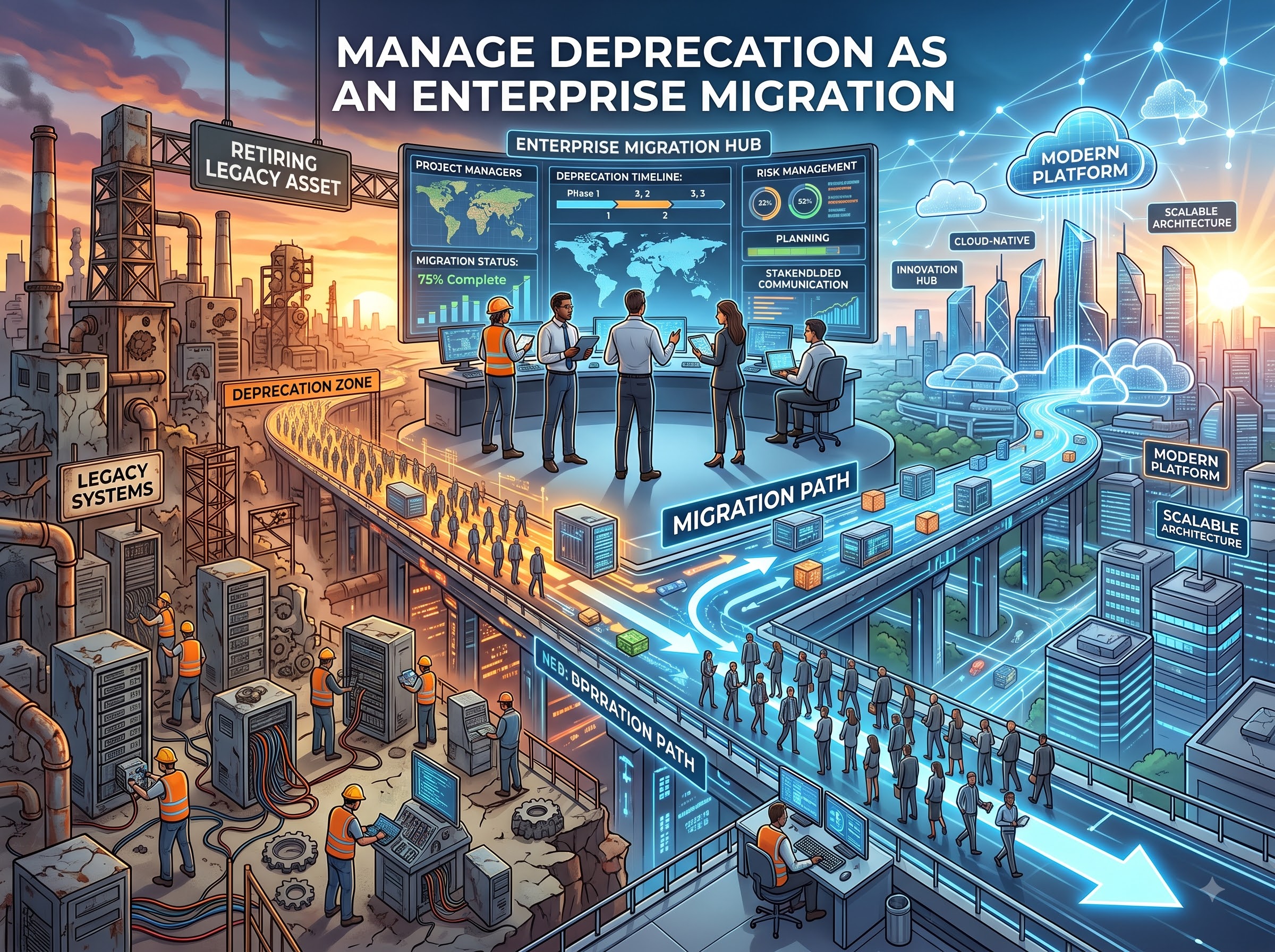
Deprecation is not a documentation notice alone. It is a governed migration with an inventory, dates, owners, and measurable exit criteria. The enterprise should announce the replacement contract, freeze new consumers on the old version, publish a support window, and expose version usage by consumer. High-volume and high-risk integrations should migrate first enough to reveal defects, while critical contingency paths remain available until evidence supports retirement.
Extensions should be explicit exceptions rather than silent postponements. Each extension needs a consumer owner, business reason, restricted scope, revised deadline, and compensating controls. CCA must continue enforcing current business policy even when an older API remains temporarily supported. Backward compatibility should never mean preserving an obsolete entitlement or allowing a retired template.
Use Dual Run Without Creating Dual Authority
During migration, the old and new interfaces may operate in parallel. They should both call the same CCA authority rather than maintaining separate rule sets. Shadow evaluation can compare how the new contract maps context and how CCA decides, but only one path should be authorized to create the executable transaction until release criteria are met. This avoids duplicate orders and competing sources of truth.
Comparison records should focus on meaningful differences: eligibility outcome, authoritative field values, selected template, required approval, quantity limit, destination, provider route, and reason code. Differences must be triaged as intended contract changes, mapping defects, stale source data, or policy defects. BOC can coordinate the exception queue and verify that corrections are reflected in subsequent runs.
Protect the CCA to BCM Contract
The most sensitive contract is the handoff from authority to execution. CCA should issue a versioned, locked authorization containing the approved identity fields, design reference, quantity, destination, provider route, approvals, policy version, template version, and decision identifier. BCM can add operational identifiers and fulfillment states, but it should not reinterpret the business decision.
Changes to this contract require careful compatibility testing because a missing or redefined field can affect physical production. Idempotency keys, authorization hashes, and expiration rules should be stable across retries. If a material value changes after authorization, the transaction should return to CCA for re-evaluation rather than relying on a downstream patch.
Evolve Webhooks and Lifecycle Events Safely
Asynchronous events require the same lifecycle discipline as request APIs. Event names, status meanings, timestamps, sender identity, correlation fields, and retry behavior form a contract. Consumers must tolerate documented additive fields, but a new status or changed terminal-state meaning may require a versioned event. Signatures, replay windows, and duplicate handling should be tested during every migration.
BOC needs a canonical lifecycle even when providers use different terms or replace their APIs. Adapter versions should preserve the original provider event, normalize it to the enterprise state, and link it to the CCA decision and BCM order. An adapter upgrade is successful only when operational evidence remains complete, and exceptions continue to route to accountable owners.
Security, Privacy, and Audit Controls
| Control area | Lifecycle Requirement | Evidence |
|---|---|---|
| Authentication | Version-specific client registration, strong credentials rotation, and environment isolation | Identity owner method rotation and last use |
| Authorization | Least-privilege scope plus current contextual CCA decision | Scope result decision reason and policy version |
| Data minimization | Remove obsolete fields and prevent sensitive values from spreading through compatibility layers | Payload classification field inventory and retention rule |
| Change approval | Independent review for contract mapping policy and provider changes | Approver tests effective date and rollback |
| Release integrity | Signed artifacts, controlled deployment, and reproducible configuration | Build version deployment record and environment |
| Retirement | Disable routes, credentials, jobs, and subscriptions after verified migration | Last-use consumer sign-off and closure record |
Operational Metrics for API Lifecycle Health
Useful measures include consumers by supported version, traffic on deprecated versions, migration completion by risk tier, contract-test coverage, semantic decision mismatch rate, mapping defects, CCA denials by reason, duplicate orders prevented, webhook verification failures, lifecycle-event completeness, extension age, unresolved migration exceptions, and retired credentials still attempting access.
Metrics should be segmented by consumer, environment, legal entity, region, card program, and provider. A new version may show low error rates because only a small population has migrated. Adoption, governance correctness, and operational completion must be read together. The target is not merely current software; it is continued enterprise control through change.
Implementation Roadmap
- Inventory all business card API consumers, versions, credential mappings, webhooks provider adapters, and accountable owners.
- Document CCA business invariants and separate API contract versions from policy template mapping and adapter versions.
- Create a capability catalog with ownership scope, data classification, compatibility policy, and support window.
- Establish consumer registration and telemetry that identifies version usage by service identity and environment.
- Build schema contract semantic authorization execution and operational reconciliation tests for the highest-volume journey.
- Define release classifications, approval paths, overlap periods, rollback conditions, and emergency procedures.
- Pilot a controlled migration with dual-run comparison while maintaining one CCA authority and one executable path.
- Publish deprecation dates, dashboards, and escalation routes, and stop onboarding new consumers to old versions.
- Retire routes, credentials jobs, and event subscriptions only after adoption and reconciliation evidence is complete.
- Review lifecycle health quarterly and feed defects, exceptions, and consumer needs into the governed roadmap.
Frequently Asked Questions
What is business card API lifecycle management?
It is the controlled design, release, support, migration, and retirement of APIs that connect enterprise systems to governed business card services.
Why must CCA remain central during an API upgrade?
CCA owns eligibility, identity fields, templates, approvals, quantity, routing, and exceptions. Keeping that authority centralized prevents old and new consumers from applying different business rules.
Does every policy change require a new API version?
No. A CCA policy can be effective-dated independently when the external contract remains compatible. The transaction should retain both contract and policy versions.
What makes an API change breaking?
A change is breaking when an existing approved consumer cannot preserve its expected contract or governed business outcome without modification.
Can old and new versions run together?
Yes, during a controlled overlap. Both should use the same CCA authority, and only one path should create the executable order unless duplicate-safe release controls exist.
What is BCM responsible for during migration?
BCM must accept the approved execution contract, preserve idempotency, produce the authorized card, and return correlated lifecycle evidence without rewriting CCA policy.
What does BOC contribute?
BOC monitors adoption, mismatches, failures, event completeness, exceptions, and final reconciliation across versions and providers.
When can a deprecated version be retired?
After registered consumers have migrated or received controlled exceptions, recent telemetry confirms no unowned use and end-to-end reconciliation is complete.
The Strategic Outcome
Disciplined API lifecycle management lets enterprises modernize connected business card services without fragmenting authority. Consumers receive stable capabilities and predictable support. Integration teams can revise mappings and infrastructure. CCA continues to decide the permitted business identity and transactions. BCM executes a locked authorization, and BOC proves that migrations and operational outcomes remain under control.
This operating model reduces the hidden cost of integration change. New portals, source systems, and providers can be introduced without rebuilding governance in each interface. Older versions can be retired with evidence instead of hope. Most importantly, the CCA website remains what the enterprise needs it to be: the central administrative and policy authority for business card ordering at scale.
Choose one production business card API and trace its consumers, version, mappings, CCA policy dependencies, BCM handoff, provider events, and BOC evidence. Any unknown consumer, duplicated business rule, unsupported version, untested semantic change, or retirement without reconciliation should become a prioritized lifecycle-control action.