

Why Enterprise Business Card Governance Requires Integration With Existing Systems
Introduction
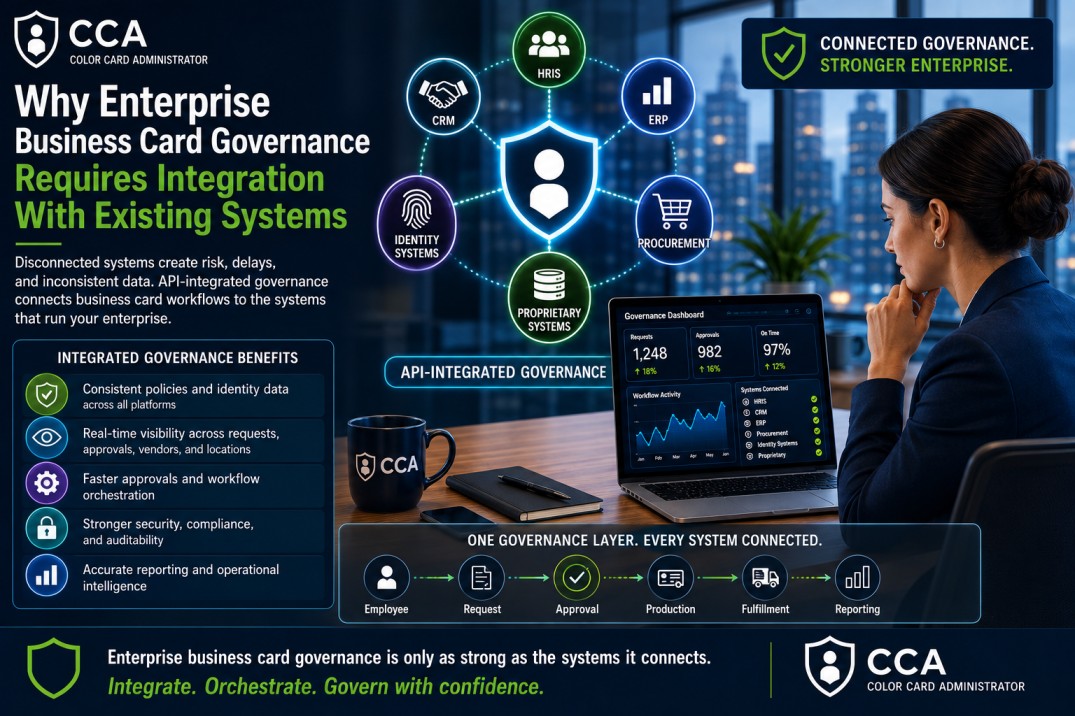
Enterprise business card governance is no longer limited to templates, approvals, ordering controls, and vendor management. Modern enterprises operate across interconnected systems that manage employee identity, onboarding workflows, procurement operations, financial controls, customer information, operational reporting, and governance activities.
Organizations increasingly expect business card workflows to connect with HRIS platforms, CRM environments, ERP systems, procurement applications, identity management platforms, reporting tools, and proprietary enterprise systems.
Governance explains the category. Workflow orchestration explains the operating model. API integration explains why enterprise buyers care.
Enterprise business card governance is one control layer within the broader category of API-integrated enterprise business card printing and management. For medium, large, and enterprise organizations, business card programs now involve ordering, printing, approvals, brand standards, vendor coordination, reporting, and system connectivity. Governance only works when those pieces are connected to the systems the organization already uses.
The Problem With Isolated Governance Systems

Many organizations continue to operate business card workflows independently from the systems that manage employee data, approvals, procurement activity, and operational reporting. Employee information may be updated in HR systems but not reflected in business card ordering platforms. Procurement approvals may be tracked separately from fulfillment workflows.
As organizations scale, these disconnected processes create operational friction, identity inconsistencies, onboarding delays, auditability gaps, and reduced visibility.
Why Existing System Integration Matters
Business card governance does not exist in isolation. Every business card request relies on information that already exists elsewhere within the enterprise.
Employee data originates in HRIS systems. Customer-facing identity consistency often relates to CRM environments. Financial controls and reporting depend on ERP systems. Procurement workflows govern spending, approvals, and vendor activity.
Integration allows governance workflows to use authoritative data directly from enterprise platforms, reducing administrative effort while improving accuracy and consistency.
The Role of HRIS Integration
Human Resource Information Systems often serve as the primary source of employee identity data. New hires, promotions, transfers, title changes, department updates, and employee exits all originate within HR systems.
When business card governance connects directly to HRIS platforms, organizations gain stronger identity consistency and lifecycle management.
CRM and Customer-Facing Identity Consistency
Integrating business card governance with CRM environments helps ensure identity consistency across customer-facing interactions while supporting stronger brand integrity.
ERP and Procurement Governance
When business card workflows connect with ERP systems and procurement platforms, organizations gain stronger visibility into approvals, vendor activity, spending controls, and fulfillment execution.
Workflow Orchestration Across Enterprise Systems
Enterprise business card workflows frequently intersect with HRIS platforms, CRM environments, ERP systems, procurement applications, identity management platforms, vendor fulfillment systems, and operational reporting tools.
Workflow orchestration coordinates these systems into a unified governance framework.
Integration and Operational Visibility
Operational visibility remains one of the most important benefits of connected governance infrastructure. Leaders need visibility into request activity, approval status, identity changes, vendor execution, procurement workflows, reporting metrics, and auditability data.
Business Card Governance as Connected Infrastructure
Business card governance should not be viewed as a standalone ordering process. It is part of enterprise identity governance, onboarding orchestration, procurement governance, operational visibility, workflow automation, and enterprise systems architecture.
Why This Matters When Choosing a Business Card Management Platform
For enterprise buyers, business card governance should not be evaluated separately from ordering, printing, approval workflows, reporting, and fulfillment execution. A traditional print vendor may produce cards, but medium and large-sized organizations often need a connected platform that can support employee data, brand standards, procurement rules, approval routing, vendor coordination, and operational visibility.
That is why API-integrated enterprise business card printing and management is different from ordinary business card printing services. It connects governance to the practical workflows companies use to request, approve, print, manage, and report on business card activity.
For organizations that need practical execution for business card ordering, approvals, printing, reporting, and fulfillment, Business Card Manager supports the operational layer of the CCA ecosystem.
Strategic Takeaway
Organizations that connect governance workflows to HRIS platforms, CRM environments, ERP systems, procurement infrastructure, identity management platforms, reporting environments, and proprietary enterprise systems achieve stronger operational visibility, workflow orchestration, auditability, identity consistency, and governance maturity.
CCA’s ecosystem connects category authority, API infrastructure, business card printing and management, business-to-business lead generation, business systems education, and future platform expansion.
Integration is not simply a technology decision. It is a governance strategy.
Explore how CCA supports API-integrated enterprise business card governance across workflow, procurement, identity, and operational systems.