Pillar guide Enterprise framework

Business Card Governance:
The Complete Guide.

Treat business cards as governed identity assets, not ad-hoc print purchases. This guide defines the discipline, walks through the seven control areas that make it work, and routes you to deeper reading on risk, integration, and digital identity execution.

7 Control AreasThe full stack from permissions through integrations.
4-Stage MaturityFrom centralization to governed infrastructure.
3 Deep DivesRisk, integration, and digital identity articles.
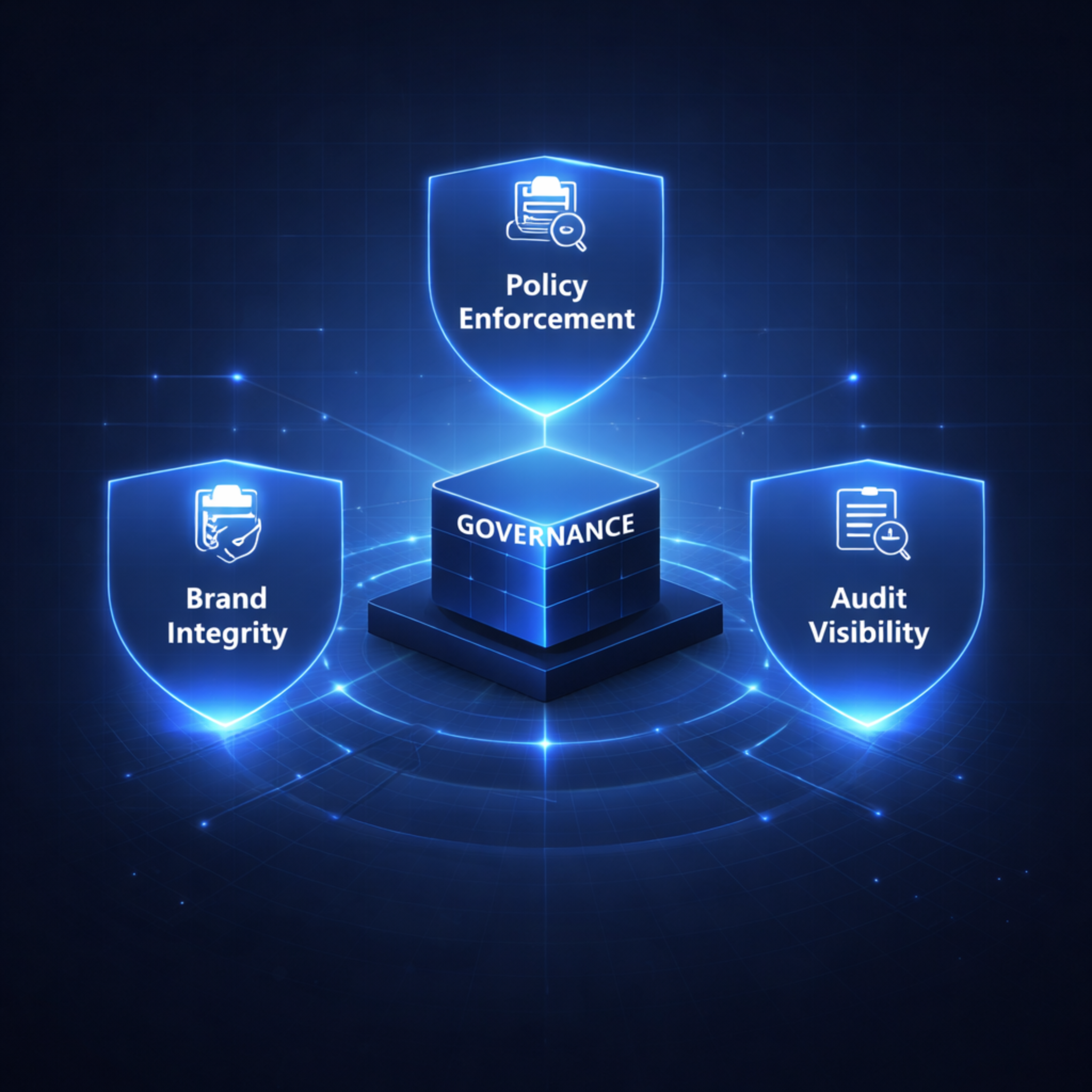
Business card governance framework diagram showing role-based access, approval routing, template control, funding logic, audit visibility, identity execution, and enterprise integrations
01 · Definition

What “governance” actually means in this context

Most organizations already govern email accounts, system access, expense approvals, and vendor onboarding. Business cards are usually the exception — left to email requests, individual managers, and unmanaged vendors.

Governance closes that gap by embedding policy directly into the ordering layer so every order passes through the same rules regardless of department, region, or business unit. The result is not a stricter purchasing process; it is a consistent identity execution layer that procurement, HR, brand, and compliance can all rely on.

For the platform-level view of how this is enforced, see CCA’s governance framework.

02 · Context

Why this matters at enterprise scale

Small organizations can manage business card ordering through informal coordination. Enterprises cannot. Fragmentation emerges naturally as organizations grow across regions, business units, and systems — and it shows up as brand inconsistency, procurement blind spots, compliance gaps, and onboarding lag.

The operational consequences of leaving this ungoverned are covered in detail in Business Card Governance for Enterprise Organizations, which also lays out the four-stage maturity path organizations typically follow.

03 · Framework

The seven control areas of business card governance

A mature governance model is built from seven control areas working together. Each one is a lever; missing any of them creates a predictable failure mode.

01

Role-Based Permissions

Who can order, who can approve, and who can manage templates — defined by role, department, location, and business unit rather than by individual relationships. The foundation; without it every other control becomes negotiable.

02

Approval Routing

Configurable approval chains aligned to management hierarchy, budget authority, and brand review. Routing should be deterministic — the same kind of order always follows the same path — so approval becomes a system behavior, not a manager-by-manager judgment call.

03

Brand & Template Control

Centralized, locked templates with field-level restrictions on titles, layouts, disclaimers, and contact data. Identity consistency is enforced at the template level so it cannot drift through copy-paste, local vendors, or “just this once” exceptions.

04

Funding Logic

Spend limits, cost-center routing, sponsorship rules, and procurement policy enforcement applied inside the ordering workflow — not after the fact through expense reconciliation. Funding rules are where governance and procurement meet.

05

Audit Visibility & Reporting

A complete, queryable record of who ordered what, under which policy, approved by whom, funded from where. Auditability is what converts governance from a policy document into something procurement and compliance can verify.

06

Identity Execution

Business cards are identity assets, not stationery. Governance treats them the way IT treats account provisioning — issued on role assignment, updated on role change, revoked on offboarding. The digital side of this is covered in our digital identity governance guide.

07

Enterprise Integrations

Governance only scales when it is wired into HRIS, procurement, SSO, ERP, and CRM systems so policy enforcement runs on real organizational data instead of a parallel set of spreadsheets. The integration patterns and the operational before/after picture are detailed in Enterprise Integration of Business Card Governance Systems.

04 · The Stack

How the controls fit together

These seven areas are not a checklist — they are a stack. Each layer depends on the one below it.

Who acts

Permissions & Routing

Role-based permissions and approval routing define who is allowed to act, and on whose sign-off.

What is allowed

Templates & Funding

Template and funding controls define the boundaries of every order — brand-safe and budget-safe by default.

What was done

Audit Visibility

Audit visibility records what was actually done so procurement and compliance can verify policy adherence.

When & with what

Identity & Integrations

Identity execution defines when ordering should happen automatically; integrations connect it to the systems of record.

Organizations that adopt these in isolation tend to plateau. Organizations that adopt them as a stack reach what the enterprise governance article calls Stage 4 — governance as infrastructure rather than governance as policy.

05 · Deeper reading

Explore in depth

The three articles below go deeper on the angles introduced above. Read them in the order that matches where your organization is today.

Cluster · Risk & Maturity

Business Card Governance for Enterprise Organizations

If you’re building the internal case, start here. Covers the categories of risk created by decentralized ordering and the four-stage maturity model — centralization, workflow governance, system integration, full infrastructure.

Read the maturity model

Cluster · Integration

Enterprise Integration of Business Card Governance Systems

If your framework exists on paper, this is how to operationalize it. Walks through HRIS, procurement, workflow, identity, and reporting integration — and the before/after operational picture once they’re connected.

Read the integration guide

Cluster · Digital Identity

Digital Identity Governance for Enterprise Business Card Systems

If your environment is hybrid, mobile-first, or shifting digital-first, read this. Covers digital business cards as governed identity assets, workflow orchestration, and audit visibility for digital identity execution.

Read the digital guide

From framework to working system.

Governance is enforced at the platform level. Map your organization’s hierarchy, approval structures, procurement policies, and brand standards into a unified business card governance framework designed for enterprise scale.