

End-to-End API Traceability For Enterprise Business Card Ordering
Enhancing Business Card Request Traceability for Effective Order Management
This video emphasizes the importance of traceability in managing business card requests, ensuring every step from initial request to final delivery is clearly documented and controlled. Traceability connects various roles and systems to maintain accountability while safeguarding sensitive data. The framework involves key authorities responsible for approval, processing, and operational oversight.
Traceability Must Preserve the Purpose of CCA
An API integration can move a business card request through several systems in seconds, yet an enterprise may need to explain that transaction months later. The question is not merely whether an endpoint responded. The enterprise must show which application initiated the intent, which source values were trusted, what policy CCA applied, whether approval was required, what authorization was issued, how the order entered BCM and how exceptions were resolved.
Color Card Administrator (CCA) remains the central administrative authority for enterprise business card programs. It governs eligibility, approved identity fields, templates, quantities, approval routes, destinations and ordering rights. Business Card Manager (BCM) is the business card ordering management system or software that accepts and manages valid CCA-authorized orders. Business Ops Center (BOC) provides operational oversight, exception ownership and reconciliation. Traceability connects evidence across these boundaries without transferring authority away from CCA.
A Trace Is More Than a Log Entry
Traditional application logs describe local technical activity. End-to-end traceability describes the governed business meaning of a transaction across systems. It connects a user intent to an authenticated consumer, a normalized request, a CCA policy decision, an approval state, a locked authorization, a BCM-managed order and the operational events that follow. Each system retains its own record, while stable correlations let authorized teams reconstruct the full journey.
This distinction matters during delay and failure. A timeout does not prove that no decision or order exists. A successful HTTP response does not prove the correct employee, template or quantity was authorized. Traceability combines technical signals with authoritative business records so operators can determine the actual state before retrying, correcting or escalating.
Build a Governed Evidence Chain
| Evidence record | Authoritative question | Primary owner | Correlation requirement |
|---|---|---|---|
| Consumer request | Who initiated which business intent and in which tenant? | Connected application | Consumer request ID and trace ID |
| CCA evaluation | Which normalized facts and policy version were evaluated? | CCA authority layer | Trace ID and decision ID |
| Approval record | Who approved or rejected which locked proposal? | CCA approval governance | Decision ID and approval ID |
| Authorization | What exact order parameters became valid and until when? | CCA authority layer | Authorization ID and payload digest |
| Managed order | Did BCM accept the authorization and create an order? | BCM ordering software | Authorization ID and BCM order ID |
| Operational event | What production, shipment or exception state was reported? | BCM and BOC | BCM order ID and event ID |
| Reconciliation case | What mismatch occurred and how was it resolved? | BOC oversight | Case ID linked to all relevant IDs |
Start with a Business Intent Identifier
The first durable identifier should represent the business intent, not a network attempt. A portal may submit the same intent more than once because a response was lost or the user refreshed the page. Those attempts should carry the same idempotency key or consumer request ID so CCA can recognize that the business meaning has not changed. A materially different employee, program, quantity or destination needs a new intent.
Keep the business identifier separate from the distributed trace ID. The trace ID helps engineers follow a specific standardizing identity execution path through services. The business intent identifier survives retries, asynchronous approvals and later support work. Together they answer both what the enterprise intended and how a particular technical attempt was processed.
Capture CCA Decision Evidence Without Exposing Policy Internals
CCA should record the decision ID, policy version, effective date, trusted source references, normalized attributes, outcome, required approval route and reason category. The evidence must be sufficient to reproduce and defend the decision, but it should not expose sensitive rule logic or unnecessary personal information to every consumer.
Return a safe decision reference and an action-oriented outcome such as eligible, approval required, denied or incomplete data. Detailed evidence remains access controlled inside CCA. This lets connected applications present the correct next step while preserving separation between user experience, policy administration and audit access.
Lock the Authorization Before BCM Execution
When policy and approval conditions are satisfied, CCA should issue a time-bound authorization that represents the approved transaction. It should reference the employee or eligible subject through an appropriate enterprise identifier, include approved card fields, template, quantity, destination and program controls, and carry a digest or version marker. Any material change requires CCA to evaluate a new intent rather than editing the approved payload in transit.
Business Card Manager (BCM), the business card ordering management system or software, validates and accepts the authorization, creates the managed order and returns a stable BCM order ID. BCM is not an external print vendor and the consumer should not bypass it to select a provider or create production work independently. The authorization ID remains the bridge between CCA authority and BCM execution.
Trace Asynchronous Approvals Correctly
Approvals break the assumption that one request produces one immediate answer. The initial trace may end with approval required, while a later approval event resumes the governed lifecycle. The approval record therefore needs its own identifier and must remain linked to the original decision and business intent. A callback, webhook or status query should report the new state without creating a second request.
Store who acted, the role in which the person acted, the decision, timestamp, delegated authority if applicable and the version of the proposal reviewed. Do not rely on an email notification as the approval record. Notifications are communication artifacts; the CCA approval record is the authoritative evidence.
Normalize Events Across BCM and Operations
| Canonical state | Meaning | Source evidence | Operator response |
|---|---|---|---|
| Authorized | CCA issued a valid locked authorization | CCA authorization record | Permit one governed BCM submission |
| Accepted | BCM created a managed order | BCM order ID and acceptance time | Stop creation retries and track order |
| In progress | The managed order is being processed | Normalized BCM or provider event | Monitor against expected service level |
| Completed | The governed order reached its completion criterion | Completion and delivery evidence | Close routine monitoring |
| Exception | A condition needs investigation or intervention | Error category and linked evidence | Open or update BOC case |
| Cancelled | Authorized cancellation completed | Cancellation authority and result | Reconcile downstream activity |
| Unknown | Current outcome cannot yet be established | Missing, delayed or conflicting evidence | Query by correlations before resubmission |
Design Privacy Safe Observability
Traceability does not justify copying a complete business card compliance payload into every log, metric and support tool. Record identifiers, state transitions, timing, versions, safe reason categories and payload digests. Mask or omit names, phone numbers, email addresses, addresses and other personal fields unless a specifically authorized investigation requires them. Apply retention and access controls based on the evidence purpose.
Separate operational telemetry from authoritative records. A dashboard may summarize latency, error counts and state transitions, but it must not become a place where identity fields or approvals are changed. Corrections occur in the responsible source or CCA workflow, and new governed events update the evidence chain.
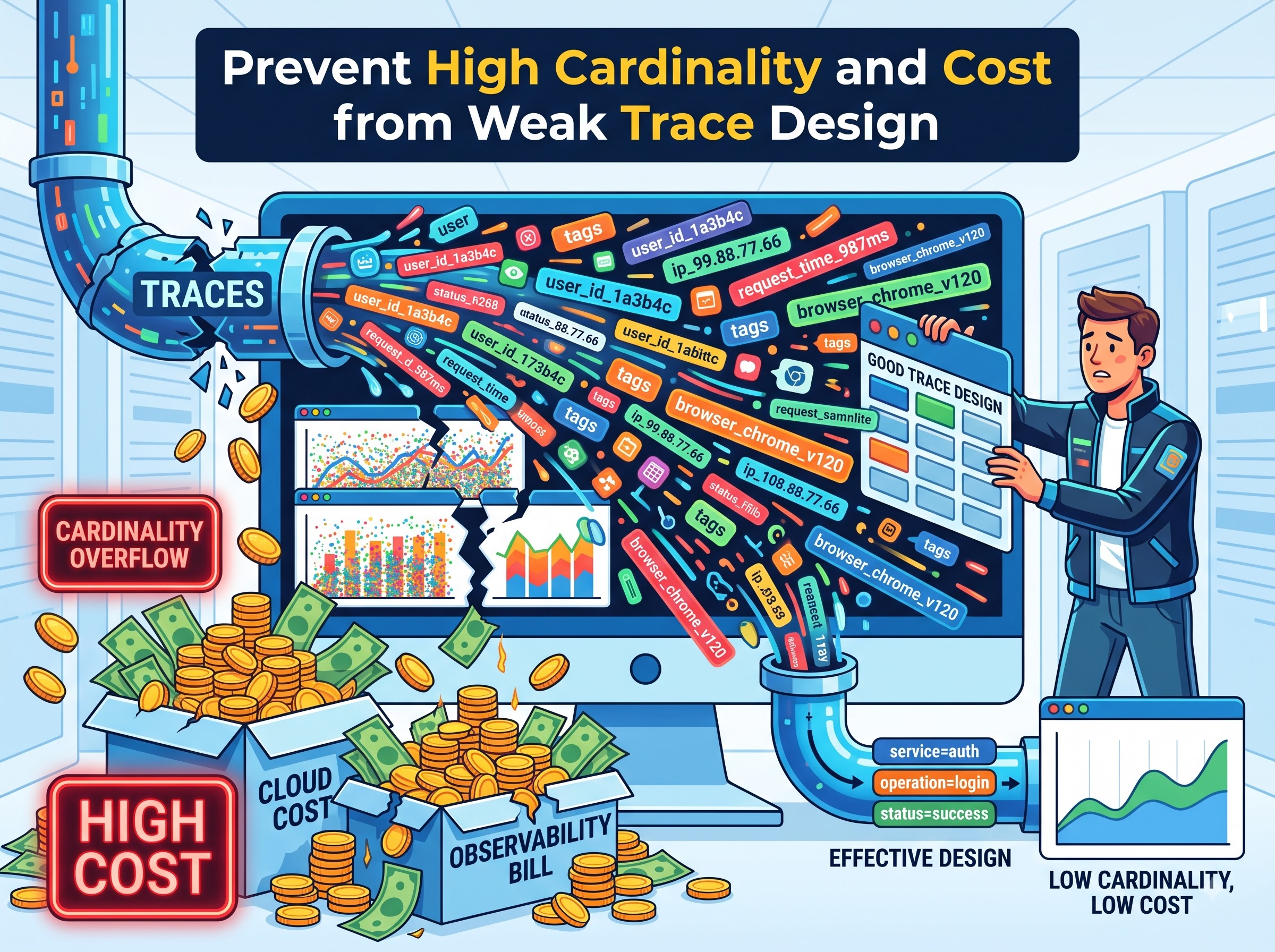
Prevent High Cardinality and Cost from Weak Trace Design
A trace program can become expensive or unusable when every raw value becomes a searchable label. Keep metrics low cardinality by grouping on tenant class, operation, outcome, version and safe error category. Put unique request, decision, authorization and order identifiers in trace or log records where teams can retrieve them when needed.
Sampling also needs governance. Routine successful technical spans may be sampled, but decision records, authorization issuance, BCM acceptance, exceptions, security-relevant denials and reconciliation outcomes should follow evidence retention rules rather than generic telemetry sampling. Audit evidence cannot disappear because a performance tool chose not to retain a trace.
Use Traceability to Resolve Unknown Outcomes
The most important operational question after a timeout is whether the governed action occurred. The consumer should query CCA by the business intent or authorization ID. If authorization exists, it should query BCM by authorization ID or order ID before attempting another submission. BOC should receive a case only when the records remain missing, delayed or contradictory after automated checks.
A well-designed unknown-outcome procedure prevents duplicate orders. It also preserves accountability because the operator can show which records were checked, what was known at each step and why the final corrective action was authorized. A blind retry discards that context and can convert a temporary visibility problem into a physical duplicate.
Detect Gaps Through Reconciliation
| Reconciliation check | Potential gap | Governed action |
|---|---|---|
| CCA authorization without BCM order | Submission failed, delayed or never attempted | Check validity and outcome before controlled resubmission |
| BCM order without expected CCA authorization | Broken control boundary or data-link defect | Contain activity and investigate immediately |
| Multiple BCM orders for one authorization | Idempotency or acceptance defect | Stop duplicates and preserve evidence |
| Completion event without prior normalized states | Missing event or mapping problem | Repair lineage without rewriting history |
| BOC case without linked order and authorization | Weak exception context | Enrich the case from authoritative correlations |
| Expired authorization still receiving attempts | Stale job or unsafe consumer behavior | Reject, notify owner and assess access |
Define Access and Retention by Evidence Class
Not every team needs every record. Consumer support may need safe status and correlation references. CCA administrators need decision and approval evidence. BCM operations need authorization and managed-order context. BOC investigators need cross-system lineage for exceptions. Security and audit teams may need longer retention or controlled access to sensitive records. Use role-based access and record every evidence lookup that carries elevated sensitivity.
Retention should reflect legal, contractual, operational resilience and privacy requirements. Align related records long enough to reconstruct the transaction, while avoiding indefinite duplication of personal information. When records expire, preserve non-personal aggregate measures where useful and ensure deletion does not leave misleading orphan references.
Measure Traceability as an Operational Control
| Measure | What it reveals | Target direction |
|---|---|---|
| Correlation completeness | Transactions with request, decision, authorization and order links | Increase toward full coverage |
| Decision-to-order match rate | BCM orders aligned to valid CCA authorizations | Maintain at controlled maximum |
| Unknown-outcome age | Time until uncertain state becomes known | Reduce |
| Duplicate order rate | Orders created for the same governed intent | Reduce toward zero |
| Exception reconstruction time | Time to assemble evidence for a BOC case | Reduce |
| Orphan record count | Records lacking required upstream or downstream linkage | Reduce toward zero |
| Sensitive telemetry findings | Logs containing prohibited personal values | Reduce toward zero |
Implementation Roadmap
- Define the authoritative records owned by connected applications, CCA, BCM and BOC.
- Create a correlation model for business intent, distributed trace, decision, approval, authorization, BCM order, event and case identifiers.
- Specify which identifiers cross each API boundary and which remain internal.
- Record versioned CCA decision evidence with safe outcome and reason categories.
- Issue immutable time-bound authorizations and require BCM to return a stable managed-order identifier.
- Normalize asynchronous approval and order events without creating duplicate business intents.
- Design privacy-safe logs, traces and metrics with role-based access and retention.
- Automate unknown-outcome queries and reconciliation checks before any resubmission.
- Monitor correlation completeness, orphan records, duplicates and evidence reconstruction time.
- Test the complete evidence chain during consumer certification and after material integration changes.
Frequently Asked Questions
What is end-to-end API traceability?
It is the ability to connect a business intent to its authenticated request, CCA decision, approval, authorization, BCM-managed order and operational outcome using governed records and stable identifiers.
Is a distributed trace ID enough?
No. A trace ID follows one technical execution. A business intent may span retries, approval delays, and asynchronous events, so it also needs durable business and record identifiers.
What is BCM in this architecture?
Business Card Manager (BCM) is the business card ordering management system or software that accepts and manages valid CCA-authorized orders. It is not the external print vendor.
Should logs contain the full business card payload?
No. Prefer identifiers, state, timing, safe reason categories, versions, and digests. Personal fields should be minimized, protected and retained only when justified.
What should happen after a timeout?
Query by the existing intent, authorization or BCM order correlation. Establish whether the action occurred before any controlled retry or resubmission.
Can observability tools change CCA decisions?
No. They report evidence and operational signals. Eligibility, fields, approvals, quantities and ordering rights remain governed in CCA.
How does traceability prevent duplicate orders?
It lets consumers and operators find the existing authorization and BCM order after uncertainty, while idempotency prevents the same governed intent from creating another order.
When should traceability be tested?
During consumer certification, contract changes, identity or scope changes, approval-flow changes, BCM handoff changes and incident recovery exercises.
The Strategic Outcome
End-to-end traceability turns a chain of API calls into a defensible enterprise record. It allows the organization to prove what was requested, what CCA decided, what was approved, what BCM accepted and what BOC reconciled. Operators can resolve uncertainty without weakening policy or creating duplicate orders, while auditors can follow the transaction without treating raw technical logs as authoritative business evidence.
The model protects the purpose of the CCA website. CCA remains the authority for business-card governance; Business Card Manager remains the business card ordering management software that executes valid authorizations; and BOC remains the oversight and reconciliation layer. Integration expands reach, but it does not fragment control.
Select one production business card transaction and attempt to reconstruct it from the originating application through CCA, approval, authorization, BCM order and BOC evidence. If the team cannot establish the complete outcome without searching personal data, interpreting inconsistent IDs or making assumptions, prioritize a governed correlation and evidence model before expanding API volume.