

API Credential Rotation and Workload Identity Governance for Enterprise Business Card Integrations
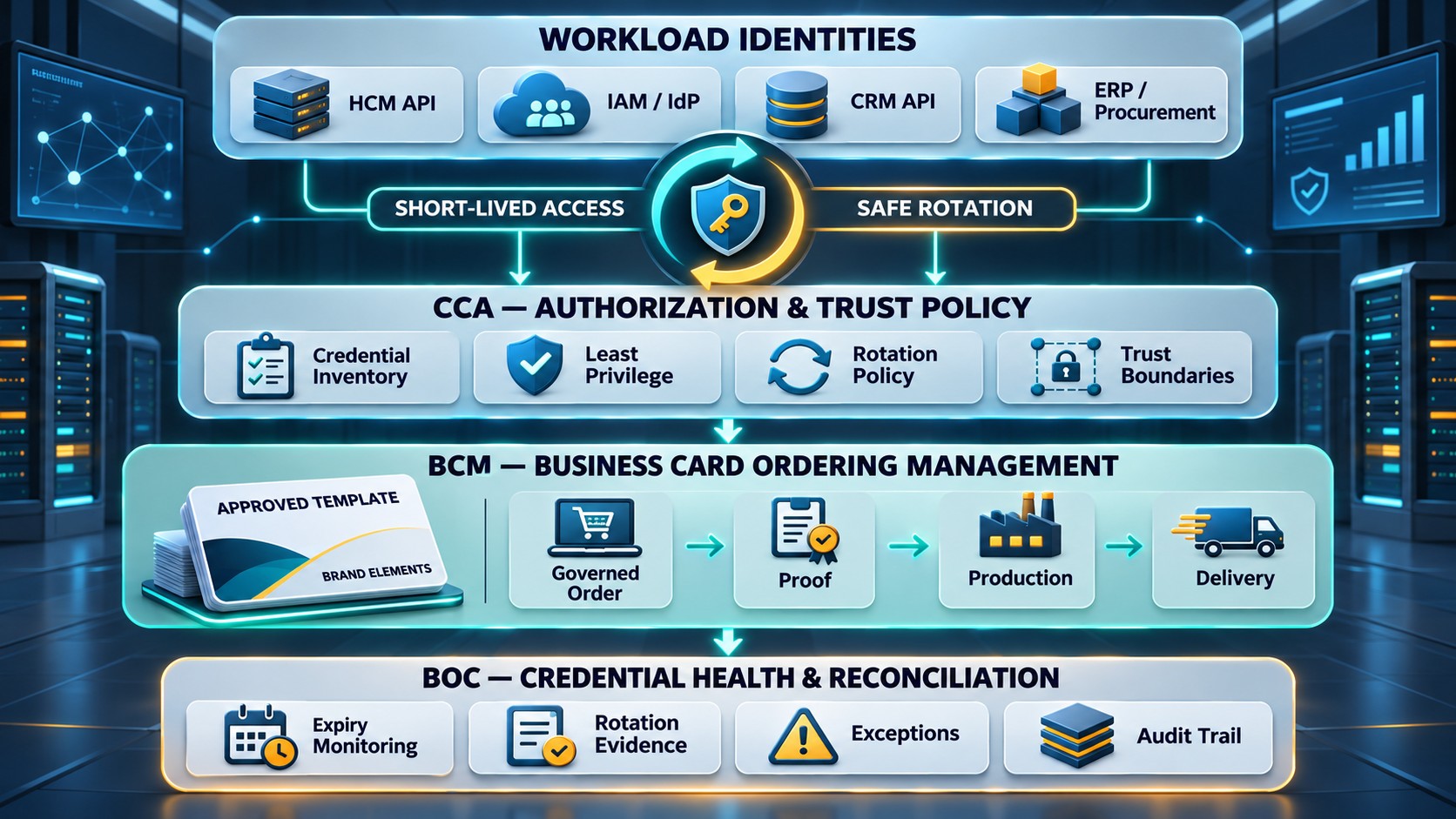
Securing machine-to-machine access without interrupting governed business card ordering.
Machine Access Is Part of Business Authority
Business card integrations connect HCM, IAM, CRM, directories, procurement platforms, CCA, BCM, providers and operational tools. Each connection requires a machine identity that proves which workload is calling, which environment it represents and which actions it may perform. If that identity is shared, overprivileged or left active after a change, technical access can become unauthorized business authority.
Credential rotation reduces the time a compromised secret remains useful, but rotation alone is not governance. The enterprise must inventory workload identities, bind them to owners and purposes, issue narrowly scoped trust, rotate without uncontrolled downtime, revoke obsolete access and reconcile every integration path. The objective is secure continuity: no unmanaged credential should decide or execute a business card action.
Keep CCA, BCM, and BOC Responsibilities Explicit
Color Card Administrator, or CCA, is the enterprise policy and orchestration authority for API-connected business card programs. CCA determines eligibility, approved identity, templates, quantities, approvals and provider routing. It should also require authenticated workload context before accepting facts or issuing authorization.
Business Card Manager, or BCM, is the business card ordering management system or software. BCM manages permissions, approvals, templates, quantities, authorized orders, proofing, production coordination, delivery status and reporting. BCM should accept only trusted CCA authorizations and narrowly scoped operational callers.
Business Ops Center, or BOC, provides credential-health visibility, exception ownership and reconciliation. BOC tracks issuance, expiry, rotation, failed authentication, revocation and affected transactions. CCA owns business authority, BCM owns governed execution and BOC owns operational accountability.
Inventory Every Workload Identity
| Workload | Purpose | Governance evidence |
|---|---|---|
| Source connector | Send authoritative workforce or CRM facts | Owner, source, fields and environment |
| Integration gateway | Validate and route API traffic | Consumer ID, policy and destination |
| CCA service | Evaluate policy and issue authorization | Service identity and decision scope |
| BCM service | Create and manage authorized orders | Allowed operations and tenant |
| Provider connector | Transmit production-ready order and receive status | Provider, region and route |
| BOC collector | Read operational states and evidence | Read scope and retention purpose |
| Automation job | Rotate, reconcile or clean up records | Schedule, privilege and approval |
The inventory should include certificates, API keys, OAuth clients, signed assertions, service accounts, managed identities and secrets references. Human administrator accounts should not be reused as integration identities.
Prefer Short-Lived Workload Identity
Where supported, use workload identity federation, managed identity or signed short-lived tokens rather than long-lived static secrets. The calling platform proves its identity to an approved trust service and receives a token limited by audience, scope and lifetime. This reduces secret distribution and makes revocation more responsive.
Static credentials may still exist for legacy providers. Store them in an approved secrets manager, restrict retrieval to the intended workload and rotate them on a defined schedule. Do not embed credentials in source code, configuration files, templates, logs or support tickets.
Classify Credential Types
| Credential type | Strength | Primary control |
|---|---|---|
| Managed identity | No application-held secret | Platform trust and resource scope |
| Federated workload token | Short-lived and environment-bound | Issuer, subject, audience and claims |
| Client certificate | Strong mutual authentication | Private-key custody and expiry |
| OAuth client secret | Broad compatibility | Secret manager, short lifetime and rotation |
| API key | Simple but often coarse | Gateway restriction, vaulting and rapid replacement |
| Signed webhook secret | Validates callback origin | Dual validation and rotation window |
Apply Least Privilege by Business Function
A source connector that supplies employee facts should not create BCM orders. A provider callback should not change CCA policy. A BOC collector may need read access to status and evidence but not template administration. Define scopes around the business function and data required, not around the convenience of one broad integration role.
Separate production and nonproduction identities. Bind tokens to intended audiences and tenants. Restrict network origin where practical. Review scopes whenever an API, workflow, provider or organizational responsibility changes.
Define Trust Boundaries
| Boundary | Required assertion | Unsafe condition |
|---|---|---|
| Source to CCA | Approved source, tenant, environment and field purpose | Unknown producer can influence identity |
| Portal to CCA | Authenticated user context and delegated permission | Portal claims become automatic authority |
| CCA to BCM | CCA workload identity plus locked authorization | Caller creates order without CCA decision |
| BCM to provider | Approved BCM connector, account and route | Order reaches unapproved production tenant |
| Provider to BOC | Signed callback and provider correlation | Spoofed status changes operational state |
| BOC to systems | Read-scoped operational identity | Monitoring tool gains write privilege |
Design Rotation Before the Credential Expires
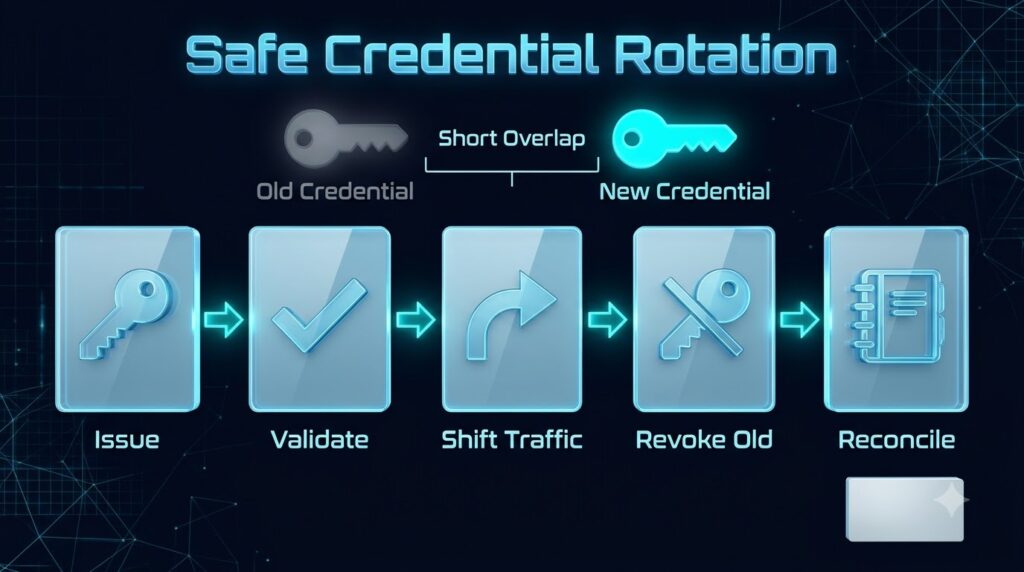
Rotation is a planned transition from one credential to another. The process should create the replacement, distribute it through approved references, validate the new path, shift traffic, observe results and revoke the old credential. Expiry should be a backstop, not the normal trigger.
Define the owner, renewal lead time, maximum lifetime, overlap period, validation test, rollback condition and evidence. A certificate or secret that expires during a provider outage can turn one dependency incident into a complete integration interruption.
Use a Safe Rotation Sequence
| Stage | Control objective | Exit condition |
|---|---|---|
| Prepare | Confirm owner, scope, dependency and maintenance window | Rotation plan approved |
| Issue | Create replacement with equal or narrower privilege | New credential stored securely |
| Distribute | Update workload reference without exposing value | Target services resolve new version |
| Validate | Run authentication and governed transaction test | CCA and BCM path succeeds |
| Shift | Move normal traffic to replacement | Error and latency remain stable |
| Revoke | Disable old credential after controlled overlap | No legitimate traffic uses old version |
| Reconcile | Confirm access, decisions and orders during transition | BOC closes with evidence |
Use Dual Credential Overlap Carefully
Some systems require a brief period in which old and new credentials are both valid. The overlap should be intentionally short, visible and monitored. It is not permission to leave both credentials active indefinitely. Record which workloads still use the old version and block closure until traffic reaches zero.
When a platform does not support overlap, coordinate an atomic reference update with bounded retry and rollback. Synthetic transaction monitoring can validate the authentication, CCA decision and BCM acknowledgment immediately after the change.
Protect the CCA-to-BCM Trust Relationship
CCA should authenticate to BCM with a dedicated workload identity and send a signed or otherwise protected authorization containing decision ID, approved identity, template, quantity, routing, policy version and idempotency key. BCM should verify both the caller and the authorization context before order creation.
Credential rotation must not cause BCM to accept a different caller or bypass decision validation. During overlap, both credentials should map to the same approved workload and scope. A new client identity should require explicit trust onboarding rather than inheriting access from an old secret.
Separate Authentication Failure from Policy Denial
| Result | Meaning | Response |
|---|---|---|
| Invalid credential | Caller identity cannot be trusted | Reject before business evaluation |
| Expired credential | Trust material exceeded permitted lifetime | Rotate or recover through approved path |
| Wrong audience | Token was issued for another service | Reject and investigate configuration |
| Insufficient scope | Known caller lacks requested permission | Deny operation and review least privilege |
| CCA policy denial | Trusted facts do not permit card action | Do not treat as credential incident |
| BCM contract rejection | Trusted call does not meet order contract | Correct authorization or schema |
Monitor Credential Health Without Exposing Secrets
Monitor identifier, type, owner, issuer, expiry, scope, last successful use, last failure, rotation version and revocation state. Do not collect raw keys, secrets, private certificates or full access tokens. Logs should mask authorization headers and sensitive claims.
Alert early enough for investigation and change control. Separate approaching expiry from active failure. A credential that is valid for another 30 days may still be unsafe if its owner is unknown, its scope expanded or its workload was retired.
Handle Emergency Rotation and Compromise
Suspected compromise changes the sequence. Contain the credential immediately, determine affected services and decide whether emergency revocation is safer than brief overlap. Use an approved break-glass identity only when normal rotation cannot restore critical service, and keep its scope and lifetime minimal.
After replacement, review access logs, CCA decisions, BCM orders, provider submissions and BOC cases during the exposure window. A successful credential change does not prove that unauthorized activity did not occur before revocation.
Reconcile the Exposure Window
| Evidence | Question | BOC action |
|---|---|---|
| Authentication log | Which workload used the credential and when? | Identify expected and anomalous use |
| CCA decision | Which authorizations were issued? | Validate source, policy and outcome |
| BCM order | Which orders were created or changed? | Confirm authorization and idempotency |
| Provider submission | Which production jobs were sent? | Verify route, product and quantity |
| Callback state | Which fulfillment events returned? | Reject spoofed or mismatched evidence |
| Administrative change | Who issued, rotated or revoked trust? | Confirm approval and timing |
| Final disposition | Was each affected transaction valid? | Correct, cancel or close with evidence |
Govern Credential Ownership and Lifecycle
Every workload identity needs a business owner, technical owner, system purpose, environment, approved scopes and retirement condition. Ownership should not depend on one individual remaining in the role. Team and service records must survive organizational change.
Retire identities when integrations, providers, environments or projects end. Revoke credentials, remove trust policies, disable secret references, close network access and update monitoring. An unused identity with valid privilege remains a risk even if it has not authenticated recently.
Use BOC for Credential Operations
| BOC signal | Operational question | Action |
|---|---|---|
| Expiry horizon | Which credentials are approaching renewal? | Assign rotation before risk window |
| Rotation progress | Which workload still uses the old version? | Escalate and prevent premature closure |
| Authentication spike | Did failures begin after a change? | Correlate version and deployment |
| Unknown caller | Is an unregistered identity requesting access? | Block and investigate |
| Scope drift | Did privilege exceed the approved baseline? | Contain and restore least privilege |
| Revoked use | Is traffic attempting an obsolete credential? | Locate stale workload or malicious use |
| Evidence gap | Can every rotation and affected transaction be linked? | Recover records before closure |
Measure Workload Identity Governance
| Measure | What it reveals | Target direction |
|---|---|---|
| Identity inventory coverage | Every integration caller is known and owned | Complete |
| Short-lived adoption | Workloads avoid persistent shared secrets | Increase |
| Rotation success | Credential changes complete without unsafe interruption | Complete |
| Expired credential incidents | Planning failed before lifetime ended | Zero |
| Overprivileged identities | Scope exceeds approved business function | Decrease to zero |
| Obsolete access | Retired workloads retain valid trust | Zero |
| Exposure reconciliation | Affected decisions and orders have disposition | Complete |
Implement Credential Governance in Stages
- Inventory every source, gateway, CCA, BCM, provider, callback and BOC workload identity.
- Assign business owner, technical owner, purpose, environment and retirement condition.
- Replace shared secrets with managed or federated workload identity where supported.
- Define least-privilege scopes, audiences, tenants and network restrictions.
- Set credential lifetime, renewal lead time, overlap, validation and rollback rules.
- Protect the CCA-to-BCM handoff with trusted identity and locked authorization.
- Automate issue, distribution, validation, shift, revocation and evidence collection.
- Configure BOC alerts for expiry, failures, unknown callers, scope drift and revoked use.
- Test planned rotation, no-overlap rotation, expiry and suspected-compromise scenarios.
- Review access whenever APIs, providers, environments or organizational ownership change.
Frequently Asked Questions
What is workload identity?
It is the machine identity used by an application, service or automation to authenticate to another system.
What is credential rotation governance?
It is the controlled issue, validation, transition, revocation and evidence process for machine trust material.
What is CCA?
CCA is the enterprise policy and orchestration authority for governed business card identity, eligibility, templates, quantities, approvals and routing.
What is BCM?
BCM is the business card ordering management system or software that executes authorized orders, proofing, production coordination, delivery and reporting.
What is BOC?
BOC provides credential-health monitoring, exception ownership, exposure analysis and source-to-card reconciliation.
Are API keys always unsafe?
They are often coarse and long-lived, but can be governed through vaulting, gateway restrictions, narrow use and rapid rotation when alternatives are unavailable.
Why prefer short-lived tokens?
They reduce persistent secret distribution and limit the useful lifetime of stolen credentials.
Can old and new credentials overlap?
Yes, for a short monitored transition when the platform supports it; the old credential should be revoked after use reaches zero.
Does credential failure mean CCA denied an order?
No. Authentication failure occurs before business policy evaluation and must remain distinct from a CCA denial.
What happens after suspected compromise?
Contain and replace trust, then reconcile authentication, CCA decisions, BCM orders and provider actions during the exposure window.
The Strategic Outcome
Credential rotation and workload identity governance protect the machine-to-machine trust that carries enterprise business identity. CCA receives facts from known sources, BCM executes only trusted authorization and BOC makes rotation, revocation and exposure visible.
The organization gains secure continuity without shared secrets, excessive privilege or expired credentials becoming hidden authority over business card ordering.
Choose the CCA-to-BCM connection and document its workload identity, owner, scope, audience, lifetime, rotation method, overlap, validation and revocation evidence. Run a controlled rotation, confirm one authorized BCM order path and use BOC to prove that the old credential no longer receives traffic.