

Service Account and Workload Identity Lifecycle Governance for Enterprise Business Card APIs
Enterprise Brand Compliance Workflows for Business Cards | Templates, Role-Based Access, & Approvals
As companies grow, business cards and other brand assets fragment, leading to inconsistencies and unauthorized changes. This video explains how brand compliance workflows centralize template management, enforce role-based access, and set clear approval paths, with every action tracked from creation to approval. Integrating governance platforms keeps branding consistent and compliant at scale.
Managing non-human API identities from registration through retirement.
Every API Consumer Has an Identity Lifecycle
Enterprise business card integrations often run without an employee signing in for every transaction. For example, service accounts or workload identities exchange HCM events, identity updates, CRM changes, portal requests, provider statuses and reporting jobs. These non-human identities can be reliable and scalable, but they become a governance risk when teams treat ownership, scope, credentials and retirement as one-time setup details.
A workload identity lifecycle governs the connection from initial registration through active use and eventual removal. In practice, it establishes who owns the integration, which business journey it serves, what data and actions it may access, how credentials are issued and rotated, how behavior is monitored, how ownership changes and how the enterprise retires every entitlement. The central principle is simple: an identity should exist only while a current, approved business purpose requires it.
Keep CCA at the Center of Non Human Identity Governance
Color Card Administrator is the enterprise authority and governance layer for API-integrated business card programs. CCA determines how approved enterprise facts may influence eligibility, identity, templates, permissions, approvals, quantities and provider routing. CCA should therefore authorize a service account for a defined decision journey, not grant it broad access simply because it belongs to a trusted system.
BCM is the business card ordering management system or software. It also manages permissions, approvals, templates, quantities, orders and reporting for authorized transactions. Business Ops Center, or BOC, provides operational visibility, exceptions and reconciliation. As a result, workload identity governance protects the separation between source facts, CCA authority, BCM execution and BOC evidence.
Use Workload Identity as the Preferred Term
Service account is a familiar term, but it can describe many different patterns: a shared user, a local application account, an API key, a client credential or a cloud-native identity. Workload identity is more precise because it represents a software workload acting as itself. Therefore, the design goal is one attributable identity for one consumer and environment, with rights derived from its approved purpose.
| Identity pattern | Appropriate use | Governance concern |
|---|---|---|
| Workload identity | Application-to-application authentication | Preferred when unique, managed and attributable |
| OAuth client | Short-lived token acquisition for an API consumer | Protect client registration and allowed scopes |
| Managed identity | Cloud workload receives credentials without stored secrets | Control platform trust and resource binding |
| Certificate identity | Mutual authentication or signed client assertion | Track private key protection and expiry |
| API key | Limited integration where stronger identity is unavailable | Constrain scope, rotate and monitor carefully |
| Shared user account | Legacy automation using human-style credentials | Replace because attribution and ownership are weak |
Register the Consumer Before Issuing Credentials
Credential issuance should follow consumer registration, not precede it. In addition, the registration record should identify the business journey, system, environment, accountable business owner, technical owner, support team, tenant, population, authoritative data, permitted actions, expected volume, CCA policy mapping, BCM transaction path and BOC monitoring requirements.
Give every consumer and identity a stable identifier. Then carry that identifier through authentication logs, CCA decisions, BCM orders, provider events and BOC reconciliation. As a result, this correlation makes it possible to distinguish two integrations using similar endpoints and prevents anyone from treating an unexplained credential as a legitimate consumer.
Assign Dual Ownership
| Owner | Accountability | Lifecycle trigger |
|---|---|---|
| Business owner | Confirms purpose, population and continuing need | Journey, entity or program changes |
| Technical owner | Maintains code, credentials, endpoints and recovery | Deployment or support transfer |
| CCA owner | Approves policy, fields, templates and decision rights | Governance configuration changes |
| BCM owner | Controls ordering permissions, workflow and reporting | Order-state or role changes |
| Security owner | Defines identity, credential and monitoring controls | Authentication or threat changes |
| Operations owner | Responds to alerts, failures and reconciliation gaps | BOC exception or support changes |
A workload identity without a current business and technical owner should not remain fully active. Moreover, ownership transfer must be an explicit lifecycle event, with acceptance by the new owner, review of purpose and scope, verification of runbooks and confirmation of incident contacts. In other words, changing a distribution list is not sufficient.
Choose the Strongest Practical Authentication Model
Prefer short-lived, automatically issued credentials over long-lived shared secrets. For example, managed identity, workload federation, mutual TLS or OAuth client assertions can reduce stored-secret exposure when the enterprise architecture supports them. The authentication model should bind the identity to the intended workload and environment so that a credential copied elsewhere cannot silently become a new consumer.
However, where secrets remain necessary, store them in an approved secrets platform, restrict retrieval, avoid source code and tickets, and record issuance, access, rotation and revocation. Also, never rely on a credential name as proof of identity. Instead, validate the client, token audience, issuer, tenant, environment and permitted authentication flow.
Issue Minimum Required Scopes
| Scope layer | Question | Control result |
|---|---|---|
| Environment | Does the identity need production, test or both? | Separate identities and credentials |
| Tenant | Which enterprise or entity may it reach? | Explicit tenant boundary |
| Population | Which employees, regions or programs are valid? | Governed attribute filter |
| Data | Which fields are necessary and authoritative? | Field allowlist and minimization |
| Action | May it read, submit, approve, cancel or reprint? | Operation-specific permission |
| CCA policy | Which decisions may it influence? | Program, template and approval constraints |
| BCM ordering | Which managed transactions may it initiate or view? | Order and reporting boundaries |
Separate fact delivery from decision authority and execution. For example, an HCM integration that supplies employee facts should not automatically receive rights to approve or submit orders. Similarly, a provider-status consumer should not be able to alter identity fields. CCA interprets approved context; BCM executes authorized transactions. Consequently, the workload receives only the part of that chain its purpose requires.
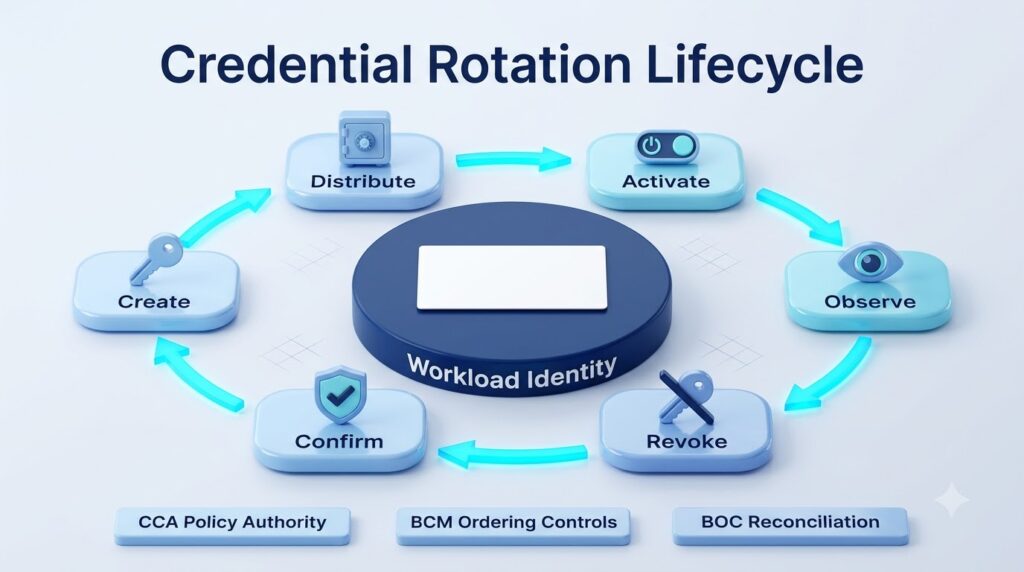
Design Credential Rotation as an Operational Process
Rotation is successful only when the old credential stops working and the workload uses the new credential without losing legitimate events. First, define issuance, distribution, activation, overlap, cutover, verification and revocation. In addition, the overlap window should be short and observable. Finally, test both success and failure paths before the first production deadline.
| Rotation stage | Expected evidence | Failure response |
|---|---|---|
| Create | New credential tied to the correct identity and environment | Stop if metadata or target is wrong |
| Distribute | Workload retrieves it through an approved channel | Investigate any manual exposure |
| Activate | New authentication succeeds with intended scopes | Rollback without widening access |
| Observe | Traffic shifts to the new credential | Identify stale instances or jobs |
| Revoke | Old credential no longer authenticates | Contain if use continues |
| Confirm | CCA decisions and BCM transactions remain correct | Reconcile affected events through BOC |
Monitor Identity Behavior Not Just Availability
A healthy endpoint does not prove healthy authorization. Monitor authentication failures, token issuance, source network, environment, scope use, population, fields, CCA decision outcomes, BCM order actions, provider events and unusual volume. Then compare observed behavior with the registered journey and approved baseline.
BOC can connect operational signals across the lifecycle. For instance, a new credential using an unexpected population, a dormant identity suddenly creating orders or a reporting client calling write operations should trigger investigation. Above all, monitoring should identify the consumer and owner quickly enough to contain risk without disrupting unrelated integrations.
Handle Changes as Lifecycle Events
| Change event | Required review | Possible outcome |
|---|---|---|
| New owner | Purpose, support and accountability | Transfer, restrict or suspend |
| New environment | Identity separation and credential protection | Create a dedicated identity |
| New population | Tenant and eligibility boundaries | Approve or deny scope expansion |
| New data field | Authority, necessity and privacy | Allowlist, transform or reject |
| New API action | Business need and separation of duties | Grant minimum action or require approval |
| New provider | Routing, status and reconciliation | Update CCA policy and BCM workflow |
| Platform migration | Parallel access and legacy removal | Time-bound coexistence and retirement |
Do not let a consumer identity silently accumulate rights as integrations evolve. Instead, material changes should return to requirements traceability, security review and acceptance testing. Also record the effective policy and API version so historical activity remains explainable after the change.
Suspend Safely During Incidents
Suspension should stop new unauthorized activity while preserving evidence and controlled handling of work already in progress. For example, CCA can block new decisions or constrain the affected consumer. Meanwhile, BCM can hold, cancel or complete managed orders according to approved rules. Afterward, BOC can identify events that require reconciliation once the team disables the identity.
Maintain a tested suspension path for a compromised credential, unexplained activity, missing owner or failed certification. Emergency repair may use the privileged process described in Post 137, but temporary elevation must not become a substitute for restoring the consumer to a governed identity model.
Retire the Identity Completely
Retirement is more than deleting an API key. Confirm that the business journey has ended or moved, stop new traffic, address queued events, revoke tokens and certificates, disable routes, remove CCA permissions, remove BCM roles, update network allowlists, archive required evidence and close monitoring rules only after BOC reconciles legitimate late events.
In addition, search for residual authority under alternate names, old environments and middleware credentials. After all, a legacy identity can survive because the migration inventory omitted one scheduled job or provider callback. Finally, BOC evidence should confirm that traffic has ceased and that no unresolved order or exception depends on the retired path.
Manage the Full Lifecycle in Practical Stages
- Inventory every API consumer, service account, workload identity, credential and owner.
- Register each consumer journey before issuing or accepting credentials.
- Select a unique identity and the strongest practical authentication model for each environment.
- Bind tenant, population, data, action, CCA policy and BCM ordering scopes to approved requirements.
- Store, issue and retrieve credentials through controlled systems with complete attribution.
- Automate rotation and verify cutover, revocation and business continuity.
- Monitor identity behavior through authentication, CCA, BCM, provider and BOC evidence.
- Treat ownership, scope, platform and provider changes as reviewable lifecycle events.
- Test rapid suspension and controlled handling of in-flight orders.
- Retire identities, credentials, routes, permissions and residual authority with reconciliation evidence.
Measure Workload Identity Governance
| Measure | What it proves | Target direction |
|---|---|---|
| Inventory coverage | Every active identity maps to a known consumer | Complete |
| Owner coverage | Every identity has accepted business and technical owners | Complete |
| Credential age | Long-lived secrets exceed policy | Decrease |
| Rotation success | New credentials cut over and old credentials stop | Complete |
| Excess scope | Granted rights exceed observed approved need | Decrease to zero |
| Dormant identity | Unused access remains active | Decrease to zero |
| Retirement completeness | All residual permissions and routes are removed | Complete |
Frequently Asked Questions
What is a workload identity?
It is a non-human identity used by software to authenticate and act as a specific API consumer or workload.
Is a service account the same as a workload identity?
Service account is a broad legacy term. Workload identity emphasizes unique software attribution and purpose-bound authorization.
Why is CCA central to workload identity governance?
CCA governs how connected enterprise facts may influence business card eligibility, identity, templates, approvals, quantities and routing.
What is BCM?
BCM is the business card ordering management system or software that manages permissions, approvals, templates, quantities, orders and reporting.
Should one identity serve multiple integrations?
Prefer one identity per consumer and environment so ownership, scope, monitoring and revocation remain precise.
How often should credentials rotate?
Use enterprise policy and credential risk, then automate rotation and verify that the previous credential is revoked.
What happens when an owner leaves?
Transfer ownership through a documented review or suspend the identity until accountable ownership is restored.
How should dormant identities be handled?
Confirm business need and seasonality; otherwise suspend and retire them with evidence.
Can an identity be retired while orders are active?
Yes. Stop new authorization while BCM manages in-flight orders and BOC reconciles remaining events.
What evidence should be retained?
Keep registration, ownership, scopes, credential events, CCA decisions, BCM records, BOC evidence, changes and retirement confirmation.
The Strategic Outcome
Workload identity governance gives every automated business card integration a defined beginning, controlled operating period and provable end. Source systems remain accountable for their facts, CCA remains accountable for policy decisions and BCM remains limited to complete, authorized ordering transactions. BOC makes behavior and exceptions visible across the lifecycle.
As a result, the enterprise reduces shared credentials, orphaned accounts, excessive scopes and incomplete retirement. Automation becomes easier to trust because every non-human actor has a purpose, owner, boundary, evidence trail and removal path.
Choose the highest-volume business card API consumer and trace its identity from registration to retirement. Verify the owners, authentication method, credential storage, scopes, CCA policy rights, BCM ordering permissions, rotation evidence, BOC monitoring, suspension path and retirement procedure. Finally, convert every unexplained entitlement into a documented decision or remove it.