

API Credential Rotation and Cryptographic Trust Governance for Enterprise Business Card Integrations
Business Card Onboarding Automation for Enterprises | Role-Based Templates, Approvals & Audit Trails
Many organizations neglect business card provisioning during onboarding, which leads to manual requests, branding errors, delays, and little audit visibility. This video explains how connecting card workflows to onboarding systems triggers automation when an employee record is created, with role-based templates, automated approvals, approved print vendors, and tracking. Learn the benefits for onboarding speed, data accuracy, and governance.
Business card API credential rotation governance: protecting machine trust while preserving governed business card operations.
Credential Rotation Is a Governance Event
Teams often treat API credentials as plumbing: create a secret, configure an endpoint and replace the value before it expires. However, in an enterprise business card program, the credential represents much more. It links a software workload to the authority to supply identity facts, request CCA decisions, initiate BCM transactions or receive operational status. As a result, a failed or poorly controlled rotation can interrupt ordering, conceal the true consumer or leave an old credential active after the team deploys the new one. That is why business card API credential rotation governance matters.
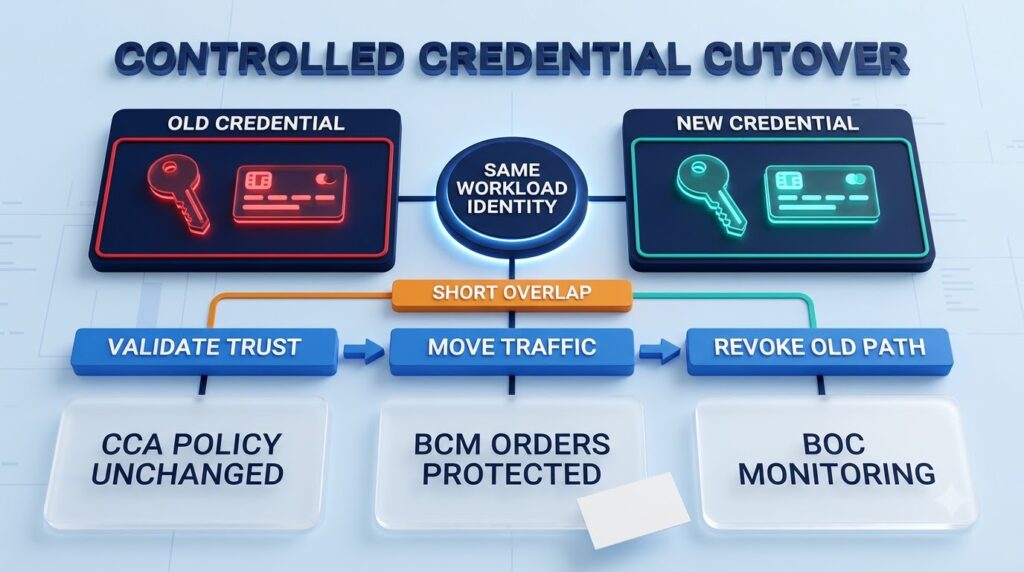
Business card API credential rotation governance is the controlled replacement of secrets, certificates, keys or token-signing trust without changing the approved business purpose. In practice, it covers inventory, ownership, issuance, validation, distribution, overlap, cutover, observation, revocation and reconciliation. Therefore, the outcome is not simply successful authentication. Instead, it is continued access by the same approved workload, with the same or narrower authority and complete evidence that the old trust path has ended.
Keep CCA Authority Stable Through the Cutover
To begin with, Color Card Administrator is the enterprise authority and governance layer for API-integrated business card programs. Specifically, CCA determines how approved enterprise facts may influence eligibility, identity, templates, permissions, approvals, quantities and provider routing. For this reason, credential replacement must not silently change which programs, populations, fields or actions the workload can influence.
Meanwhile, BCM is the business card ordering management system or software. In addition, it manages permissions, approvals, templates, quantities, orders and reporting for authorized transactions. Similarly, Business Ops Center, or BOC, provides operational visibility, exceptions and reconciliation. Consequently, a safe rotation preserves CCA policy, BCM ordering continuity and BOC correlation while changing only the cryptographic material used to prove the workload identity.
Know What Is Being Rotated
| Credential type | Typical role | Primary rotation concern |
|---|---|---|
| Client secret | OAuth client authentication | Secure distribution and short overlap |
| Private key | Signed client assertion or request signing | Private key custody and public-key registration |
| Client certificate | Mutual TLS workload authentication | Certificate chain, subject and expiry validation |
| API key | Legacy or limited API authentication | Attribution, scope and prompt revocation |
| Signing key | Token or event signature validation | Trusted key publication and verifier refresh |
| Federated trust | External workload exchanges identity claims | Issuer, audience, subject and policy binding |
First, record the credential type, workload identity, consumer, environment, owner, issuer, creation time, expiry, permitted audience, scopes, storage location, last use, rotation method and revocation path. However, do not inventory raw secret values. In other words, the inventory should prove control without exposing the material it protects.
Separate Identity from Credential
The workload identity should remain stable while its credential changes. For example, reusing a new client identity for every rotation can break attribution, scopes, monitoring and historical evidence. Conversely, treating a secret as the identity encourages teams to share it across applications. Instead, the enterprise should identify the consumer through a stable registration and use replaceable credentials as authentication factors for that identity.
However, if a migration requires a new identity, manage it as a distinct lifecycle event with mapped ownership, policy, permissions and retirement. In short, a credential rotation should not become an undocumented consumer migration.
Set Risk Based Lifetimes
| Risk factor | Higher risk condition | Governance response |
|---|---|---|
| Privilege | Can change identity, approval, quantity or routing | Shorter lifetime and stronger authentication |
| Population | Can reach many entities or employees | Tighter scope and faster revocation |
| Storage | Secret exists outside managed custody | Remediate storage and rotate immediately |
| Exposure | Credential appeared in code, logs or tickets | Treat as compromised |
| Usage | High volume or provider-impacting actions | Continuous monitoring and rehearsed cutover |
| Recovery | No rapid replacement or rollback path | Build and test before production use |
Of course, a fixed calendar is useful but insufficient. Therefore, rotate on policy and also after suspected exposure, ownership change, platform migration, trust-store change, material scope reduction or provider transition. Similarly, short-lived tokens reduce risk only when the long-lived mechanism that obtains them is also protected and governed.
Design the Rotation Before the Deadline
To start, the rotation runbook should identify the target identity, systems that consume the credential, preparation window, approvers, validation tests, overlap period, cutover signal, rollback limit, revocation time and reconciliation owner. Above all, avoid scheduling the first production test near expiration. Otherwise, expiry pressure encourages unsafe extensions and broad temporary access.
| Stage | Control objective | Required evidence |
|---|---|---|
| Prepare | Confirm identity, owner, scope and dependencies | Approved change and current inventory |
| Issue | Create new material through an approved authority | Credential metadata and custody record |
| Distribute | Deliver without exposing secret material | Managed retrieval and recipient attribution |
| Validate | Test identity, audience, scope and policy behavior | Positive and negative test results |
| Activate | Move intended traffic to the new credential | Observed authentication and correlation |
| Revoke | Disable the old trust path promptly | Failed old authentication and revocation record |
| Reconcile | Confirm CCA and BCM outcomes remain complete | BOC evidence and exception closure |
Protect Credential Issuance and Distribution
To begin, issue credentials through approved identity, certificate or secrets platforms. In addition, restrict who can request, approve, retrieve and rotate them. Bind each credential to the intended workload and environment; teams should not copy a production secret into test, and one consumer should not reuse another consumer’s certificate or API key.
In general, prefer workload federation, managed identity, short-lived tokens or certificate-based authentication when the architecture supports them. However, where a static secret remains necessary, store it in managed custody and let the workload retrieve it at runtime. Equally, avoid email, chat, tickets, spreadsheets, source repositories and deployment logs.
Validate Trust Before Cutover
| Validation area | Test | Failure prevented |
|---|---|---|
| Identity | New material authenticates as the intended workload | Misattributed consumer |
| Audience | Token or certificate is accepted only by the target service | Cross-service replay |
| Environment | Production and nonproduction trust remain separate | Environment crossover |
| Tenant | Credential cannot access another enterprise boundary | Tenant leakage |
| Scope | Data and action rights match the approved baseline | Privilege expansion |
| CCA policy | Allowed, denied and review-required decisions remain correct | Governance bypass |
| BCM execution | Only authorized transactions reach managed ordering | Uncontrolled production |
Negative tests are essential. For example, attempt an expired credential, revoked credential, wrong audience, wrong environment, unauthorized population, prohibited field, excessive quantity and unapproved action. In other words, the service should not accept the new credential merely because a trusted platform issued it.
Use a Short Controlled Overlap
For instance, some systems require old and new credentials to coexist while distributed instances update. However, the overlap should be planned, brief and observable. Then identify which credential handled each request and measure traffic migration. In contrast, a long overlap creates two valid paths and can hide a stale deployment or unauthorized copy.
Moreover, do not expand scopes to simplify cutover. Instead, both credentials should map to the same approved workload identity and authorization baseline. Similarly, if the new credential requires different rights, review the change separately before activation.
Preserve Idempotency and Order Continuity
In particular, authentication retries during rotation can replay events. Therefore, use correlation identifiers and idempotency controls so a repeated request does not create duplicate card orders, approvals, cancellations or reprints. CCA should produce consistent decisions for the same governed request, and BCM should preserve one managed transaction rather than treating the new credential as a new business event.
In addition, plan for callbacks and provider statuses that may arrive after the initiating credential changes. At the same time, credential retirement should stop unauthorized new activity without losing legitimate lifecycle events for orders already in production or delivery.
Observe the Cutover Through BOC
| Operational signal | Meaning | Response |
|---|---|---|
| New credential success | Expected traffic has started moving | Compare volume and decisions with baseline |
| Old credential use | A stale instance or unexpected copy remains | Locate source before revocation deadline |
| Authentication failures | Configuration, trust or clock issue | Investigate without widening access |
| Scope denials | New material has different or incorrect rights | Correct registration or reject change |
| Duplicate attempts | Retry or idempotency weakness | Hold duplicates and fix correlation |
| Order exceptions | BCM or provider lifecycle was interrupted | Reconcile affected transactions |
| Unknown source | Credential is used outside the approved workload | Contain and treat as incident |
Revoke and Prove the Old Path Is Closed
In fact, cutover is incomplete until the previous credential can no longer authenticate. Revoke the secret, certificate, key or trust relationship; invalidate cached tokens where feasible; remove old material from workloads and stores; update allowlists and confirm that monitoring no longer sees legitimate use. Finally, do not leave the old credential available as an informal rollback option.
If rollback becomes necessary, make it a time-bound approved decision with a clear endpoint. Furthermore, a failed rotation should not normalize permanent dual credentials. As a result, BOC evidence should show which requests used each credential and confirm that old-path traffic ended.
Respond to Compromise Differently from Routine Rotation
Routine rotation can use a controlled overlap. In contrast, suspected compromise requires containment first: disable the exposed path, preserve evidence, issue replacement material through a trusted channel and assess unauthorized activity. Also, do not reuse the same secret or assume that expiry alone ends risk.
For example, CCA can suspend new decisions for the affected consumer while BCM protects in-flight order states. Meanwhile, BOC can identify unusual populations, actions and provider events for reconciliation. Likewise, privileged emergency access should follow the governed break-glass model described in Post 137.
Implement Business Card API Credential Rotation Governance in Practical Stages
- Inventory every secret, certificate, key, trust relationship, consumer and owner.
- Separate stable workload identities from replaceable credential material.
- Set risk-based lifetimes and event-triggered rotation requirements.
- Create runbooks covering issuance, distribution, validation, overlap, rollback and revocation.
- Automate secure retrieval and renewal wherever architecture supports it.
- Test identity, audience, environment, tenant, scope, CCA policy and BCM execution.
- Use a short observable overlap and attribute every request to old or new material.
- Protect retries with correlation and idempotency controls.
- Revoke the previous trust path and remove residual material completely.
- Use BOC evidence to reconcile outcomes and improve the next rotation.
Measure Rotation Governance
| Measure | What it proves | Target direction |
|---|---|---|
| Inventory coverage | Every active credential has a known identity and owner | Complete |
| Rotation timeliness | Credentials rotate before policy or expiry deadlines | Complete |
| Manual exposure | Secret material moves through uncontrolled channels | Decrease to zero |
| Overlap duration | Old and new credentials remain valid together | Decrease |
| Old path use | Traffic continues after cutover | Decrease to zero |
| Revocation success | Previous material can no longer authenticate | Complete |
| Business continuity | CCA decisions and BCM transactions remain correct | Complete |
Frequently Asked Questions
What is API credential rotation?
In short, it is the controlled replacement of a secret, certificate, key or trust relationship used by an approved workload identity.
Why is rotation a governance issue?
Because the credential controls access to data, CCA decisions and BCM ordering actions, replacement must preserve identity, scope and evidence.
What is BCM?
In simple terms, BCM is the business card ordering management system or software that manages permissions, approvals, templates, quantities, orders and reporting.
Should the workload identity change during rotation?
Normally no. Instead, keep the identity stable and replace only its authentication material unless the change needs a separately governed migration.
How long should old and new credentials overlap?
In general, only as long as needed for observable cutover, with a defined revocation deadline.
Does a short-lived token eliminate rotation?
No. In fact, the credential or trust mechanism used to obtain the token still requires protection and lifecycle governance.
What should be tested before cutover?
Above all, test identity, audience, environment, tenant, scopes, CCA policy decisions, BCM transactions and negative authorization paths.
How are duplicate orders prevented during rotation?
Therefore, use correlation identifiers and idempotency so retries do not create a second managed transaction.
What happens if the old credential is still used?
First, locate the source, contain unexpected use and do not close the rotation until you revoke the old path.
How should suspected compromise be handled?
To begin, contain immediately, preserve evidence, replace through a trusted channel and reconcile affected CCA and BCM activity through BOC.
The Strategic Outcome
Business card API credential rotation governance lets the enterprise renew machine trust without changing the approved business purpose of an integration. CCA continues to govern identity decisions, BCM continues to manage authorized ordering and BOC preserves the operational evidence needed to prove continuity and revocation.
As a result, the enterprise reduces long-lived secrets, hidden copies, expired certificates and permanent overlap. In addition, each credential has an owner, a defined lifetime, a tested replacement path and a provable end.
Select the highest-risk business card API credential and perform a complete rotation rehearsal. Verify its identity, owner, storage, audience, scopes, CCA policy rights, BCM ordering permissions, cutover tests, idempotency, BOC monitoring and revocation proof. Then, correct every dependency before the real expiry or incident forces the change.