

API Contract Versioning and Backward Compatibility for Enterprise Business Card Integrations
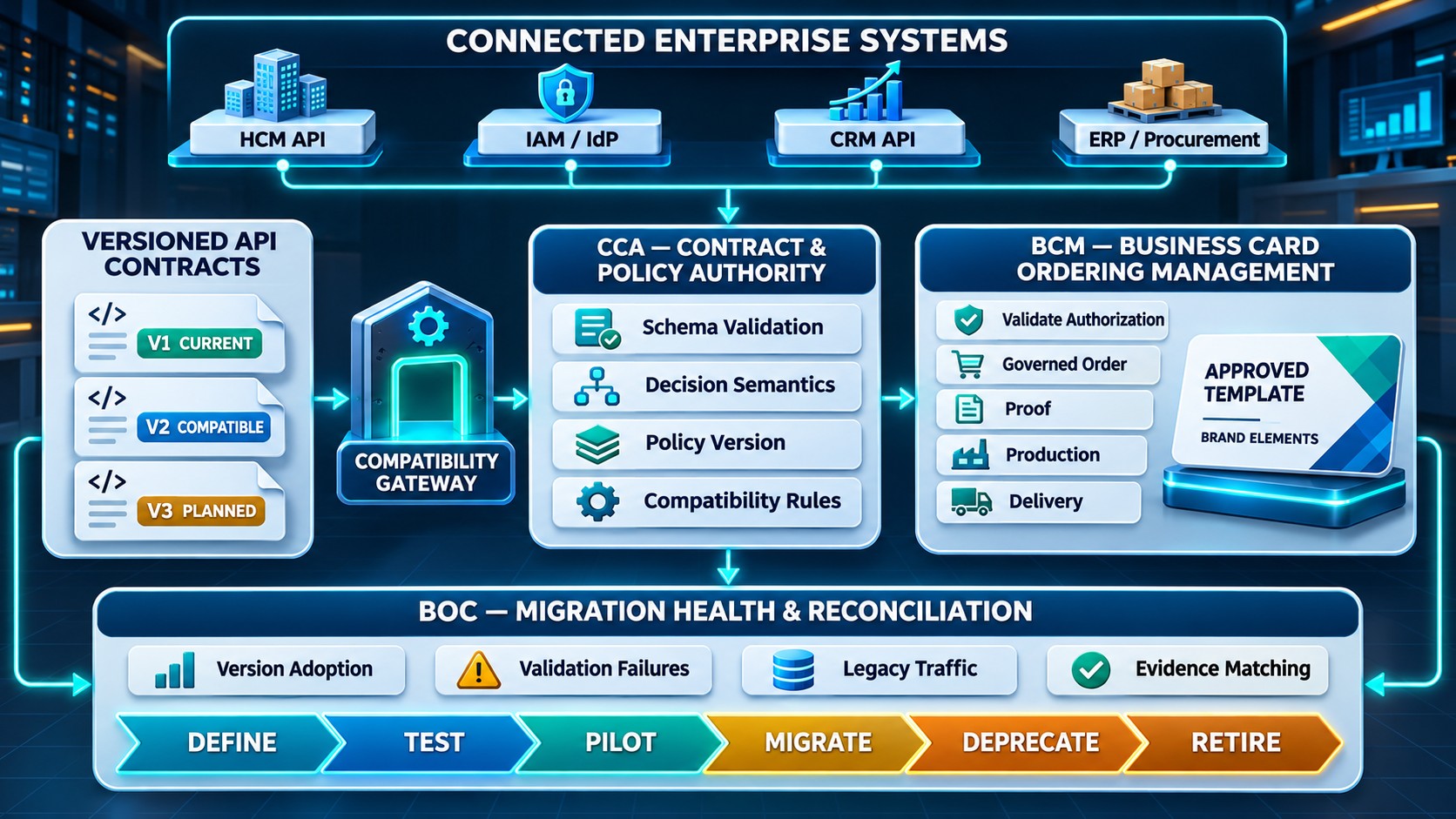
Evolving connected systems without breaking governed business card ordering.
API Change Is a Business Governance Event
Enterprise business card integrations exchange workforce facts, approved identity fields, template identifiers, quantities, approval results, order acknowledgments and fulfillment events. A seemingly small API change can alter which data is accepted, how an authorization is interpreted or whether an approved order reaches production. Contract evolution therefore affects business authority, not only software compatibility.
A governed program makes change explicit. Producers and consumers agree on schemas, semantics, validation rules, error behavior, security requirements and transition dates. CCA controls how connected facts become authorized business card decisions. BCM executes only a valid, governed order contract. BOC identifies incompatible traffic, migration gaps and transactions that require reconciliation.
Keep CCA, BCM, and BOC Roles Clear
Color Card Administrator, or CCA, is the enterprise policy and orchestration authority. It evaluates authoritative source data and controls business-card eligibility, approved identity, templates, quantities, approvals and provider routing. CCA owns the meaning of its authorization contract and the policy version that produced each outcome.
Business Card Manager, or BCM, is the business card ordering management system or software. It manages permissions, approvals, templates, quantities, authorized orders, proofing, production coordination, delivery status and reporting. BCM validates the order contract before execution and must not infer missing authority from an older or ambiguous payload.
Business Ops Center, or BOC, provides compatibility monitoring, exception ownership and source-to-card reconciliation. It correlates contract versions, validation failures, decisions, orders and provider events. CCA owns authority, BCM owns governed execution and BOC owns operational accountability.
Define the API Contract Beyond Field Names
| Contract element | Governance question | Required evidence |
|---|---|---|
| Resource model | What business object is represented? | Canonical definition and owner |
| Field semantics | What does each value mean? | Type, format, source and purpose |
| Requiredness | When must a value be supplied? | Conditional validation rule |
| Authorization | Which caller may perform the operation? | Identity, scope and policy |
| Idempotency | How are duplicate requests controlled? | Key behavior and retention |
| Errors | How does the consumer respond safely? | Stable codes and remediation |
| Events | How are state changes communicated? | Envelope, ordering and replay rule |
| Lifecycle | How does the contract change or retire? | Version and deprecation policy |
Documentation should distinguish transport validity from business validity. A payload may be syntactically correct yet still fail CCA policy, BCM order rules or provider-routing requirements.
Choose a Versioning Model Deliberately
Versioning can appear in the URL, request header, media type, event envelope or negotiated capability set. The specific mechanism matters less than consistency and observability. Every request, decision, order and event should reveal which contract version governed it.
Use a major version when compatibility cannot be preserved. Minor additions should remain optional and safely ignorable. Patch-level corrections should not change business meaning. Avoid silent semantic changes under an unchanged version, because consumers cannot distinguish new behavior from a defect.
Classify Changes Before Release
| Change | Compatibility | Governed response |
|---|---|---|
| Add optional field | Usually backward compatible | Document default and consumer behavior |
| Add enum value | Potentially breaking | Require unknown-value handling |
| Change requiredness | Breaking for some clients | Create new version or transition rule |
| Rename or remove field | Breaking | Introduce replacement and migration period |
| Change field meaning | Breaking even if type is unchanged | Version semantics explicitly |
| Tighten validation | Potentially breaking | Measure existing traffic first |
| Change error code | Operationally breaking | Maintain stable error taxonomy |
| Change event ordering | Breaking for stateful consumers | Version event behavior |
Design for Additive Evolution
Prefer changes that allow existing consumers to continue: add optional fields, preserve defaults, tolerate unknown fields and keep stable identifiers. Consumers should not reject a message merely because it contains data introduced after their deployment. Producers should not assume that every consumer immediately uses a new field.
Additive does not always mean safe. A new enum value can break switch statements. A new optional identity field can alter card rendering if a downstream system treats presence as approval. Evaluate both structural and semantic compatibility before release.
Protect CCA Decision Semantics
The CCA authorization should carry a decision identifier, policy version, contract version, approved identity fields, template, quantity, routing, validity window and idempotency key. These values form a locked decision context. BCM should validate the context rather than reconstructing authority from source data.
If CCA changes how eligibility or routing is evaluated, preserve the policy version with the outcome. Contract version and policy version are related but distinct: the contract describes how systems communicate; policy describes why CCA authorized or denied the action.
Govern the CCA to BCM Contract
| Control | CCA responsibility | BCM responsibility |
|---|---|---|
| Identity | Authenticate as approved policy service | Verify caller, tenant and audience |
| Authorization | Send complete locked decision context | Reject missing or altered authority |
| Schema | Publish supported order contract | Validate without unsafe inference |
| Idempotency | Issue stable transaction key | Prevent duplicate order creation |
| Version | Declare contract and policy versions | Record versions with the order |
| Failure | Return actionable policy outcome | Return stable contract error |
| Evidence | Preserve source and decision linkage | Preserve execution and status linkage |
Use Consumer Driven Contract Testing
Contract tests verify that a producer continues to satisfy the expectations of known consumers. HCM connectors can test accepted workforce events, CCA can test authorization envelopes, BCM can test order creation and provider adapters can test production and callback messages. These tests should run before deployment and against representative tenant configurations.
Testing must include business cases, not only schemas: ineligible worker, restricted template, multilingual identity, duplicate request, missing approval, unknown enum, delayed callback and provider rejection. A contract that parses successfully can still produce an unsafe business result.
Build a Compatibility Test Matrix
| Test dimension | Examples | Pass condition |
|---|---|---|
| Producer and consumer | Current to current, new to current, current to new | Supported combinations behave as documented |
| Payload shape | Optional, missing, unknown and null fields | No unsafe default or rejection |
| Business policy | Eligible, denied, exception and expired decision | CCA outcome remains authoritative |
| Ordering | Duplicate, retry and out-of-order event | BCM remains idempotent and consistent |
| Security | Wrong tenant, scope, audience or signature | Request rejected before execution |
| Failure | Timeout, rate limit and dependency outage | Stable retry and error behavior |
| Evidence | Decision, order and event correlation | BOC can reconcile end to end |
Run Versions in Parallel Without Splitting Authority
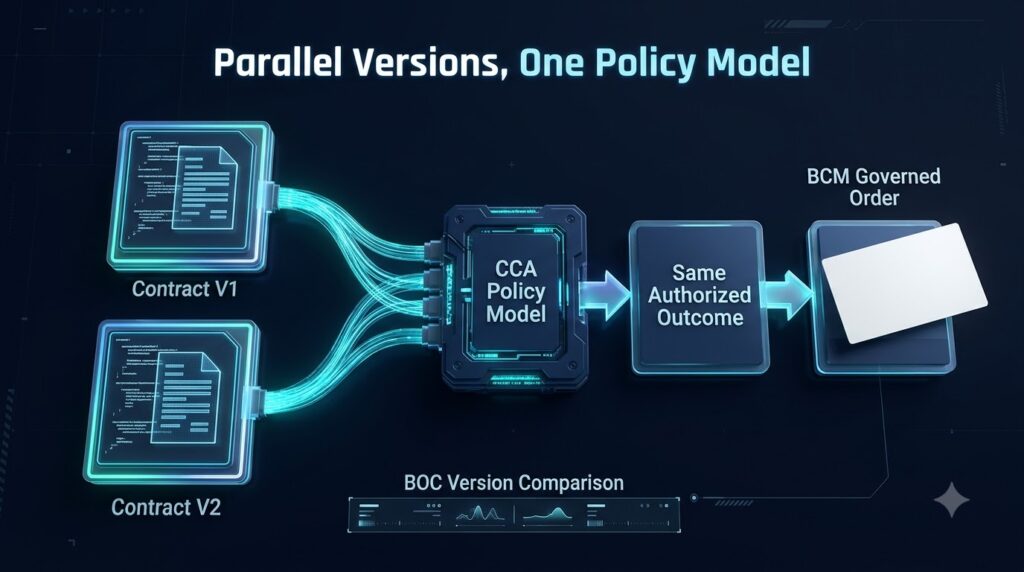
During migration, CCA may support more than one contract version. Both versions must map to the same authoritative policy model. Parallel support should not create one permissive path and one restrictive path for the same business action. Compare decisions and normalized outputs before shifting production traffic.
Use a translation layer only when mappings are explicit and testable. Record the inbound version, normalized representation and outbound version. Do not hide lossy conversion; route exceptions for remediation when the older contract cannot express a required control.
Use a Controlled Migration Lifecycle
| Stage | Control objective | Exit condition |
|---|---|---|
| Discover | Inventory producers, consumers, owners and versions | Dependency map complete |
| Design | Define new contract and compatibility rules | Architecture and governance approved |
| Publish | Release specification, examples and dates | Consumers acknowledge plan |
| Validate | Run schema, contract, policy and security tests | Supported matrix passes |
| Pilot | Send controlled tenant or workflow traffic | CCA and BCM outcomes reconcile |
| Migrate | Move consumers with observable checkpoints | Target adoption reached |
| Deprecate | Block new adoption and warn remaining clients | No unapproved legacy use |
| Retire | Disable old version and close evidence | BOC confirms zero legitimate traffic |
Make Deprecation Measurable
A deprecation notice should state the affected version, replacement, migration guide, test environment, support window, final date and escalation path. Publish dates early enough for enterprise change control. Avoid indefinite support that leaves obsolete validation and security behavior active.
Measure real usage by caller, tenant, operation and outcome. A version is not ready for retirement because documentation says so; it is ready when authorized traffic has migrated, exceptions have owners and BOC confirms that remaining calls are invalid or intentionally blocked.
Keep Errors Stable and Actionable
Consumers need durable error categories such as authentication failure, insufficient scope, schema violation, CCA policy denial, BCM contract rejection, duplicate request, rate limit and dependency outage. A human-readable message may improve, but the machine code and remediation meaning should remain stable within a version.
Do not collapse every failure into a generic response. Integration teams must know whether to rotate credentials, correct data, request approval, stop retrying or wait for recovery. Safe retry behavior is part of the contract.
Use BOC for Version Operations
| BOC signal | Operational question | Action |
|---|---|---|
| Version adoption | Which callers remain on each version? | Assign migration owner and date |
| Validation failure | Which field or rule is incompatible? | Correct producer or mapping |
| Semantic variance | Do versions produce different CCA outcomes? | Stop rollout and investigate |
| Order rejection | Is BCM rejecting trusted authorization? | Compare contract and policy context |
| Legacy traffic | Who called a deprecated endpoint? | Warn, throttle or block by policy |
| Translation loss | Did normalization discard required control? | Route exception; do not infer |
| Evidence gap | Can decision, order and event versions be linked? | Recover correlation before closure |
Reconcile Change Windows
For every rollout, define the observation window and compare authentication, validation, CCA decisions, BCM orders, provider submissions and callbacks. Investigate unexpected changes in denial rate, duplicate prevention, template selection, quantity, route, latency and error distribution.
Rollback restores service but does not close governance. BOC should identify transactions processed during the affected window and determine whether each was valid, corrected, cancelled or accepted with documented evidence.
Measure API Contract Governance
| Measure | What it reveals | Target direction |
|---|---|---|
| Contract inventory coverage | Every production integration and version is known | Complete |
| Compatibility pass rate | Supported combinations behave safely | Complete |
| Unversioned semantic changes | Behavior changed without an explicit contract | Zero |
| Deprecated traffic | Callers still depend on retirement candidate | Decrease to zero |
| Migration lead time | Consumers receive adequate transition time | Predictable |
| Version-related order failures | Change disrupted governed ordering | Zero |
| Reconciliation completion | Affected decisions and orders have disposition | Complete |
Implement Contract Governance in Stages
- Inventory HCM, IAM, CRM, portal, CCA, BCM, provider and BOC API consumers and versions.
- Assign a business owner, technical owner, semantic owner and retirement condition to each contract.
- Document resources, fields, business meaning, security, idempotency, errors and events.
- Classify proposed changes as compatible, conditionally compatible or breaking before development.
- Create schema, consumer-driven, business-policy, security and failure tests.
- Protect the CCA-to-BCM authorization with explicit contract and policy versions.
- Pilot new versions with controlled traffic and end-to-end BOC reconciliation.
- Publish migration, deprecation and retirement dates with accountable owners.
- Block new adoption of deprecated versions and monitor remaining legitimate traffic.
- Retire only after zero-use evidence and complete change-window reconciliation.
Frequently Asked Questions
What is an API contract?
It is the agreed structure, meaning, security, behavior and lifecycle that govern communication between systems.
What is API versioning governance?
It is the controlled process for introducing, supporting, migrating, deprecating and retiring API behavior.
What is CCA?
CCA is the enterprise policy and orchestration authority for governed business card identity, eligibility, templates, quantities, approvals and routing.
What is BCM?
BCM is the business card ordering management system or software that executes authorized orders, proofing, production coordination, delivery and reporting.
What is BOC?
BOC monitors compatibility health, owns exceptions and reconciles decisions, orders and events across versions.
Is adding an optional field always safe?
No. A consumer may mishandle unknown fields, or the new field may change business meaning when present.
When is a new major version required?
Use one when a change cannot preserve the documented behavior of existing consumers.
Can CCA support two versions at once?
Yes, if both versions map to the same authoritative policy model and their outcomes are tested and observable.
How should BCM handle missing authorization fields?
It should reject an incomplete contract rather than infer authority or use an unsafe default.
When can an old version be retired?
After migration owners close exceptions and BOC confirms that no legitimate production traffic remains.
The Strategic Outcome
API contract governance lets enterprises evolve connected systems without weakening business authority or disrupting business card ordering. CCA preserves policy meaning across versions, BCM executes only complete and compatible authorization, and BOC makes migration risk and operational evidence visible.
The result is controlled change: integrations can improve while eligibility, approved identity, templates, quantities, routing and order evidence remain governed end to end.
Select the CCA-to-BCM order contract and document its current version, consumers, business semantics, required authorization fields, errors, idempotency, tests and retirement policy. Introduce one additive change in a test environment, validate old and new consumers, pilot controlled traffic and use BOC to reconcile every resulting decision and order.