

Salesforce Connected Business Identity Governance

Salesforce contains valuable context about the people who represent an enterprise in the market. Sales roles, territories, business units, customer segments, regional assignments, campaign responsibilities, office details, and approved customer-facing contact channels may all influence how an employee presents the organization. Connecting this information to a business card program can eliminate repetitive entry and improve accuracy. Yet a direct data connection does not, by itself, establish which CRM fields are authoritative, which may appear publicly, who may change them, or when an exception requires approval.
Color Card Administrator (CCA) provides the missing authority layer. It allows Salesforce context to inform business identity without permitting CRM convenience to override HR records, brand policy, legal requirements, access controls, or procurement rules. CCA validates incoming data, applies controlled mappings, separates standard changes from exceptions, routes decisions to accountable owners, and releases an approved identity specification into Business Card Manager (BCM) for ordering and fulfillment. The integration therefore becomes a governance capability rather than a field-mapping exercise.
For enterprise buyers, this distinction is decisive. The goal is not merely to make business card ordering available from Salesforce. The goal is to ensure that every identity artifact created from Salesforce-connected data is authorized, consistent, explainable, and traceable across its full lifecycle.
Why Salesforce Connectivity Creates an Identity-Governance Question
Salesforce is often treated as a customer and revenue system, but its records frequently contain public-facing identity information. A sales representative may have a territory designation, a market-specific telephone number, a customer-facing title, or a team assignment that differs from the organization’s internal hierarchy. A partner manager may need a regional designation. A service leader may use an approved support channel rather than a personal extension. These details can make a business card more useful, but they also create ambiguity when CRM data conflicts with HR, directory, brand, or legal sources.
If the integration simply copies whichever Salesforce value is available, the enterprise can automate inconsistency. Informal titles may become printed titles. Stale territories may persist after reassignment. Free-text fields may introduce nonstandard capitalization, abbreviations, or unsupported claims. A broad Salesforce permission may unintentionally become the power to alter a regulated identity artifact. CCA addresses this risk by asking an authority question before a synchronization question: what is Salesforce allowed to influence, under whose control, and with what evidence?
This approach protects the value of the CRM connection. Salesforce remains a trusted source for the customer-facing context it legitimately owns. It does not become the accidental master for employment identity, brand presentation, or purchasing authority.
CCA and BCM Have Different Responsibilities in the Salesforce Architecture
CCA is the enterprise authority engine. It governs source precedence, permitted field use, template eligibility, user scope, approval routing, exception treatment, policy versions, and evidence retention. BCM is the conversion and workflow execution engine. It receives an approved identity specification, supports the ordering experience, coordinates fulfillment, and returns status and transaction evidence. Salesforce supplies relevant CRM context and may provide a convenient starting point for an authorized request.
Keeping these roles separate prevents execution convenience from weakening governance. A button, flow, or Salesforce action can initiate a request, but it should not silently decide that every visible CRM value belongs on a printed artifact. CCA establishes the governed boundary; BCM carries the approved outcome into production. The resulting architecture is understandable to sales operations, marketing, HR, IT, procurement, and audit teams because each platform performs a defined role.
Defining Which Salesforce Data May Influence a Business Card
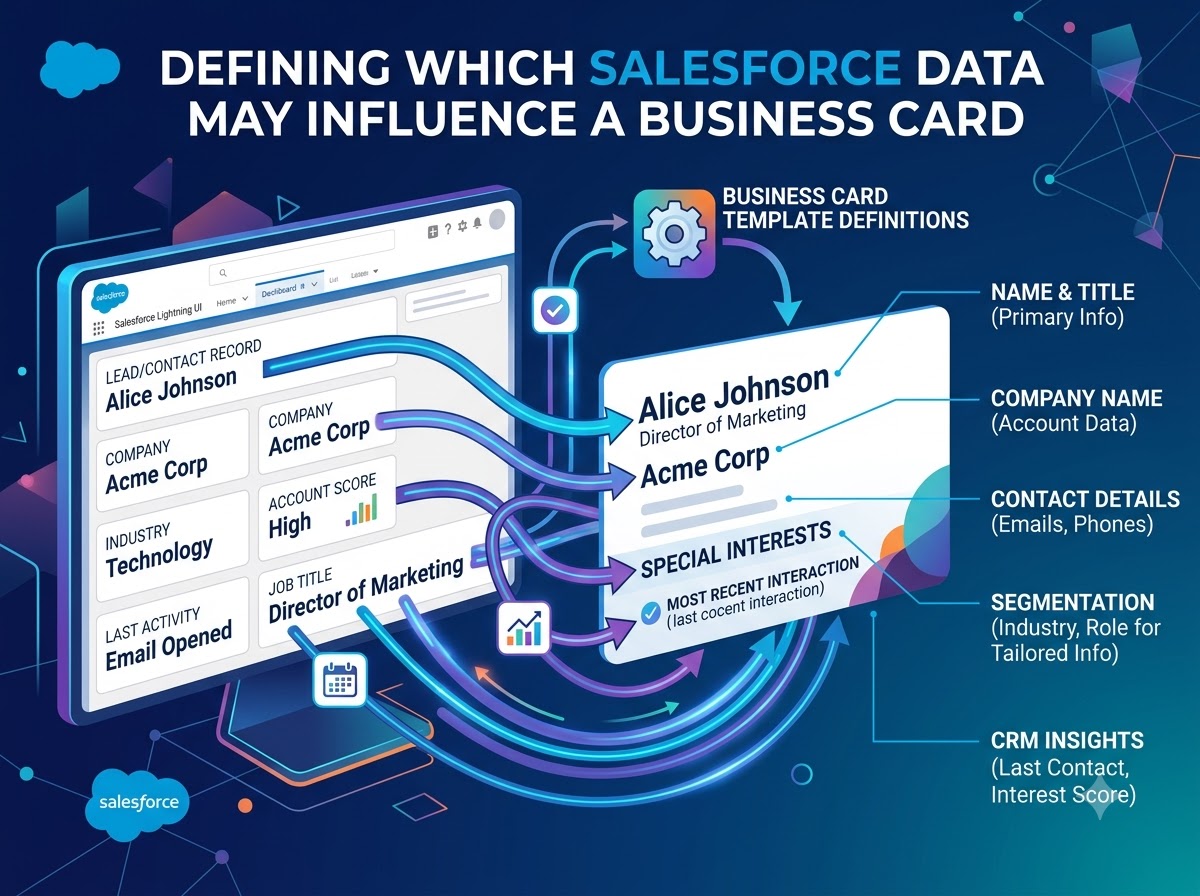
A disciplined Salesforce business card integration begins with a field-authority matrix. Each potential attribute should have an owner, an allowed purpose, a transformation rule, an approval requirement, and a fallback behavior. This is especially important because custom Salesforce objects and fields often reflect local operating practices rather than enterprise-wide standards.
Employment identity remains HR-authoritative
Legal name, preferred-name policy, employment status, official job title, department, manager, legal entity, and primary work location ordinarily originate in an HRIS or HCM platform. Salesforce may hold copies for routing or reporting, but a copied value should not automatically gain equal authority. CCA can compare sources, flag divergence, and prevent an outdated CRM copy from replacing an approved HR value.
Customer-facing context may be CRM-authoritative
Territory, market segment, account team, regional responsibility, partner designation, campaign role, or an approved public contact route may originate in Salesforce. CCA can map selected values to approved display options. A standardized territory code might generate a permitted regional label, while a free-text campaign description remains contextual and never becomes card content.
Brand and legal presentation remain policy-authoritative
Logo, typography, color, layout, trademark treatment, regulated credentials, entity disclosures, localization, and accessibility requirements should come from centrally controlled templates and policies. Salesforce can help determine which policy applies—for example, by business unit or region—but it should not redefine that policy.
Commercial execution remains procurement-authoritative
Cost centers, budgets, supplier assignments, purchase-order requirements, quantity limits, shipping rules, and legal-entity billing may be enriched by Salesforce context, yet the applicable commercial authority belongs to procurement, finance, or ERP systems. CCA keeps identity approval and purchasing approval distinct so neither becomes a shortcut around the other.
A Governed Salesforce-to-Card Workflow
The strongest architecture separates request initiation, data validation, policy decisions, execution, and reconciliation. A typical flow can operate as follows:
- An authorized Salesforce action or lifecycle event creates a request containing only the required record identifiers and approved contextual fields.
- CCA verifies the initiating user, permission scope, source record, event time, employee relationship, and applicable organization or region.
- CCA retrieves or references authoritative HR and directory attributes, then applies field precedence, controlled mappings, template rules, and data-quality checks.
- Standard requests move through policy-based validation; only genuine deviations are routed to the responsible HR, brand, legal, managerial, or procurement approver.
- CCA creates a version-controlled identity specification and releases it to BCM only after all required decisions are complete.
- BCM manages ordering and fulfillment with an approved vendor, then returns quantity, cost, supplier, shipping, completion, and error status for reporting and audit.
The sequence is intentionally more precise than ‘Salesforce sends an order.’ It preserves control points while still reducing manual effort. It also allows the enterprise to diagnose failures accurately: source-data defect, mapping issue, policy exception, approval delay, purchasing restriction, supplier error, or fulfillment problem.
Role-Based Access: Salesforce Permission Is Not Ordering Authority
Salesforce permission sets, profiles, roles, groups, territories, and account relationships can help establish context, but they should not be copied mechanically into CCA. The ability to edit an employee-related field in Salesforce may exist for operational reasons and does not necessarily confer authority to publish that value on a business card. Similarly, a sales operations administrator may need broad CRM visibility without having brand, purchasing, or identity-approval rights.
CCA can translate enterprise identity and Salesforce context into narrowly defined responsibilities. An employee may request only for themselves. A manager may review requests within a reporting scope. A regional coordinator may submit on behalf of an assigned population. A brand administrator may govern templates without approving spend. A procurement user may approve quantities and suppliers without editing identity data. A technical integration account may exchange data without interactive administrative access.
This separation of duties reduces standing privilege and makes accountability visible. It also prevents a common integration shortcut in which the most convenient administrator role becomes the owner of every decision.
Managing Customer-Facing Titles Without Losing Control
Salesforce-connected teams often have legitimate reasons to use customer-facing titles that differ from internal HR labels. A payroll title may be too broad, too technical, or poorly suited to a specific market. The answer, however, is not unrestricted free text. CCA can support a governed title model in which approved external titles are mapped to roles, job families, regions, certifications, or managerial approvals.
A standard mapping may permit ‘Enterprise Account Executive’ for employees in a defined sales role. A regulated industry title may require credentials and legal review. A leadership title may require HR validation. A localized title may require approved translation. A nonstandard request can enter an exception workflow with a reason, evidence, named approver, effective date, and expiration or review requirement.
This model respects the operational value of Salesforce while protecting the organization from title inflation, inconsistent promises, brand fragmentation, and regulatory exposure. It also creates reusable policy. Once a legitimate exception pattern is understood, the enterprise can decide whether to formalize it rather than approving the same variation repeatedly.
Territories, Regions, and Organizational Change
Territories and customer assignments change frequently. If a business card is automatically reissued after every Salesforce update, integration can increase cost and waste. CCA should interpret the event before initiating execution. A back-end territory code change may require no card update. A move into a new country may require a different legal entity, language, address, telephone format, template, and supplier. A temporary account assignment may be relevant inside Salesforce but inappropriate for a durable printed artifact.
CCA can classify changes by materiality, compare the current approved identity with the proposed state, and determine whether to update the record, request review, issue a digital change, or authorize a printed reissue. Effective dates are essential: future assignments should not appear early, and expired responsibilities should not remain indefinitely. This event-to-decision model turns CRM synchronization into selective, explainable lifecycle control & management.
Flow, APIs, Webhooks, and Integration Middleware
Salesforce Flow, platform events, outbound messages, APIs, webhooks, and middleware can all support the connection. The appropriate mechanism depends on transaction volume, latency, error tolerance, security architecture, and the organization’s integration standards. Technical flexibility is useful, but every route should enter the same CCA governance model.
API design should address authenticated service identities, least-privilege scopes, encryption, secret rotation, allow-listed operations, rate limits, retries, timeouts, idempotency, duplicate suppression, schema validation, versioning, monitoring, and dead-letter or exception queues. Correlation identifiers should link the Salesforce event to the CCA decision, BCM order, supplier transaction, and returned status. Sensitive data should be minimized rather than copied merely because it is accessible.
The integration also needs business controls that technical documentation often overlooks: field ownership, permitted transformations, policy versions, approval thresholds, effective dates, stale-record handling, conflict resolution, and retention. A technically successful API call is not proof that an identity decision was authorized.
Failure Handling Must Preserve Authority
Enterprise integrations operate in imperfect conditions. Salesforce may be unavailable, a custom field may be renamed, an employee record may be incomplete, a territory may not map to an approved label, or a callback may arrive twice. A governed system should fail predictably. It should not replace missing authoritative data with free text, release an order because an approval timeout occurred, or create duplicate production requests after a retry.
CCA can place incomplete or conflicting requests into a visible exception queue, preserve the last known approved specification, identify the responsible data owner, and record every retry or manual intervention. High-risk failures should stop execution. Lower-risk informational updates may wait for recovery. The control policy should define the difference in advance so operational pressure does not determine authority case by case.
Audit Evidence Across Salesforce, CCA, BCM, and Fulfillment
A complete audit record should allow an authorized reviewer to reconstruct why a particular card was produced. Relevant evidence includes the Salesforce record and event, source-system values, field mappings, transformations, user and service identities, applicable policy and template versions, differences from the previous approved identity, approvers and timestamps, exception reasons, released specification, supplier, quantity, cost allocation, fulfillment result, and any integration errors.
This evidence supports more than a formal audit. Sales operations can identify stale or inconsistent CRM fields. HR can see recurring title conflicts. Marketing can detect template or terminology pressure. Procurement can measure supplier performance and reprint cost. IT can review failed calls, excessive privilege, and unusual activity. Governance creates a feedback loop that improves upstream processes rather than hiding their defects behind successful orders.
Security, Privacy, and Data-Minimization Requirements
A Salesforce integration should exchange only the information required for the approved purpose. Customer records, opportunity data, compensation indicators, performance details, private employee attributes, and unrelated notes have no place in a business identity workflow. CCA should use constrained service permissions, explicit field allow lists, role- and region-based visibility, secure credential handling, and documented retention periods.
The organization should also define whether CCA stores a value, references it, or retains only evidence that a validation occurred. Integration logs may need different retention from final approval records. Sandbox and production environments should be separated, test data should be controlled, and deprovisioning should follow authoritative identity events. These practices keep useful CRM context from expanding the platform’s privacy footprint unnecessarily.
Implementation Roadmap for a Salesforce-Connected CCA Program
Phase 1: establish the authority model
Inventory candidate Salesforce fields, objects, actions, and lifecycle events. For each one, define the business owner, data owner, approved purpose, source precedence, transformation rule, approval need, retention requirement, and failure behavior. Resolve disagreements before automating them.
Phase 2: design the minimum governed use case
Select one valuable, repeatable scenario—such as a standard employee request for an established sales role. Connect Salesforce identifiers and approved context to authoritative HR and directory data. Validate user scope, template selection, title mapping, and exception routing without attempting to automate every regional variation at once.
Phase 3: connect execution and reconciliation
Release only the approved identity specification to BCM. Add procurement controls, supplier routing, quantities, shipping, and returned status. Ensure that Salesforce displays useful progress without becoming the sole evidence system or a second source of approval truth.
Phase 4: test lifecycle and failure scenarios
Test transfers, title changes, future effective dates, departures, duplicate events, stale records, rejected exceptions, unavailable systems, permission changes, partial fulfillment, and supplier failures. Enterprise readiness is demonstrated by controlled exception behavior, not only by a successful standard request.
Phase 5: optimize using evidence
Measure manual corrections, exception rates, approval duration, mapping failures, reprint causes, supplier performance, cost variance, and unused permissions. Use these findings to improve Salesforce data quality, CCA policy, BCM workflow, and the integration backlog.
What Enterprise Buyers Should Evaluate
A buyer considering a Salesforce business card integration should ask how the provider governs the connection, not merely whether Salesforce appears on an integrations page.
- Which Salesforce objects and fields are supported, and how are standard and custom fields governed?
- Can the platform distinguish CRM-owned context from HR-owned identity, brand-owned presentation, and procurement-owned execution?
- Can it map Salesforce roles, regions, territories, and groups into limited request or approval scope without granting broad administration?
- Can it compare proposed data with the current approved identity and route only material changes or exceptions?
- Can it manage effective dates, duplicate events, retries, unavailable sources, mapping failures, and rejected requests safely?
- Can it produce linked evidence from the originating Salesforce event through policy, approval, BCM execution, vendor fulfillment, and reporting?
- Can the API and integration model extend to HRIS, identity, ERP, procurement, and service-management systems without creating competing control frameworks?
Buyer-Intent Bridge: From Salesforce Integration to Identity Control
Organizations searching for a Salesforce business card integration or Salesforce business card ordering solution often begin with a practical problem: sales employees re-enter data, titles are inconsistent, regional details are wrong, approvals are slow, or order status is invisible. Connecting Salesforce can reduce friction, but the durable solution is a governed architecture that decides which CRM data is trusted, what may be published, who may act, and what evidence must remain.
CCA provides that authority layer. It turns Salesforce context into policy-aware identity decisions, coordinates accountable approvals, and releases only a controlled specification to BCM. BCM then manages the conversion from approved identity to order and fulfillment. Together, the platforms help the enterprise gain the convenience of CRM-connected workflows without surrendering brand, identity, security, procurement, or audit control.
Frequently Asked Questions
What is a Salesforce business card integration?
It is a governed connection that allows authorized Salesforce data or events to inform employee business card requests, identity validation, approvals, ordering status, or reporting. An enterprise-grade integration preserves source authority, policy, permissions, exception handling, security, and audit evidence.
Should Salesforce be the source of truth for employee titles?
Usually not for official employment titles. HRIS or HCM systems commonly own employment identity. Salesforce may own approved customer-facing context or a governed external-title field. CCA can enforce precedence and route differences for approval.
Can employees order business cards directly from Salesforce?
Salesforce can provide an authorized initiation point, but the request should still pass through CCA validation, policy, permissions, and approvals before BCM executes the order. A CRM action should not bypass enterprise controls.
How are Salesforce custom fields handled?
Each custom field should be explicitly allow-listed, mapped, validated, and assigned an owner and purpose. Free-text or locally defined fields should not become public identity content automatically.
Does Salesforce integration remove the need for approvals?
No. It can remove unnecessary review for standard requests using trusted data, while directing nonstandard titles, template deviations, regulated content, unusual quantities, or purchasing exceptions to the correct authority.
What happens when Salesforce and HR data conflict?
The predefined source-of-authority model determines which value controls. CCA can block execution, preserve the current approved identity, and route the conflict to the responsible owner rather than choosing silently.
What is the difference between CCA and BCM in this workflow?
CCA governs data authority, policy, access, approvals, exceptions, and the approved identity specification. BCM converts that approved specification into an ordering and fulfillment workflow and returns execution evidence.
Conclusion: Connect Salesforce Without Delegating Identity Authority
Salesforce can make business card workflows more accurate, timely, and useful by supplying customer-facing context and a familiar point of engagement. Yet connectivity becomes enterprise infrastructure only when the organization controls what Salesforce may influence, how conflicts are resolved, who may act, which exceptions require approval, and how every outcome is evidenced.
CCA gives the enterprise that control plane. It protects source authority, translates CRM context through governed mappings, separates responsibilities, manages lifecycle events and failures, and releases only approved identity specifications into BCM execution. The result is not simply Salesforce-connected ordering. It is Salesforce-connected business identity governance—designed for consistency, accountability, security, and scale.