

Workday-Connected Business Identity Governance

Workday is frequently the authoritative system for worker identity, employment status, job profile, supervisory organization, company, cost center, location, manager, and effective-dated workforce change. Those attributes are highly relevant to business cards and other employee-facing identity materials. Connecting them can remove duplicate entry, accelerate onboarding, reduce stale information, and improve consistency across a distributed enterprise.
Yet source authority does not eliminate the need for governance. A Workday title may be designed for compensation or organizational reporting rather than external communication. A future-dated transfer may not be ready for publication. A contingent worker may require a different template or may be ineligible. A location record may identify a work site but not the approved public address. A termination event may require immediate access removal while an outstanding print order must be stopped. Automation without decision controls can move reliable HR data into the wrong public context with greater speed.
Color Card Administrator (CCA) provides the enterprise authority layer between Workday and execution. It validates worker events, applies field-level authority and presentation rules, determines eligibility, interprets effective dates, controls user scope, routes genuine exceptions, and creates a version-controlled identity specification. Business Card Manager (BCM), the conversion engine, then turns that approved specification into an ordering and fulfillment workflow. Together, the platforms make Workday connectivity an accountable identity-governance capability rather than a simple employee-data import.
Why Workday Integration Is More Than Data Synchronization
The phrase “Workday business card integration” can suggest a straightforward sequence: retrieve the worker record, populate a template, and send the card to production. That model overlooks the difference between an authoritative employment fact and an approved external representation. Workday may accurately state a job profile such as a highly technical internal classification, while the enterprise has approved a simpler customer-facing title. It may hold multiple addresses, phone numbers, organizations, or assignments, each valid for a different purpose. CCA must decide which governed interpretation applies to the artifact.
The same principle applies to events. Hire, rehire, transfer, promotion, leave, return, location change, manager change, legal-entity change, and termination do not all require the same response. Some should create eligibility, some should propose an update, some should require review, and some should revoke access without producing anything. CCA converts workforce events into policy decisions and preserves evidence of why an action did—or did not—occur.
This prevents a common enterprise failure: treating every technically valid HR change as an immediate production instruction. Workday remains the authority for the workforce facts it owns. It remains the authority for translating those facts into permitted identity content and controlled action.
CCA and BCM Have Distinct Roles in the Workday Architecture
It is the authority engine. It governs source precedence, worker eligibility, field mappings, presentation policy, template assignment, delegated access, approval routing, exception duration, lifecycle state, and evidence retention. BCM is the conversion and execution engine. It presents the approved business card ordering experience, manages quantities and fulfillment, coordinates approved suppliers, and returns commercial and operational status.
This separation is important because an HR event should not become an unreviewed purchase instruction. A new hire may be eligible for a standard identity configuration but still require a manager-selected quantity, a confirmed shipping destination, or procurement authorization. Conversely, procurement approval should never authorize a nonstandard title or unapproved logo. CCA resolves identity authority; BCM executes the authorized outcome. The boundary makes responsibilities understandable to HR, brand, IT, procurement, operations, and audit teams.
Establishing Field-Level Authority for Workday Data
A governed integration starts with an attribute authority register. For every Workday field used or referenced, the organization should document the business owner, intended purpose, public-display rule, transformation, effective-date behavior, sensitivity, approval requirement, and fallback. This is more precise than declaring Workday the source of truth for everything.
Worker identity and status
Worker ID, employment status, worker type, legal name, preferred name under policy, hire date, termination date, company, and primary position are commonly HR-authoritative. CCA can use them to identify the person, determine eligibility, establish the applicable legal context, and manage lifecycle state. Sensitive attributes that are unnecessary for identity execution should remain outside the integration.
Job titles and external presentation
Job profile, business title, position title, and local title fields can have different purposes. CCA can map approved Workday values to a controlled external-title catalogue, preserve approved abbreviations and capitalization, and route unsupported variants. The integration therefore uses Workday as evidence without assuming that every HR label belongs on a public artifact.
Organizations, companies, cost centers, and locations
Supervisory organization, company, business unit, cost center, and location can help select policy, approver, template, supplier, language, and charge allocation. They should not be printed automatically. An internal cost-center name may be unsuitable externally, and a Workday location may differ from the approved public-facing address. CCA maps organizational facts to governed presentation and execution rules.
Contact and directory attributes
Work email and business phone details may originate in Workday, an identity directory, a telecommunications platform, or another authoritative service. CCA applies source precedence and validation rather than accepting whichever value arrives last. This avoids race conditions during onboarding and transfers, when systems may update at different times.
Effective Dating Is a Governance Control
Workday’s effective-dated model is one of its greatest strengths, but it requires disciplined interpretation. A promotion approved today may take effect next month. A transfer may be corrected or rescinded. A future hire may not yet have a final email address or office. If a connected system acts on transaction-entry time rather than effective time, it can expose confidential changes, publish information early, or produce an artifact that becomes obsolete before delivery.
CCA can maintain proposed, approved, scheduled, active, superseded, and revoked identity states. It can hold a future specification until the effective date, apply lead-time rules where production must begin earlier, and require explicit authorization when early disclosure creates risk. If a future event changes, CCA can cancel or recompute the proposed identity and identify any BCM order already in progress.
Effective dating also supports expiration. Temporary assignments, acting titles, project roles, and exceptions should have defined end dates or review dates. Without that control, a legitimate temporary change can become a permanent public misrepresentation. CCA makes time part of policy rather than merely a timestamp in an integration log.
A Governed Workday-to-Card Lifecycle
A resilient integration separates event capture, identity decisioning, approval, execution, and reconciliation. A typical lifecycle operates as follows:
- Workday publishes or makes available an eligible worker event containing only the required identifiers and allow-listed attributes.
- CCA verifies the source, event type, worker relationship, effective date, organizational scope, data completeness, and applicable policy version.
- CCA resolves field precedence, maps worker attributes to approved external identity values, selects the eligible template family, and compares the proposal with the current approved specification.
- Standard, policy-conforming outcomes proceed automatically; material changes and genuine exceptions are routed to the accountable HR, manager, brand, legal, IT, or procurement owner.
- CCA records the decision and releases a version-controlled identity specification to BCM only when the required conditions are satisfied.
- BCM manages the authorized request, quantity, supplier, shipping, production, and fulfillment, then returns status, cost, errors, and completion evidence.
- CCA reconciles the execution result with the Workday event and preserves a traceable lifecycle record.
The model supports automation without collapsing authority into a single system. It also makes failures diagnosable: incomplete HR data, mapping conflict, ineligible worker, early effective date, pending exception, purchasing restriction, integration error, or supplier failure each has a distinct owner and resolution path.
New-Hire Onboarding Without Premature Production
New-hire business cards are a high-value use case because manual processes often begin late and require repeated data entry. Workday can provide a confirmed worker identity, organization, manager, location, start date, and job information. CCA can evaluate whether the worker is eligible, whether the title maps to an approved external form, whether required contact channels exist, and which regional or legal template applies.
The system should not treat “pre-hire record exists” as “ready to print.” A start date may change, a background or employment condition may remain incomplete, a phone number may not be assigned, or the employing entity may be corrected. CCA can use readiness gates and lead-time thresholds: prepare the proposed identity, request only missing decisions, and release to BCM at the controlled point that balances timely arrival with the risk of premature production.
This approach improves the employee experience while protecting confidential data and avoiding waste. Managers see a predictable workflow, HR retains authority over workforce status, and procurement receives an order only after the identity state is approved.
Transfers, Promotions, and Organizational Change
A transfer can alter company, department, location, manager, cost center, region, language, title, phone routing, template, supplier, and billing rules. Not every change is material to the external identity, and not every material change requires immediate reprinting. CCA can compare the current approved specification with the effective-dated proposal and classify the delta.
A cost-center change with no public or purchasing effect may require only a record update. A move to another legal entity may require a different disclosure and template. A promotion may require an approved external-title mapping. A relocation may change the public office address, telephone format, language, supplier, and shipping route. CCA can select the appropriate response—no action, digital update, approval request, scheduled replacement, or urgent revocation—rather than allowing every HR event to trigger the same workflow.
Materiality rules reduce unnecessary reprints and approval traffic while ensuring that important identity changes are not missed. They also create evidence for sustainability and cost governance by showing why a replacement was authorized.
Contingent Workers, Multiple Positions, and Complex Worker Models
Large enterprises employ contingent workers, seasonal staff, secondees, interns, acquired populations, employees with multiple positions, and people with concurrent assignments. A simplistic “active worker equals eligible” rule can grant inappropriate access or produce misleading identity artifacts. CCA can evaluate worker type, assignment, company, location, sponsorship, duration, and policy eligibility before enabling any request.
Where a person has multiple positions, the organization must define which assignment governs the external identity and whether multiple approved identities are permitted. The answer may depend on legal entity, customer-facing responsibility, region, or effective period. CCA can require a designated primary identity, restrict secondary identities, and retain the authorization linking each artifact to its legitimate assignment.
Temporary populations may receive limited templates, lower quantities, explicit expiration, manager sponsorship, or no printed card at all. These are policy choices that should be transparent and repeatable rather than improvised by local administrators.
Delegated Security Is Not Identity Authority
Workday security groups and business-process roles can help establish context, but a broad HR permission should not automatically become authority to change public identity content or approve purchasing. HR partners may view sensitive data across a population without owning brand decisions. Managers may approve staffing transactions without permission to authorize executive titles. Integration service accounts may read allow-listed fields but should have no interactive administrative rights in CCA.
CCA translates enterprise roles into narrowly scoped capabilities: self-request, request on behalf of a defined population, title review, template administration, identity exception approval, quantity approval, supplier administration, or technical integration. Separation of duties ensures that no convenient role silently accumulates control over data, policy, approval, and execution.
When a manager or organization changes in Workday, CCA can update delegated scope and pending approval routing without erasing the original evidence. This is essential for long-running requests and retrospective audit, where the current hierarchy may differ from the hierarchy that existed when the decision was made.
Exceptions Should Be Controlled, Time-Bound, and Learnable
Even a well-designed Workday model will not cover every externally valid identity. A customer-facing title may differ from the job profile, an employee may need a bilingual format, a newly acquired business may temporarily retain a legacy brand, or a regulated credential may require additional proof. CCA routes these deviations to the authority that owns the risk rather than turning free text into an informal escape path.
A complete exception includes the requested variation, business reason, affected worker and artifact, supporting evidence, named approver, policy version, effective date, expiration or review date, and final disposition. Repeated exceptions can then reveal a missing standard. Governance should learn: legitimate recurring patterns can become approved mappings, while risky or unnecessary requests can be eliminated with clearer policy.
Integration Engineering Must Protect the Decision Model
Workday integrations may use APIs, reports as a service, event mechanisms, enterprise integration middleware, or scheduled extracts according to architecture and operational need. Whatever transport is selected, it should enter the same CCA control plane. The integration must authenticate service identities, minimize scopes, encrypt data, validate schemas, handle pagination and rate limits, rotate secrets, monitor latency, and preserve correlation identifiers.
Idempotency is critical. A replayed hire or transfer event must not create duplicate identities or orders. Out-of-order events must be detected, and corrected or rescinded transactions must supersede earlier proposals predictably. The design should define retry limits, dead-letter handling, reconciliation, alert ownership, and recovery objectives. A successful HTTP response proves transport, not authorization; only a completed CCA decision permits release to BCM.
The interface should also minimize data. Compensation, demographic, medical, performance, government identifier, and unrelated personal information have no role in business-card governance. Explicit field allow lists and retention policies keep the integration proportionate to its purpose.
Termination, Cancellation, and Deprovisioning
A termination or rescinded hire is not merely another update. CCA should promptly remove request authority, stop new production, invalidate pending identity proposals, and evaluate whether open BCM orders can be cancelled. The handling may differ for immediate, future-dated, voluntary, or corrected events, but the policy must be established before an urgent case occurs.
The platform should preserve historical evidence while restricting ongoing access. An approved artifact record may remain for audit even after the user is deprovisioned. Pending exceptions should close or transfer to an accountable owner. Returned order status should show whether production was stopped, completed, or already shipped. This reconciled view prevents the enterprise from assuming that disabling an account automatically cancelled a physical transaction.
Audit Evidence Across Workday, CCA, BCM, and Fulfillment
An authorized reviewer should be able to reconstruct the full reason for an identity artifact. Evidence may include the Workday worker and event identifiers, event and effective dates, source attributes, mapping and transformation results, prior and proposed identity versions, eligibility decision, policy and template versions, approvers, exception rationale, release timestamp, BCM request, supplier, quantity, cost allocation, shipping result, integration errors, retries, cancellations, and final disposition.
This record supports HR data quality, brand governance, access review, procurement analysis, integration operations, internal audit, and dispute resolution. It also enables meaningful metrics: percentage of straight-through requests, exception frequency by title or region, future-event changes, preventable reprints, approval duration, mapping defects, failed events, cancelled orders, and supplier performance. Evidence becomes an improvement system, not an archive that is opened only during an audit.
Implementation Roadmap for a Workday-Connected CCA Program
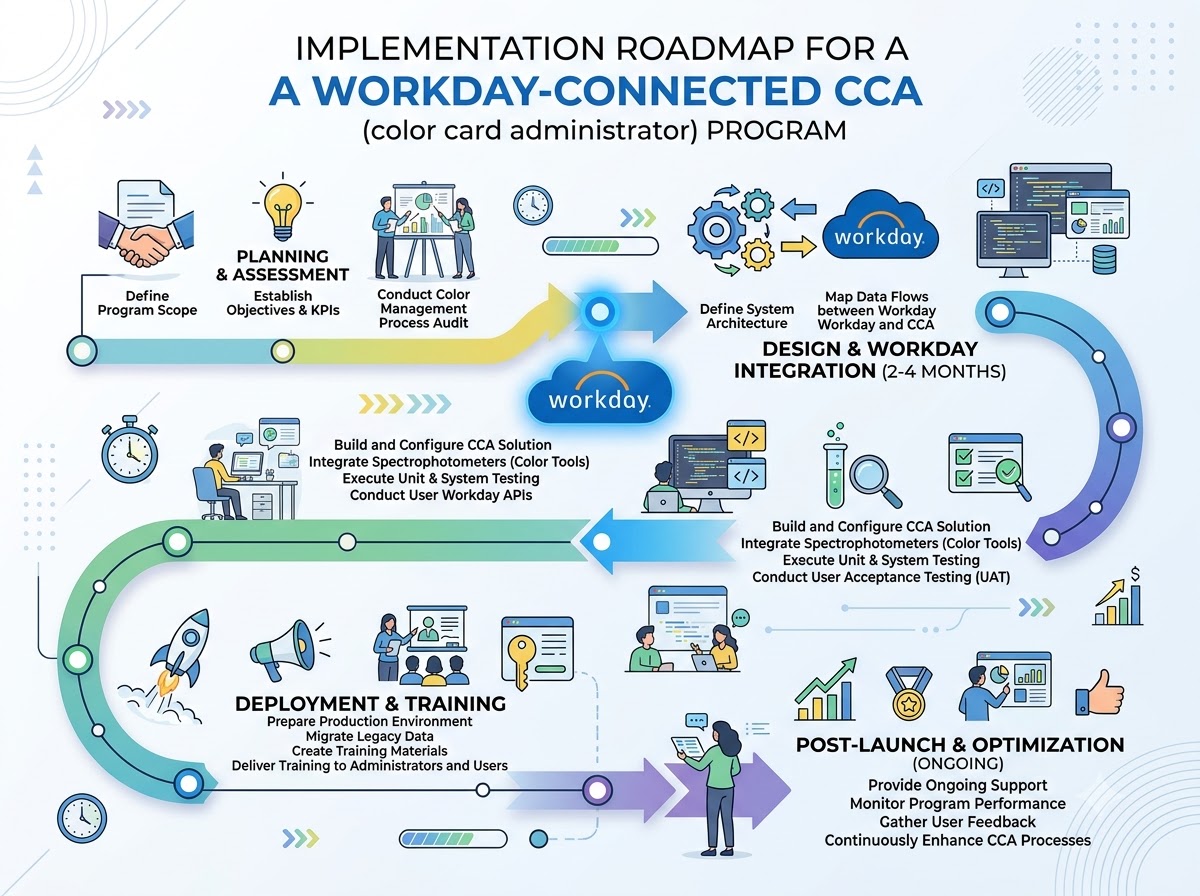
Phase 1: define authority and eligibility
Inventory the Workday worker types, staffing events, business processes, fields, organizations, locations, and security contexts relevant to identity. Document authority, display rules, sensitivity, effective-date behavior, eligibility, exception ownership, retention, and failure response before building automation.
Phase 2: Implement a controlled onboarding use case
Start with one repeatable population, such as standard employees in a defined company and region. Validate worker readiness, approved title mapping, template selection, contact-data availability, delegated scope, and lead-time policy. Keep exceptions visible rather than forcing every variation into the first release.
Phase 3: Add execution and reconciliation
Release approved specifications to BCM, connect quantity and procurement controls, and return order and fulfillment status. Use shared correlation identifiers so HR, CCA, BCM, and supplier events can be traced without making Workday the only evidence repository.
Phase 4: test lifecycle complexity
Test future-dated hires, date changes, rescinds, rehires, transfers, promotions, multiple positions, contingent workers, leaves, manager changes, terminations, duplicate and out-of-order events, missing data, unavailable systems, rejected exceptions, and supplier failures.
Phase 5: expand and optimize
Add regions, worker populations, event types, and suppliers only after the authority model is stable. Use evidence to improve Workday data quality, mapping rules, approval thresholds, policy coverage, procurement controls, and integration monitoring.
What Enterprise Buyers Should Evaluate
A buyer evaluating Workday business card ordering should ask how the platform interprets workforce data and lifecycle events—not simply whether a Workday connector exists.
- Which Workday worker types, fields, organizations, and events are supported, and how is each attribute’s authority documented?
- Can the platform distinguish HR facts from approved external presentation, brand policy, directory data, and procurement authority?
- Does it understand effective dates, future changes, rescinds, corrections, multiple positions, and out-of-order events?
- Can it evaluate eligibility and readiness before enabling access or starting production?
- Can standard changes proceed automatically while true identity, legal, brand, or purchasing exceptions reach the correct owner?
- Can delegated scope change with Workday organizations and managers while historical approval evidence remains intact?
- Can it stop or reconcile pending production after termination, cancellation, or a changed start date?
- Can it trace one worker event through CCA policy, approval, BCM execution, supplier fulfillment, and final status?
Buyer-Intent Bridge: From Workday Integration to Identity Control
Organizations searching for a Workday business card integration often want to eliminate manual entry, prepare cards for new hires, keep titles and locations current, and simplify approvals. Those outcomes are valuable, but they are sustainable only when the connection preserves authority. The enterprise needs to know which Workday fields may be used, how effective dates are interpreted, who is eligible, what counts as a material change, when an exception is required, and how a physical order is reconciled after a lifecycle event changes.
CCA supplies that authority layer. It transforms Workday worker data and events into controlled identity decisions, protects brand and legal policy, updates delegated scope, manages exceptions, and releases only an approved identity specification. BCM then converts the specification into a governed ordering and fulfillment process. The combined model delivers HRIS-connected efficiency without allowing automation to outrun accountability.
Frequently Asked Questions
What is a Workday business card integration?
It is a governed connection that allows approved Workday worker data and lifecycle events to inform eligibility, identity validation, approvals, business card requests, and reporting. Enterprise integration includes policy, effective dating, security, exceptions, reconciliation, and audit evidence—not only field transfer.
Is Workday always the source of truth for business card content?
Workday is commonly authoritative for employment facts, but brand presentation, approved external titles, public addresses, contact channels, and purchasing controls may have other owners. CCA applies field-level precedence and presentation policy.
Can business cards be prepared before a new hire starts?
Yes, when readiness and confidentiality rules permit it. CCA can stage a future identity, wait for required data, apply lead-time rules, and release to BCM only at the approved point.
How does the integration handle future-dated transfers or promotions?
CCA maintains proposed and active identity states, evaluates material changes, schedules activation, and recomputes or cancels the proposal if the Workday event changes or is rescinded.
Does every Workday change trigger a reprint?
No. CCA compares the proposed and current approved identity, then applies materiality, cost, timing, and policy rules. Non-public changes may require no production action.
How are contingent workers and multiple positions handled?
Eligibility and identity selection are policy-driven. CCA can restrict templates and quantities, require sponsorship, choose a governed primary assignment, permit controlled secondary identities, and apply expiration.
What happens after a termination or rescinded hire?
CCA removes request authority, blocks new release, closes or reroutes pending decisions, and attempts to cancel or reconcile open BCM orders while preserving historical evidence.
What is the difference between CCA and BCM?
CCA governs workforce-data authority, eligibility, policy, access, approvals, exceptions, lifecycle state, and the approved identity specification. BCM converts that specification into ordering and fulfillment and returns execution evidence.
Conclusion: Connect Workday Without Turning Every HR Event Into an Order
Workday provides the workforce facts and lifecycle signals that can make enterprise business identity more accurate and timely. Its value is greatest when those signals enter a disciplined decision model. Effective dates, worker types, multiple assignments, title mappings, location rules, delegated security, exceptions, and cancellations all require governance before identity moves into production.
CCA gives the enterprise that control plane. It interprets Workday data through policy, determines eligibility and materiality, protects source boundaries, schedules valid changes, routes accountable exceptions, and preserves linked evidence. BCM then executes the approved result through ordering and fulfillment. The outcome is not simply automated business card ordering. It is Workday-connected business identity governance—designed for enterprise consistency, accountability, privacy, and scale.