

Enterprise Business Card Integrations For Identity Governance

Enterprise business card programs rarely fail because an organization cannot print a card. They fail because employee identity data, approval authority, brand rules, purchasing controls, and fulfillment activity are distributed across systems that were never designed to operate as one governance environment. An HR platform may hold an employee’s legal name and job title. A CRM may define a customer-facing role or regional assignment. An identity directory may determine access. Procurement may control suppliers, budgets, and cost centers. Yet the business card request often begins again as manually entered data in a disconnected portal.
Color Card Administrator (CCA) closes that governance gap. It provides an enterprise authority layer that can receive trusted data from HRIS/HCM, CRM, identity, ERP, procurement, and workflow platforms; apply policy and approval logic; and control how business identity moves into execution. The result is not simply faster ordering. It is a controlled operating model in which identity information has an authoritative source, changes follow accountable workflows, access reflects enterprise roles, and every approved outcome can be traced.
| Core principle Integration creates value only when connected data is translated into enforceable authority: who may request, which identity attributes may be used, who must approve, which template and supplier are valid, and what evidence is retained. |
The Integration Problem Is Really an Authority Problem
Most integration discussions begin with endpoints, fields, and data transfer. Those details matter, but they are not the strategic starting point. The first question is which enterprise system is authoritative for each decision. If Workday or SAP SuccessFactors owns employee title and department, CCA should not allow a requester to silently replace those values. If Microsoft Entra ID or Okta governs authentication and group membership, ordering permissions should not depend on a separate, manually maintained user list. If procurement assigns cost centers and approved suppliers, fulfillment should not bypass those controls merely because a card design has been approved.
This authority-first approach prevents connectivity from becoming another source of inconsistency. It distinguishes a governed integration architecture from a collection of convenience connectors. CCA treats data lineage, policy ownership, exception handling, and audit evidence as parts of the integration itself. A successful connection does not merely answer, “Did the data arrive?” It answers, “Was the correct source trusted, was the correct rule applied, did the correct person approve, and was the outcome executed within policy?”
CCA’s Role in the Connected Enterprise Architecture
CCA should be understood as the authority engine within the broader business identity environment. It determines how enterprise rules govern identity execution. Business Card Manager (BCM) serves as the workflow and conversion engine that carries approved requirements through ordering and fulfillment. Business Ops Center (BOC) provides the operational education and strategic context that helps organizations design repeatable processes. This separation keeps the architecture clear: connectivity supplies context, CCA establishes authority, BCM executes the governed workflow, and operational reporting closes the control loop.
The separation is important because no single source system contains every rule. HR may own employee attributes, marketing may own brand standards, local managers may validate role-specific details, procurement may own supplier and spend policy, and IT may own access. CCA coordinates these authorities without forcing the enterprise to make one application the artificial owner of every decision.
The Five Integration Domains That Shape Identity Execution
1. HRIS and HCM: the employee lifecycle foundation
Platforms such as Workday, SAP SuccessFactors, Oracle HCM Cloud, ADP Workforce Now, UKG, BambooHR, Rippling, and Zoho People can provide the employee records that initiate or change business identity requirements. New-hire status, preferred name policy, job title, department, manager, location, cost center, employment status, and effective dates can become governed inputs rather than manually retyped fields.
The deeper value appears across the lifecycle. A new hire may become eligible for a card only after the employment record reaches an approved status. A title change can trigger review without automatically producing unnecessary inventory. A transfer can update location, phone format, legal entity, language, and template eligibility. A departure can remove access and stop pending fulfillment. CCA transforms these events into controlled decisions rather than treating every data change as an unconditional order.
2. CRM: context for customer-facing identity
Salesforce, Microsoft Dynamics 365, HubSpot, and Zoho CRM contain context that may matter for customer-facing employees: business unit, territory, market, team, office, account assignment, campaign role, or approved public contact channel. A CRM integration can reduce duplicate data entry and help align business cards with the operating reality of sales and service teams.
However, CRM data must not overrule HR or brand authority by default. A territory label may be useful on a card, while an informal opportunity-team name may not be an approved title. CCA provides the policy boundary. It can identify which CRM attributes are displayable, which require managerial or marketing approval, and which are contextual only. This turns CRM connectivity into controlled identity enrichment instead of unrestricted personalization.
3. Identity, SSO, and directories: access as a governance control
Microsoft Entra ID, Okta, and Google Workspace or Cloud Identity can support single sign-on, user provisioning, group-based access, and timely deprovisioning. These capabilities are operationally valuable, but their governance contribution is more significant: access can reflect current employment, organizational role, administrative responsibility, and regional scope.
An employee may be permitted to request only for themselves. A regional coordinator may act for a defined population. A brand administrator may maintain templates but lack purchasing authority. A procurement administrator may view spend and supplier performance without changing identity content. CCA can map directory attributes and groups to these separated responsibilities, reducing standing privilege and preventing a broad administrator role from becoming the answer to every operational need.
4. ERP and procurement: identity execution under commercial control
Oracle NetSuite, SAP Ariba, Coupa, and related finance or procurement platforms connect identity execution to cost centers, purchase approvals, approved vendors, invoicing, budget ownership, and reporting. This is where a business card program becomes visible as an enterprise spend process rather than an isolated print transaction.
CCA can help ensure that an approved identity does not automatically mean an unrestricted purchase. Quantity thresholds, regional suppliers, legal entities, tax requirements, budget owners, and purchase-order rules may still apply. By retaining identity approval and commercial approval as distinct controls, the enterprise gains both brand integrity and procurement accountability.
5. Workflow, service management, and collaboration
ServiceNow can frame a business card request as part of an enterprise service catalog and route exceptions through established operational workflows. Slack and Microsoft Teams can provide notifications, reminders, and status visibility. Zapier and Make can bridge smaller systems where direct integrations are not yet justified. These connections make the process accessible, but they should not become shadow systems of record.
A notification may invite an approver to act, but the authoritative decision should remain recorded in the governed workflow. A collaboration message may announce fulfillment, but it should not be the only evidence that an approval occurred. CCA preserves this distinction between engagement channels and control records.
From Data Synchronization to Governed Decisions
An enterprise integration model should separate four actions that are often collapsed into one: importing data, validating authority, approving an exception, and executing an order. Data can be synchronized without being approved for publication. A valid employee record can still require brand review. An approved identity can still require budget authorization. A completed purchase can still require reconciliation and audit retention.
CCA makes these transitions explicit. A practical control sequence is:
- Receive an event or request from an authorized source and identify its system, timestamp, and record owner.
- Validate required attributes, data quality, template eligibility, user permissions, and applicable policies.
- Route only genuine decisions or exceptions to the responsible approver, with context already assembled.
- Release an approved, version-controlled identity specification to BCM and the authorized fulfillment path.
- Return status, cost, vendor, quantity, and completion evidence to reporting or source systems as required.
This sequence prevents automation from accelerating mistakes. It also gives teams a common operating language: source, policy, decision, execution, and evidence.
Designing a Source-of-Truth Model
The phrase “single source of truth” can be misleading in a complex enterprise because different systems legitimately own different facts. A more useful design is a federated source-of-authority model. HRIS may own employment identity; CRM may own customer-facing assignment; a directory may own access; marketing may own visual standards; procurement may own commercial policy; and CCA may own the governed identity specification and its approval history.
For every field or decision, the organization should define the authoritative source, permitted transformations, refresh timing, approval requirement, fallback behavior, and retention rule. If a source is unavailable, the process should fail predictably. Some fields may remain read-only; some may permit an exception with documented approval; others may be calculated from controlled mappings. The objective is not maximum automation. It is reliable authority at every point where business identity can change.
API Governance Beyond the Endpoint
A business card management API creates the technical path for connectivity, but enterprise readiness depends on the control model surrounding that path. Authentication, least-privilege scopes, encryption, rate limits, retries, idempotency, version management, monitoring, and error handling all matter. Equally important are business controls: field ownership, validation rules, approval thresholds, effective dates, duplicate prevention, exception queues, and audit retention.
CCA’s integration strategy should therefore support both direct platform connections and a governed API layer. Direct integrations provide buyer clarity for strategic systems such as Salesforce, Workday, Microsoft Entra ID, SAP SuccessFactors, Oracle HCM, and ServiceNow. APIs and connector platforms provide extensibility for enterprise-specific applications and emerging requirements. Both routes should lead into the same policy framework rather than creating separate standards for each connector.
Lifecycle Events That Should Trigger Control—not Automatic Printing
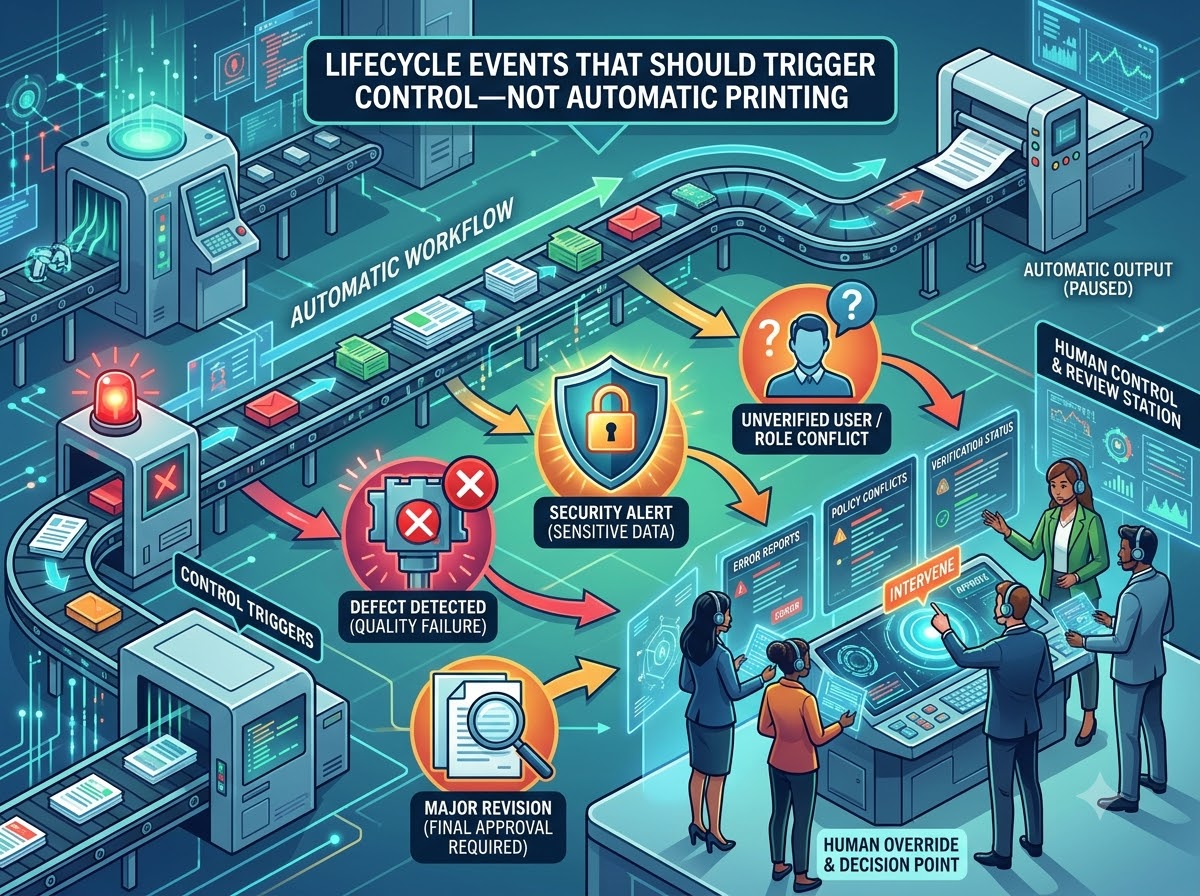
Employee lifecycle integration is most valuable when events are interpreted with operational judgment. A new hire may require a digital identity immediately but a printed card only after role confirmation. A promotion may require a new card, while a minor department-code correction may require only a record update. A location change may require new legal text, language, phone formatting, or supplier routing. A termination should remove access and cancel pending requests, but it should not erase the audit history.
This event-to-decision model reduces waste and avoids overproduction. It also prevents a common integration mistake: assuming every upstream change should automatically create a downstream transaction. CCA can classify events, evaluate policy, calculate whether reissue is necessary, and escalate ambiguous cases. Automation becomes selective, explainable, and aligned with enterprise outcomes.
Approval Orchestration Across Functions
Business identity sits at the intersection of several accountable functions. HR validates employment and official role data. Marketing or brand teams govern visual identity and naming standards. Managers confirm operational necessity and local context. Procurement governs supplier and spend policy. IT controls access and integration security. Legal or compliance teams may govern regulated titles, entity disclosures, accessibility, or regional requirements.
CCA should route decisions according to the attribute or exception at issue rather than sending every request through a generic chain. A standard request using trusted data may move with minimal human intervention. A nonstandard title may go to HR. A template deviation may go to brand governance. A rush quantity beyond threshold may go to procurement. Conditional routing reduces approval fatigue while strengthening accountability because the right authority receives the right decision.
Auditability, Reporting, and Evidence
A connected program should make it possible to reconstruct why a business card was produced. The evidence should include the source records used, the policy version applied, edits or transformations, approvers and timestamps, exception reasons, template version, supplier, quantity, cost allocation, fulfillment status, and any returned error. This is more than order history. It is the decision history of an enterprise identity artifact.
Operational reporting can then move beyond counts and spend. Leaders can identify recurring source-data defects, approval bottlenecks, high exception rates, unauthorized free-text usage, dormant permissions, supplier variance, reprint causes, and lifecycle events that generate avoidable inventory. These insights help HR, marketing, procurement, IT, and operations improve the upstream system—not merely process individual orders faster.
Security and Privacy by Design
Integration expands the value of enterprise data, but it also expands responsibility. CCA should minimize the employee attributes it receives, avoid retaining data that is not required for governance or audit, separate administrative duties, and restrict visibility by role and organizational scope. Sensitive HR data does not belong in an ordering workflow simply because an HRIS connection exists.
Organizations should establish documented purposes for each field, retention periods for integration logs and approvals, secure treatment of credentials and tokens, and monitoring for unusual access or bulk activity. Deprovisioning should follow authoritative identity events. These controls allow connectivity to support the program without turning the business card platform into an unnecessary replica of the employee system.
A Practical Enterprise Integration Roadmap
The right roadmap is based on governance value, buyer need, and process risk—not on the number of logos displayed on an integrations page. Most enterprises can begin with four foundations: one authoritative employee source, one identity and access source, one governed workflow into BCM, and one reporting path. CRM, procurement, service management, and collaboration integrations can then be added according to use case.
Phase 1: establish authority
Define field ownership, roles, policies, approval boundaries, lifecycle events, and the minimum audit record. Select the source system for each critical attribute and resolve conflicts before building automation.
Phase 2: connect high-value systems
Prioritize the systems that reduce the greatest risk or manual effort. For many enterprises, that means HRIS/HCM, Microsoft Entra ID or Okta, and the existing Salesforce connection. Validate read, write, update, deprovisioning, and exception scenarios—not only the happy path.
Phase 3: govern execution and spend
Connect the approved identity specification to BCM, authorized suppliers, cost centers, and procurement workflows. Reconcile outcomes and retain execution evidence.
Phase 4: extend and optimize
Add ServiceNow, ERP, procurement, collaboration, and connector-layer integrations where they improve user experience or control. Use reporting to refine policies, reduce exceptions, and identify the next integration based on measurable operational demand.
What Enterprise Buyers Should Evaluate
A buyer evaluating enterprise business card integrations should look beyond a connector list. Platform selection should test whether the provider can explain data ownership, approval authority, exception behavior, lifecycle events, and evidence retention. A long integration catalog has limited value if every connection bypasses policy or creates a separate administrative model.
- Can the platform distinguish source data from approved display data?
- Can permissions and approver scope follow directory groups, roles, regions, and legal entities?
- Can it apply template, brand, quantity, supplier, and cost-center rules before execution?
- Can it manage retries, duplicates, unavailable sources, rejected changes, and human exceptions?
- Can it produce a traceable record from source event through approval, order, fulfillment, and reporting?
- Can integrations be expanded through a governed API without creating a second control model?
Buyer-Intent Bridge: From Integration Interest to Governance Readiness
Organizations searching for a Salesforce business card integration, Workday business card ordering integration, HRIS business card workflow, employee directory integration, or business card management API are often trying to solve a visible process problem: duplicate entry, inaccurate titles, slow approvals, disconnected purchasing, or weak reporting. The durable solution is not simply to connect the requested system. It is to place that connection inside an enterprise identity governance model.
CCA provides the authority layer for that model. It helps the enterprise determine which data is trusted, which policies apply, who can act, when exceptions are justified, and what evidence must remain. BCM then converts the governed decision into an operational workflow and fulfillment outcome. Together, connectivity becomes a control capability rather than a technical feature.
Frequently Asked Questions
What is an enterprise business card integration?
It is a governed connection between a business card management environment and enterprise systems such as HRIS/HCM, CRM, identity directories, ERP, procurement, workflow, or collaboration platforms. Its purpose is to exchange trusted data and status while preserving policy, approval, security, and audit controls.
Which integration should an enterprise implement first?
Begin with the system that is authoritative for the highest-risk or highest-volume data. For many organizations, this is HRIS/HCM for employee identity and an identity provider for access. The existing operating environment, source-data quality, and governance maturity should determine the sequence.
Does HRIS integration eliminate approvals?
No. Trusted HR data can reduce unnecessary review, but brand exceptions, regulated titles, local information, quantities, budgets, and supplier rules may still require approval. Integration should make approval selective and contextual, not remove accountable authority.
How does CRM integration support business card governance?
CRM can provide customer-facing context such as team, territory, market, or approved contact information. CCA determines which CRM fields may influence the identity specification and whether additional approval is required.
What is the difference between CCA and BCM in an integration architecture?
CCA is the enterprise authority and governance layer: it governs data, policy, permissions, approvals, and exceptions. BCM is the workflow and conversion layer that carries an approved specification through ordering and fulfillment. The distinction prevents execution convenience from weakening governance.
Why is an API important if direct integrations are available?
Direct integrations address strategic platforms and make common use cases easier to deploy. A governed API supports proprietary systems, specialized applications, and future requirements. Both should use the same authority, validation, security, and audit framework.
Conclusion: Connectivity Must Strengthen Control
Enterprise business identity cannot be governed effectively when trusted data, approval authority, access, purchasing, and fulfillment remain disconnected. At the same time, connecting systems without defining authority can move errors faster and make accountability harder to locate. The objective is therefore not integration for its own sake. It is connected governance.
CCA gives the enterprise a durable control layer across HRIS, CRM, identity, ERP, procurement, workflow, and collaboration environments. It turns source-system data into policy-aware decisions, releases only governed specifications into execution, and preserves the evidence required to understand every outcome. That is how business card integration evolves from convenience into enterprise infrastructure.
| Build a governed integration roadmap Connect employee data, access, approvals, brand standards, procurement controls, and fulfillment through an authority-first architecture. Explore CCA’s governance and integration capabilities, then map the systems, policies, and lifecycle events that should shape your enterprise business card program. |