

Integrating Business Card Governance with Enterprise HRIS Systems
Introduction
Enterprise identity workflows increasingly depend on integration infrastructure. As organizations scale across departments, onboarding systems, procurement operations, distributed workforces, and identity management environments, maintaining operational consistency becomes increasingly difficult without centralized workflow synchronization.
HRIS platforms now sit at the center of enterprise identity ecosystems. They contain authoritative employee identity data that drives onboarding, provisioning, approvals, organizational hierarchy management, and operational identity execution across the enterprise.
However, many organizations still operate business card workflows independently from HRIS infrastructure. This creates fragmented onboarding experiences, inconsistent identity standards, operational delays, duplicate data entry, and governance visibility gaps.
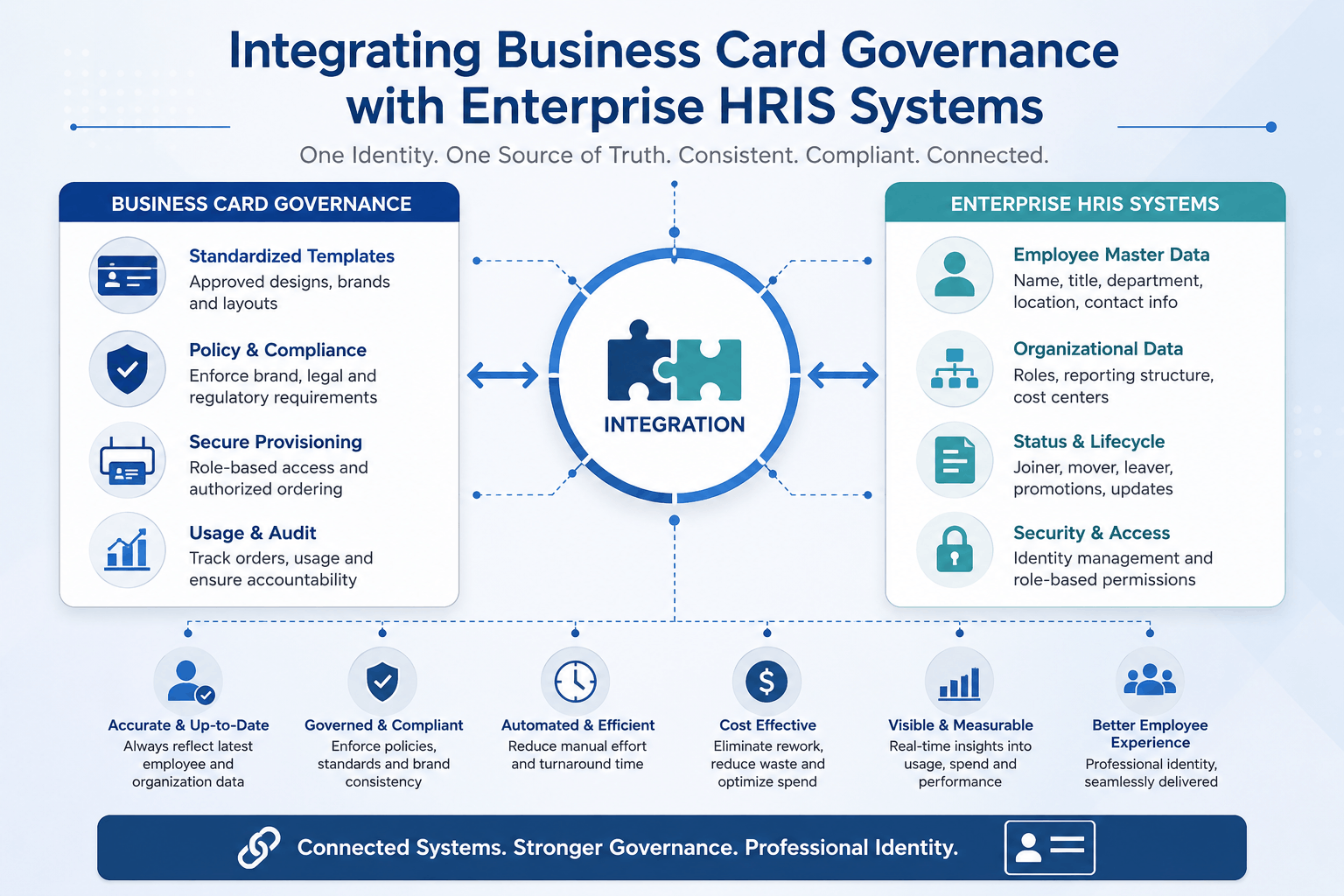
This is why Integrating Business Card Governance into HRIS infrastructure has become foundational to modern enterprise identity strategies. Business card provisioning can no longer function as a disconnected administrative process. It must operate as part of a synchronized enterprise identity infrastructure.
Why HRIS Integration Matters
Organizations implementing onboarding governance systems frequently discover that disconnected identity workflows create operational fragmentation across departments and systems. When business card provisioning operates outside HRIS environments, employees often experience delays, inconsistent approvals, outdated contact information, and disconnected onboarding processes.
Without centralized synchronization, identity execution becomes difficult to manage at scale. HR teams may update employee information in one system while business card workflows continue using outdated records stored elsewhere. This creates inconsistencies across operational environments while reducing governance visibility.
Integrating Business Card Governance directly into HRIS workflows ensures employee identity data flows consistently across enterprise systems from the beginning of the onboarding lifecycle.
This improves operational consistency while minimizing manual intervention and administrative inefficiencies.
The Difference Between Workflow Automation and Workflow Synchronization
Many organizations mistakenly believe workflow automation alone solves governance challenges. While automation improves efficiency, automation without synchronization can still create fragmented identity execution.
Organizations implementing governance-first identity systems understand that operational synchronization is essential for scalable governance infrastructure. Workflow synchronization ensures that onboarding systems, approval routing, procurement platforms, identity management systems, and business card provisioning workflows all operate using centralized and authoritative employee identity data.
This distinction is critical.
Automation focuses on completing tasks faster.
Synchronization ensures every operational system functions consistently within the enterprise governance infrastructure.
Organizations focused on Integrating Business Card Governance into synchronized HRIS environments gain stronger operational control because workflows remain aligned across systems.
How HRIS Integration Improves Identity Standardization
Organizations implementing enterprise identity standardization strategies frequently discover that centralized HRIS synchronization dramatically reduces identity fragmentation. Standardized identity execution depends on every operational system using consistent employee information, approved templates, and centralized governance controls.
When business card workflows integrate directly with HRIS platforms, organizations can automatically apply role-based templates, department-specific branding standards, and approval routing policies during onboarding.
This reduces inconsistencies caused by manual data entry or decentralized provisioning workflows.
Integrated identity systems also improve scalability. As enterprises expand across locations, departments, and distributed workforces, HRIS integration ensures identity execution remains standardized regardless of organizational complexity.
The Role of Workflow Orchestration
Organizations implementing workflow orchestration strategies gain significantly stronger governance visibility across enterprise infrastructure. Workflow orchestration connects onboarding activities, approvals, provisioning systems, procurement operations, and business card workflows into a unified operational framework.
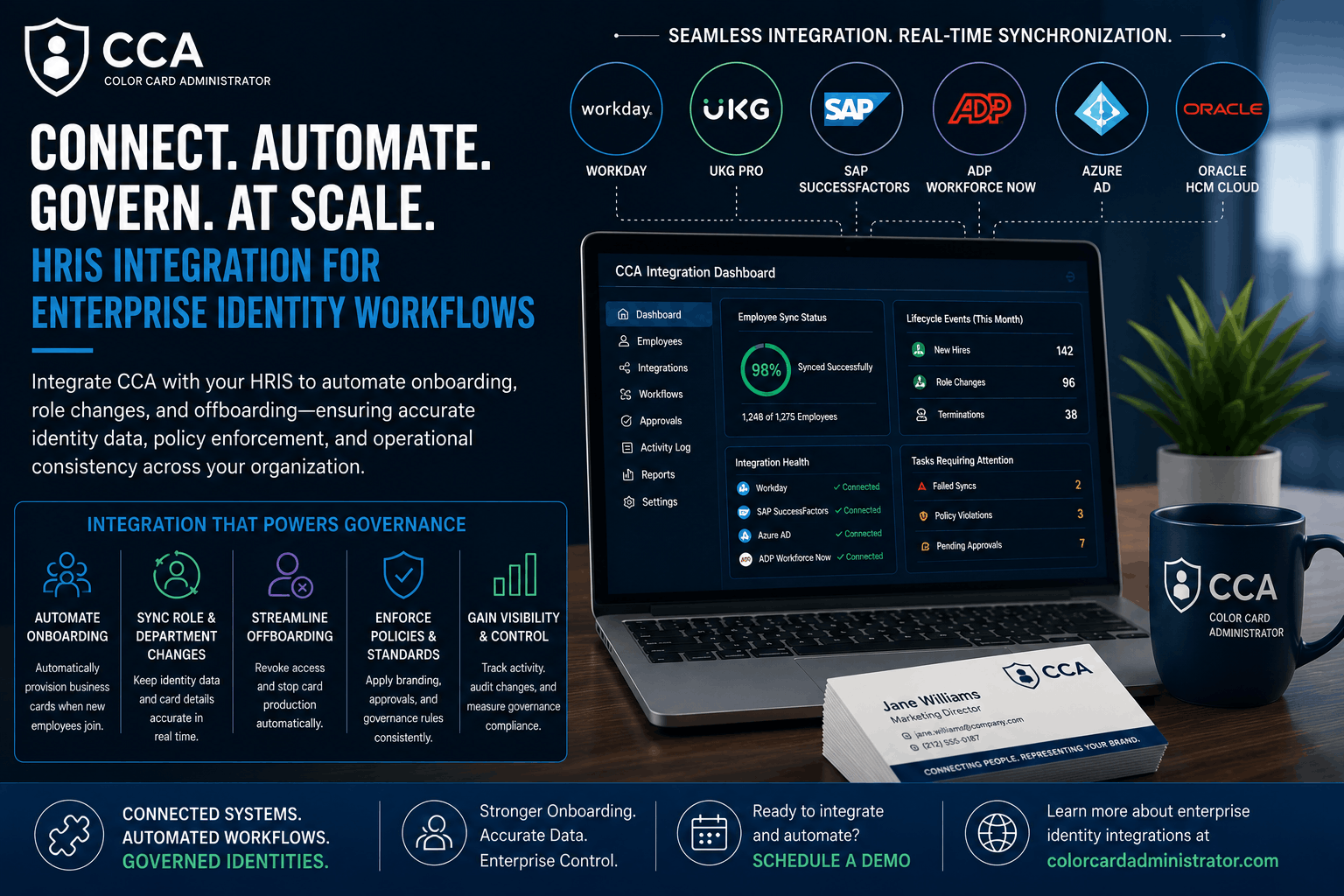
For example, when a new employee record is created within the HRIS environment, onboarding workflows can automatically trigger business card provisioning, approval routing, and vendor coordination based on predefined governance policies.
This orchestration eliminates fragmented operational processes while improving workflow consistency and auditability.
Integrating Business Card Governance into orchestrated enterprise workflows strengthens governance maturity by embedding operational control directly into onboarding infrastructure.
Why Governance Visibility Matters
Organizations implementing governance visibility systems understand that centralized visibility is foundational to operational governance. Without visibility, enterprises cannot effectively monitor identity execution across systems, workflows, approvals, and operational environments.
HRIS integration improves governance visibility by centralizing identity-related activities within synchronized systems. Organizations gain measurable insight into onboarding workflows, provisioning activity, approval histories, compliance tracking, and identity lifecycle management.
This visibility supports audit readiness, operational reporting, and long-term governance optimization.
As enterprise environments become increasingly distributed, visibility becomes essential for maintaining infrastructure-level operational control.
How Governance Platforms Enable HRIS Integration
Platforms such as Business Card Solutions systems allow organizations to synchronize employee identity data, automate onboarding provisioning, coordinate operational workflows, centralize governance visibility, enforce approval governance, maintain auditability, and orchestrate enterprise identity systems.
These platforms transform business card provisioning from a disconnected administrative task into a governed enterprise identity process.
Organizations implementing centralized governance platforms gain stronger workflow consistency, reduced operational risk, and scalable identity management across distributed enterprise environments.
Strategic Takeaway
Enterprise identity execution depends on the integration infrastructure.
Organizations that operate business card workflows independently from HRIS systems often struggle with onboarding inconsistencies, fragmented operational visibility, disconnected approvals, and identity governance gaps.
As enterprise identity workflows expand across onboarding systems, procurement infrastructure, operational approvals, and distributed environments, Integrating Business Card Governance becomes essential for:
- identity consistency
- onboarding synchronization
- governance visibility
- auditability
- workflow orchestration
- infrastructure-level operational control
HRIS integration is not simply about automation.
It is about synchronizing enterprise identity infrastructure across the organization.