

Automating Business Cards During Employee Onboarding
Introduction
Automating Business Cards during employee onboarding is no longer just an operational convenience. In modern enterprise environments, it has become a critical control requirement for maintaining consistency, governance, and scalability across identity workflows.
Enterprise onboarding processes are highly structured, system-driven, and integrated with HR, procurement, compliance, and identity management systems. However, business card provisioning is often excluded from these workflows, forcing organizations to rely on manual requests, disconnected approvals, and inconsistent vendor coordination. This creates operational gaps that weaken identity governance and reduce visibility across onboarding infrastructure.
When organizations fail to integrate business card provisioning into onboarding workflows, identity execution becomes fragmented. Employees may receive incorrect branding, outdated contact details, inconsistent templates, or delayed approvals. These issues are not simply administrative inefficiencies. They represent governance failures that impact compliance, operational consistency, and enterprise identity control.
Why Onboarding Workflows Break Without Automation
Many organizations still manage business card requests outside centralized onboarding systems. Employees or managers submit requests manually after onboarding is completed, often through email chains, spreadsheets, or disconnected procurement systems. This creates unnecessary delays and increases the likelihood of operational inconsistencies.
Without Automating Business Cards, organizations commonly experience:
- Manual requests after onboarding
- Inconsistent approvals across departments
- Template misuse and branding inconsistencies
- Vendor fragmentation
- Duplicate or outdated employee information
- Lack of audit visibility
- Delayed identity provisioning
These issues become increasingly difficult to manage as organizations scale. Enterprise environments require standardized workflows that operate consistently across locations, departments, and integrated systems. Manual business card processes cannot reliably support that level of operational complexity.
How Business Card Automation Works
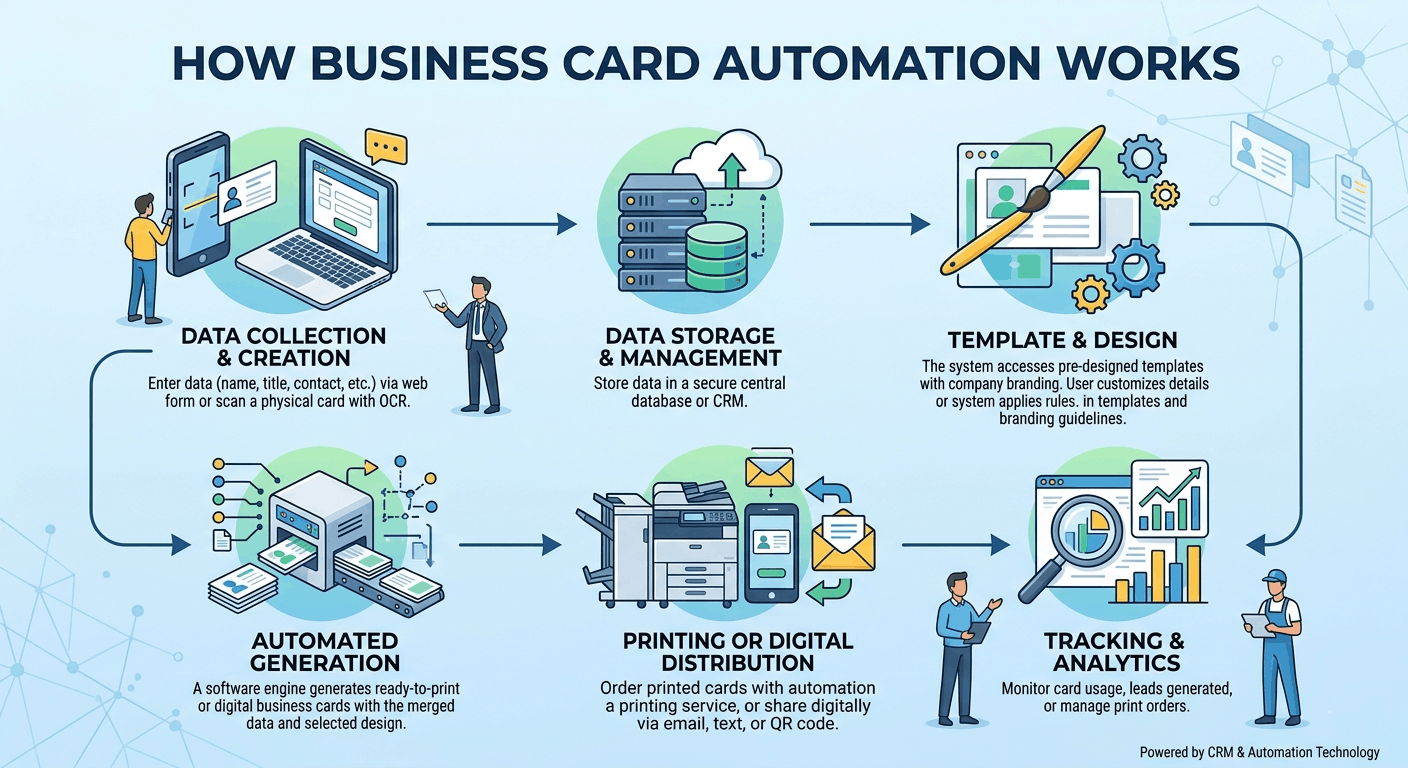
Automating Business Cards requires integrating provisioning workflows directly into enterprise onboarding systems. Instead of treating business card ordering as a separate administrative task, organizations embed it into identity execution infrastructure.
The process typically begins with HRIS-triggered provisioning. When a new employee record is created within the HR system, onboarding workflows automatically initiate identity-related actions, including business card provisioning.
Role-based template assignment ensures employees receive approved business card formats based on department, role, location, or organizational hierarchy. This prevents unauthorized template modifications and maintains brand consistency across the enterprise.
Automated approval workflows route requests through predefined governance structures. Managers, procurement teams, or compliance stakeholders approve requests according to organizational policy without relying on manual communication.
Policy enforcement is another critical component. Governance rules embedded within the system ensure that all business card requests follow approved standards, formatting requirements, and operational controls.
Vendor integration further strengthens operational consistency by connecting approved print vendors directly to enterprise workflows. This eliminates fragmented ordering processes while improving visibility into production and fulfillment.
Finally, audit logging provides complete operational traceability. Every request, approval, modification, and fulfillment action is recorded, supporting compliance reporting and governance visibility.
Operational Impact
Organizations implementing Automating Business Cards within onboarding workflows experience significant operational improvements.
Automation eliminates delays caused by manual requests and disconnected approvals. Employees receive identity assets faster, improving onboarding efficiency and organizational readiness.
Errors are also reduced because employee information flows directly from authoritative systems rather than being entered manually across multiple platforms. This improves data accuracy while reducing rework and operational friction.
Compliance and governance visibility improve substantially. Organizations gain centralized oversight into how business cards are created, approved, and distributed across enterprise environments. This visibility strengthens audit readiness and supports policy enforcement.
Most importantly, automation creates consistency at scale. Regardless of organizational size or complexity, business card provisioning follows standardized governance workflows aligned with enterprise systems.
Governance as Infrastructure
Modern enterprises increasingly treat identity governance as operational infrastructure rather than administrative oversight. In this model, Automating Business Cards becomes part of a broader enterprise identity ecosystem connected to HR platforms, procurement systems, approval workflows, compliance controls, and vendor management infrastructure.
This integration ensures that business card provisioning aligns with enterprise identity standards from the beginning. Governance becomes embedded directly into operational systems instead of relying on reactive enforcement.
As organizations continue scaling digital operations, governance-first automation becomes essential for maintaining operational consistency and reducing identity fragmentation.
Strategic Takeaway
Automating Business Cards during onboarding ensures identity execution remains consistent, compliant, scalable, and operationally controlled across enterprise environments.
Organizations that integrate business card provisioning into onboarding workflows improve efficiency, reduce operational risk, strengthen governance visibility, and maintain brand consistency across all identity assets.
Business card automation is not simply about convenience.
It is about operational control, governance enforcement, and scalable identity infrastructure.