

Google Workspace–Connected Business Identity Governance
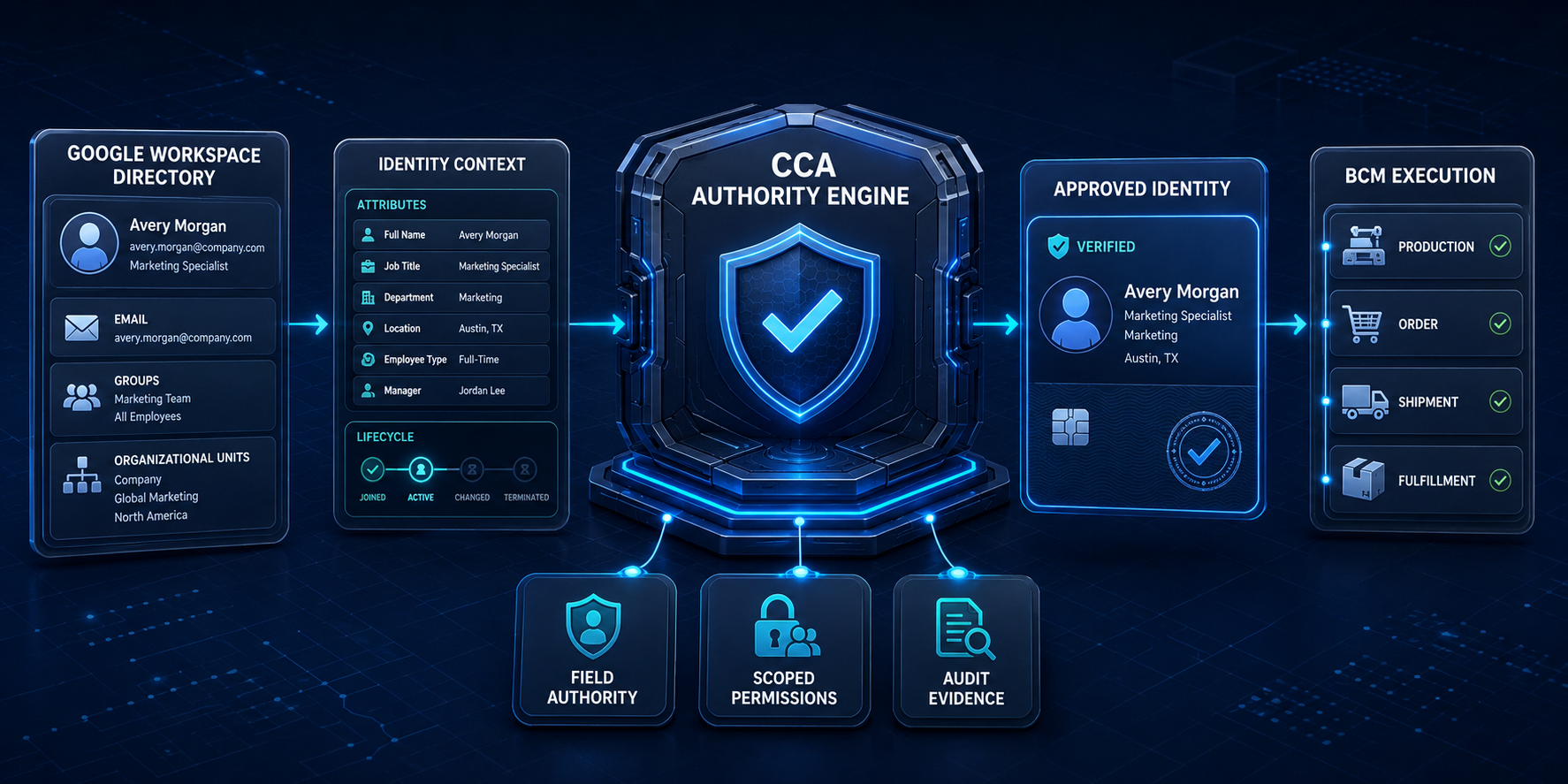
Google Workspace can provide a familiar access environment and useful directory context for enterprise employees. Names, email addresses, organizational relationships, locations, account status, group context, and other permitted attributes can help identify the actor, route a request, prefill an experience, or determine who should see a workflow. Those capabilities improve convenience. They do not determine which public identity an employee is authorized to present, which company or brand may appear, which customer-facing title is approved, or when a business card specification is safe to produce.
Color Card Administrator (CCA) supplies the authority layer between Google Workspace context and business identity execution. CCA validates the actor and subject, interprets permitted directory attributes, coordinates authoritative HR, legal, brand, location, and finance sources, applies field-level policy, limits acting-on-behalf authority, governs approvals and exceptions, and preserves the evidence behind each outcome. Business Card Manager (BCM) then converts the approved identity specification into ordering and fulfillment. Google Workspace supports access and context; CCA governs public identity; BCM executes the approved result.
This separation allows enterprise identity governance to use directory-based convenience without turning a collaboration or account directory into an unintended identity master. Standard requests can move quickly because approved values and policies are already resolved. Conflicting names, unmapped titles, ineligible brands, location ambiguity, personal contact data, delegated requests, lifecycle timing, and source outages receive controlled treatment. The result is a faster employee experience with clear authority, least privilege, data minimization, and auditable release into production.
Why Directory Connectivity Is a Governance Issue
A business card is a public enterprise identity artifact. It can communicate a person’s name, external title, company, legal entity, brand, division, location, phone number, email address, credential, language, and professional role. These fields carry legal, reputational, privacy, security, and commercial consequences. A directory can store or display some of them, but storage does not establish publication authority.
Directory data is usually optimized for account administration, communication, internal discovery, and collaboration. A display name may follow an internal convention. A job title may be copied from HR even though the approved customer-facing title uses different language. A location may be a site code rather than a publishable address. A primary email address may identify the account but not the contact identity appropriate for a particular brand. Groups may represent access convenience rather than formal business authority.
CCA governs the transformation from directory context to approved external business identity governance. It distinguishes a useful input from a controlling source, an authenticated account from an authorized action, and an internal profile from a permitted public representation. Google Workspace can help identify who is present and provide selected context. CCA determines what that person may request, change, approve, administer, and release.
A Governed Architecture for Google Workspace, CCA, and BCM
A resilient integration separates trusted access, source authority, identity governance, ordering execution, and evidence. The technical connection may use approved federation, directory, group, event, API, synchronization, or integration services according to the organization’s Google Workspace edition, licensing, security architecture, and data policies. The authority model should remain stable even when the implementation method changes.
The architecture should establish these boundaries:
- Google Workspace authenticates the actor and provides only the account, directory, group, organizational, and lifecycle context approved for the CCA use case.
- Authoritative HR, legal, brand, location, finance, and other enterprise systems remain responsible for the facts and decisions they own.
- CCA validates identity, maps source values to approved external presentation, governs permissions, delegation, template eligibility, approvals, exceptions, and release criteria.
- BCM converts only the approved identity specification into supplier, quantity, ordering, production, shipment, and fulfillment activity.
- The evidence record links account context, source facts, transformations, policy version, decisions, approved specification, order, and final outcome.
This model prevents CCA from becoming a shadow directory and prevents the Google Workspace profile from becoming an accidental source of public identity policy. Only the minimum attributes needed for identity correlation, access, routing, governance, or audit should cross the boundary. Sensitive HR, security, personal, or financial information that does not serve the business identity purpose should remain outside it.
Authentication Establishes the Actor, Not the Authority
Google Workspace can participate in a trusted sign-in experience according to the enterprise’s identity architecture. That can reduce separate credentials and help establish a consistent actor identity. Successful authentication, however, does not mean the user may order any template, change any identity field, act for any employee, approve any exception, or administer every organization.
CCA evaluates authorization at the action level. It considers the actor, subject, relationship, organization, geography, role, template, field, request type, quantity, effective period, and policy version. An employee may request a standard card but not change a title. A manager may act for direct reports but not for an entire division. A location coordinator may manage one site without controlling legal entities or brands. A technical administrator may maintain the integration without gaining authority to approve public identity.
This distinction supports least privilege that is meaningful to the business process. Google Workspace helps establish who is attempting the action. CCA determines whether that actor may perform the specific action for the specific subject and whether the resulting identity is permitted.
Governing Directory Attributes
Each Google Workspace attribute used by CCA should have a documented source, owner, definition, allowed values, sensitivity classification, transformation rule, effective-date behavior, and fallback. A populated field is not necessarily accurate, current, or authorized for every downstream purpose.
Stable identifiers and account correlation
Names and email addresses can change and should not be the only correlation keys. CCA should use an approved stable identifier to associate the account with the correct enterprise person or subject record. Duplicate, merged, recycled, renamed, suspended, and reactivated accounts require controlled resolution. A mismatch should stop the affected action rather than attach history or authority to the wrong person.
Names and external presentation
A directory may contain legal, preferred, display, transliterated, or alias names. CCA applies enterprise rules for external presentation, punctuation, capitalization, scripts, regional conventions, privacy, and regulated populations. A user-editable display name can inform the experience without automatically becoming printable. Exceptions retain the source value, proposed presentation, rationale, approver, and effective period.
Titles and organizational context
Directory job titles, departments, managers, and organizational units can support internal discovery and access routing. They may not match the approved public hierarchy or customer-facing language. CCA maps trusted context to controlled title libraries, business units, brands, template families, approval scopes, and reporting dimensions. It distinguishes employing entity, external brand, department, division, and cost center rather than treating them as interchangeable.
Locations and contact information
A directory location can be a building name, office code, region, worksite, remote designation, or internal label. It is not automatically a publishable postal address. CCA resolves permitted location and contact presentation through governed tables. It prevents home addresses and personal contact data from being exposed and applies regional formatting, language, disclosure, and privacy requirements.
Groups and Organizational Units Are Policy Inputs
Google Groups and organizational structures may provide useful eligibility, routing, and population context. They should not become an unreviewed collection of business rules hidden inside technical administration. Every group or organizational mapping used by CCA should have a clear owner, purpose, membership source, scope, review cycle, conflict rule, and deprovisioning behavior.
A broad application assignment may establish basic access. Governed mappings can then identify employees, managers, request coordinators, brand reviewers, HR exception owners, procurement reviewers, auditors, and platform operators. CCA translates those signals into explicit action-level permissions. It should not grant global authority because a user belongs to a technically convenient group.
Nested groups, dynamic membership, manually maintained lists, and overlapping assignments require careful testing. A membership rule can behave as configured while still producing an inappropriate business outcome. Renamed groups or reorganized units can orphan mappings. CCA should apply deny-by-default behavior when privilege cannot be resolved, preserve the policy and mapping version, and route genuine conflicts to accountable owners.
Lifecycle Governance for Joiners, Movers, and Leavers
Account and directory events can improve the timing and security of business card programs, but technical account states are not always identical to employment states. Account creation, activation, suspension, restoration, and deletion may occur at different times from hiring, transfer, promotion, leave, termination, or public identity effective dates.
For joiners, CCA can stage a request and identify missing fields while preventing premature release. Access and production can depend on worker status, start date, record completeness, role, location, sponsorship, and business need. For movers, a change in manager, department, title, location, legal entity, brand, or group can trigger evaluation without automatically creating a reprint. CCA determines materiality and the correct effective date.
For suspensions and leaves, policy should define whether to block new activity, pause pending work, or preserve the current identity. For leavers, access and delegated authority should end promptly while historical decisions, orders, and audit evidence remain attributable. CCA separates access removal from evidence retention and prevents old sessions, links, approvals, or pending requests from producing unauthorized execution.
Delegated Administration and Acting on Behalf of Others
Managers, executive assistants, HR teams, workplace coordinators, marketing operations, and service desks may need to request or monitor cards for other people. Directory relationships can help establish context, but a manager field, shared mailbox, group membership, or calendar access does not automatically grant authority to alter another person’s public identity.
CCA validates the relationship between actor and subject and limits the delegation by population, organization, geography, field, template, request type, purpose, and time. It records the subject, acting user, values viewed or changed, approvals obtained, and final outcome. A coordinator authorized to submit standard replenishments for one location may not change titles, choose another brand, or approve an exception.
Administrative duties should also remain separated. Workspace administration, identity policy administration, brand configuration, template management, supplier operations, procurement approval, audit review, and platform support are different responsibilities. Technical access to configure a connector must not create business authority over public identity.
Approval and Exception Governance
The objective of directory integration is not to add approvals to every request. It is to automate decisions already resolved by policy and direct the remaining judgment to the accountable owner. A request using an approved name, mapped title, eligible brand, valid location, authorized actor, standard template, and permitted quantity can proceed with minimal intervention.
Different exceptions require different authorities. HR may resolve a source-data discrepancy. Brand may decide a nonstandard presentation. Legal or compliance may review an entity or disclosure issue. Identity governance may resolve an access, group, delegation, or account-correlation conflict. Procurement may decide a quantity, supplier, budget, or rush exception. Each reviewer should see the precise issue and only the context needed to decide it.
CCA records the source values, proposed change, triggered policy, actor and subject, relevant directory context, approver scope, timestamp, rationale, effective period, downstream impact, and decision version. Authentication establishes who acted; CCA confirms whether that person had authority to make the decision.
Source Precedence and Conflict Resolution
Google Workspace may receive attributes from HR, identity platforms, administrators, applications, or synchronization processes. CCA may also receive approved facts directly from designated enterprise systems. A field-level authority matrix should determine which source controls each fact and decision. The most recent value is not automatically the most authoritative.
When sources conflict, CCA can select the designated source, apply an approved transformation, or stop execution for accountable review. The business card workflow should not write corrections back upstream unless the enterprise has expressly assigned that function, ownership, and control. Manual overrides require a reason, authorized approver, narrow scope, and expiry where appropriate.
Repeated conflicts should be measured because they often reveal a stale directory mapping, incomplete HR feed, uncontrolled display-name editing, outdated title library, incorrect group rule, retired location, or policy gap. The long-term control is to improve the source or mapping, not normalize repeated manual workarounds.
Integration and Security Governance
The connection should use only Google Workspace capabilities approved for the enterprise’s licensed environment and architecture. Service identities, credentials, keys, certificates, tokens, scopes, APIs, event subscriptions, middleware, and synchronization jobs are privileged assets. They require named ownership, secure storage, rotation, least-privilege access, environment separation, monitoring, and prompt revocation.
Data movement should be encrypted, purpose-limited, rate-controlled, idempotent, and reconcilable. Duplicate events must not create duplicate approvals or orders. Source outages should produce explicit workflow states and safe retries rather than silent fallback to stale or user-entered identity. Operational logs should preserve diagnostic evidence without exposing unnecessary employee or security-sensitive information.
Configuration changes are also governance events. Revised schemas, renamed attributes, group-rule changes, organizational restructuring, changed scopes, connector upgrades, and credential rotation can cause business failures even when authentication still works. Versioned mappings, controlled testing, separation of duties, release management, reconciliation, and periodic review keep CCA aligned with the directory environment.
Audit Evidence and Operational Reporting
A governed program should reconstruct why a specific identity was approved and produced. Evidence can include the authenticated actor, subject, stable identifier, permitted directory attributes, group and organizational context, relationship or delegation, authoritative values, transformations, policy version, validations, approvers, exception rationale, approved specification, template version, BCM order, supplier, quantity, cost allocation, fulfillment status, and cancellation or error history.
Reporting should extend beyond successful sign-ins and order volume. Leaders can examine denied access, orphaned mappings, stale groups, excessive privilege, dormant delegations, source conflicts, unmapped titles, blocked requests, terminated approvers, lifecycle timing, manual overrides, reprints caused by late changes, integration failures, and reconciliation gaps. These measures show whether directory connectivity is strengthening governance rather than merely reducing data entry.
A Practical Implementation Roadmap
Phase 1: Define authority and trust boundaries
Inventory actors, subjects, fields, directory attributes, groups, organizational units, lifecycle states, decisions, and downstream controls. Assign a source and accountable owner to each. Establish the separation between Google Workspace access, CCA authority, and BCM execution.
Phase 2: Map minimum-necessary context
Map only the identifiers, attributes, groups, relationships, and lifecycle signals required for access, routing, policy, or evidence. Define external-name rules, title mappings, brand eligibility, location presentation, template access, fallbacks, and exception owners.
Phase 3: Configure least-privilege roles
Create scoped requester, delegate, approver, administrator, support, and audit roles. Limit actions by population, entity, geography, field, template, purpose, and time. Establish recertification, segregation of duties, emergency access, and prompt removal.
Phase 4: Secure and validate the connection
Configure credential protection, minimum scopes, monitoring, safe retries, duplicate protection, and reconciliation. Test changed names, recycled emails, duplicate accounts, conflicting sources, overlapping groups, future-dated changes, suspensions, leavers, unavailable approvers, expired delegations, and source outages.
Phase 5: Connect governed execution
Release only the approved identity specification into BCM. Keep supplier, quantity, budget, purchase, and fulfillment controls distinct from identity authorization. Return execution status to the evidence trail without allowing downstream systems to rewrite approved identity.
Phase 6: Measure and improve
Review access denials, exception volume, stale mappings, lifecycle timing, delegation, source conflicts, overrides, reprints, failures, and reconciliation results. Improve source data and policy before expanding automation.
What Enterprise Buyers Should Evaluate
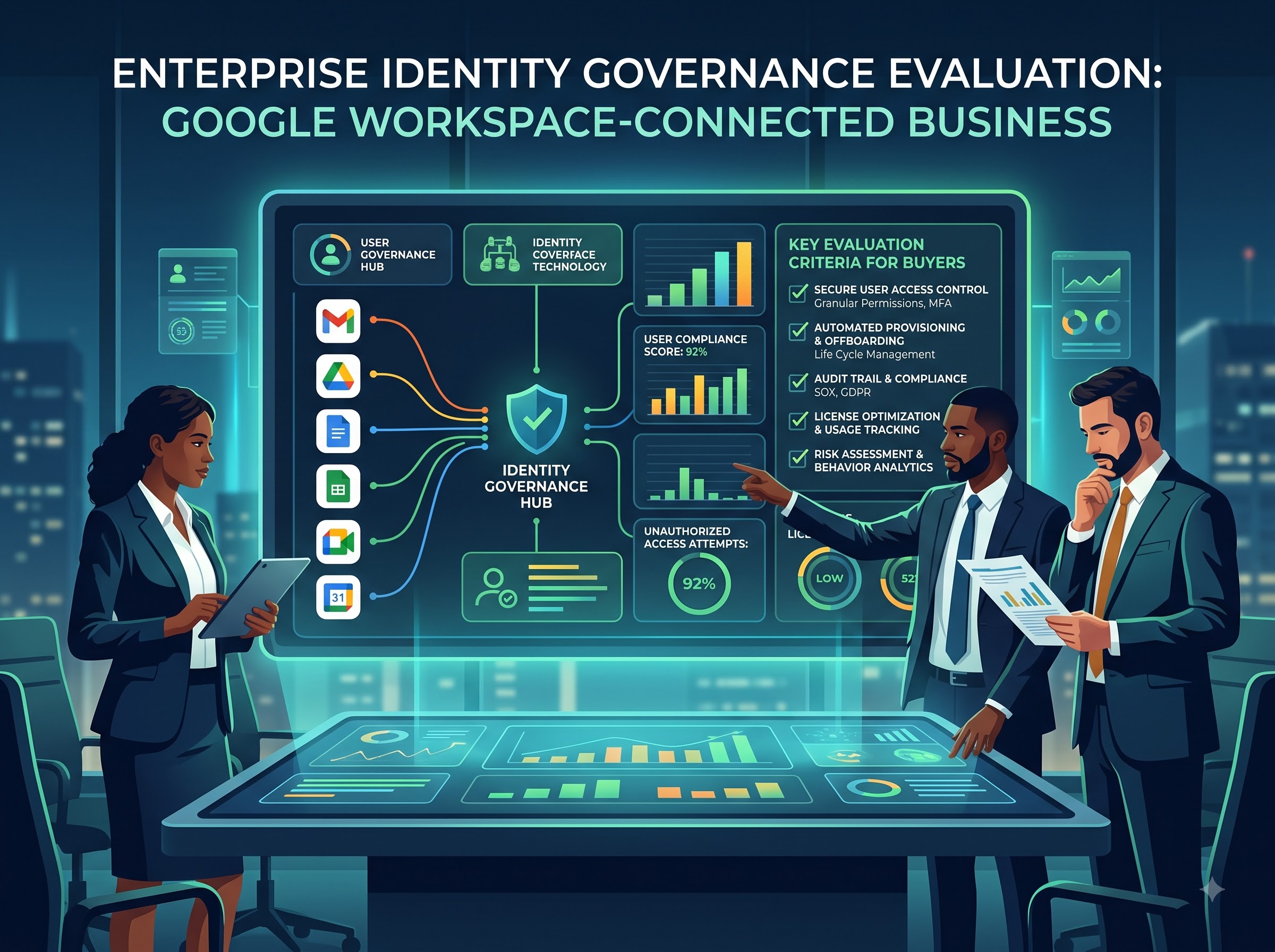
- Can the platform separate Google Workspace authentication and directory context from public identity authority?
- Can stable identifiers correlate people correctly when names, emails, accounts, or employment states change?
- Can directory attributes, groups, and organizational units inform policy without becoming uncontrolled print sources?
- Can requester, subject, delegate, approver, and administrator identities remain distinct and attributable?
- Can access be limited by population, entity, geography, relationship, field, template, purpose, and time?
- Can joiner, mover, suspension, and leaver events trigger appropriate controls without destroying historical evidence?
- Can source conflicts and different identity, brand, legal, access, and procurement exceptions reach accountable owners?
- Can the enterprise reconstruct the complete path from sign-in through CCA approval and BCM fulfillment?
- Can the integration operate with minimization, least privilege, versioned mappings, monitored retries, and reconciliation?
Buyer-Intent Bridge: From Google Workspace Directory Data to Governed Identity Execution
Organizations searching for a Google Workspace business card integration often want employees to sign in easily, use existing directory data, reduce rekeying, keep access current, and simplify ordering. Those outcomes are valuable, but they do not answer the central governance question: which person may present which title, company, brand, location, and contact information, under whose authority, with what evidence?
CCA supplies that authority layer. It uses permitted Google Workspace context to validate the actor and support scoped access, then coordinates authoritative sources, identity policy, permissions, approvals, exceptions, and evidence. BCM receives only the approved identity specification for ordering and fulfillment. Together, Google Workspace, CCA, and BCM create a controlled path from directory context to business identity execution without confusing profile availability with permission to print.
Frequently Asked Questions
What is a Google Workspace business card integration?
It is a controlled connection that uses permitted Google Workspace authentication and directory context to support access, routing, identity governance, and business card workflows. CCA governs public identity and authority; BCM executes the approved specification.
Is Google Workspace the source of truth for every card field?
No. It may provide or aggregate selected attributes, but designated HR, legal, brand, location, and finance systems remain authoritative for the facts and decisions they own. CCA coordinates those authorities.
Does successful Google sign-in authorize an employee to order any card?
No. Authentication confirms the actor. CCA determines what that actor may do for which subject, organization, field, template, request type, purpose, and time.
Can Google Groups control CCA roles?
Groups can provide eligibility and role context, but CCA should translate them into explicit action-level scopes. Every mapped group requires an owner, purpose, membership source, review cycle, conflict rule, and deprovisioning behavior.
Can managers or assistants order for employees?
Yes, when policy permits. CCA evaluates the actor, subject relationship, population, organization, geography, request type, fields, purpose, and delegation period, and records both identities.
What happens when an employee leaves?
Account deactivation can remove access and invalidate delegations or pending approval authority. CCA blocks new activity according to policy while preserving historical decisions, orders, and evidence.
How does CCA handle conflicting directory attributes?
CCA applies a field-level authority matrix. It uses the designated source, an approved transformation, or accountable exception review. A recently synchronized directory value does not automatically override a more authoritative source.
Conclusion
Google Workspace can strengthen enterprise business card programs by providing trusted access and controlled directory context. Those capabilities become materially more valuable when they operate within a clear authority model rather than being treated as automatic permission to publish or print.
CCA validates the actor and subject, interprets directory context, coordinates authoritative facts, applies public identity and brand policy, limits permissions and delegation, governs exceptions, and preserves evidence. BCM executes the approved specification through ordering and fulfillment. This separation provides directory-based convenience without surrendering enterprise control over public identity.
Contact the CCA team to assess your Google Workspace integration model and design a controlled path from enterprise directory context to governed business identity execution through BCM.