

Slack-Connected Business Identity Workflow Governance
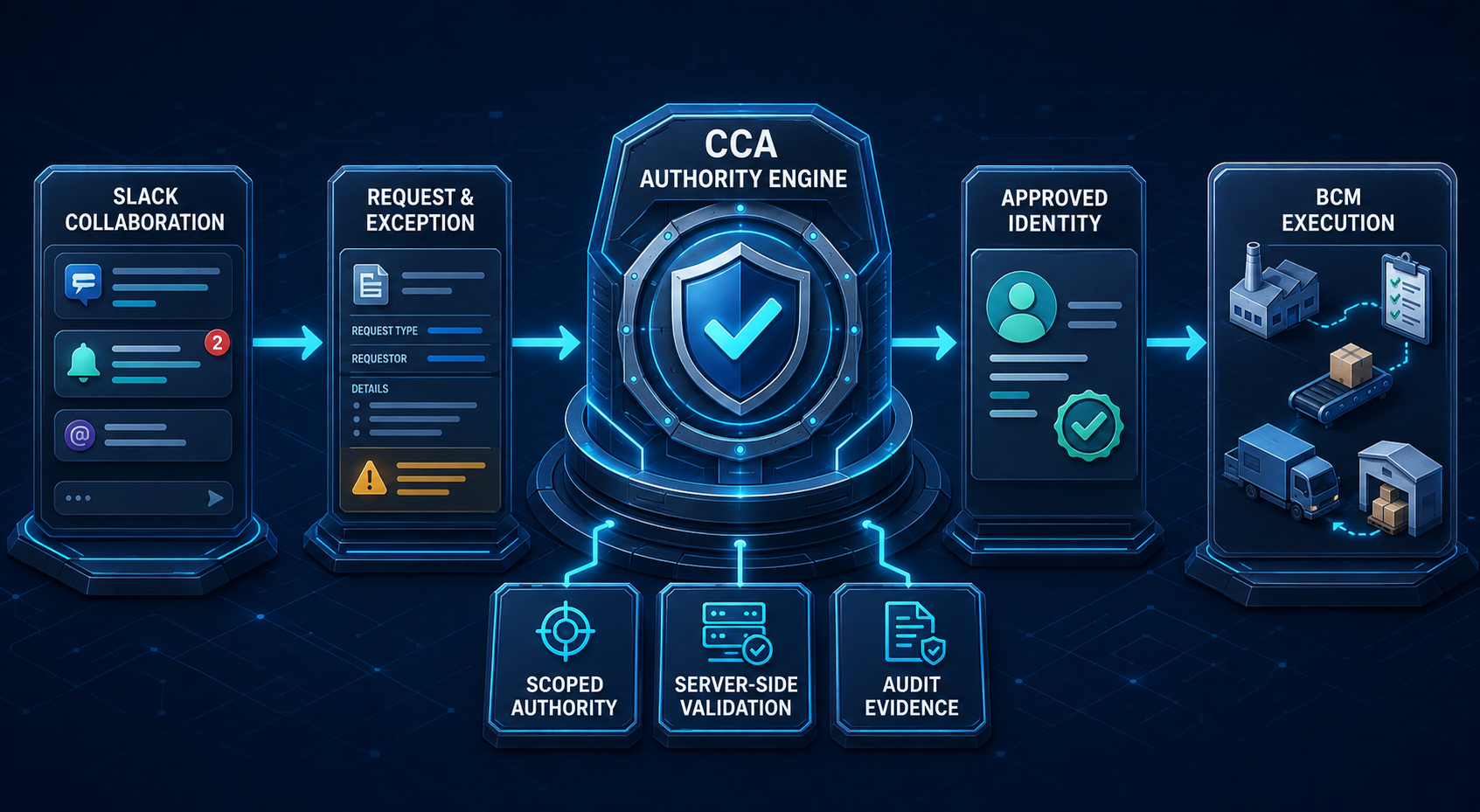
Slack can make enterprise work more immediate. Employees can receive request confirmations, managers can see approval reminders, exception owners can coordinate resolution, and operations teams can monitor order or fulfillment events without moving constantly between systems. That convenience is valuable, but a message, button, reaction, thread reply, or workflow completion does not by itself determine what public identity an employee may present or whether a business card governance specification is authorized for production.
Color Card Administrator (CCA) supplies the authority layer behind a Slack-connected experience. CCA validates the actor and subject, retrieves or verifies authoritative identity facts, applies field-level identity and brand policy, limits acting-on-behalf authority, determines the accountable approver, governs exceptions, and preserves the evidence behind every decision. Business Card Manager (BCM) then converts the approved identity specification into ordering and fulfillment. Slack communicates and coordinates; CCA decides; BCM executes.
This separation allows an enterprise to gain speed without turning collaboration into an uncontrolled approval system. Standard requests can progress with concise notifications and secure deep links. Genuine exceptions can reach the correct owner with the minimum context needed to act. Every interactive action is revalidated inside the authoritative workflow before it changes state. Sensitive identity data stays out of channels where it is unnecessary, and the complete decision record remains in CCA rather than being fragmented across chat history.
Why Slack Connectivity Is a Governance Issue
A business card is a public enterprise identity governance artifact. It can communicate a person’s name, customer-facing title, company, legal entity, brand, division, location, phone number, email address, credentials, language, and professional role. These elements create legal, reputational, privacy, security, and commercial consequences. Slack can help people coordinate a request, but it is not automatically the authoritative source for those facts or the owner of the policies that govern their use.
Without a defined control model, collaboration can weaken an otherwise disciplined program. A requester may paste an unapproved title into a channel. An approver may respond with a check-mark reaction without seeing the exact identity specification. A coordinator may forward a message to a different audience. A stale interactive notification may remain actionable after the employee, policy, template, or approval scope has changed. A private channel may create the appearance of security while retaining more identity data than the process requires.
CCA governs the meaning and consequence of each workflow action. It distinguishes communication from authorization, submitted values from authoritative facts, operational acknowledgment from formal approval, and channel membership from decision rights. Slack can surface work and help accountable people respond promptly, but only CCA determines whether the action is valid and whether the specification may advance to BCM.
A Governed Architecture for Slack, CCA, and BCM
A resilient integration separates collaboration, source authority, business identity governance, execution, and evidence. The technical implementation may use approved Slack platform capabilities, APIs, events, interactive components, workflow tools, middleware, or managed integration services according to the enterprise’s licensed environment and security architecture. The control model should remain stable even when those implementation details change.
The architecture should establish these boundaries:
- Slack presents permitted notifications, reminders, exception prompts, status summaries, and secure links for the intended audience.
- Authoritative HR, directory, legal, brand, location, and finance systems remain responsible for the facts and decisions they own.
- CCA validates identities, field authority, permissions, delegations, template eligibility, approvals, exceptions, and release criteria.
- BCM executes only the approved identity specification through ordering, production, shipment, and fulfillment.
- The evidence record connects the source facts, policy version, notification, actor action, server-side validation, decision, approved specification, order, and final outcome.
Slack should receive only the minimum information needed to help a user understand and act. A notification can identify the request type, subject, due date, exception category, and current state while linking to the governed record for sensitive details. The chat message is a view of work, not a duplicate system of record. If Slack is unavailable, CCA should retain the workflow state and support an alternate governed route rather than losing or fabricating a decision.
Notifications Must Not Become Authoritative Records
Notifications are most useful when they are concise, timely, and actionable. They are most dangerous when users assume the message contains the complete and current record. Identity facts, approver scope, template eligibility, policy versions, and exception conditions can change after a notification is delivered. Edited, copied, forwarded, exported, or retained messages can also outlive the business purpose for which they were created.
CCA should generate notifications from the authoritative workflow state and include a request reference, clear status, required action, expiry where relevant, and secure deep link. The displayed content should be appropriate for the audience and channel. A manager may need to know that a direct report has a title exception; the manager does not necessarily need to see unrelated HR attributes, personal contact data, cost information, or another employee’s request history.
The authoritative record remains in CCA. If the underlying request changes, CCA can invalidate the prior action, issue an updated notification, and preserve both events. Slack history may support operational traceability, but it should not be the only evidence of what was proposed, what policy applied, who had authority, or what was ultimately approved.
Interactive Approvals Require Server-Side Revalidation
Slack buttons and other interactive controls can reduce friction, but they must never operate as unconditional approval tokens. When a user selects Approve, Reject, Request Changes, or Open Exception, CCA should revalidate the action against the current authoritative state before committing a decision.
Revalidation should confirm the authenticated actor, actor-to-approver correlation, subject, relationship or delegation, approval scope, request version, policy version, exception type, effective dates, prior decisions, and current workflow status. It should also confirm that the action has not expired, been duplicated, been superseded, or already been completed elsewhere. A success response should be returned only after the authoritative system has committed the valid result.
This matters because collaboration is asynchronous. An approver may click an old message after moving to a different role. A request may be revised after an exception is raised. Another approver may have already acted. A source-system correction may remove the need for an exception. Server-side validation turns the Slack interaction into a request to decide, not the decision itself.
Approval Authority Must Remain Scoped
Channel access does not equal approval authority. A person may be able to read a request because they support a team, participate in a project, or belong to an operations channel. That membership must not permit the person to approve an executive title, legal entity, brand, location, credential, or personal-data exception.
CCA evaluates decision rights at the level of the issue. HR may own a source-data discrepancy. Brand may own a nonstandard presentation. Legal or compliance may own entity wording or a required disclosure. Identity governance may own delegation or role conflicts. Procurement may own quantity, supplier, budget, or rush-order exceptions. The same request can contain several issues that require separate accountable decisions.
Approval scope should be limited by population, organization, geography, field, template family, request type, materiality, and time. CCA records both the subject and acting user, including acting-on-behalf context. Broad Slack workspace roles, channel ownership, or app administration should never silently translate into enterprise identity authority.
Channels, Direct Messages, and Audience Boundaries
The delivery method should match the sensitivity and coordination need. Direct messages may be appropriate for individual reminders. Restricted channels may support a defined operations team. Shared channels, broad project rooms, guest-accessible spaces, and externally connected environments require additional caution because membership and retention can change independently of the business card workflow.
Every notification pattern should have a documented audience, data classification, content limit, retention expectation, and escalation route. Channel naming should not be treated as a security control. The integration should verify the destination and apply deny-by-default behavior when audience or policy cannot be resolved.
Sensitive values should be minimized or masked. Home addresses, personal phone numbers, private email addresses, HR status, security details, and unnecessary financial data should not appear in a message merely because they exist in a source system. CCA can present the specific issue requiring action and keep the complete evidence behind authenticated access.
Governing Exceptions Without Moving Policy Into Chat
Slack can make exception coordination faster, but the exception itself must remain structured. Free-text discussion may explain business context, yet it cannot replace a defined exception type, policy trigger, requested value, current authoritative value, accountable owner, required evidence, rationale, effective period, and final disposition.
CCA creates and manages that structured exception record. A Slack message can tell the responsible owner that an external-title mapping is unresolved or that a requested brand is not eligible for the employee’s population. The owner follows a secure link or uses a validated interaction to approve, reject, request evidence, or return the issue for correction. The decision is recorded against the exact request version and policy condition.
Threads may support clarification, but important facts should be captured in the governed record. Otherwise, future auditors and operators must reconstruct a decision from partial chat history, deleted messages, inaccessible workspaces, or ambiguous reactions. CCA preserves durable evidence while allowing Slack to improve response time.
Delegation and Acting-on-Behalf Workflows
Executive assistants, managers, HR teams, workplace coordinators, marketing operations, and service desks may need to initiate or monitor requests for other employees. Slack makes it easy to mention another person or forward a request, but those actions do not establish delegation.
CCA validates whether the actor may act for the named subject and for the requested purpose. Delegation should be attributable, population-scoped, field-scoped, purpose-specific, time-bound, and reviewable. A coordinator authorized to submit standard replenishments for one region may not be authorized to change titles, select another legal entity, or approve the coordinator’s own exception.
Notifications should clearly distinguish the subject from the acting user. They should avoid language that suggests the delegate owns the identity being published. If a delegation expires, the related interactive action should fail safely and route to an accountable alternative without erasing the original context.
Lifecycle Changes and Stale Workflow Actions
Joiner, mover, leave, and leaver events can change access, identity, approver relationships, brand eligibility, location, and order timing. A Slack message delivered before one of these changes may no longer represent a valid decision context.
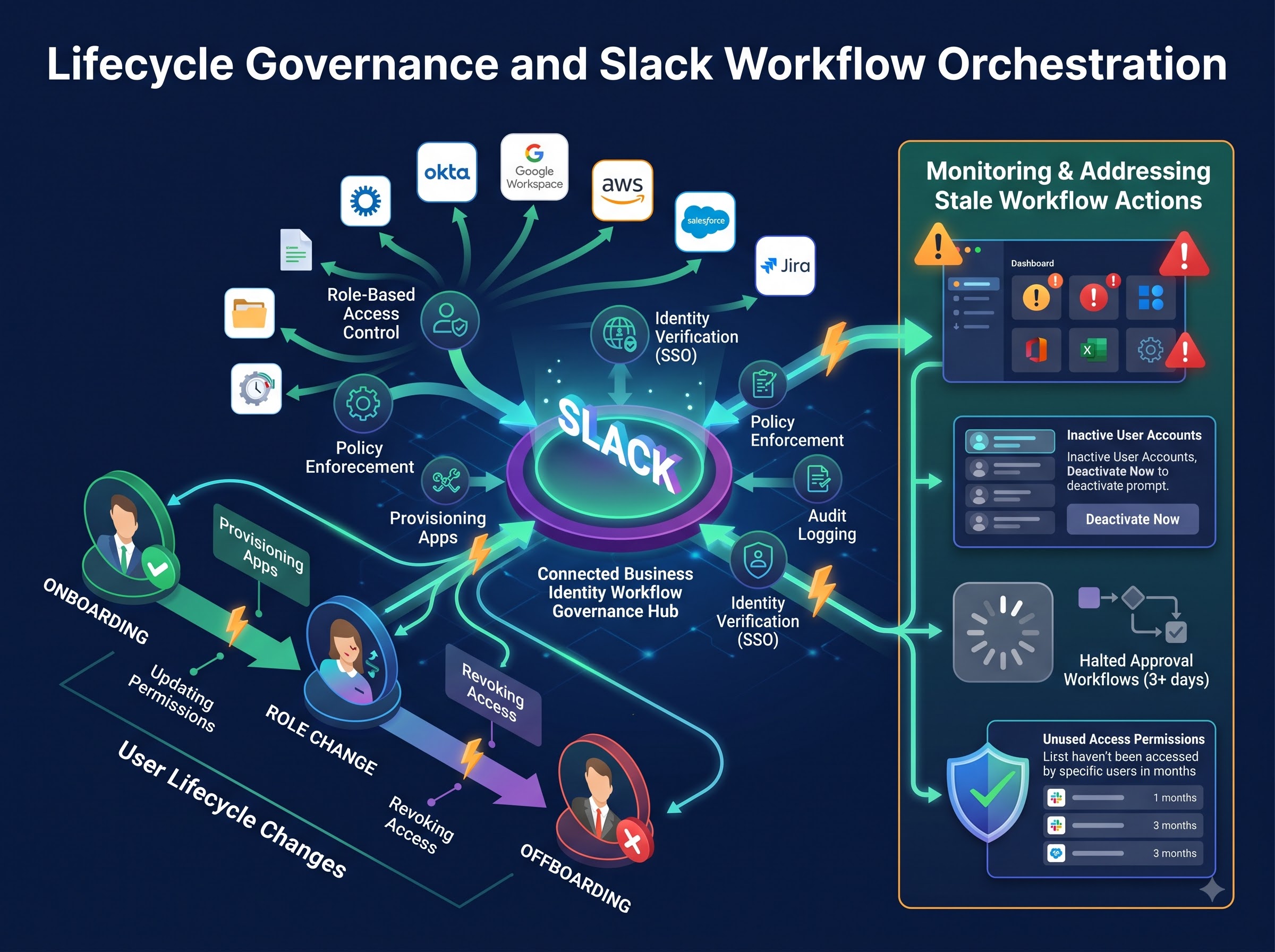
CCA should evaluate lifecycle events against pending requests and approvals. A new hire may be staged but not released before an authorized start condition. A mover may require a new approver or template family. A suspended user may lose the ability to act while historical evidence remains intact. A departing approver’s pending tasks may need reassignment. A leaver’s unapproved request may need to stop even if an old approval button is still visible.
The workflow should never infer employment status solely from Slack activity, presence, profile text, or channel membership. Authoritative lifecycle signals and enterprise policy determine the response. CCA invalidates stale actions, preserves the event history, and ensures that BCM receives no superseded identity specification.
Security and Integration Governance
The Slack connection should use only the capabilities approved for the enterprise environment. App credentials, signing secrets, tokens, service identities, webhooks, event subscriptions, interaction endpoints, and middleware are privileged assets. They require named ownership, secure storage, rotation, least-privilege scopes, environment separation, monitoring, and prompt revocation when no longer needed.
Inbound events and interactive requests should be authenticated, validated, rate-controlled, protected against replay, and processed idempotently. Outbound messages should use controlled destinations and safe retries. Duplicate delivery must not create duplicate approvals, orders, or exception decisions. Operational logs should support diagnosis without exposing unnecessary identity data or secret material.
Configuration changes also require governance. A changed channel mapping, expanded app scope, revised message template, renamed workflow, modified interaction route, or altered retention rule can create a business control failure even when the integration remains technically available. Versioned configuration, separation of duties, controlled testing, release management, operational reconciliation, and periodic access review keep the Slack connection aligned with CCA policy.
Audit Evidence and Operational Reporting
A governed program should be able to reconstruct the complete path from request to production. Evidence may include the requester and subject, authoritative source values, proposed values, policy and template versions, notification type and destination class, message reference, actor interaction, validation outcome, approval scope, exception rationale, timestamps, approved specification, BCM order, supplier, quantity, shipment, fulfillment, cancellation, and error history.
Reporting should go beyond message delivery and response counts. Leaders can examine expired actions, invalid approval attempts, wrong-audience blocks, stale channel mappings, duplicate events, unresolved exceptions, reassigned approvers, excessive reminders, delayed decisions, source conflicts, policy overrides, notification failures, and reconciliation gaps. These measures reveal whether collaboration is improving governed execution rather than simply generating more activity.
Audit access should remain role-based. Operational teams may need workflow status, while auditors may require decision evidence and integration logs. Broad export of channel history is not a substitute for purpose-specific, access-controlled reporting from CCA and BCM.
A Practical Implementation Roadmap
Phase 1: Define the authority model
Inventory request types, actors, subjects, identity fields, policies, approvers, exceptions, Slack audiences, BCM outcomes, and evidence requirements. Assign authoritative sources and accountable owners. Explicitly separate collaboration, authorization, identity approval, and ordering execution.
Phase 2: Design minimum-necessary messages
Define each notification’s purpose, audience, content, destination type, sensitivity, expiry, action, fallback, and retention expectation. Use secure links for detailed records. Avoid copying broad employee profiles or complete request histories into Slack.
Phase 3: Map interactions to governed actions
For every button or workflow action, define the server-side identity correlation, permission check, request-version check, policy validation, duplicate protection, success condition, and error behavior. Treat each interaction as a request for CCA to decide.
Phase 4: Secure and test the integration
Configure least-privilege credentials, protected secrets, verified events, monitored endpoints, rate limits, safe retries, idempotency, and environment separation. Test stale messages, changed approvers, revised requests, expired delegations, lifecycle events, wrong channels, duplicate clicks, partial outages, and recovery.
Phase 5: Connect controlled execution
Release only the CCA-approved identity specification into BCM. Return order and fulfillment status through minimum-necessary notifications without allowing Slack to rewrite the approved identity, quantity controls, supplier rules, or evidence.
Phase 6: Measure and improve
Review action validity, exception aging, reminder effectiveness, notification failures, audience blocks, integration errors, policy overrides, reprints, and reconciliation results. Improve policy, message design, ownership, source data, and workflow routing before expanding automation.
What Enterprise Buyers Should Evaluate
- Can the platform separate Slack communication from authoritative identity and approval decisions?
- Does every interactive approval undergo current, server-side validation before workflow state changes?
- Can the enterprise limit decision rights by population, entity, geography, field, template, request type, purpose, and time?
- Can requester, subject, delegate, approver, and administrator identities remain distinct and attributable?
- Can sensitive identity data be minimized by message type, audience, and destination?
- Can stale, duplicated, superseded, or unauthorized actions fail safely without losing evidence?
- Can different identity, brand, legal, security, procurement, and operational exceptions reach their accountable owners?
- Can lifecycle and delegation changes invalidate pending authority without destroying historical records?
- Can the enterprise reconstruct the path from Slack notification through CCA decision and BCM fulfillment?
- Can app credentials, scopes, events, retries, configuration changes, and reconciliation be governed as enterprise controls?
Buyer-Intent Bridge: From Slack Notifications to Governed Identity Execution
Organizations searching for a Slack business card workflow integration often want faster approvals, fewer missed requests, clearer exception ownership, and convenient order-status updates. Those are practical objectives. The buying question is whether the integration merely sends messages or connects collaboration to an enforceable authority model.
CCA provides that model. It determines which facts are authoritative, which identity presentation is permitted, which actor may make each decision, and what evidence must be preserved. Slack helps the right people see and respond to work. BCM executes only the approved specification. Together, they create a controlled path from collaboration to business identity execution without confusing conversation with authorization.
Frequently Asked Questions
What is a Slack business card workflow integration?
It is a controlled connection that uses Slack for permitted notifications, reminders, exception prompts, workflow actions, and status communication while authoritative identity decisions and execution remain governed in CCA and BCM.
Can a Slack message approve a business card request?
A Slack interaction can initiate an approval action, but CCA should revalidate the actor, authority, request version, policy, exception, and current status before recording the decision. The message itself is not the authoritative approval record.
Is a private Slack channel sufficient for sensitive identity data?
No. Private-channel membership can change, and message retention or export may extend beyond the workflow purpose. Content should still be minimized, classified, access-controlled, and linked to the governed record.
Can a check-mark reaction count as approval?
Not unless the enterprise has deliberately mapped that action to a secure, authenticated, server-validated process with clear scope and evidence. In most cases, a generic reaction lacks the context required for an accountable identity decision.
What happens if an approver clicks an old notification?
CCA should validate the current request and authority state. If the request changed, the action expired, the approver moved roles, or another decision already occurred, the action should fail safely and direct the user to the current record.
Can Slack replace CCA or BCM?
No. Slack is the collaboration surface. CCA is the authority engine for identity, permissions, approvals, exceptions, and evidence. BCM is the execution engine for approved ordering and fulfillment.
How should order status appear in Slack?
BCM can return controlled status events that CCA or the integration presents to authorized audiences. Messages should reveal only the necessary milestone and secure reference, and they must not expose unrelated employee, supplier, financial, or shipment data.
Conclusion
Slack can improve the speed and visibility of enterprise business card workflows. It can surface pending work, connect exception owners, reduce missed approvals, and communicate execution status in a familiar environment. Those advantages are sustainable only when collaboration remains connected to authoritative policy and does not become an informal substitute for it.
CCA governs the actor, subject, identity facts, public presentation, permissions, approvals, exceptions, and evidence behind every action. BCM executes the approved specification through ordering and fulfillment. Slack supports communication around that governed path. The result is faster coordination without surrendering enterprise control over public identity.
Contact the CCA team to design a Slack-connected workflow with validated permissions, accountable exceptions, minimum-necessary data, complete evidence, and controlled execution through BCM.