

Enterprise Identity Governance: Connecting Business Card Management with Digital Workplace Operations
Introduction
Enterprise identity extends far beyond usernames and access credentials. Every customer-facing asset, including business cards, email signatures, employee profiles, and digital workplace records, contributes to how an organization presents itself internally and externally.
When these assets are managed independently, governance gaps appear. Leading enterprises are therefore integrating business card management into a broader identity governance framework.
The Shift from Print Management to Identity Governance

Traditional business card programs focused primarily on ordering and printing. Modern enterprises focus on governance.
Every request must align with:
- HR records
- Approval policies
- Branding standards
- Procurement rules
- Identity lifecycle events
Business card printing is the transaction.
Business card management is the workflow.
Governance is the control layer.
API integration is the differentiator.
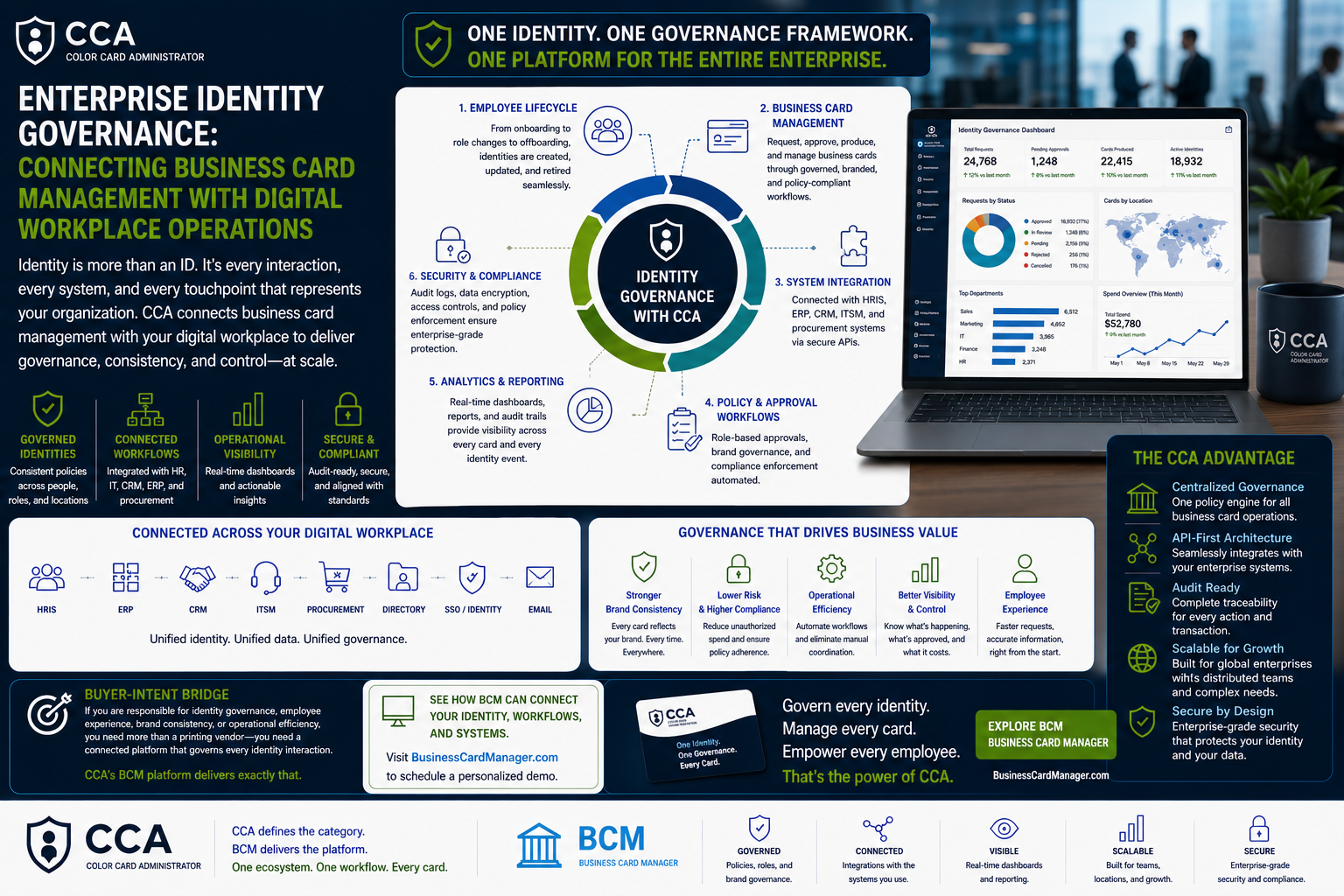
Connecting Business Systems
Business card workflows should interact with:
- HRIS
- ERP
- CRM
- Procurement
- Onboarding
- Identity management
- Reporting systems
API-connected platforms eliminate duplicate data entry, improve data accuracy, and create a single operational process from employee onboarding through role changes and offboarding.
Governance Through Centralization
A centralized platform standardizes:
- Templates
- Approval workflows
- Role-based permissions
- Vendor management
- Reporting
- Compliance
Employees receive a consistent experience while administrators gain complete operational visibility across business units and regions.
Operational Intelligence
Dashboards provide insight into:
- Request volumes
- Approval turnaround times
- Fulfillment status
- Policy exceptions
- Procurement spending
- Vendor performance
These metrics allow leaders to improve efficiency while maintaining enterprise governance.
Security, Compliance, and Auditability
Identity governance requires traceability.
Every request, approval, template change, production event, and fulfillment action should be recorded.
Comprehensive audit trails strengthen compliance initiatives and simplify internal reviews and external audits
Business Value
Organizations that integrate identity governance with business card management:
- Reduce administrative effort
- Accelerate onboarding
- Protect brand integrity
- Improve procurement oversight
- Deliver a consistent employee identity across the enterprise
Buyer-Intent Bridge
Enterprise buyers should evaluate platforms based on:
- Centralized governance
- Configurable workflows
- API integrations
- Reporting depth
- Auditability
- Identity lifecycle support
- Scalability
Rather than printing capabilities alone.
Strategic Takeaway
Enterprise identity governance creates a connected operational framework where business card management becomes an integrated component of digital workplace operations.
This approach improves visibility, governance, compliance, and long-term scalability.