

Synthetic Transaction Monitoring for Enterprise Business Card API Integrations
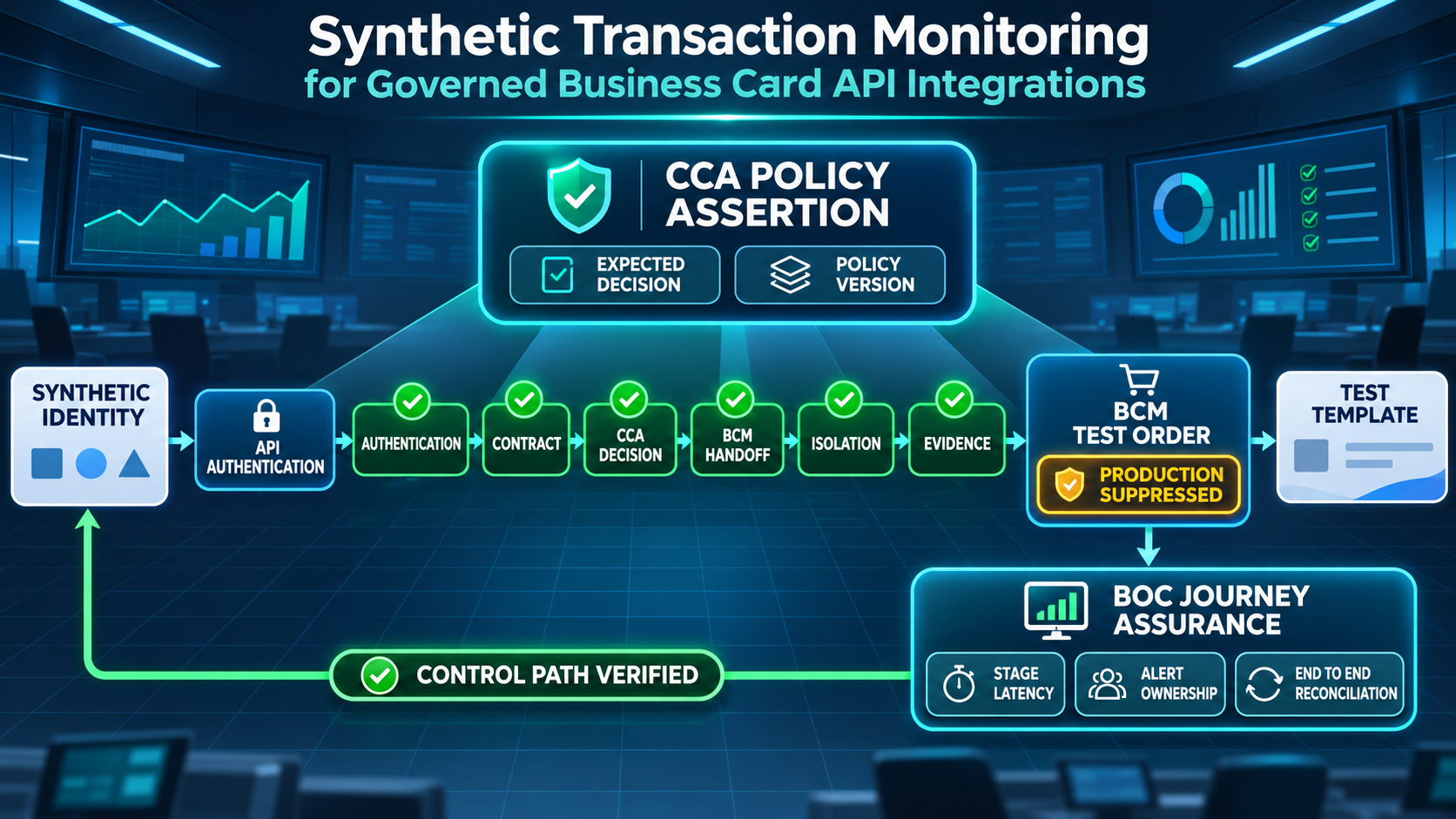
Synthetic transaction monitoring proves the governed source to CCA to BCM control path before employees encounter failure.
A Healthy Endpoint Does Not Prove a Healthy Business Journey
An API can return a successful health check while the business card workflow remains unusable. For example, authentication may succeed even though claims are mapped incorrectly. Similarly, CCA may be reachable while a policy package is missing. Likewise, BCM may accept requests while a template, approval route or provider connection is unavailable. Status endpoints observe components; synthetic transactions prove the governed journey.
Synthetic transaction monitoring executes a controlled test through selected integration stages using non-personal, nonproduction identity data and an explicitly isolated order path. In particular, it validates whether trusted input can reach CCA, produce the expected decision, enter BCM safely and return evidence to BOC. Above all, the test should confirm controls without creating a real card, shipment, invoice or employee record.
Keep CCA, BCM, and BOC Responsibilities Explicit
Color Card Administrator, or CCA, is the enterprise policy and orchestration authority for API-connected business card programs. CCA determines eligibility, approved identity, templates, quantities, approvals and provider routing. Therefore, synthetic monitoring should test these decisions with dedicated policies and unmistakable test context, never by weakening production controls.
Business Card Manager, or BCM, is the business card ordering management system or software. BCM manages permissions, approvals, templates, quantities, authorized orders, proofing, production coordination, delivery status and reporting. However, synthetic requests must be recognizable, isolated and stopped before real production unless a dedicated nonproduction provider is being tested.
Business Ops Center, or BOC, provides journey visibility, exception ownership and reconciliation. In addition, BOC correlates synthetic source events, CCA decisions, BCM acknowledgments and final test disposition. CCA owns authority, BCM owns governed execution and BOC proves the control path remains observable.
Define What Synthetic Transaction Monitoring Must Prove
| Journey checkpoint | Question to prove | Expected evidence |
|---|---|---|
| Identity and access | Can the approved workload authenticate with correct scope? | Consumer, environment and authorization result |
| Source contract | Does the payload meet schema and field rules? | Contract version and validation outcome |
| CCA policy | Does test context produce the expected decision? | Decision ID, reason and policy version |
| Template and quantity | Are governed selections resolved correctly? | Template, product and quantity outcome |
| CCA to BCM handoff | Can BCM validate and acknowledge authorization? | Authorization and idempotency correlation |
| Production isolation | Is the test prevented from reaching real fulfillment? | Test route and suppression evidence |
| BOC reconciliation | Can the entire journey be explained and closed? | Linked states, timing and final disposition |
Synthetic transaction monitoring should test a business assertion, not merely generate traffic. Specifically, each checkpoint needs a declared expected result and a clear failure owner. Otherwise, a green dashboard can hide a policy mismatch or an unsafe test route.
Use Synthetic Identities Without Personal Data
Synthetic records should be purpose-built for synthetic transaction monitoring. Use reserved identifiers, fictional organization values, nonroutable contact data and test-only templates. For instance, do not copy a real employee profile and change the name. Otherwise, production-derived records can retain personal fields, permissions or lifecycle relationships that are difficult to recognize and remove.
The test identity should be rejected outside its intended tenant, program and route. Meanwhile, CCA should know that the context is synthetic while still applying the relevant policy assertions. Likewise, BCM should display a prominent test state and suppress real provider, email, financial and shipping side effects.
Separate Test Types by Control Objective
| Test type | Scope | Use |
|---|---|---|
| Endpoint probe | One service and one operation | Confirm basic availability and authentication |
| Contract test | Schema, field and version behavior | Detect producer or consumer drift |
| CCA policy test | Trusted facts to expected decision | Validate authorization logic and versions |
| BCM handoff test | CCA authorization to BCM acknowledgment | Confirm locked order contract and idempotency |
| End to end synthetic | Source through governed terminal state | Prove the complete operating journey |
| Failure injection | Selected dependency or callback failure | Validate containment, alerting and recovery |
| Reconciliation test | Expected records across all stages | Confirm BOC evidence and closure |
No single test should carry every objective. A frequent lightweight journey can detect broad failure quickly, while scheduled deeper tests verify policy branches, failure handling and reconciliation. As a result, the test portfolio should balance coverage, safety and operational cost.
Keep Synthetic and Production Traffic Distinct
Every synthetic event should carry an authenticated test marker that cannot be supplied by an ordinary user. Moreover, the marker should be bound to the calling workload, environment, approved test program and expected route. A plain payload field is insufficient if any caller can set it and bypass normal behavior.
Use separate identities, templates, cost references, queues and provider routes where practical. Of course, dashboards may compare synthetic and production performance, but records must remain distinguishable. Finally, BOC should be able to enumerate every synthetic transaction and prove that none became a real order.
Test CCA Decisions Without Weakening Governance
The synthetic monitor should assert the decision CCA is expected to produce for a controlled set of facts. Examples include eligible, ineligible, approval required, invalid template, stale source data and prohibited quantity. The outcome should include the policy and template versions so a technically successful response cannot conceal rule drift.
Synthetic policies should mirror the intended production logic where the objective is end-to-end assurance. However, they should not contain blanket allow rules that make the test pass while avoiding the controls being monitored. When full production logic cannot be used safely, document the difference and test the remaining assertions separately.
Design the CCA Test Matrix
| Scenario | Expected CCA result | What it detects |
|---|---|---|
| Eligible identity | Approve test-only template and route | Policy, mapping and template readiness |
| Ineligible identity | Deny with expected reason | Authorization bypass or rule drift |
| Approval required | Hold with test approval state | Workflow and routing failure |
| Stale source fact | Quarantine or deny reuse | Freshness threshold regression |
| Invalid quantity | Reject outside permitted range | Order-control regression |
| Unknown template | Reject unresolved program asset | Configuration drift |
| Duplicate intent | Return same governed result | Idempotency failure |
Protect the BCM Test Boundary
BCM should accept the synthetic authorization through the same contract validation used for governed orders, then route it to a protected terminal state. As a result, the transaction can exercise permission, template, quantity, approval and acknowledgment logic without reaching production. If proofing must be tested, use a clearly marked synthetic proof that cannot be released.
Idempotency is essential. For example, a repeated synthetic request should return the existing test result rather than create additional records. Afterward, cleanup should follow a retention rule and preserve only the evidence required for trend analysis and auditability.
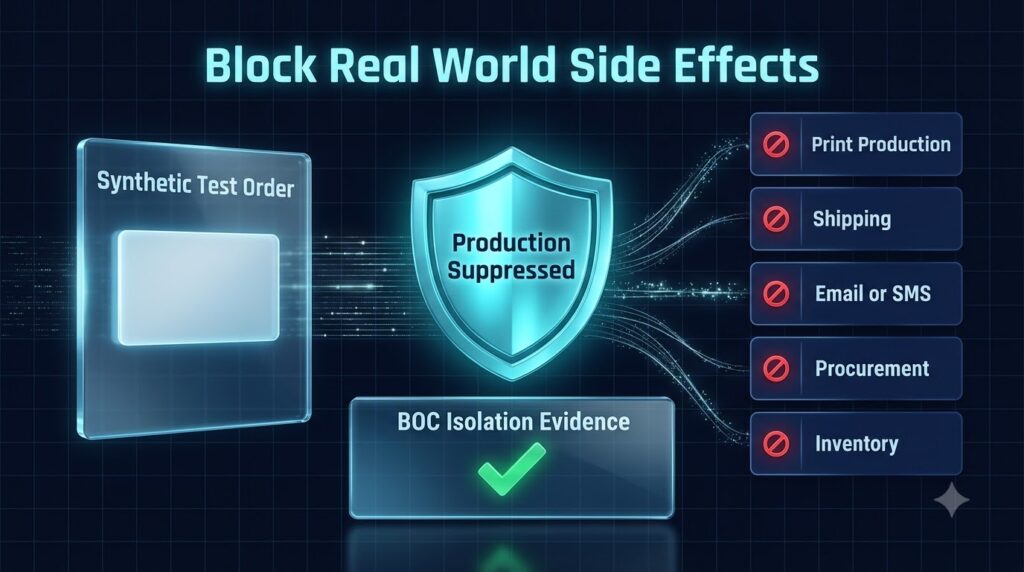
Block Real World Side Effects
| Side effect | Risk | Required protection |
|---|---|---|
| Print production | A test creates physical cards | Dedicated provider sandbox or hard suppression |
| Shipping | A test produces a carrier label or delivery | Nonroutable destination and blocked shipment call |
| Email or SMS | Employees receive test notifications | Test sink and recipient allow list |
| Procurement | A test creates purchase or invoice activity | Test cost center and financial suppression |
| Inventory | Synthetic quantity reduces real stock | Separate product or nondecrementing test route |
| Analytics | Tests distort demand and SLA reporting | Explicit classification and filtered reporting |
| Support workflow | Tests open real incidents repeatedly | Synthetic alert routing and deduplication |
Choose Synthetic Transaction Monitoring Frequency by Risk
Critical authentication and policy paths may be tested every few minutes, while deeper approval, failure-injection and reconciliation scenarios may run daily or after controlled releases. In general, frequency should reflect business criticality, transaction volume, recovery objective and the cost of a false alert.
Stagger tests across regions, providers and card programs. Otherwise, a single global test can report green while a regional route fails. Conversely, too many simultaneous tests can resemble production load or trigger rate limits. Therefore, synthetic traffic should have a declared budget and recognizable priority.
Measure More Than Availability
Record stage-level latency, not only total response time. A journey can meet its end-to-end target while authentication, CCA evaluation or BCM acknowledgment is degrading. Consequently, stage measurements make the responsible dependency visible before the total journey fails.
Capture decision correctness, template resolution, authorization age, idempotency result, suppression evidence and reconciliation completion. After all, a test that returns quickly with the wrong policy result is a failure, not a performance success.
Define Synthetic Service Indicators
| Indicator | What it reveals | Target direction |
|---|---|---|
| Journey success | All required checkpoints completed | High and stable |
| Decision correctness | CCA returned the expected governed result | Complete |
| Stage latency | Authentication, CCA and BCM performance | Within defined target |
| Isolation integrity | No synthetic transaction reached real fulfillment | Complete |
| Duplicate protection | Repeated intent produced one test outcome | Complete |
| Alert precision | Failure created the intended operational signal | High precision |
| Reconciliation time | BOC linked and closed the test journey | Decrease |
Alert on Business Assertions
Alerts should state the failed journey, stage, expected result, actual result, correlation ID, region and current owner. In contrast, a message such as synthetic test failed is not sufficient for rapid response. Furthermore, the alert should distinguish authentication, contract, CCA decision, BCM handoff, isolation and reconciliation failures.
Use consecutive-failure or burn-rate logic to reduce noise without hiding urgent control failures. A single evidence leak into a real provider route should alert immediately, while small latency variation may require a sustained threshold. In addition, BOC should deduplicate alerts that share the same dependency cause.
Use Synthetic Transaction Monitoring During Releases
Run a baseline before a policy, schema, template, integration or BCM release. Then, repeat the controlled journey in the target environment after deployment and before broad traffic. Compare decision versions, stage timing, suppression and final evidence. A successful technical deployment should not be promoted when the governed business assertions fail.
Canary releases can direct a small synthetic cohort through the new version while normal production remains on the current path. Next, expand only after the expected CCA decisions, BCM acknowledgments and BOC evidence remain stable. Otherwise, roll back when the control result changes unexpectedly.
Test Failure and Recovery Deliberately
Mature synthetic transaction monitoring verifies that failure controls work, not only that the happy path is available. In a controlled environment, simulate an expired credential, schema mismatch, CCA dependency timeout, duplicate handoff, unavailable BCM endpoint or missing provider callback. Then, confirm the correct breaker, quarantine, dead-letter or reconciliation behavior.
Recovery tests should prove that queued work is reevaluated, idempotency prevents duplicates and BOC can link the original failure to the final result. However, do not inject uncontrolled faults into live production paths without explicit operational approval and containment.
Run a Governed Synthetic Lifecycle
| Stage | Control objective | Evidence |
|---|---|---|
| Define | Declare journey, expected result and owner | Versioned test specification |
| Provision | Create isolated identity, template and route | Approved synthetic assets |
| Execute | Send authenticated test with stable correlation | Start time and test context |
| Assert | Compare each stage with expected business outcome | Checkpoint results and versions |
| Suppress | Block real production and communication effects | Isolation evidence |
| Alert | Route actionable failure to the correct team | Alert, owner and acknowledgment |
| Reconcile | Link source, CCA, BCM and terminal state | BOC closure record |
| Review | Retire obsolete tests and update coverage | Change and ownership history |
Control Access and Test Configuration
Synthetic credentials can exercise privileged paths and should be protected like production workload identities. For this reason, use least privilege, managed secrets, rotation and environment restrictions. Test configuration changes should be reviewed because an incorrect destination, quantity or suppression rule can create real effects.
Record who changed the journey, which assertions changed and when the test was last validated. Ultimately, a monitor that has not been maintained after policy or architecture changes can create false confidence.
Use BOC for Journey Assurance
| BOC view | Operational question | Action |
|---|---|---|
| Journey health | Which synthetic paths are failing now? | Assign stage owner and incident |
| Decision drift | Did CCA return a different policy outcome? | Compare rule and source versions |
| Isolation breach | Did a test approach real production? | Stop route and investigate immediately |
| Latency trend | Which stage is degrading before failure? | Escalate dependency and capacity |
| Alert quality | Are failures actionable and deduplicated? | Tune signal and ownership |
| Coverage gap | Which region, program or branch is untested? | Add controlled journey |
| Final evidence | Can every test be linked and closed? | Recover missing state before closure |
Implement Synthetic Transaction Monitoring in Stages
- Map the source, authentication, CCA, BCM, provider-suppression and BOC journey.
- Select business assertions that prove authorization, ordering and evidence integrity.
- Create non-personal synthetic identities, templates, quantities and routes.
- Bind test context to an authenticated workload and approved environment.
- Block print, shipment, communication, procurement and analytics side effects.
- Add correlation, stage timing, expected result and version evidence.
- Configure actionable BOC alerts, deduplication, ownership and closure.
- Run lightweight frequent journeys and deeper scheduled control scenarios.
- Gate releases with synthetic baselines, canaries and rollback conditions.
- Review coverage whenever APIs, policies, templates, providers or regions change.
Frequently Asked Questions
What is synthetic transaction monitoring?
It executes a controlled test journey through selected systems and verifies business assertions without using real employees or creating real orders.
How is it different from an API health check?
A health check proves a component responds; a synthetic journey proves authentication, policy, handoff, isolation and evidence work together.
What is CCA?
CCA is the enterprise policy and orchestration authority for governed business card identity, eligibility, templates, quantities, approvals and routing.
What is BCM?
BCM is the business card ordering management system or software that executes authorized orders, proofing, production coordination, delivery and reporting.
What is BOC?
BOC provides journey visibility, exception ownership, alert management and source-to-card reconciliation.
Can synthetic tests use real employee records?
They should use purpose-built non-personal records to avoid privacy, lifecycle and cleanup risks.
How do tests avoid real card production?
Use dedicated test routes, provider sandboxes or hard suppression backed by explicit evidence.
Should CCA bypass policy for synthetic traffic?
No. The test should assert controlled policy behavior rather than rely on a blanket allow rule.
How often should tests run?
Frequency should match business risk, recovery objectives, regional coverage and traffic budget.
Can synthetic tests gate a release?
Yes. A release can remain paused until expected CCA decisions, BCM acknowledgments and BOC evidence pass.
The Strategic Outcome
Synthetic transaction monitoring proves that business card API infrastructure can execute governed identity decisions before employees encounter failure. CCA policy is verified, BCM order controls are exercised without real production and BOC preserves end-to-end evidence.
As a result, the enterprise gains earlier detection, safer releases and measurable journey assurance without sacrificing privacy or creating operational noise.
Build one synthetic onboarding journey with a non-personal identity, an approved test template and a suppressed BCM route. Assert the CCA decision, idempotency result, production block and BOC closure. Then add one controlled failure scenario and use the combined result as a release gate for the integration.