

API Data Quality Threshold and Quarantine Governance for Enterprise Business Card Integrations
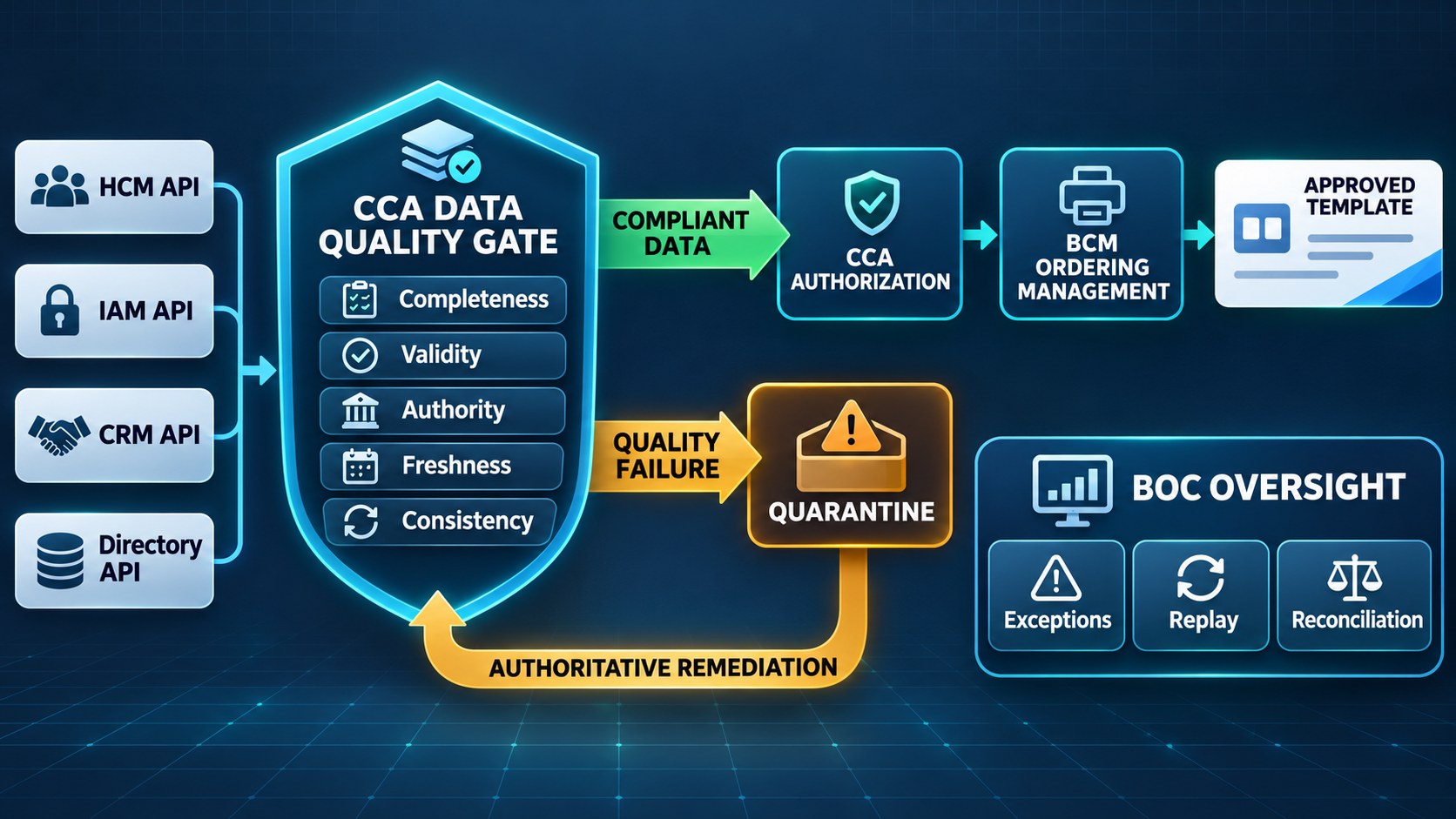
Preventing incomplete, stale, conflicting or malformed identity data from becoming an authorized order.
Data Quality Is an Authorization Prerequisite
An API can deliver a technically valid response and still provide unsafe business identity data. A record may be incomplete, stale, duplicated, inconsistent with an authoritative source or effective on a future date. If that record moves directly into ordering, the integration converts a data problem into a public identity, production expense and operational exception.
CCA should treat data quality as an authorization prerequisite. Before an identity can become an approved business card order, the data must satisfy declared rules for completeness, validity, authority, freshness, consistency, uniqueness and timing. Records that do not meet the required threshold should be held in a governed quarantine state—not silently repaired, guessed or passed downstream.
Keep CCA, BCM, and BOC Responsibilities Explicit
Color Card Administrator, or CCA, is the enterprise policy and orchestration authority for API-connected business card programs. CCA determines eligibility, approved identity fields, templates, quantities, approval routes and provider routing. Data-quality rules belong inside this decision boundary because they determine whether the available facts are trustworthy enough to support authorization.
Business Card Manager, or BCM, is the business card ordering management system or software. BCM manages user permissions, approvals, templates, quantities, authorized orders, proofing, production coordination, delivery status and reporting. BCM should execute a complete CCA authorization; it should not invent missing identity facts or reinterpret a quality failure.
Business Ops Center, or BOC, provides operational visibility, exception ownership and reconciliation. BOC tracks quarantined records, remediation, replay, downstream acknowledgments and final outcomes. CCA decides whether data is fit for authorization, BCM manages the approved order and BOC makes unresolved quality conditions accountable.
Define the Quality Dimensions
| Dimension | Question | Example control |
|---|---|---|
| Completeness | Are all required facts present? | Required field and conditional field checks |
| Validity | Does each value conform to its contract? | Type, length, format and allowed-value validation |
| Authority | Did the value come from its approved owner? | Field-level source precedence |
| Freshness | Is the fact recent enough for this decision? | Observed-at and source-version threshold |
| Consistency | Do related facts agree? | Country, location, language and template compatibility |
| Uniqueness | Does the event identify one intended subject? | Stable identity and duplicate-event detection |
| Effective timing | Is the change active for this order? | Effective-from and effective-through evaluation |
A single quality score can summarize risk, but it should not hide the reason for failure. A missing legal disclosure can be a hard stop even when every other field is correct. A missing optional mobile number may have no effect. CCA should preserve the individual rule results that explain the final decision.
Classify Fields by Decision Importance
Not every field should have the same consequence. Required fields are necessary for identity, brand, legal, production or delivery. Conditional fields become required only when a program, location, role or product rule applies. Informational fields can enrich reporting without blocking an order. This classification prevents minor gaps from stopping valid work while ensuring that critical facts cannot be bypassed.
| Field class | Quality outcome | CCA action |
|---|---|---|
| Required | Missing, invalid, stale or unauthorized | Quarantine; no ordering authorization |
| Conditional | Rule applies and value is unusable | Quarantine or route to explicit approval |
| Informational | Unavailable or below preferred quality | Continue with warning and evidence |
| Prohibited | Unexpected sensitive or out-of-scope value | Reject payload and raise security review |
Validate the Contract Before the Policy
The integration boundary should first validate authentication, schema, field types, enumerations, size limits, timestamps and correlation identifiers. Contract validation protects the service from malformed input. CCA then evaluates business quality: source authority, role eligibility, location compatibility, effective timing, approved identity, template and quantity policy.
Keeping these layers distinct improves diagnosis. A schema violation means the producer did not meet the technical contract. A policy denial means the record was understood but not authorized. A quality quarantine means the transaction may become eligible after trustworthy data is corrected or clarified.
Use Risk-Based Thresholds
| Severity | Typical condition | Permitted outcome |
|---|---|---|
| Critical | Unknown subject, prohibited field or untrusted source | Reject and investigate |
| High | Required identity, legal, location or authority failure | Quarantine; block authorization |
| Medium | Conflicting facts or approaching freshness limit | Hold for resolution or approved exception |
| Low | Optional enrichment unavailable | Proceed with warning |
| Advisory | Preference or formatting improvement | Proceed and report |
Thresholds should be versioned by card program and effective date. A field that is optional in one country may be required in another. A threshold that is appropriate for a reorder may not be appropriate for a new hire. CCA should record which policy and quality-rule versions produced the result.
Quarantine Instead of Guessing
Quarantine is a controlled state for a record that cannot safely proceed but may be remediated. It protects the enterprise from three dangerous defaults: substituting a convenient source, allowing a user to overwrite authoritative data or sending an incomplete transaction to BCM for someone else to fix.
A quarantined item should retain a privacy-safe correlation identifier, source and source version, quality findings, affected policy, owning team, permitted remediation, due time and replay status. It should not become a shadow database of full workforce payloads. Store only the evidence required to resolve and audit the condition.
Preserve Source Authority During Remediation
Remediation should occur at the system that owns the fact whenever practical. If HCM owns legal name and employment status, the correction belongs in HCM. If a controlled directory owns published contact details, the correction belongs there. CCA can then reevaluate the corrected source version.
Temporary exceptions should be narrow, time-bound and approved. They should identify the permitted field, business reason, approver, expiration and affected transaction. An operator should not be able to replace an authoritative field simply because production is urgent.
Resolve Conflicts with Field Ownership
| Conflict | Authority rule | Safe resolution |
|---|---|---|
| HCM title differs from CRM title | Use field-level ownership by published purpose | Select approved owner; retain conflict evidence |
| Directory contact is older than source | Apply freshness and source version | Wait for synchronization or refresh source |
| Location and template region disagree | CCA program compatibility rule | Quarantine and correct location or assignment |
| User entry changes governed identity | User is not authoritative | Ignore edit and explain permitted correction path |
| Two active records share an identity key | Uniqueness rule fails | Investigate merge or identifier defect |
Field ownership should be explicit enough that the same conflict always produces the same result. Otherwise, integration order becomes accidental authority: whichever system responds last wins.
Govern Freshness and Effective Dates
A recent API call does not guarantee fresh data. The response should carry the source observation time, source version or effective date needed to evaluate currency. CCA can compare that evidence with the program threshold and transaction purpose.
Future-dated transfers, terminated workers, expiring assignments and delayed directory updates require different handling. CCA should authorize against the correct effective state, not merely the latest event received. When timing is ambiguous, quarantine the decision until the authoritative state is clear.
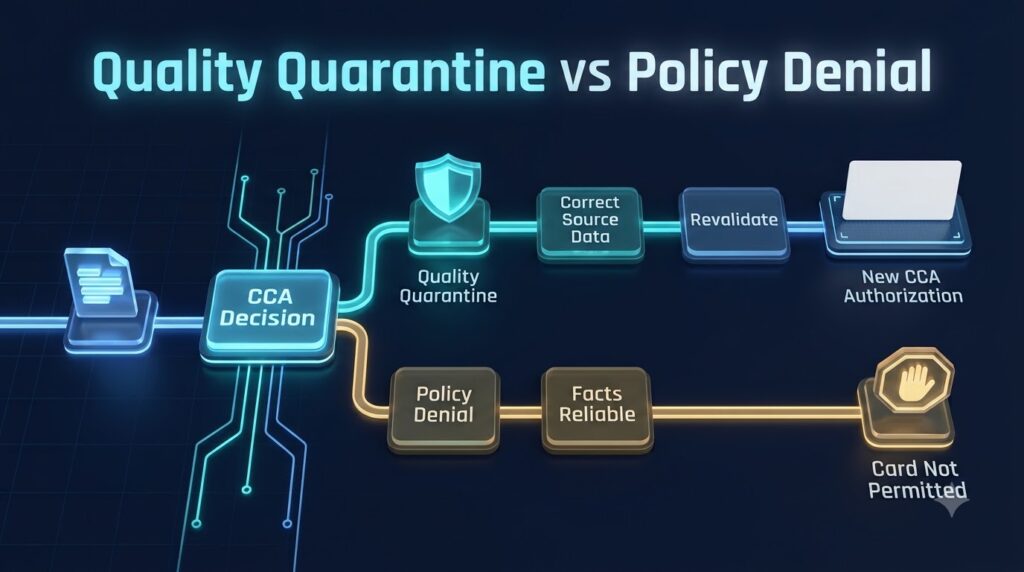
Distinguish Quarantine from Policy Denial
A quality quarantine says the available facts are not reliable enough to decide. A policy denial says the facts are reliable and the requested card is not permitted. This distinction matters to users, operators, analytics and automation. Replaying corrected data can resolve a quarantine; replaying the same facts should not overturn a policy denial.
Expose a safe status and reason category to the requesting system while keeping sensitive internal detail restricted. The user experience can state that authoritative information requires correction without revealing confidential employment or security data.
Protect the CCA to BCM Handoff
CCA should send BCM a locked authorization containing the approved identity, template, quantity, approval state, cost context, routing, decision ID, rule versions and idempotency key. The handoff should contain no unresolved high-severity quality findings. BCM should validate the authorization contract and reject expired, incompatible or duplicate requests.
BCM may manage proofing and authorized corrections that do not change the governed identity. A material identity, template, quantity or route change returns to CCA for reevaluation. This keeps the business card ordering management system aligned with the enterprise decision rather than turning order editing into a policy bypass.
Run a Controlled Quarantine Lifecycle
| State | Control objective | Exit condition |
|---|---|---|
| Detected | Capture a rule failure once | Finding and correlation recorded |
| Classified | Assign severity and responsible owner | Required action and due time set |
| Investigating | Confirm source, scope and impact | Root condition understood |
| Remediating | Correct the authoritative source or approved mapping | New source version available |
| Revalidating | Run contract, quality and policy again | All blocking findings cleared |
| Released | Issue a new CCA authorization | BCM acknowledges one authorized order |
| Closed | Reconcile evidence and final outcome | BOC confirms resolution or governed cancellation |
Use BOC for Operational Ownership
| BOC signal | Operational question | Action |
|---|---|---|
| Quarantine age | Is a record approaching its service target? | Escalate to owning team |
| Repeat failure | Is the same source or mapping failing again? | Open systemic problem review |
| Volume spike | Did a deployment or bulk event create a surge? | Pause cohort and contain impact |
| Replay mismatch | Did corrected data create a second order? | Stop replay and reconcile idempotency |
| Downstream rejection | Did BCM reject an otherwise approved handoff? | Separate contract from quality issue |
| Unclosed evidence | Is the final source-to-card chain incomplete? | Recover acknowledgment or close exception |
BOC should make quality work measurable without becoming another source of truth. It correlates identifiers, states and evidence; authoritative corrections remain with the owning system, and authorization remains with CCA.
Design Safe Remediation and Replay
Replay begins with a new or corrected authoritative source version. CCA should rerun contract validation, quality checks and policy from the beginning. It should not simply remove the quarantine flag. If the decision changes, preserve both the original finding and the new authorization so the outcome remains explainable.
Use stable correlation and idempotency keys across retries. Before BCM accepts the released transaction, verify whether an order already exists, is in proof, is in production or has been cancelled. A remediation process that produces duplicates is not a recovery process.
Control Bulk Events and Migrations
Organizational changes, acquisitions, directory migrations and mass title updates can introduce thousands of records with the same defect. Validate representative cohorts before full release. Apply quality gates at the batch and record level, then stop the cohort when failure rates exceed a declared threshold.
Do not lower production quality rules merely to complete a migration. Use a documented exception cohort, corrected mapping or phased authorization. BOC should compare expected, quarantined, authorized, ordered and completed counts so missing and duplicate outcomes are visible.
Measure Data Quality Governance
| Measure | What it reveals | Target direction |
|---|---|---|
| First-pass quality | Records clear all required checks | Increase |
| Quarantine rate | Transactions require remediation | Decrease by root cause |
| Time to resolution | Operational effort before safe release | Decrease |
| Repeat failure rate | Correction did not remove systemic cause | Decrease to zero |
| Unauthorized bypasses | Orders proceeded with blocking findings | Zero |
| Duplicate order rate | Replay or retry created extra execution | Zero |
| Reconciliation coverage | Released records reach one evidenced outcome | Complete |
Implement Quality Governance in Stages
- Inventory source systems, field owners, API contracts, card programs and downstream ordering dependencies.
- Classify fields as required, conditional, informational or prohibited for each program.
- Define contract validation separately from business quality and policy authorization.
- Set severity, freshness, consistency, uniqueness and effective-date thresholds in CCA.
- Design privacy-safe quarantine records, ownership, service targets and escalation paths.
- Protect the CCA-to-BCM handoff with locked authorization, expiry and idempotency.
- Implement authoritative-source correction, revalidation and controlled replay.
- Configure BOC dashboards for age, spikes, repeat failures, replays and reconciliation.
- Test missing, stale, conflicting, duplicate, future-dated and malformed scenarios.
- Review thresholds after source, schema, policy, template, provider or organizational changes.
Frequently Asked Questions
What is business card API data quality governance?
It is the controlled validation of source authority, completeness, validity, freshness, consistency, uniqueness and timing before a business card action is authorized.
What is CCA?
CCA is the enterprise policy and orchestration authority that evaluates trusted data and authorizes governed business card identity, templates, quantities, approvals and routing.
What is BCM?
BCM is the business card ordering management system or software that manages permissions, approvals, templates, quantities, authorized orders, fulfillment coordination and reporting.
What is BOC?
BOC provides operational monitoring, exception ownership and reconciliation across source records, CCA decisions, BCM orders and final outcomes.
Why quarantine a record instead of rejecting it?
Quarantine preserves a controlled remediation path when trustworthy correction may make the transaction eligible.
Can a user fix a quarantined identity field?
Only when that user is an approved authority for the field; otherwise the correction should occur in the owning source.
Is a schema-valid payload automatically safe to order?
No. Technical validity does not prove source authority, freshness, consistency or policy eligibility.
Can BCM repair missing identity data?
BCM should execute the authorized order, not invent governed facts. Material corrections return to the source and CCA.
How should corrected records be replayed?
Rerun validation, quality and policy with stable correlation and idempotency, then confirm that BCM creates only one order.
What should BOC monitor?
Quarantine age, repeat failures, volume spikes, replay integrity, downstream rejections and source-to-card reconciliation.
The Strategic Outcome
API data-quality governance turns unreliable integration input into an explicit control decision. CCA authorizes only trustworthy identity, BCM manages only governed business card orders and BOC makes every quarantine, remediation, replay and final outcome visible.
The result is a business card program that can integrate at enterprise speed without allowing poor data to become a public identity, production cost or audit problem.
Choose one high-volume business card integration and trace every required field from its authoritative source through CCA and BCM to final fulfillment. Define its quality dimensions, blocking threshold, quarantine owner, correction path, replay behavior and BOC evidence. Then test the workflow with missing, stale, conflicting, duplicate and future-dated records before expanding automation.