

Circuit Breaker and Graceful Degradation Governance for Enterprise Business Card API Integrations
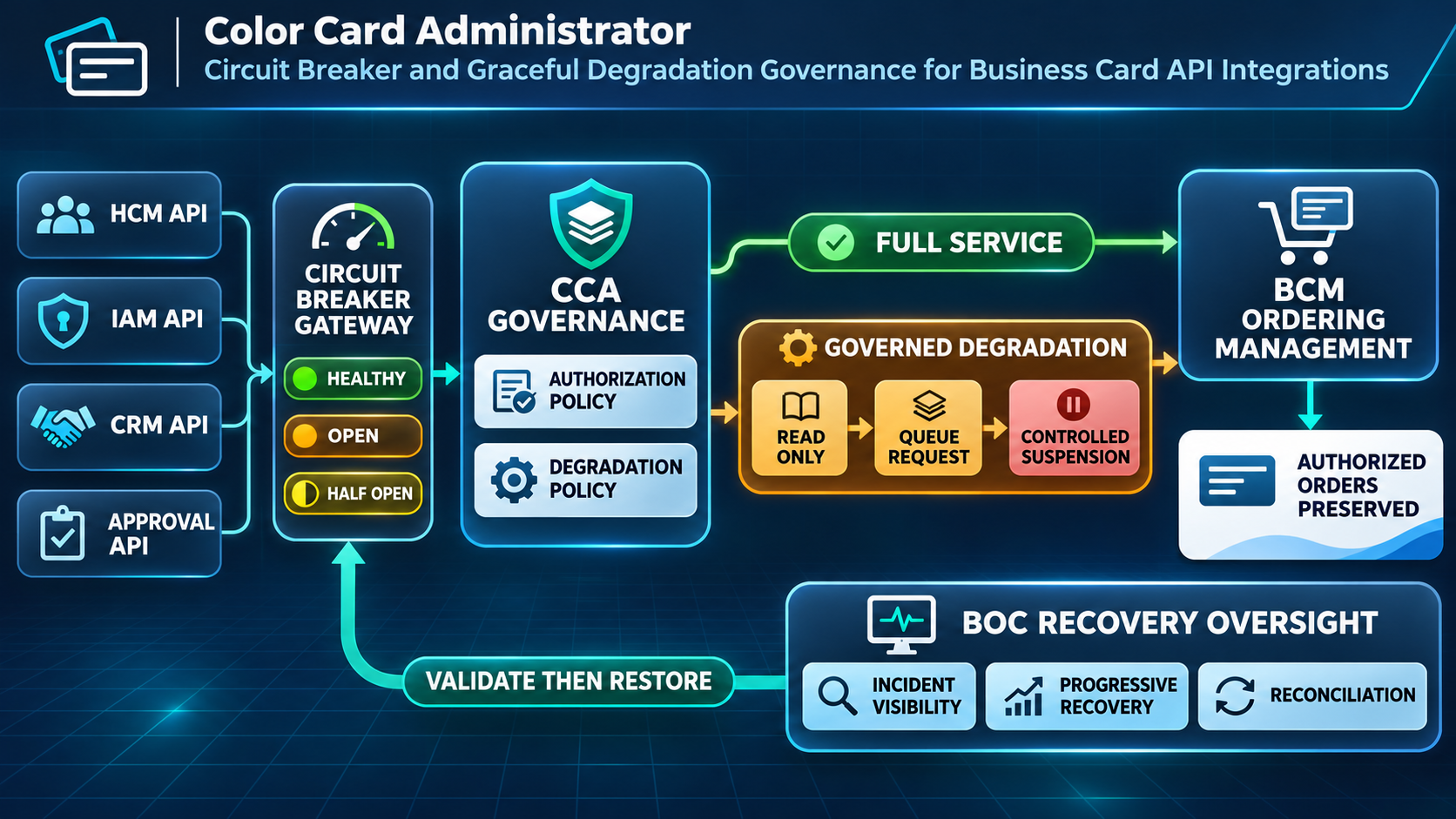
Circuit breaker governance protects governed business identity decisions when connected enterprise services become unstable.
Availability Must Not Override Authorization
An enterprise business card workflow may depend on HCM, IAM, CRM, directories, procurement services, approval engines, ordering software, print providers and carrier callbacks. When one dependency slows down or fails, a tightly coupled integration can exhaust connections, repeat requests and spread the incident across otherwise healthy systems. As a result, the impact is not only downtime. In addition, it can produce stale identity decisions, duplicate orders and manual work that bypasses enterprise policy.
Circuit breaker governance and graceful degradation limit that blast radius. A circuit breaker stops repeated calls to an unhealthy dependency and allows controlled testing before normal traffic resumes. Graceful degradation defines which business capabilities may continue, which must pause and which can operate from verified evidence. Therefore, in a CCA program, continuity is permitted only when authorization integrity remains intact.
Keep CCA, BCM, and BOC Responsibilities Explicit
Color Card Administrator, or CCA, is the enterprise policy and orchestration authority for API-connected business card programs. CCA decides eligibility, approved identity, templates, quantities, approvals and provider routing. During an incident, CCA also determines whether existing decision evidence remains usable or whether new authorization must wait for an authoritative dependency.
Business Card Manager, or BCM, is the business card ordering management system or software. BCM manages permissions, approvals, templates, quantities, authorized orders, proofing, production coordination, delivery status and reporting. BCM can continue managing confirmed orders when policy allows, but it should not manufacture missing authorization or identity data.
Business Ops Center, or BOC, provides incident visibility, exception ownership and reconciliation. BOC correlates breaker state, queued work, CCA decisions, BCM orders and final outcomes. CCA owns business authority, BCM owns governed execution and BOC owns operational accountability.
Map Dependencies by Business Criticality
| Dependency | Business purpose | Failure consequence |
|---|---|---|
| HCM or IAM | Employment, role and lifecycle authority | Eligibility and identity may be unsafe to decide |
| Directory or CRM | Published contact and customer-facing role data | Some card fields may become stale or incomplete |
| Approval service | Confirm authorized exception or quantity | Order cannot advance without evidence |
| CCA policy service | Evaluate identity, template and route | No new governed authorization |
| BCM ordering | Create and manage the approved order | Execution pauses while authorization remains intact |
| Print provider | Produce and ship the card | Order remains confirmed but fulfillment is delayed |
| Status callback | Return proof, shipment or delivery state | Execution may continue while visibility becomes incomplete |
The correct degradation response depends on the business function, not simply the HTTP status. For example, a missing carrier callback is different from unavailable employment authority. Consequently, dependency mapping should identify whether a failure affects authentication, authoritative facts, policy, ordering, production or evidence.
Use Circuit Breaker Governance to Contain Failure
A circuit breaker observes failures and latency over a defined window. When the threshold is exceeded, it opens and rejects new calls quickly instead of waiting for repeated timeouts. Then, after a recovery interval, it permits limited probes in a half-open state. Successful probes can close the circuit; renewed failures reopen it.
In circuit breaker governance, thresholds should reflect the dependency and business risk. For instance, a high-volume directory lookup may require a different window from a low-volume approval service. Breakers should work with timeouts, bulkheads, rate limits and bounded retries. However, they should not conceal the incident by endlessly serving fallback data.
Define Circuit Breaker Governance States
| State | Technical behavior | Governance behavior |
|---|---|---|
| Closed | Calls flow normally and health is measured | CCA uses current trusted evidence |
| Open | Calls fail fast and dependency is isolated | Affected decisions pause or follow approved degradation |
| Half open | Limited probes test recovery | No broad release until business checks pass |
| Forced open | Operator isolates a known-risk service | Incident authority and reason are recorded |
| Disabled for test | Breaker logic is intentionally bypassed | Nonproduction only with controlled scope |
Under circuit breaker governance, breaker state should be visible to CCA and BOC. Nevertheless, a technical recovery signal is necessary but not sufficient for business recovery. In particular, caches, event backlogs and downstream state may still be stale after the endpoint begins responding.
Separate Fail Fast from Business Denial
A fail-fast response says the requested dependency is unavailable or intentionally isolated. In other words, it is not a policy denial. The requesting portal should receive a safe status that distinguishes temporary service protection from an ineligible business card request. As a result, this prevents users from resubmitting denied actions or interpreting an outage as an employment decision.
Additionally, correlation identifiers, dependency name, breaker state and retry guidance can be exposed without revealing sensitive infrastructure or workforce detail. Meanwhile, BOC should preserve the full diagnostic evidence for authorized operators.
Choose a Governed Degradation Mode
| Mode | Permitted behavior | Required condition |
|---|---|---|
| Full service | New decisions and orders proceed | All critical authorities healthy |
| Read only | Users view existing card and order status | No new side effects |
| Queue intake | Requests are accepted but not authorized | Intent captured with clear pending status |
| Verified evidence | CCA reuses a recent signed decision artifact | Policy, age and scope explicitly permit reuse |
| Order continuity | BCM continues an already authorized order | Existing authorization and order state confirmed |
| Controlled suspension | New actions stop safely | Critical authority or policy service unavailable |
Graceful degradation is not the same as continuing at all costs. Instead, a safe system may become read only, accept a request for later evaluation or pause new orders. Above all, the permitted mode must be defined before the incident and tied to evidence, scope, age and risk.
Protect Authoritative Identity During Degradation
Of course, cached workforce or directory data can improve performance, but cache availability does not make the data authoritative forever. CCA should know the source version, observation time, effective date and permitted maximum age for every reusable fact. Moreover, high-risk fields such as employment status, legal entity and role eligibility may require live or event-confirmed evidence.
When the threshold is exceeded, CCA should hold the decision rather than silently extend trust. Similarly, a user-entered correction, old proof or prior card image should not substitute for authoritative source data. Finally, the system should explain the correction or waiting path without exposing confidential details.
Preserve Existing CCA Decisions Carefully
A versioned CCA authorization can support continuity when policy allows. Specifically, the artifact should bind the approved identity, template, quantity, route, policy version, effective scope and expiration. However, reuse is safe only for the same business intent and within the declared validity period.
If a role, employment state, approval, template or destination may have changed, the authorization should not be extended simply because a dependency is unavailable. Instead, queue the request for fresh evaluation or require an approved exception. Afterward, BOC should record every degraded reuse and its final reconciliation.
Protect BCM Order Execution
BCM can continue proofing, production coordination and delivery tracking for an order already authorized by CCA, provided the unavailable dependency is not required for the next action. Meanwhile, the authorization ID and idempotency key should remain attached to the order throughout the incident.
Conversely, BCM must not create a new order from a queued request that lacks CCA authorization. It should also avoid duplicating an existing order when acknowledgments or callbacks are delayed. Once service returns, BCM should expose its authoritative order state so queued and retried requests can be reconciled before any new execution.
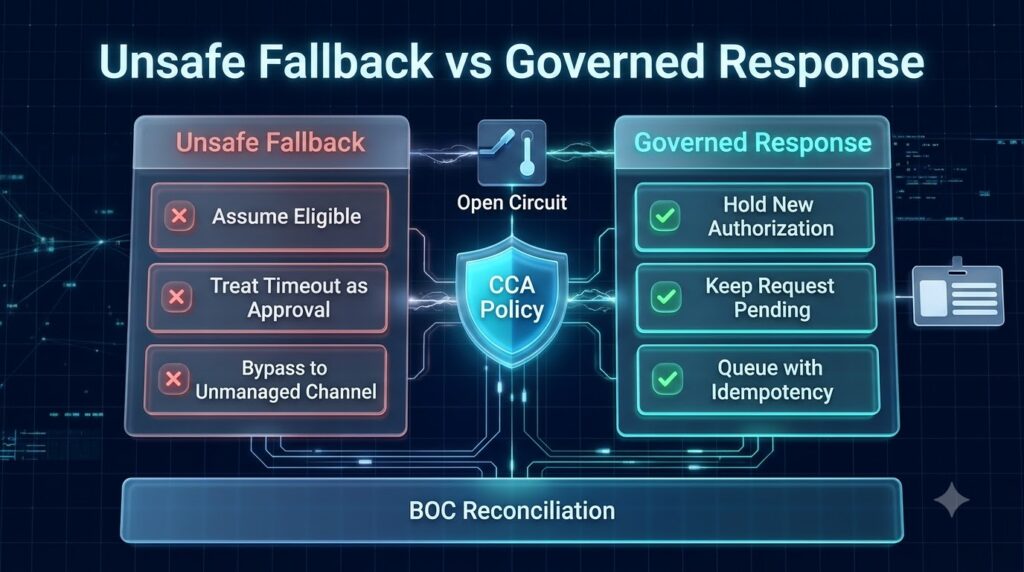
Apply Dependency Specific Fallbacks
| Unavailable service | Unsafe fallback | Governed response |
|---|---|---|
| HCM eligibility | Assume employee remains eligible | Hold new authorization or use unexpired approved evidence |
| Directory contact | Accept unrestricted user edits | Use approved fields within freshness limit or hold |
| Approval engine | Treat timeout as approval | Keep request pending with no BCM order |
| CCA policy | Send request directly to BCM | Suspend new orders; preserve existing execution |
| BCM API | Create order through an unmanaged channel | Queue authorized intent with idempotency |
| Print provider | Reroute without policy evaluation | Return material route change to CCA |
| Provider callback | Assume production failed | Query provider and reconcile before retry |
Use Bulkheads to Limit the Blast Radius
A breaker protects calls to a dependency; a bulkhead limits the resources one failing workload can consume. Separate connection pools, queues, concurrency and rate limits by source, business unit, provider or workflow criticality. For example, a large low-priority reorder campaign should not exhaust capacity required for approved onboarding orders.
Accordingly, BOC should monitor saturation and reject or defer work according to declared priority. However, resource isolation must not change eligibility or quantity policy. It only preserves the ability of governed traffic to make progress.
Coordinate Timeouts, Retries, and Breakers
Timeouts should reflect the service-level objective and the caller capacity. Likewise, retries should be bounded, use backoff and jitter, and operate only on errors that are safe to repeat. Consequently, the breaker threshold should account for those retries so one user request does not contribute uncontrolled failure volume.
Furthermore, layered services need a common retry budget. If the portal, integration gateway, CCA and BCM all retry independently, one failure can multiply into dozens of calls. Therefore, prefer one owning layer for retry and propagate clear failure semantics to the others.
Run a Controlled Recovery Sequence
| Recovery stage | Control objective | Release condition |
|---|---|---|
| Detect | Confirm dependency health has degraded | Breaker opens with evidence |
| Contain | Stop cascading calls and isolate workload | Error volume stabilizes |
| Assess | Identify affected decisions and orders | Scope and business risk known |
| Probe | Test dependency with limited traffic | Technical health meets threshold |
| Validate | Confirm data freshness and business state | CCA evidence is trustworthy |
| Ramp | Restore traffic in measured cohorts | No renewed saturation or policy drift |
| Reconcile | Close queued and in-flight outcomes | BOC confirms one final state |
Do Not Close the Incident at Endpoint Recovery
An endpoint can return healthy responses while event queues remain delayed, caches remain stale or BCM acknowledgments remain incomplete. Therefore, recovery should verify data currency, policy versions, pending approvals, active orders and provider state. Only then should normal throughput resume.
Next, use progressive release with cohort limits and abort thresholds. If error rates, latency, stale-data findings or duplicate detections rise, reopen the circuit and preserve the evidence. In short, a fast rollback is part of safe recovery, not an admission of failure.
Secure Operational Overrides
Forced-open, forced-closed and degradation overrides can affect enterprise orders. Therefore, restrict them through least privilege, strong authentication, time limits and recorded approval. In addition, the operator should state the dependency, business scope, reason, expected behavior and expiration.
Equally important, a forced-closed breaker should never be used to silence an alert while the dependency remains unhealthy. Instead, emergency continuity should choose an approved degradation mode rather than bypass technical and business controls together.
Use BOC for Incident Operations
| BOC signal | Operational question | Required action |
|---|---|---|
| Breaker state | Which dependency and workflow are isolated? | Assign owner and business scope |
| Degradation mode | What user and order actions remain permitted? | Confirm CCA policy and messaging |
| Queue age | Are pending requests exceeding service targets? | Escalate and prioritize cohorts |
| Authorization age | Are reusable decisions approaching expiry? | Hold or reevaluate in CCA |
| BCM order state | Which approved orders are already active? | Preserve execution and prevent duplicates |
| Recovery probe | Is technical health stable under limited traffic? | Increase gradually or reopen circuit |
| Reconciliation gap | Are source, decision, order and outcome aligned? | Resolve before incident closure |
Measure Resilience Governance
| Measure | What it reveals | Target direction |
|---|---|---|
| Breaker activation accuracy | Circuits open for real dependency failure | High precision |
| Cascading failure rate | One outage damages other services | Decrease to zero |
| Degraded decision count | CCA actions use approved fallback evidence | Monitor and explain |
| Unauthorized continuity | Orders bypass required authority | Zero |
| Queue recovery time | Pending requests reach governed disposition | Decrease |
| Duplicate order rate | Retry or recovery creates extra execution | Zero |
| Reconciliation coverage | Every affected transaction has final evidence | Complete |
Implement Circuit Breaker Governance in Stages
- Map HCM, IAM, CRM, directory, approval, CCA, BCM, provider and callback dependencies.
- Classify each dependency by authoritative function, business criticality and failure consequence.
- Define timeouts, retry budgets, breaker thresholds, probes and bulkhead capacity.
- Document approved full-service, read-only, queue, evidence-reuse and suspension modes.
- Bind cached facts and CCA decisions to source version, freshness, scope and expiration.
- Protect BCM order creation with CCA authorization and stable idempotency.
- Configure BOC visibility for breaker state, queues, overrides, recovery and reconciliation.
- Test slow, unavailable, stale, partial and recovered dependency scenarios.
- Practice progressive restoration with cohorts, abort thresholds and rollback.
- Review the model after API, policy, template, provider or architecture changes.
Frequently Asked Questions
What is a circuit breaker?
It is a resilience control that stops repeated calls to an unhealthy dependency and permits limited probes before normal traffic resumes.
What is graceful degradation?
It is a predefined reduction in capability that preserves safe functions while suspending actions that lack trustworthy authority or evidence.
What is CCA?
CCA is the enterprise policy and orchestration authority for governed business card identity, eligibility, templates, quantities, approvals and routing.
What is BCM?
BCM is the business card ordering management system or software that executes authorized orders, proofing, production coordination, delivery and reporting.
What is BOC?
BOC provides incident visibility, exception ownership, recovery monitoring and source-to-card reconciliation.
Can CCA use cached identity data during an outage?
Only when policy permits the field, source version, freshness, scope and risk for the specific decision.
Can BCM continue during a CCA outage?
BCM may continue confirmed orders when the next action is covered by an existing valid authorization, but it should not create new unauthorized orders.
Does an open circuit mean the employee is ineligible?
No. It indicates dependency protection, not a business policy denial.
When should normal traffic resume?
After technical probes, data-freshness checks, business-state validation and progressive cohort monitoring succeed.
How does BOC close the incident?
BOC links affected sources, CCA decisions, BCM orders, queued work, overrides and final outcomes before closure.
The Strategic Outcome
Circuit breaker governance and graceful degradation prevent an unstable dependency from becoming an authorization failure across the enterprise. CCA preserves decision integrity, BCM protects authorized order execution and BOC maintains incident accountability.
As a result, the organization gains continuity without treating stale data, manual bypasses or duplicate orders as acceptable resilience techniques.
Select one high-volume business card integration and simulate an unavailable HCM or approval dependency. Confirm that the circuit opens, the user receives a temporary service status, CCA blocks unsafe authorization, BCM preserves existing approved orders and BOC can reconcile every queued or degraded transaction after recovery.