

API Versioning and Contract Governance for Enterprise Business Card Integrations
Identity Execution Governance with CCA | Policy-Driven Control, Real-Time Enforcement & Audit Trails
Authentication answers who you are, but it doesn't control what you execute. This video explains why authenticated actions like placing orders or changing configurations can run without governance, creating over-permissioned identities and missing audit trails. See how a governance-first approach with CCA brings policy-driven execution, real-time enforcement, and complete auditability to every identity action.
Business card API versioning governance: changing connected systems without breaking business card authority, ordering or evidence.
An API Change Can Change the Business Outcome
Enterprise teams often describe API versioning as a technical compatibility problem. However, in a business card program, an API contract carries more than fields and status codes. In practice, it communicates authoritative workforce facts, exposes permitted ordering choices, records approvals, creates controlled orders and returns production or delivery evidence. A change to the contract can therefore alter who is eligible, which identity is printed, what quantity is allowed or whether an exception remains visible. That is why business card API versioning governance matters.
Business card API versioning governance, also called API contract governance, is the discipline that defines how a connected business capability changes without losing its meaning. In particular, it covers ownership, semantic definitions, schema compatibility, lifecycle states, testing, release communication, consumer migration, deprecation, retirement and reconciliation. Therefore, the objective is not indefinite backward compatibility. Instead, it is controlled change with a provable business result.
Keep the Roles of CCA, BCM and BOC Explicit
Color Card Administrator, or CCA, is the enterprise control and orchestration layer for API-connected business card governance. First, it receives trusted facts from systems such as HCM, HRIS, CRM, ERP, procurement, SSO and proprietary applications. Then CCA applies enterprise rules for eligibility, approved identity, templates, brand standards, permissions, quantities, approvals and routing. In other words, it does not merely copy source data into a print file.
Business Card Manager, or BCM, is the business card ordering management system or software. Meanwhile, BCM manages the controlled ordering workflow, including permissions, approvals, templates, quantities, order creation, production coordination, delivery status and reporting. Similarly, Business Ops Center, or BOC, provides operational visibility, exception management and reconciliation across the source event, CCA decision, BCM transaction and fulfillment result.
Above all, a version change must preserve these boundaries. First, source systems remain authoritative for their approved facts. Likewise, CCA remains authoritative for the governed business card decision. Similarly, BCM remains responsible for managed ordering and execution. Finally, BOC confirms that the connected process reached the expected outcome. As a result, a new API version should not move authority merely because a new field or endpoint makes bypassing the intended control easier.
Treat the Contract as a Business Agreement
| Contract element | Technical meaning | Business governance meaning |
|---|---|---|
| Resource | Object represented by the API | The governed employee, identity, request, decision or order |
| Field | Named value and data type | An attribute with a defined owner, purpose and permitted use |
| Operation | Action exposed to a consumer | A right to request, approve, order, cancel or retrieve evidence |
| Status | Lifecycle state | A controlled milestone with operational consequences |
| Error | Failure response | A decision about retry, correction, review or rejection |
| Event | Asynchronous notification | Evidence that a meaningful state changed |
| Version | Published contract baseline | A governed set of semantics, controls and compatibility expectations |
For this reason, document the business definition beside the schema. For example, a field called title may mean the HCM job title, the externally approved business title or free-form text. However, those meanings are not interchangeable. Consequently, a technically valid payload can still produce an unauthorized identity if the contract does not declare ownership and transformation rules.
Version Semantics, Not Only Syntax
For instance, a new optional field is often called nonbreaking because older consumers can ignore it. However, the field may be operationally breaking if it changes approval, template selection, pricing, legal text or provider routing. Similarly, renaming a status can break dashboards and reconciliation even when the order continues to print.
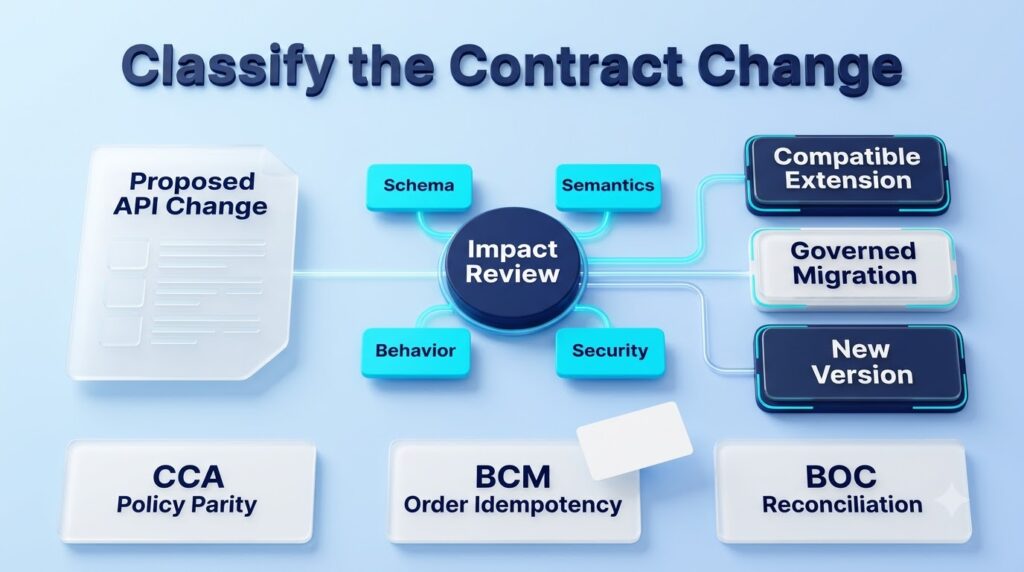
Therefore, classify changes through both technical and business impact. Specifically, ask whether the change modifies authority, meaning, validation, default behavior, required evidence, timing or downstream action. If the answer is yes, manage it as a governed contract change even when the wire format remains compatible.
Classify Changes Before Release
| Change class | Example | Required treatment |
|---|---|---|
| Compatible extension | New optional correlation metadata | Document, test and monitor adoption |
| Conditional change | New field required for one legal entity | Publish applicability and migration rules |
| Semantic change | Existing field gains a different business meaning | Create a new version and prohibit silent reinterpretation |
| Behavioral change | Default quantity or approval route changes | Policy approval, regression testing and effective dating |
| Breaking schema change | Field removed, type changed or endpoint replaced | Versioned migration and deprecation window |
| Security change | New audience, scope or authentication requirement | Security review and controlled credential transition |
| Lifecycle change | Status added, merged or retired | Update BCM workflow and BOC reconciliation logic |
Design a Stable Canonical Model
To start, CCA integrations should use a stable business vocabulary for identity, decision, approval and order concepts. Thus, the canonical model separates enterprise meaning from vendor-specific payloads. An HCM worker event, CRM territory update and employee portal request may use different terms, but CCA should translate them into governed concepts before making a decision.
However, a canonical model is not a dumping ground for every upstream attribute. Instead, include only data needed to establish identity context, policy, ordering and evidence. In addition, define the owner, allowed values, format, sensitivity, effective date and transformation rule for each element. As a result, this reduces consumer coupling and prevents a source-system redesign from becoming an uncontrolled business card redesign.
Use Clear Versioning Boundaries
First, version at a boundary that consumers can understand and operate. For example, common approaches include a path, media type, schema identifier or event type. However, the mechanism matters less than deterministic discovery, consistent routing and unambiguous evidence. In addition, every transaction should record the contract version used for validation and decisioning.
Of course, avoid creating a new major version for every small change, but do not hide breaking semantics behind the same label. Also, maintain a change log that distinguishes additions, deprecations, validation changes, security requirements and business-behavior changes. Furthermore, effective dates should be explicit, especially when policy and contract changes must activate together.
Govern Inbound Source Contracts
| Inbound concern | CCA control | Failure prevented |
|---|---|---|
| Source identity | Authenticate consumer and validate tenant and environment | Untrusted data injection |
| Schema | Validate structure, types, enumerations and version | Malformed or misread facts |
| Field authority | Accept each attribute only from its approved owner | Source conflict and unauthorized overwrite |
| Effective time | Apply changes at the intended business date | Premature or stale identity |
| Deduplication | Use stable event and correlation identifiers | Repeated lifecycle actions |
| Minimum data | Reject incomplete decision context | Assumed eligibility or template |
| Unsupported version | Return a specific migration error | Silent data loss or fallback |
HCM, IAM, CRM and procurement integrations should not obtain ordering authority simply by sending a valid payload. Instead, CCA validates the source and contract, then applies the current enterprise policy. Consequently, an accepted event can still lead to denial, review or no action when the person, role or request is not eligible.
Govern Decision and Experience APIs
Employee portals and enterprise applications may also use CCA APIs to display permitted business card options. In that case, the response should be policy constrained: approved program, template, editable fields, allowed values, quantity ceiling, approval requirement and effective policy version. Therefore, the front end should not recreate these rules locally.
When a decision contract changes, migrate the interface and its validation together. Otherwise, a portal that understands a new field but still enforces an old rule can display an option that CCA later denies. Conversely, a stale portal may suppress a permitted choice. Thus, contract tests should confirm both presentation and final server-side authority.
Protect the CCA to BCM Handoff
First, CCA should send BCM a versioned authorization rather than a loosely structured card record. Specifically, the transaction should contain stable request and decision identifiers, approved business identity, template version, quantity, delivery context, cost allocation, policy version and approval evidence. In addition, BCM must reject unauthorized edits or incompatible payloads instead of attempting to infer missing governance.
Because BCM is the business card ordering management system or software, its contract also covers order states, proofing, cancellation, reprint, shipment and reporting. Therefore, changes must preserve idempotency and state transitions. Above all, a version migration must never create two production orders for one governed request.
Normalize Return Events for BOC
| Provider or BCM event | Canonical lifecycle meaning | BOC action |
|---|---|---|
| Accepted | Managed order acknowledged | Start expected-state monitoring |
| Proof ready | Review artifact available | Track approval or timeout |
| Production started | Physical execution committed | Restrict cancellation path |
| Shipped | Carrier movement recorded | Validate destination and tracking |
| Delivered | Fulfillment reported complete | Await reconciliation evidence |
| Rejected | Transaction cannot proceed | Open owned correction or policy exception |
| Canceled or reprinted | Prior execution changed | Preserve linkage and financial treatment |
Of course, provider codes may change independently of the enterprise contract. Therefore, adapters should map them into stable canonical states while preserving the original value for diagnostics. In addition, BOC needs the contract version, correlation identifiers and timestamps to determine whether an apparent exception is a real failure or a mapping defect.
Build Contract Tests Around Business Outcomes
On its own, schema validation only proves that a message is well formed. However, contract testing must also prove that the connected business behavior remains correct. For this reason, maintain representative scenarios for hires, transfers, entity changes, title exceptions, delegated ordering, approvals, quantity limits, cancellations, reprints and delivery reconciliation.
| Test layer | Question answered | Example evidence |
|---|---|---|
| Provider conformance | Does each implementation follow the published contract? | Automated schema and behavior results |
| Consumer compatibility | Can the consumer process the planned response or event? | Consumer-driven contract test |
| CCA policy regression | Are eligibility and identity decisions unchanged where expected? | Decision comparison by policy version |
| BCM transaction test | Does one authorization create one managed order? | Idempotency and order-state evidence |
| BOC reconciliation test | Can the full transaction still be correlated? | Source-to-delivery evidence chain |
| Negative test | Are unsupported or unauthorized actions rejected clearly? | Expected error and no downstream order |
Run a Controlled Migration
- First, inventory every provider, consumer, endpoint, event subscription and contract version.
- Name the business owner, technical owner and approval authority for each contract.
- Classify the proposed change by schema, semantics, behavior, security and lifecycle impact.
- Publish the new contract, examples, change log, effective dates and migration guidance.
- Validate provider conformance and consumer compatibility in an isolated environment.
- Run representative CCA policy, BCM ordering and BOC reconciliation scenarios.
- Allow controlled parallel observation without producing duplicate business transactions.
- Then migrate consumers in planned waves and measure traffic by version.
- Stop new onboarding to the deprecated version and escalate inactive owners.
- Finally, retire the old version only after usage reaches zero and business outcomes reconcile.
Use Deprecation as a Managed Lifecycle
To begin with, deprecation is a notice that a supported contract is moving toward retirement; it is not immediate removal. First, publish the replacement, migration deadline, support limits and retirement criteria. Next, identify every active consumer and require acknowledgment from an accountable owner. Finally, usage telemetry should distinguish test traffic, production traffic, automated retries and dormant credentials.
However, do not keep a deprecated version permanently because ownership is unclear. Indeed, that converts temporary compatibility into unmanaged infrastructure. Equally, do not retire it only because the technical deadline arrived. Instead, confirm that critical consumers migrated, old traffic stopped, in-flight orders remain observable and reconciliation is complete.
Plan Rollback Without Creating Split Authority
To begin, rollback should restore a known contract and policy combination. For example, if the schema returns to an older version while CCA policy remains on a newer semantic model, consumers may receive technically valid but misunderstood decisions. Therefore, link release artifacts so contract, adapter, policy and monitoring changes can be evaluated together.
Similarly, during a failed migration, pause unsafe new actions before widening permissions or accepting unvalidated payloads. Meanwhile, BCM should protect existing order states, while BOC identifies which transactions used each version and which require correction. Ultimately, recovery is complete only after technical service and business outcomes agree.
Measure Business Card API Versioning Governance
| Measure | What it reveals | Target direction |
|---|---|---|
| Known ownership | Contracts and consumers have accountable owners | Complete |
| Version concentration | Traffic is spread across avoidable legacy versions | Concentrate on current supported versions |
| Unsupported requests | Consumers use retired or unknown contracts | Decrease to zero |
| Migration completion | Active consumers moved before retirement | Complete |
| Policy parity | Expected CCA decisions match across migration | Complete where intended |
| Duplicate orders | Version or retry behavior created repeated BCM transactions | Zero |
| Reconciliation exceptions | BOC cannot connect source, decision, order and outcome | Decrease and close |
Frequently Asked Questions
What is business card API contract governance?
In short, it is the controlled management of API meaning, ownership, compatibility, migration, deprecation and retirement across the business card lifecycle.
What is CCA?
In simple terms, CCA is the enterprise control and orchestration layer that applies eligibility, identity, template, approval, quantity and routing policy to connected business card activity.
What is BCM?
In simple terms, BCM is the business card ordering management system or software that manages permissions, approvals, templates, quantities, orders, fulfillment coordination and reporting.
What is BOC?
In short, BOC provides operational visibility, exception management and reconciliation across connected systems and fulfillment outcomes.
Does every optional field count as a nonbreaking change?
No. In fact, an optional field can change approval, routing or identity meaning and therefore require governed migration.
Should source systems send card-ready data directly to BCM?
No. Instead, trusted facts should pass through CCA policy so BCM receives an authorized order specification.
How are duplicate orders prevented during migration?
In general, stable identifiers, idempotency and controlled parallel testing prevent repeated messages from becoming new production orders.
When can an old API version be retired?
After consumers have migrated, usage is zero or formally handled, in-flight transactions remain visible and outcomes reconcile.
Why must BOC know the API version?
Above all, version context helps distinguish real operational failure from mapping, compatibility or migration defects.
Can a portal remain the employee interface?
Yes. For example, it can use CCA decision APIs while CCA remains the authoritative governance layer.
The Strategic Outcome
Business card API versioning governance lets the enterprise improve integrations without fragmenting authority. CCA continues to make governed business card decisions, BCM continues to manage authorized ordering and BOC continues to expose status, exceptions and reconciliation. As a result, connected systems can change while the business meaning remains explicit and testable.
The result is a platform that can evolve safely: every contract has an owner, every field has a meaning, every version has a lifecycle and every migration is judged by the final business outcome rather than deployment success alone.
Select one active business card API and document its consumers, current contract version, field meanings, authority boundaries, CCA policy dependencies, BCM order states, BOC evidence, compatibility tests, deprecation process and retirement criteria. Finally, if any component cannot be named or tested, treat it as a governance gap before the next change is released.