

Business Card API Governance: Controls Access, Change, & Accountability Across Enterprise Integrations
Business Card API Governance and the Role of CCA
Enterprise integration makes business card administration faster, but it also expands the number of systems, service accounts, and teams that can influence a card. HCM platforms contribute workforce facts. Identity systems authenticate users and services. CRM and procurement platforms provide commercial and financial context. Portals initiate requests. BCM coordinates fulfillment, and print providers return production and delivery events. Without a governance model, each connection can become an informal route around enterprise policy.
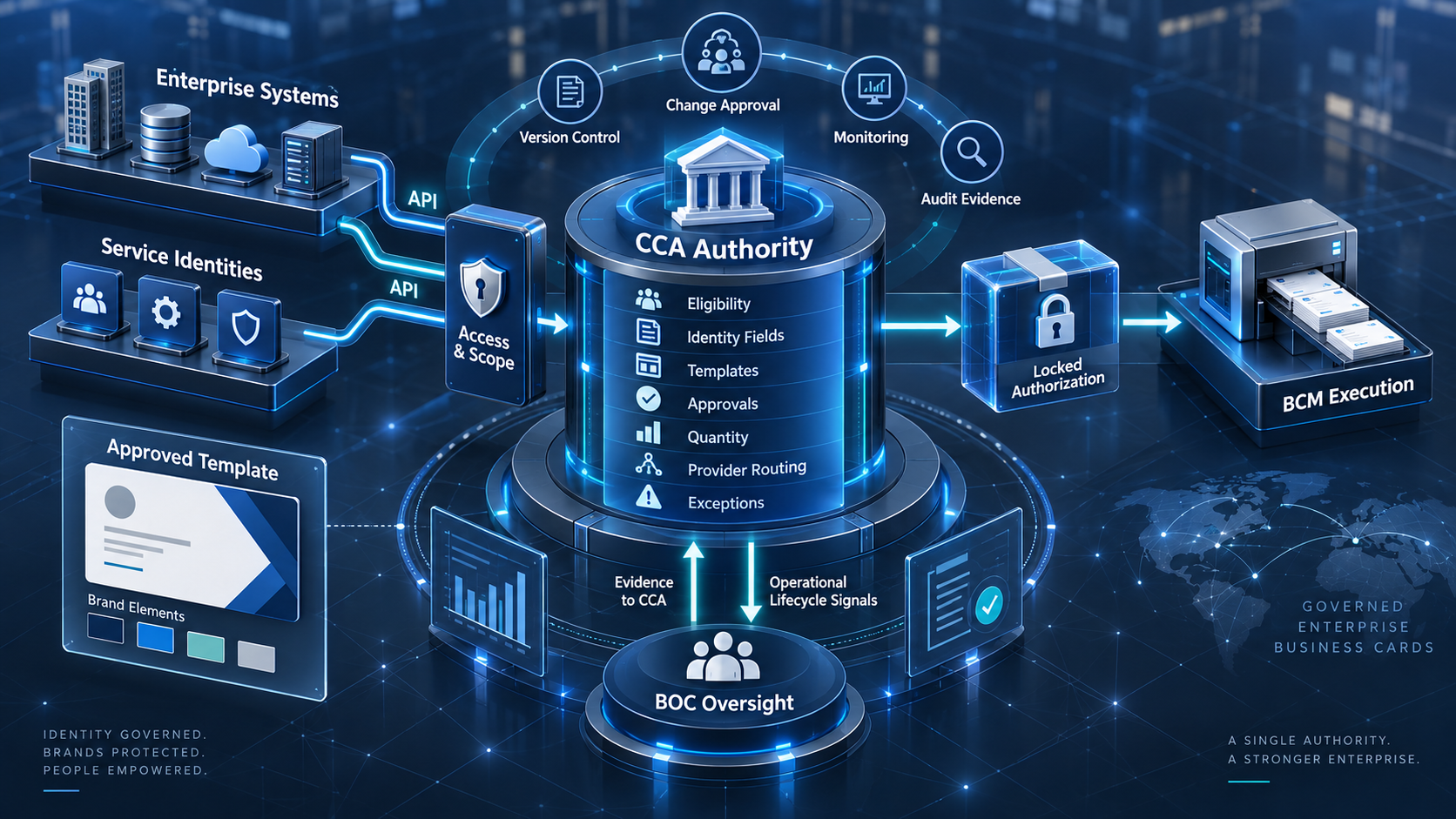
Business card API governance ensures that every connection serves one controlled program. Color Card Administrator (CCA) remains the administrative authority for eligibility, identity fields, templates, quantities, approvals, provider routing, and exceptions. Business Card Manager (BCM) executes only the transaction that CCA authorizes. Business Ops Center (BOC) makes lifecycle status, failures, and reconciliation visible. Governance defines who may use each capability, how changes are approved, what evidence is retained, and how accountability continues from source event to delivered card.
Why API Governance Is Part of Business Card Governance
An API does more than transport data. It can start a request, expose permitted fields, submit a card for approval, create an order, cancel production, or reveal status. Each operation represents a business action with consequences for identity, brand, privacy, spend, and physical fulfillment. Securing the network connection is necessary, but it does not determine whether the calling system should be allowed to perform the action.
CCA places business authorization above technical connectivity. A service may be trusted to provide employee status without being allowed to select a template. A portal may display permitted options without being allowed to alter policy. A provider may report shipment status without being allowed to change the approved identity payload. API governance makes these boundaries explicit and enforceable.
The CCA API Governance Framework
| Governance domain | Core question | CCA control | Evidence |
| Identity and access | Who or what is calling? | Service identity, authentication, role and scope validation | Caller, credential class, scope and timestamp |
| Business authorization | Which action is permitted? | Eligibility, delegation, entity, template, quantity and approval policy | Decision ID, reason and policy version |
| Data authority | Which values may be used? | Field ownership, validation, transformation and exception rules | Source, governed value and provenance |
| Contract and change | How may the integration evolve? | Schema versions, compatibility rules, testing and approvals | Change record, test result and effective date |
| Execution integrity | Did BCM and the provider follow authorization? | Locked payload, idempotency, lifecycle states, and mismatch controls | Order ID, acknowledgments and status history |
| Operational accountability | Who resolves failures and proves closure? | BOC monitoring, ownership, escalation and reconciliation | Exception owner, remediation and closure evidence |
Govern the Caller Before Governing the Call
Every machine connection should use a distinct service identity. Shared credentials obscure ownership and make it difficult to revoke one integration without disrupting others. The business card identity should state which application, environment, legal entity, or operating domain it represents. Human administrators should use personal accounts with role-based access rather than borrowing service credentials.
Authentication confirms the caller, but CCA must also evaluate authorization. A connector that synchronizes location data needs different permissions from an employee portal that submits requests or a BCM service that retrieves approved orders. Scopes should be narrow enough to separate read, validate, submit, approve, cancel, administer, and audit capabilities. High-impact actions may also require entity, region, or program restrictions.
Apply Least Privilege to Business Card Capabilities
Least privilege becomes meaningful when it is expressed in business terms. A portal may check eligibility for the signed-in employee and retrieve only that employee’s permitted card schema. An HR integration may send identity lifecycle management events but should not retrieve complete order histories. A print provider may access the production payload for assigned orders without seeing unrelated workforce records or other suppliers’ transactions.
CCA should deny any operation outside the assigned capability and record a structured reason. Temporary access should expire automatically. Delegation, such as an assistant ordering for an executive or a regional administrator managing a defined population, must be explicit, bounded, and auditable. Broad administrative access should remain exceptional and subject to review.
Separate Authentication From CCA Authorization
An identity provider can confirm that a user or service is genuine. It cannot decide which business card program, identity fields, template, quantity, or approval route are appropriate. Those are CCA decisions based on the current enterprise policy and request context. Treating successful authentication as permission to order collapses two different control responsibilities.
The integration should pass authenticated context to CCA, which resolves the applicable authority. This design supports single sign-on and modern service authentication without turning IAM groups into the only business card policy. It also allows CCA to consider lifecycle state, legal entity, card program, template availability, quantity thresholds, budget, and exception history before authorizing the action.
Govern Data Provenance and Purpose
Connected systems may contain overlapping values for names, titles, telephone numbers, locations and organizational units. API governance must specify which source owns each field and the purpose for which it may be used. The newest or easiest value is not automatically authoritative. CCA applies field-level ownership, formatting, localization, and transformation rules before a value can appear on a card.
Payload minimization is equally important. A business card management request rarely needs a complete HCM profile, personal address, date of birth, compensation data, or unrelated employment history. Integrations should send the minimum context necessary for CCA to make the decision. Logs and monitoring systems should preserve identifiers, policy versions, status, and errors without unnecessarily duplicating full identity payloads.
Control API Contracts and Versions
A business card API contract defines more than field names. It establishes required attributes, allowed values, validation rules, status meanings, error behavior, identifiers, and lifecycle expectations. Changing the contract without governance can break a portal, misroute a supplier order, or silently drop a field. The enterprise needs named owners, version rules, compatibility standards, and a documented deprecation process.
API versions should remain distinct from CCA policy and template versions. The API version describes how systems communicate. The policy version shows which eligibility, approval, or routing rules governed a decision. The template version identifies the visual and content structure authorized for production. Recording all three allows the enterprise to reconstruct an outcome accurately.
The Controlled Change Lifecycle
- Register the proposed change with its business purpose, affected consumers, owner, and risk classification.
- Assess whether the change affects authentication, scopes, data ownership, card policy, templates, approvals, ordering, or provider execution.
- Define compatibility behavior, migration requirements, effective date, rollback plan, and evidence expectations.
- Review the change with the appropriate CCA program, security, data, brand, procurement, and operations owners.
- Test normal, denied, exception, duplicate, retry, cancellation, and out-of-order scenarios in a nonproduction environment.
- Publish the approved contract and implementation guidance with a clear support and deprecation window.
- Deploy with monitoring for error rate, authorization denials, mapping changes, missing events, and reconciliation variances.
- Confirm that the change produced the intended business outcome before retiring the prior version.
Protect the CCA to BCM Authorization Boundary
The handoff from CCA to BCM is a critical governance boundary. CCA should issue a locked, versioned authorization containing the approved identity fields, template, quantity, destination, provider route, policy version, and approval evidence. BCM uses that package to create the proof and order. It should not independently reinterpret eligibility or substitute identity content.
If a material value changes after authorization, the request should return to CCA for re-evaluation. This rule prevents a downstream edit from converting an approved transaction into an unapproved one. Stable request, decision, and order identifiers connect the records without treating them as the same object. The boundary keeps policy ownership clear while allowing BCM to specialize in execution.
Govern Webhooks and Return Events
Governance continues after order submission. BCM and provider webhooks can report acceptance, proof availability, production, shipment, delivery, cancellation, rejection, and reprint. These inbound events must be authenticated, validated, idempotent, and correlated with the original CCA decision. A forged or duplicated status message must not advance a transaction or close an exception.
Provider-specific states should be normalized into a common enterprise lifecycle. BOC can then identify missing acknowledgments, late production, unauthorized substitutions, duplicate fulfillment, and delivery failures across suppliers. Event retention should be sufficient to explain the transaction while respecting privacy and operational retention policies.
Idempotency Retry and Physical Fulfillment Risk
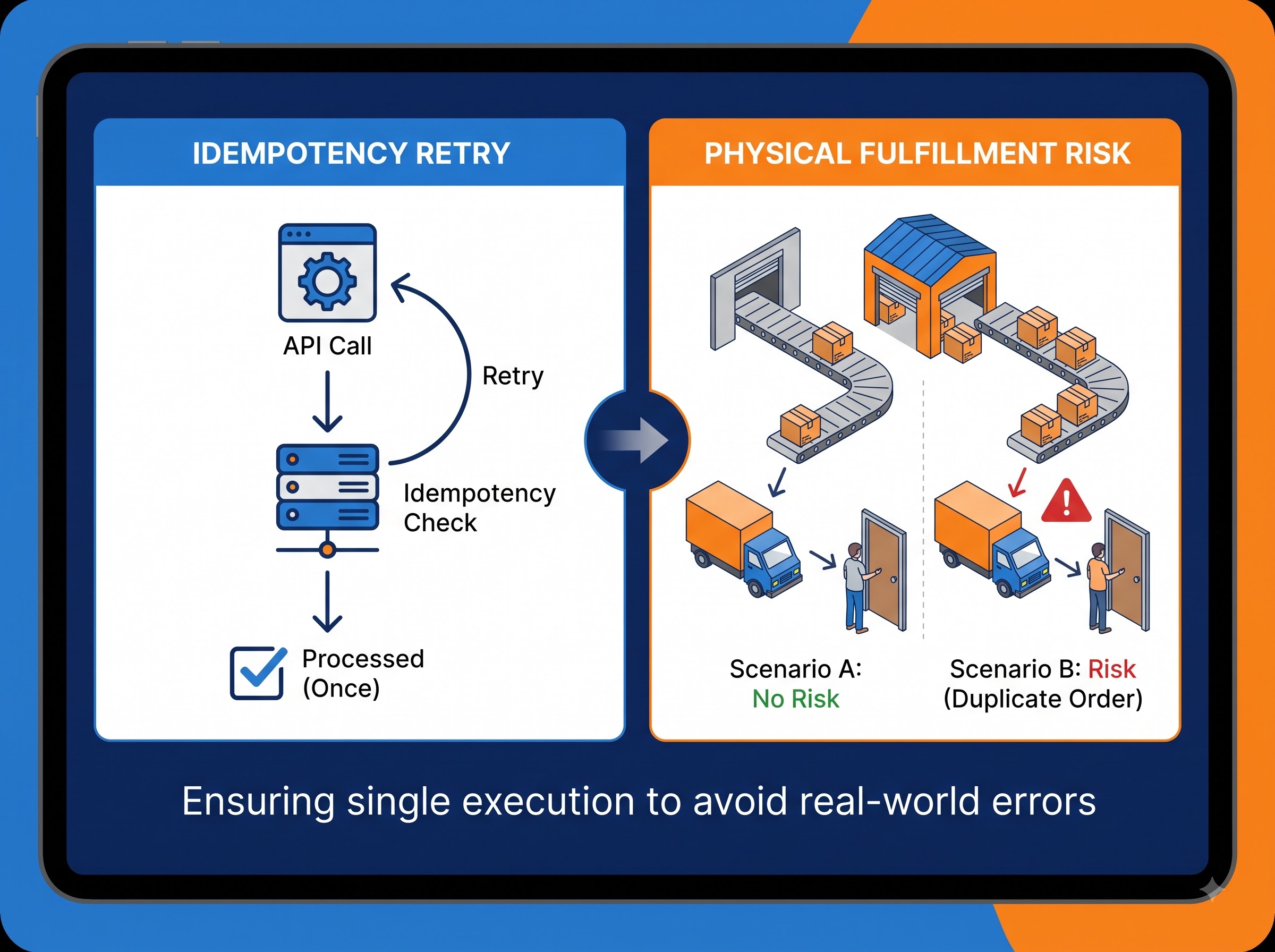
API failures are especially consequential when the outcome is a physical product. If a caller does not receive a response, it cannot assume that the order failed. Repeating the same request without a stable idempotency key may create a second print job. The governance standard must specify retry intervals, maximum attempts, acknowledgment states, and the point at which a human or automated reconciliation process intervenes.
Cancellation also requires controlled states. A termination or corrected identity may justify stopping an order, but production may already have begun. CCA determines the business authorization to cancel, BCM coordinates the execution request, and BOC records whether the provider accepted it. The final evidence should distinguish requested, accepted, rejected, and completed cancellation outcomes.
Monitoring Should Prove Control, Not Just Availability
Traditional API monitoring emphasizes latency, error rates, and uptime. CCA governance also needs business-control signals: events received from authoritative systems, requests denied by policy, field-source conflicts, approval aging, orders using current templates, duplicate submissions prevented, fulfillment statuses returned, and deliveries reconciled. These measures reveal whether the integration is supporting the intended program.
Alerts should identify the owner and required response. A transport outage belongs to the integration team; a rejected title may belong to a data steward; an expired template belongs to the brand owner; and a provider mismatch belongs to fulfillment operations. BOC can coordinate these exceptions without transferring CCA’s decision authority to the monitoring layer.
Audit Evidence Without Excessive Data Retention
A defensible record should show who or what initiated the action, the authoritative inputs used, the CCA decision and reason, policy and template versions, approvals, the locked BCM payload, provider acknowledgments, lifecycle states, exceptions and final reconciliation. This evidence supports investigations, supplier reviews, regulatory questions and internal control testing.
Evidence does not require retaining every source payload indefinitely. Stable references, hashes, selected governed values, and timestamps may be sufficient when the authoritative system preserves the original record. Retention should be risk-based, documented, and enforced. Audit exports need the same access controls and monitoring as the live platform because they can concentrate sensitive business identity information.
Operating Roles and Segregation of Duties
| Role | Primary accountability | Should not control alone |
| CCA program owner | Business card policy, service outcomes and governance priorities | Technical credentials or production overrides |
| Identity and security | Service authentication, scopes, access review and incident response | Card eligibility or template policy |
| Data steward | Authoritative field quality, mappings and source conflicts | Approval of their own high-risk exception |
| Brand owner | Templates, permitted content and visual standards | Supplier execution evidence |
| Procurement and finance | Spend, quantity, supplier and cost-allocation controls | Identity source ownership |
| Integration owner | Contracts, reliability, monitoring and technical change | Unilateral business-policy changes |
| Operations and BOC | Exceptions, service levels, reconciliation and closure evidence | Rewriting CCA authorization |
Implementation Roadmap
- Inventory every business card API, webhook, service identity, consumer, provider, and data flow.
- Assign ownership for business capabilities, data fields, contracts, credentials, policies and operational exceptions.
- Classify operations by business impact and define least-privilege scopes for each integration.
- Establish canonical identifiers, status definitions, reason codes, schema standards and version rules.
- Document the CCA authorization boundary and prevent portals, BCM, or providers from recreating policy.
- Implement strong authentication, signature validation, secret rotation, environment separation, and access review.
- Standardize idempotency, retry, cancellation, webhook, and reconciliation behavior before scaling volume.
- Create contract and control tests that include denials, stale data, duplicates, failures, and unauthorized changes.
- Pilot governance with one end-to-end source-to-card journey and close every evidence gap.
- Operate recurring reviews for access, versions, exceptions, control coverage, provider performance, and residual risk.
Measures for an Effective Governance Program
Leadership should see both technical and governance performance. Useful measures include percentage of service identities with named owners, least-privilege coverage, overdue access reviews, unsupported contract versions, change success rate, policy denial rate, source-data conflict rate, approval cycle time, duplicate orders prevented, provider-event completeness, operational reconciliation coverage, and average time to close exceptions.
Metrics should be segmented by integration, environment, legal entity, region, card program, and provider. A low API error rate can hide weak authorization or incomplete coverage. The objective is not merely to keep interfaces running; it is to prove that connected ordering remains faithful to enterprise identity, brand, approval, spend, and fulfillment policy.
Frequently Asked Questions
What is business card API governance?
It is the set of policies, roles, technical controls, and evidence requirements that keep connected business card data, decisions, orders, and outcomes authorized and accountable.
Why is CCA central to API governance?
CCA owns the administrative decisions for eligibility, identity fields, templates, quantities, approvals, provider routing, and exceptions. APIs should expose or execute those decisions without relocating authority.
Is authentication enough to authorize an order?
No. Authentication confirms identity. CCA separately determines whether the caller may perform the requested business action in the specific card program and context.
How should service accounts be managed?
Use a distinct identity for each integration, least-privilege scopes, named ownership, credential rotation, environment separation, monitoring, and recurring access review.
How are API changes controlled?
Register, assess, approve, version, test, and monitor each material change. Define compatibility, migration, effective date, rollback, and deprecation before release.
What is the role of BCM?
BCM executes the proof-to-delivery workflow using the locked authorization issued by CCA. It does not replace CCA policy.
What is the role of BOC?
BOC provides operational visibility, exception coordination, status normalization, and reconciliation while preserving CCA as the authority layer.
How can audit evidence be retained without excessive personal data?
Preserve stable references, governed values, versions, decisions, timestamps, and outcome evidence while leaving unrelated workforce data in its authoritative source.
The Strategic Outcome
Effective API governance allows the enterprise to connect more systems without creating more policy engines. Each caller receives only the capabilities it needs. Every value retains a trusted source. Each change follows an accountable lifecycle. Every CCA authorization reaches BCM intact, and each provider outcome returns through BOC for reconciliation.
CCA therefore remains the stable administrative center of the business card ecosystem. Technology can evolve, suppliers can change, and channels can expand while eligibility, identity accuracy, brand standards, approval accountability, spend discipline, and audit evidence remain governed as one enterprise program.
Inventory one high-volume business card journey and document every caller, permission, data source, contract version, CCA decision, BCM action, provider event, and BOC record. Any step without a named owner, explicit authority, or retained evidence is a priority API governance gap.