

What Is Business Card Governance?
Streamlining Business Card Management through Effective Governance
In this video, the speaker highlights a common issue in many organizations where business cards, an essential branding and communication tool, often cause confusion due to inconsistent issuance practices.
Introduction
Most enterprise organizations do not have a business card problem.
They have a control problem.
Business cards are issued across departments, locations, and vendors, often without consistent oversight. Employees request them through different channels, approvals are inconsistent, and brand standards are interpreted rather than enforced.
This is where business card governance becomes critical.
Business card governance is the system of controls, workflows, and policies that ensure every business card issued across an organization is accurate, compliant, and aligned with enterprise standards.
It transforms business cards from a decentralized purchasing activity into a managed identity system.
Why Business Card Control Breaks in Enterprise Environments
In most organizations, business card ordering evolves organically.
- Teams use different vendors
- Templates are stored in multiple places
- Approval processes are inconsistent or bypassed
- Procurement has limited visibility
- HR is disconnected from ordering workflows
Over time, this creates fragmentation.
What begins as a simple operational task becomes:
- Brand inconsistency across locations
- Unauthorized designs or outdated information
- Duplicate vendors and uncontrolled spend
- No centralized reporting or audit trail
Without governance, business cards operate outside the systems that control other enterprise assets.
The Risks of Decentralized Business Card Management
Lack of governance introduces risks that extend beyond design.
Brand Risk:
Inconsistent layouts, incorrect logos, and outdated contact information reduce brand credibility and create confusion across markets.
Operational Inefficiency:
Multiple vendors, manual approvals, and inconsistent processes increase time and cost.
Compliance Gaps:
Without policy enforcement, organizations cannot ensure that business cards align with legal, regulatory, or internal standards.
Lack of Visibility:
Most organizations cannot answer basic questions:
- Who ordered what
- Which vendors were used
- How much was spent
- Whether approvals were followed
These are governance problems, not printing problems.
What Business Card Governance Actually Means
Business card governance introduces structure and control into the ordering process.
At a foundational level, it includes:
Role-Based Access:
Employees can only access templates and ordering options aligned with their role, department, and location.
Approval Workflows:
All orders follow defined approval paths before production, ensuring oversight and consistency.
Template Governance:
Templates are centrally managed and locked, preventing unauthorized design changes.
Policy Enforcement:
Ordering rules are embedded into the system, not left to interpretation.
Audit and Reporting:
Every order is tracked, creating visibility across departments, vendors, and spend.
This transforms business card ordering into a controlled workflow rather than an ad hoc request process.
Governance as Part of Enterprise Identity Infrastructure
Business cards are not standalone assets.
They are part of a broader identity system.
In enterprise environments, organizations manage identity across systems such as:
- HRIS platforms
- CRM systems
- Procurement systems
- Marketing asset platforms
Business card governance connects to this ecosystem.
For example:
- The system can automatically provision new employees during onboarding.
- Role changes can trigger updates to business card data
- Procurement policies can control vendor selection
- Central management can enforce brand standards across all locations.
This is where governance evolves into infrastructure.
How Enterprises Implement Business Card Governance
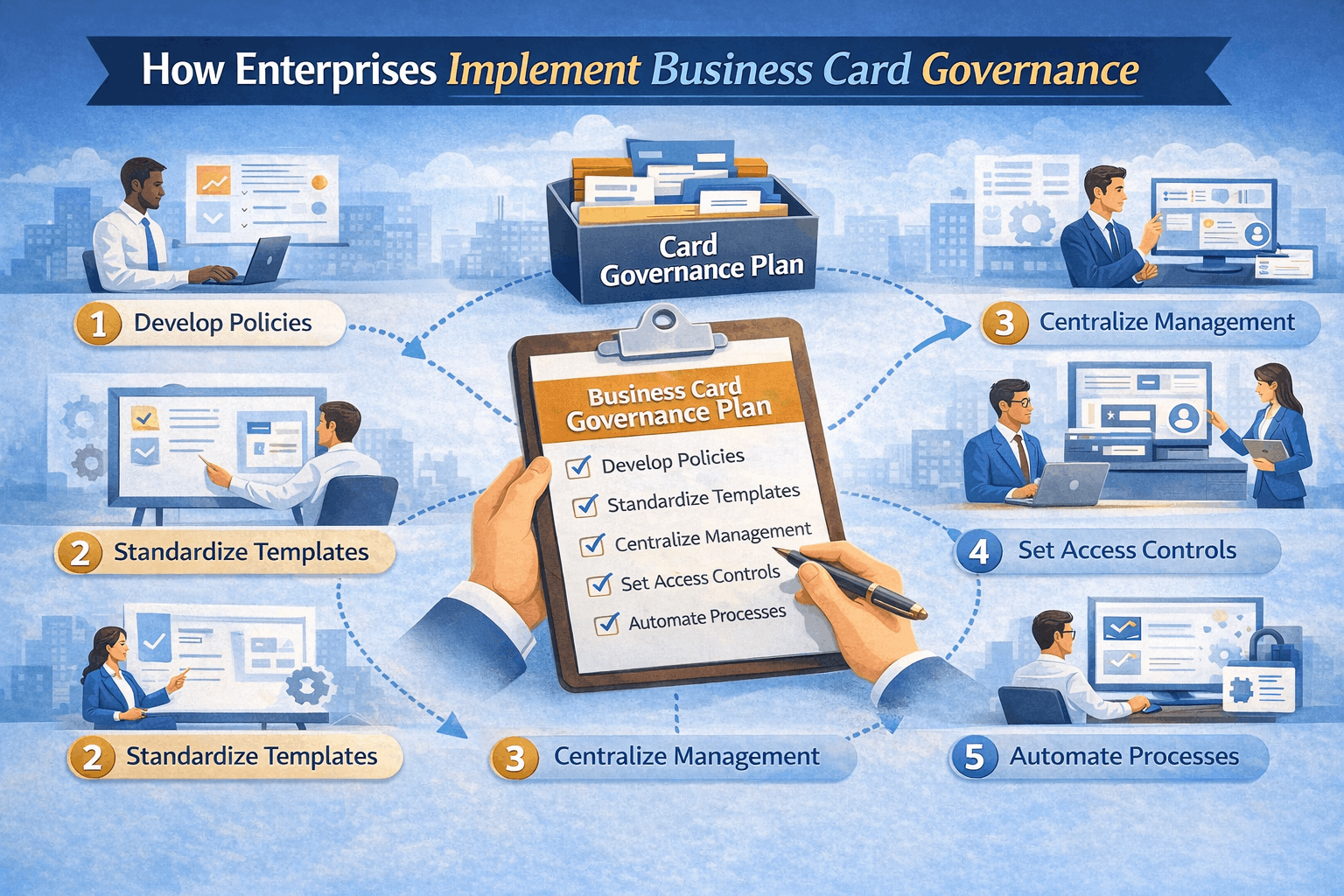
Organizations typically move toward governance in stages:
Stage 1: Centralization
Consolidating vendors, templates, and ordering processes into a single system.
Stage 2: Workflow Integration
Introducing approval workflows, role-based access, and policy enforcement.
Stage 3: System Integration
Connecting business card ordering with HR, procurement, and enterprise systems.
Stage 4: Full Governance
Achieving complete visibility, auditability, and control across the organization.
At this stage, business cards are no longer a fragmented process.
They are part of a governed operational framework.
The Role of Governance Platforms
Enterprise governance requires more than guidelines.
It requires systems that enforce rules automatically.
Governance platforms enable organizations to:
- Standardize templates across all locations
- Control access based on role and hierarchy
- Automate approvals and workflows
- Integrate with enterprise systems
- Track and report on all activity
This shifts business card management from manual coordination to system-driven control.
Conclusion
Business card governance is not about design or printing.
It is about control, consistency, and visibility across enterprise identity assets.
Without governance, organizations rely on fragmented processes that introduce risk, inefficiency, and inconsistency.
With governance, business cards become part of a structured system aligned with enterprise operations.
As organizations scale, governance is not optional.