

API Gateway Architecture For Enterprise Business Card Services
API Gateway Architecture and the Role of CCA
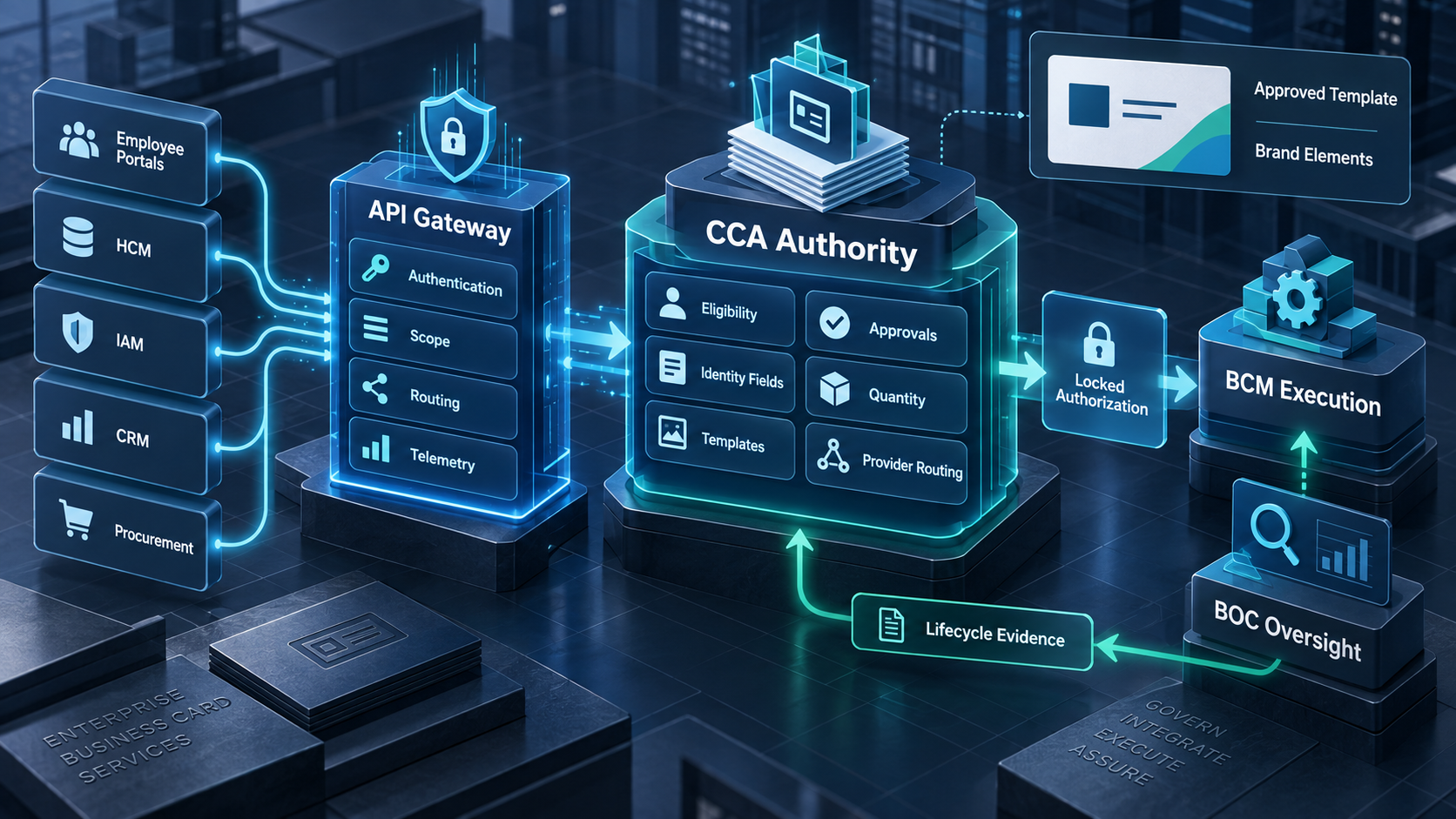
An enterprise business card program may connect employee portals, HCM platforms, identity providers, CRM applications, procurement systems, print suppliers, and operational reporting tools. An API gateway can give these consumers a consistent and protected route into shared services. It can authenticate callers, enforce transport controls, apply quotas, route requests, record telemetry, and manage API versions. Those functions are important, but they do not determine whether an employee is eligible for a card or which identity, template, quantity, approval route, and supplier should apply.
Color Card Administrator (CCA) remains the administrative authority for those business decisions. The gateway protects the route to CCA; it does not replace CCA. Business Card Manager (BCM) executes the proof-to-delivery transaction after CCA issues a governed authorization. Business Ops Center (BOC) observes identity lifecycle management events, coordinates exceptions, and reconciles operational evidence. This separation lets the enterprise standardize connectivity while preserving one source of business card authority.
Why the Gateway Must Not Become a Shadow Policy Engine
Gateways often support transformations, conditional routing, and programmable policies. That flexibility can tempt teams to place business rules at the edge: allow executives to bypass approval, map a country to a template, increase quantities for a campaign, or select a supplier from a gateway script. The result is a shadow policy engine that evolves separately from CCA. A request may then be technically valid yet inconsistent with current enterprise identity, brand, spend, or approval policy.
The durable boundary is straightforward. The gateway may decide whether a caller can reach a capability and whether the request is technically safe. CCA decides whether the requested business action is authorized in its current context. A gateway can reject a malformed token; CCA denies an ineligible card request. This can restrict request size; CCA restricts quantity. A gateway can route to the CCA service; CCA selects the permitted program, template, and provider route.
Responsibility Boundaries Across the Architecture
| Layer | Primary responsibility | Must not independently decide | Key evidence |
| API consumer | Send authenticated context and a valid business request | Eligibility, template or approval policy | Caller and request identifier |
| API gateway | Authentication enforcement, traffic protection, routing, quotas and telemetry | Card identity, quantity, provider or exception outcome | Token class, route, policy result and trace ID |
| Integration platform | Protocol mediation, orchestration and approved data mapping | A substitute business-card policy | Flow version, mapping version and execution status |
| CCA authority | Eligibility, field authority, templates, approvals, quantity, routing and exceptions | Physical production completion | Decision ID, reason, policy and template versions |
| BCM execution | Proof, order submission, production coordination and delivery workflow | Reinterpretation of CCA authorization | Order ID, locked payload and lifecycle states |
| BOC oversight | Monitoring, exception ownership, status normalization and reconciliation | Modification of approved identity or policy | Exception record, owner and closure evidence |
Design the Gateway Around Business Capabilities
A well-designed API surface reflects business capabilities rather than exposing internal database structures. Consumers may need to check eligibility, retrieve a policy-constrained card schema, validate governed fields, submit a request, retrieve approval status, obtain an authorized proof, cancel an eligible transaction or read fulfillment status. Each capability should have a clear owner, risk classification, scope, request contract, response contract, and lifecycle meaning.
Capability-oriented design prevents a portal or connector from assembling its own policy from raw records. For example, a portal should not download every template and decide which one to display. It should request the schemas permitted for the authenticated subject and context. An enterprise procurement governance connector should not overwrite the approved quantity; it should contribute the cost center or purchase reference CCA needs to reach a decision. The API expresses CCA authority in reusable form.
Authenticate at the Edge and Authorize in CCA
The gateway should validate tokens, certificates, signatures, and service identities before traffic reaches CCA. It should enforce environment separation, approved issuers, token lifetime, audience, cryptographic strength, and known client registrations. Rate limits and anomaly controls can reduce automated abuse. These are edge protections, and they should produce a reliable caller context for downstream decisions.
CCA then evaluates business authorization. It resolves whom the caller represents, whether delegation is valid, which legal entity and program apply, which fields are authoritative, whether the requested template and quantity are permitted, and whether approval or an exception is required. The CCA decision should be explicit and explainable. Successful gateway authentication must never be treated as automatic permission to order.
Use Scopes That Match Business Risk
Generic read and write scopes are too broad for an enterprise business card ecosystem. A service that supplies workforce events needs a different authority from a portal that creates requests, an approval service that records decisions, BCM retrieving authorized transactions or a supplier posting delivery status. Scopes should distinguish operations such as eligibility read, governed-schema read, request submit, approval act, authorized-order retrieve, lifecycle-event publish, cancel request and audit export.
Scopes may also be constrained by environment, entity, region, population, card program or supplier. Temporary access should expire automatically. High-impact administration and audit exports should use stronger controls and recurring review. The gateway enforces the assigned technical scope, while CCA confirms that the specific record and action remain permitted under business policy.
Control Integration Platform Orchestration
An integration platform can connect older protocols, enrich messages with approved references, coordinate asynchronous steps and handle enterprise messaging patterns. It is valuable when source systems and consumers cannot communicate directly. However, workflow orchestration should remain transparent. Every transformation must have a defined purpose, version, owner and test evidence, and it must preserve the distinction between source facts, CCA-governed values and operational outcomes.
Avoid flows that copy CCA policy into mapping scripts or low-code branches. If the integration platform receives a role and location, it should pass authoritative context to CCA rather than infer the permitted card. If it normalizes a provider event, it should preserve the original event and mapping version. Any material change to identity, quantity, template, destination or provider route after authorization must return to CCA for re-evaluation.
Create a Stable Contract Between Consumers and CCA
The gateway can present stable external contracts even as internal implementations evolve. Contracts should define required attributes, allowed enumerations, identifiers, timestamps, error semantics, pagination, status meanings and compatibility rules. They should also identify which values are supplied by the consumer, which are resolved by CCA and which are returned only as governed outputs. Ambiguous ownership creates silent policy drift.
API version, gateway policy version, integration-flow version, CCA policy version and card-template version are different records. They should not be collapsed into one field. Capturing each version makes it possible to reconstruct why a caller was admitted, how the message was transformed, which business policy authorized it and what design was released to BCM.
The Governed Request Flow
- The consumer authenticates with a registered user or service identity and submits the minimum required context.
- The gateway validates credentials, audience, scope, route, payload size, schema, and traffic policy, then issues a trace identifier.
- An integration flow performs only approved protocol mediation and mapping while preserving source provenance.
- CCA resolves eligibility, authoritative fields, permitted schema, template, quantity, approval route, destination, and provider policy.
- CCA returns an explainable decision and, when approved, creates a locked, versioned authorization for execution.
- BCM consumes the authorization, creates the proof and order, and coordinates the selected provider without rewriting policy.
- BCM and provider events return through authenticated endpoints and are normalized into the enterprise lifecycle.
- BOC monitors failures and exceptions, assigns ownership and reconciles the final outcome to the original CCA decision.
Protect the CCA to BCM Handoff
The gateway route from CCA to BCM should carry a locked authorization rather than an editable request. The package should identify the approved fields, template, quantity, shipping destination, provider route, policy version, template version, approvals and decision identifier. BCM may add execution identifiers and provider statuses, but it should not alter the business identity or governing decision.
Idempotency is essential because a timeout does not prove that a physical order failed. The gateway and BCM should recognize repeat submissions using stable keys, preserve acknowledgments and expose an unambiguous lifecycle state. Cancellation requires the same discipline: CCA authorizes the business action, BCM attempts the operational stop, and BOC records whether the provider accepted, rejected or completed it.
Govern Webhooks and Asynchronous Events
Business card fulfillment is asynchronous. Proof creation, approval, production, shipment, delivery, rejection, cancellation and reprint may occur long after the original API call. Webhook endpoints should validate signatures, timestamps, replay windows, sender identity and permitted event types. Duplicate and out-of-order messages must not create false state transitions or close exceptions incorrectly.
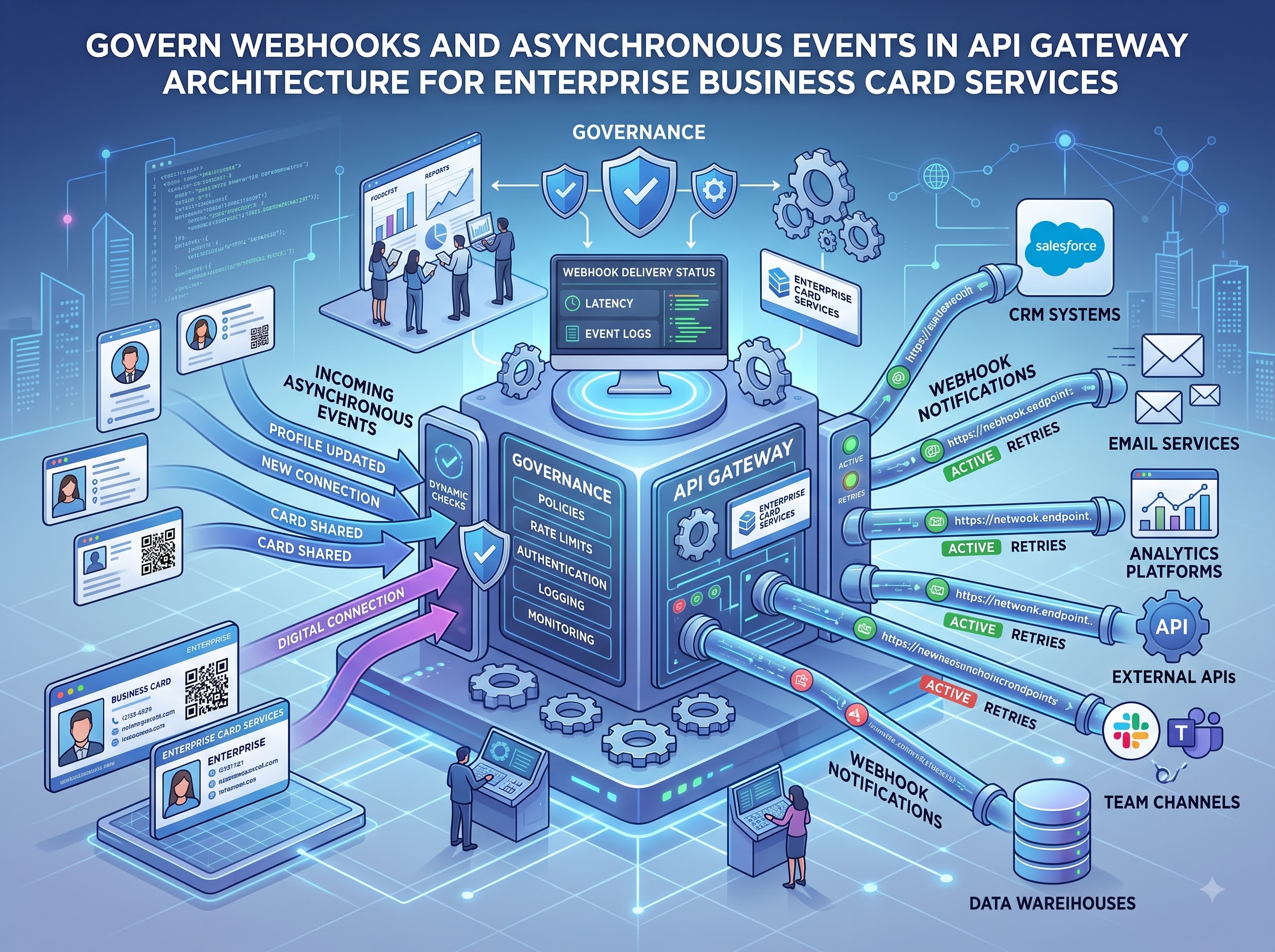
The gateway can protect and route events, but BOC needs a normalized operational view. Provider-specific terminology should map to a common lifecycle with preserved provenance. Missing acknowledgments, stalled production, unexpected substitutions, and delivery failures should generate owned exceptions. Each event should correlate to the CCA decision, BCM order and provider reference without duplicating unnecessary personal data in logs.
Resilience Without Policy Bypass
High availability should not create an alternate path around governance. When CCA is unavailable, the safe response is normally to queue a request, present a controlled status, or use a narrowly defined continuity procedure. A gateway cache may serve non-sensitive reference data with an approved freshness limit, but it should not reuse stale eligibility or silently approve a transaction that requires a current decision.
Retries, circuit breakers, queues and dead-letter handling should preserve identifiers and decision state. Teams must define which operations are safe to retry, which require reconciliation and which must stop for review. Recovery testing should include duplicate requests, lost responses, stale mappings, delayed events, partial provider acceptance, and restored service after an outage.
Observability That Proves Business Control
Gateway dashboards commonly emphasize throughput, latency, and error rates. CCA architecture requires an additional control view: authenticated callers, denied scopes, CCA policy denials, source conflicts, approval aging, current-template usage, authorization-to-order mismatches, duplicate submissions prevented, event completeness, and final reconciliation. Technical health and governance health are related but not interchangeable.
A trace should connect the consumer request, gateway admission, integration-flow execution, CCA decision, BCM order, provider event, and BOC exception. Logs should retain stable identifiers, versions, reasons, and status without copying complete workforce profiles. Alerts need a named owner: security handles credential anomalies, data stewards handle source conflicts, CCA owners handle policy defects, BCM operations handle execution failures, and BOC coordinates closure evidence.
Security, Privacy, and Audit Requirements
| Control area | Architecture requirement | Evidence to retain |
| Identity | Distinct service identities, strong credentials, rotation and environment separation | Owner, credential class, last rotation and access review |
| Authorization | Gateway scope plus contextual CCA business decision | Scope result, decision ID, reason and policy version |
| Data minimization | Only fields needed for the declared business purpose | Payload class, source references and transformation version |
| Change control | Reviewed gateway, flow, contract and CCA policy changes | Approval, tests, effective date and rollback result |
| Execution integrity | Locked authorization, idempotency and correlated lifecycle events | Authorization hash, order ID and acknowledgments |
| Audit access | Restricted exports, monitored use and enforced retention | Export requester, purpose, time range and deletion status |
Implementation Roadmap
- Inventory consumers, gateways, integration flows, CCA endpoints, BCM services, webhooks, providers and data classifications.
- Document which responsibilities belong to the gateway, integration platform, CCA, BCM and BOC.
- Define capability-based APIs and scopes aligned to business-card risk rather than generic database access.
- Register distinct identities for every integration and separate development, test and production credentials.
- Establish canonical identifiers, source provenance, version records, error semantics and lifecycle states.
- Remove duplicated eligibility, template, approval, quantity and routing rules from gateway and orchestration code.
- Protect the CCA-to-BCM authorization package and implement idempotent submission and controlled cancellation.
- Secure webhooks, normalize provider events and connect BOC exception ownership to each failure class.
- Test denial, timeout, retry, duplicate, stale-cache, out-of-order and recovery scenarios end to end.
- Operate recurring reviews for access, contracts, mappings, policy boundaries, telemetry, reconciliation, and residual risk.
Measures for Architecture Effectiveness
Useful measures include registered-consumer coverage, distinct service-identity coverage, least-privilege scope coverage, unsupported API versions, mapping changes without approval, requests denied at the gateway, requests denied by CCA policy, stale cache attempts, duplicate orders prevented, webhook verification failures, provider-event completeness, authorization-to-order mismatch rate and reconciliation coverage.
Segment results by consumer, environment, legal entity, region, card program and provider. A gateway can report perfect uptime while the business card management program remains weakly controlled. The target is a reliable connection that preserves CCA authority, passes approved work to BCM intact, and returns sufficient evidence through BOC to explain every material outcome.
Frequently Asked Questions
What is the role of an API gateway in CCA integration?
It authenticates and protects API traffic, enforces technical scopes and routing, manages versions, and produces telemetry. CCA remains responsible for business-card authorization.
Can the gateway decide which card template an employee receives?
No. It may route the request to CCA, but CCA determines the permitted program, identity fields, template, quantity, and approval route from enterprise policy.
What is the difference between gateway authorization and CCA authorization?
Gateway authorization controls whether a caller may reach a capability. CCA authorization determines whether the requested business action is permitted for the specific identity and context.
Should an integration platform transform business card data?
Only through approved, versioned mappings with clear provenance. It should not infer eligibility or recreate CCA policy in orchestration logic.
How does BCM use the gateway architecture?
BCM retrieves or receives the locked authorization issued by CCA, executes proof and fulfillment, and returns correlated lifecycle states without changing the governing decision.
What does BOC monitor?
BOC monitors lifecycle completeness, failures, mismatches, service levels, exception ownership, and reconciliation across consumers, CCA, BCM, and providers.
Can CCA decisions be cached during an outage?
Only under a narrowly approved rule with an explicit freshness limit and risk assessment. Stale eligibility or approval decisions should not silently authorize new physical orders.
What should an audit trail connect?
It should connect caller identity, gateway admission, flow version, CCA decision, locked authorization, BCM order, provider events, exceptions, and final reconciliation.
The Strategic Outcome
A governed gateway architecture gives enterprise teams one reusable integration boundary without creating another source of business-card policy. Consumers receive stable capabilities. Security teams control identities and traffic. Integration teams manage connectivity and mappings. CCA retains authority over identity, brand, approvals, quantities, routing, and exceptions. BCM specializes in execution, and BOC proves operational completion.
This separation makes the business card ecosystem easier to change. A portal can be replaced, a new HCM system connected, or a supplier added without rebuilding the authority model in every interface. The architecture scales because policy remains centralized and every technical layer has a defined responsibility, evidence model, and control boundary.
Select one high-volume request-to-delivery journey and map every gateway policy, orchestration rule, and CCA decision. Any business rule duplicated outside CCA, any service identity without a named owner, any transformation without a version or any provider event that cannot be reconciled is a priority architecture gap.