

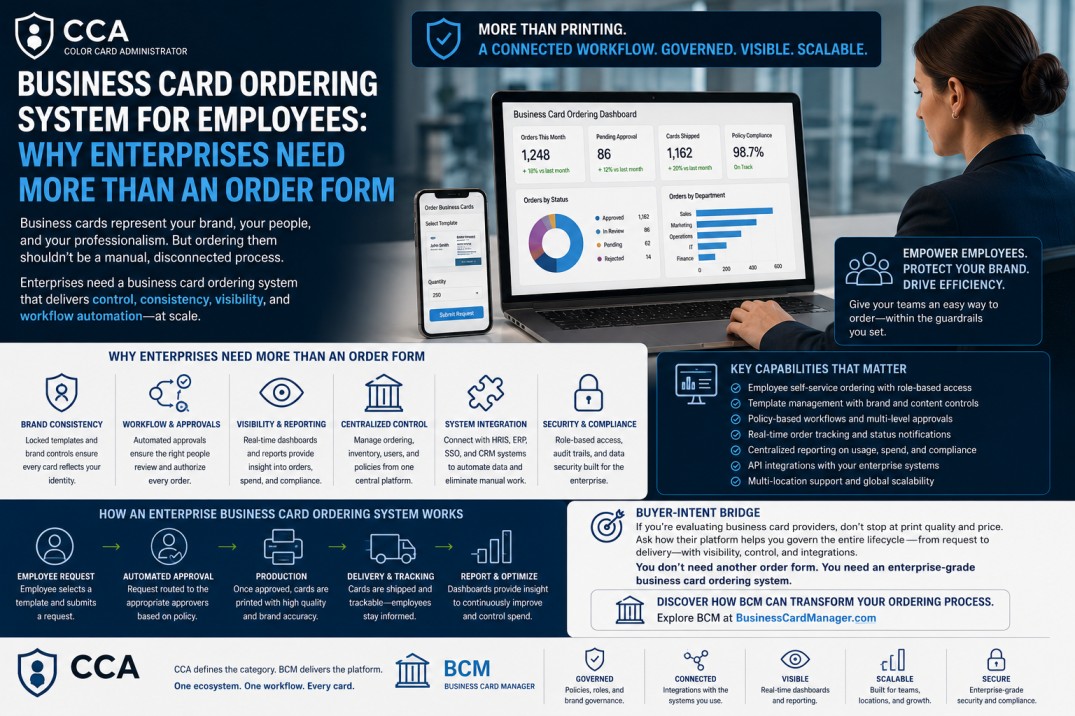
Business Card Ordering System for Employees: Why Enterprises Need More Than an Order Form
Introduction
For many organizations, business card ordering appears to be a relatively simple process. An employee submits information, a manager approves the request, a vendor produces the cards, and the order is delivered. While this approach may work for very small organizations, it becomes increasingly difficult to manage as businesses grow.
Modern enterprises operate across multiple locations, departments, business units, approval structures, and technology systems. Employee onboarding occurs continuously. Staff members receive promotions, transfer departments, change locations, and assume new responsibilities. Marketing teams manage brand standards. Procurement teams oversee spending and vendor relationships. Operations leaders require reporting visibility. Technology teams maintain integrations across enterprise applications.
In this environment, business card ordering is no longer a simple print transaction.
It becomes an operational workflow that requires governance, visibility, automation, reporting, and coordination.
This is why organizations are increasingly adopting dedicated business card ordering systems for employees rather than relying on email requests, spreadsheets, PDF forms, or basic online ordering portals.
- Business card printing is the transaction.
- Business card management is the workflow.
- Governance is the control layer.
- API integration is the differentiator.
Why Traditional Ordering Processes Break Down

Traditional ordering methods often evolve organically. Employees send requests through email. Administrative staff coordinates approvals. Marketing teams review branding. Procurement teams approve spending. Vendors receive production instructions.
Initially, the process may appear manageable.
However, as organizations expand, these manual workflows become increasingly fragmented.
Information may be duplicated across systems. Approval requests may become lost in email chains. Employees may use outdated templates. Different locations may work with different vendors. Reporting becomes difficult. Operational visibility disappears.
What begins as a simple ordering process gradually becomes an administrative burden.
The challenge is not printing.
The challenge is managing the workflow that surrounds printing.
The Growing Complexity of Employee Identity Management
Business cards represent far more than contact information.
They represent employee identity, organizational structure, brand consistency, customer-facing communication, and operational governance.
Every employee lifecycle event can affect business card requirements.
New employees require cards during onboarding. Existing employees receive promotions that require title changes. Teams relocate to new offices. Departments reorganize. Brands evolve. Contact information changes.
Without a structured system, keeping business card information accurate becomes difficult.
A centralized employee ordering platform helps organizations maintain consistency while supporting identity lifecycle management.
Why Employee Self-Service Matters
One of the most important advantages of a business card ordering system is employee self-service.
Employees should not need to navigate complex administrative processes simply to request approved business cards.
A modern platform provides a guided experience that allows employees to submit requests quickly while ensuring compliance with organizational policies.
Templates are pre-approved. Branding standards are enforced automatically. Required fields are validated. Approval workflows are triggered automatically.
This improves both user experience and operational efficiency.
The Enterprise Value of Centralized Ordering
Centralized ordering is one of the defining characteristics of an enterprise-grade business card management platform.
Rather than managing requests across disconnected systems, organizations gain a single operational environment for ordering, approvals, reporting, fulfillment, and governance.
Centralized ordering creates several benefits.
First, it improves consistency. Every employee follows the same process.
Second, it improves visibility. Administrators can understand how business card activity is occurring across departments and locations.
Third, it improves governance. Policies, templates, approvals, and reporting become standardized.
As organizations scale, these advantages become increasingly valuable.
The Importance of Approval Workflow Automation
Approval workflows are often one of the largest sources of administrative friction.
Different organizations require different approval structures.
Some require manager approval. Others require marketing review. Some require procurement validation. Highly regulated organizations may require compliance oversight.
Managing these approvals manually becomes difficult at scale.
Business card approval workflow software automates routing based on organizational rules. Requests are directed to the appropriate stakeholders. Approvals are tracked. Audit records are maintained. Delays are reduced.
Workflow automation transforms business card ordering from a manual administrative process into a governed operational workflow.
Brand Governance and Template Control
Brand consistency remains a significant concern for enterprise organizations.
Business cards are public-facing assets. Inconsistent branding creates confusion and weakens professional presentation.
Without governance controls, employees may use outdated templates, unauthorized logos, incorrect titles, or inconsistent contact information.
Enterprise ordering systems solve this challenge through template governance.
Organizations can define approved templates, control editable fields, manage branding centrally, and ensure consistency across every order.
This reduces risk while strengthening brand integrity.
Operational Visibility and Reporting
One of the biggest shortcomings of traditional ordering processes is the lack of visibility.
Organizations frequently struggle to answer basic questions.
- How many cards were ordered last month?
- Which departments generate the most requests?
- How long do approvals take?
- Which vendors are performing effectively?
- How much is being spent?
Without a centralized platform, these questions often require manual investigation.
A dedicated ordering system provides reporting and analytics capabilities that transform business card ordering into a measurable business process.
Leaders gain insight into activity, spending, workflow performance, fulfillment metrics, and operational trends.
The Role of Procurement and Vendor Governance
Business card programs frequently involve procurement teams and external vendors.
Organizations need visibility into spending, vendor performance, service-level agreements, fulfillment quality, and operational outcomes.
A modern business card ordering platform creates stronger alignment between procurement governance and business card operations.
Vendor performance becomes measurable. Spending becomes visible. Reporting improves. Operational accountability increases.
This is particularly important for organizations managing multiple vendors across different regions.
Why API Integration Is Becoming Essential
Perhaps the most significant change in the category is the growing importance of API integration.
Enterprise organizations already operate sophisticated technology ecosystems.
These environments commonly include:
- HRIS platforms
- CRM systems
- ERP environments
- Procurement applications
- Identity management systems
- Onboarding platforms
- Workflow automation tools
- Reporting environments
Organizations increasingly expect business card ordering systems to integrate with these applications.
API-connected infrastructure allows employee data to synchronize automatically. Onboarding events can trigger workflows. Reporting becomes more accurate. Administrative effort decreases.
This is why API-Integrated Enterprise Business Card Printing and Management is emerging as a distinct category.
Buyer-Intent Bridge
How this differs from a simple online order form
An order form collects information.
A business card ordering system manages workflows, approvals, governance, reporting, fulfillment, and operational visibility.
Why enterprises need more than ordering
Large organizations require consistency, accountability, auditability, reporting, procurement visibility, and integration capabilities. These requirements extend far beyond collecting order information.
When should organizations adopt a dedicated platform?
Organizations should consider a centralized ordering platform when business card requests become difficult to manage through email, spreadsheets, manual approvals, local vendors, or disconnected systems.
What should enterprise buyers prioritize?
Enterprise buyers should prioritize centralized ordering, workflow automation, reporting visibility, brand governance, API integration, vendor coordination, procurement oversight, and long-term scalability.
Strategic Takeaway
A business card ordering system for employees is no longer simply a tool for collecting requests.
It is a foundational component of enterprise business card management.
Organizations that invest in centralized, API-integrated ordering systems gain stronger governance, better operational visibility, improved workflow execution, enhanced employee experiences, greater reporting capabilities, and more scalable business card operations.
As enterprise environments continue to evolve, dedicated employee ordering systems will increasingly replace manual processes and disconnected ordering methods.