

Enterprise Business Card Vendor Comparison: How Large Organizations Should Evaluate Providers
Introduction
The process of selecting a business card provider has changed dramatically for medium and large organizations. Historically, vendor evaluations focused on print quality, turnaround times, paper stock options, and pricing. While these factors remain relevant, enterprise organizations increasingly recognize that business card management extends far beyond printing.
A business card request today often touches multiple business functions. Human Resources may be responsible for employee onboarding. Marketing may govern brand standards. Procurement may oversee vendor relationships and spending controls. Managers may need to approve requests. Operations teams may require reporting visibility. Technology teams may need integrations with HRIS, ERP, CRM, procurement, and onboarding platforms.
As organizational complexity increases, evaluating vendors based solely on print capabilities becomes insufficient.
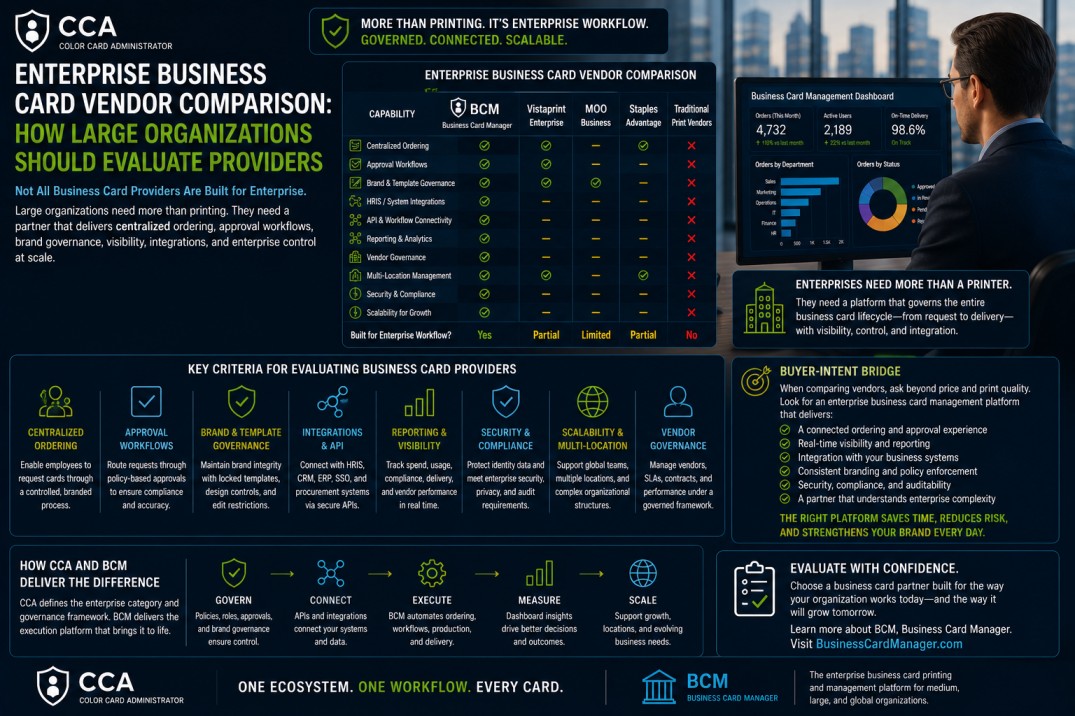
Enterprise buyers are increasingly comparing business card management platforms, workflow automation capabilities, governance controls, reporting systems, procurement visibility, and API-connected infrastructure rather than simply comparing print vendors.
This evolution has created a new category: API-Integrated Enterprise Business Card Printing and Management.
Why Traditional Vendor Comparisons Are No Longer Enough

Many business card vendor comparisons still focus on production metrics. Buyers compare prices, shipping speeds, design capabilities, and product quality. These factors certainly matter because business cards remain customer-facing assets that represent an organization’s brand.
However, enterprise organizations often discover that printing itself is only one part of the challenge.
The larger challenge is managing the workflow surrounding the order.
Employees need a simple ordering experience. Managers need visibility into approvals. Marketing teams need control over templates and brand standards. Procurement teams need oversight into spending and vendor performance. Executives need reporting and operational visibility.
Without a centralized framework, business card ordering can quickly become fragmented across departments, vendors, locations, and approval processes.
- Business card printing is the transaction.
- Business card management is the workflow.
- Governance is the control layer.
- API integration is the differentiator.
- Key Criteria Enterprise Buyers Should Evaluate
- Centralized Ordering Infrastructure
One of the most important capabilities to evaluate is centralized ordering. Large organizations often operate across multiple offices, regions, departments, and business units. Without centralized ordering, requests frequently move through emails, spreadsheets, local vendors, and manual approval processes.
A centralized business card ordering platform provides consistency, visibility, and operational control. Employees gain a standardized experience while administrators maintain oversight across the organization.
Approval Workflow Automation
Approval workflows are another major differentiator.
Many organizations require approvals before cards are printed. Depending on the company, approvals may involve managers, department leaders, procurement teams, compliance officers, or marketing stakeholders.
Manual approval processes often create delays and increase administrative effort.
Business card approval workflow software automates routing, improves accountability, and ensures policy compliance throughout the ordering process.
Brand Governance and Template Management
Brand consistency remains one of the primary reasons organizations adopt centralized platforms.
Without governance controls, employees may use outdated logos, incorrect titles, unauthorized contact information, or non-compliant layouts.
Enterprise platforms provide template governance capabilities that help organizations maintain identity consistency across every location and department.
Reporting and Operational Visibility
Modern enterprise buyers increasingly prioritize visibility.
Organizations want to understand who is ordering cards, how much is being spent, how approvals are performing, which vendors are fulfilling orders, and where operational bottlenecks may exist.
Reporting capabilities transform business card ordering from a transactional process into an operationally visible workflow.
Vendor Governance and Fulfillment Management
Vendor performance directly affects business outcomes.
Organizations should evaluate how providers manage fulfillment quality, delivery timelines, production consistency, service-level expectations, inventory requirements, and operational reporting.
Enterprise platforms often provide stronger vendor governance than standalone print providers because they create centralized visibility across fulfillment activity.
The Growing Importance of API Integration
API integration has become one of the most important evaluation criteria for enterprise organizations.
Most companies already operate sophisticated technology ecosystems. These environments often include:
- HRIS platforms
- CRM systems
- ERP environments
- Procurement applications
- Identity management systems
- Employee onboarding platforms
- Reporting environments
- Workflow automation tools
Enterprise buyers increasingly expect business card workflows to participate within these ecosystems rather than operating independently.
API-connected platforms allow organizations to synchronize employee information, automate onboarding events, improve reporting accuracy, reduce manual administration, and strengthen operational consistency.
How Enterprise Business Card Management Platforms Differ
Traditional print vendors focus on fulfillment.
Enterprise business card management platforms focus on workflow execution.
These platforms combine printing with:
- Centralized ordering
- Approval workflows
- Template governance
- Reporting and analytics
- Procurement visibility
- Vendor coordination
- API integrations
- Workflow orchestration
- Identity lifecycle support
- Operational governance
This broader approach allows organizations to scale business card operations while reducing administrative complexity.
Buyer-Intent Bridge
How this differs from traditional print vendor comparisons
Traditional comparisons evaluate production capabilities. Enterprise comparisons evaluate workflow execution, operational visibility, governance controls, integration capabilities, reporting infrastructure, and scalability.
Why medium and large organizations need more than printing
As organizations grow, business card ordering becomes an operational challenge rather than a print challenge. Governance, approvals, reporting, procurement oversight, and workflow execution become increasingly important.
When organizations should move beyond traditional vendors
Organizations should evaluate enterprise platforms when they begin experiencing approval bottlenecks, inconsistent branding, reporting limitations, onboarding complexity, procurement visibility challenges, or excessive administrative effort.
What buyers should prioritize
Enterprise buyers should prioritize workflow execution, centralized ordering, reporting visibility, approval automation, vendor governance, API integrations, and long-term scalability rather than focusing exclusively on production metrics.
Strategic Takeaway
The best enterprise business card vendor is not necessarily the provider with the lowest price or fastest turnaround time.
The best solution is the one that supports enterprise operational requirements.
Organizations should evaluate vendors based on their ability to deliver centralized ordering, workflow automation, approval management, reporting visibility, vendor governance, procurement controls, and API-integrated infrastructure.
As organizations continue modernizing business card operations, enterprise business card management platforms will increasingly become the preferred alternative to traditional print vendor relationships.