

Microsoft Entra ID–Connected Business Identity Governance

Enterprises increasingly use Microsoft Entra ID as the access front door to applications. Connecting it to business card management can simplify sign-in, reduce duplicate user administration, align access with workforce changes, and give employees a familiar route to request approved identity materials. Yet authentication alone does not answer the questions that create enterprise risk: Is the person eligible for a card? Which organization may they represent? Which title may appear publicly? May they request for others? Who can approve an exception? What happens when group membership is stale, an account is disabled, or a privileged administrator changes a policy?
Color Card Administrator (CCA) turns Entra identity signals into governed authority. It validates the tenant and account, maps directory attributes and claims through explicit policy, scopes permissions, separates administrative duties, coordinates approval, preserves evidence, and releases only an approved identity specification to Business Card Manager (BCM). BCM then governs ordering, supplier execution, shipping, cost, and fulfillment. This division enables secure directory-connected automation without confusing access with business authority.
The result is more than single sign-on for a print portal. It is an enterprise control architecture in which workforce identity, digital access, public-facing identity, brand policy, and commercial execution remain connected but independently governed.
Why an Entra ID Connection Is an Authority Question
An Entra account is a strong signal that a digital identity exists within a tenant. It does not automatically prove that every attribute is current, approved for public presentation, or sufficient to authorize a physical artifact. Display names may reflect directory conventions rather than print standards. Job titles may be abbreviated, inherited from another system, or written for internal use. Department and office fields may be inconsistently maintained. Guest accounts, service principals, contractors, acquired populations, and shared accounts may appear beside employees even though their eligibility is fundamentally different.
Group membership also carries context, not universal authority. A user may belong to Marketing, Procurement governance, or a regional sales group without owning brand policy, purchasing approval, or the right to create executive identity. Dynamic groups can be delayed or misconfigured. Nested groups may produce unintended access. Direct assignments may outlive the project that justified them. CCA therefore treats Entra signals as governed inputs. Each signal must have a defined meaning, source owner, scope, freshness requirement, and fallback behavior before it affects identity execution.
This distinction prevents a common architectural mistake: assuming that because Entra controls application access, it should also control every business decision inside the application. Secure authentication is essential. It is not a substitute for eligibility, presentation policy, approval accountability, procurement control, or audit reconciliation.
CCA and BCM Have Distinct Roles in the Entra Architecture
Microsoft Entra ID provides digital identity, authentication, tenant context, claims, groups, application assignments, and lifecycle signals. CCA consumes only the signals necessary to establish governed authority. It determines who may enter the environment, what population they may act for, which data may populate an identity, which template and policy apply, when approval is required, and whether a proposed identity is ready for execution.
BCM begins after CCA has approved the enterprise identity governance specification. It manages the authorized request, quantity, cost center, supplier, production, shipping, status, and fulfillment evidence. BCM should not reinterpret directory claims or invent permissions that CCA has not granted. Conversely, Entra should not be asked to store every print, approval, supplier, or exception rule merely because it is the authentication provider.
The boundary is deliberate: Entra proves and contextualizes the digital user; CCA governs identity authority and policy; BCM governs transactional execution. Together they form a traceable chain from sign-in through approval to fulfilled artifact.
Authentication, Eligibility, and Authorization Must Remain Separate
Authentication: who is signing in?
CCA can use Entra single sign-on with modern federation protocols, tenant restrictions, verified domains, multifactor authentication, and applicable Conditional Access policies. Authentication should validate the intended tenant, stable subject identifiers, token issuer, audience, signature, lifetime, and relevant assurance context. Email address alone is not a durable identity key because addresses can change, be reused, or exist across guest relationships.
Eligibility: may this identity participate?
Eligibility considers worker relationship, company, geography, account type, employment status, sponsorship, and policy. A successfully authenticated guest or contractor may be allowed limited access, routed to a sponsor, or denied ordering. Service and shared identities should ordinarily be excluded. An employee may be active in Entra but not eligible for printed cards in a non-customer-facing role. CCA expresses these choices as explicit, reviewable rules.
Authorization: what may the person do?
Authorization defines the permitted action and scope: request for self, request for a team, approve identity content, approve quantity, maintain templates, administer suppliers, review audit evidence, or configure integrations. CCA evaluates the action against policy and current context. Broad application assignment should never silently grant broad business authority.
A Field-Level Authority Model for Directory Data
Directory attributes can improve accuracy and reduce entry, but each field requires a documented authority model. CCA should record the source, allowed transformation, validation, presentation policy, fallback, sensitivity, and change behavior for every consumed attribute.
- Object and tenant identifiers establish durable correlation and organizational context; they should not appear on the printed artifact.
- Given name, surname, and preferred display name may require HR validation, character handling, cultural naming rules, and approval for public presentation.
- Job title may be useful context but should be mapped to an approved external title when directory content is informal, abbreviated, or ungoverned.
- Department, company, office, country, and usage location can select policy, template, language, legal entity, data residency, supplier, and approval route.
- Manager and group relationships can help determine delegated scope, but should not alone establish executive, brand, legal, or procurement authority.
- Email, telephone, and mobile attributes need formatting, publication eligibility, and privacy rules; presence in the directory does not mean permission to print.
A precedence matrix resolves conflicts among Entra, HRIS, CRM, approved brand directories, legal-entity records, and user-entered requests. CCA keeps source values separate from transformed display values so an auditor can see both what arrived and why a different approved value was released.
A Governed Entra-to-Card Workflow
A resilient enterprise business card workflow automation separates sign-in, signal collection, policy decision, approval, release, execution, and reconciliation:
- The user authenticates through the approved Entra tenant under the enterprise authentication and Conditional Access policy.
- CCA validates identity and token context, resolves the stable user record, and retrieves only allow-listed attributes, assignments, or lifecycle signals.
- CCA evaluates eligibility, delegated population, requested action, template, field precedence, materiality, and the applicable policy version.
- A standard, policy-conforming self-request may proceed with minimal friction; material changes and exceptions route to the accountable owner.
- CCA records the decision and releases a version-controlled identity specification to BCM only after every required gate is satisfied.
- BCM applies quantity, supplier, shipping, cost, and production controls, then returns status and fulfillment evidence.
- CCA reconciles the result with the originating user, policy, approval, and directory state to preserve an end-to-end record.
The design supports straight-through processing without making every sign-in or directory change an order. A person can be authenticated yet ineligible, eligible yet unauthorized for a particular action, authorized yet awaiting approval, or approved yet blocked by a purchasing rule. Those distinctions make automation explainable and recoverable.
Groups and Claims Should Express Context, Not Hidden Policy
Entra groups and token claims are useful for coarse application assignment and contextual routing. They become risky when complex identity policy is compressed into opaque group names such as “card-admin” or “executive-print.” Business owners may not know who maintains the membership, why a user was added, whether nested membership applies, or when the entitlement expires. A claim may also become stale until a new token is issued.
CCA should map external groups to narrow internal roles with explicit scope, conditions, and review ownership. The mapping—not the group name—defines the business authority. High-impact roles should require direct, reviewed assignments or additional approval, and privileged actions should be step-up protected where appropriate. When claims are missing, excessive, contradictory, or stale, the system should fail safely and route the case rather than infer the most permissive outcome.
This model keeps enterprise access teams responsible for digital entitlements while allowing brand, HR, legal, procurement, and business owners to retain their own decision rights. It also makes access reviews meaningful: reviewers see the actual CCA capability and population affected, not merely an unexplained directory group.
Lifecycle Provisioning Must Control Joiners, Movers, and Leavers
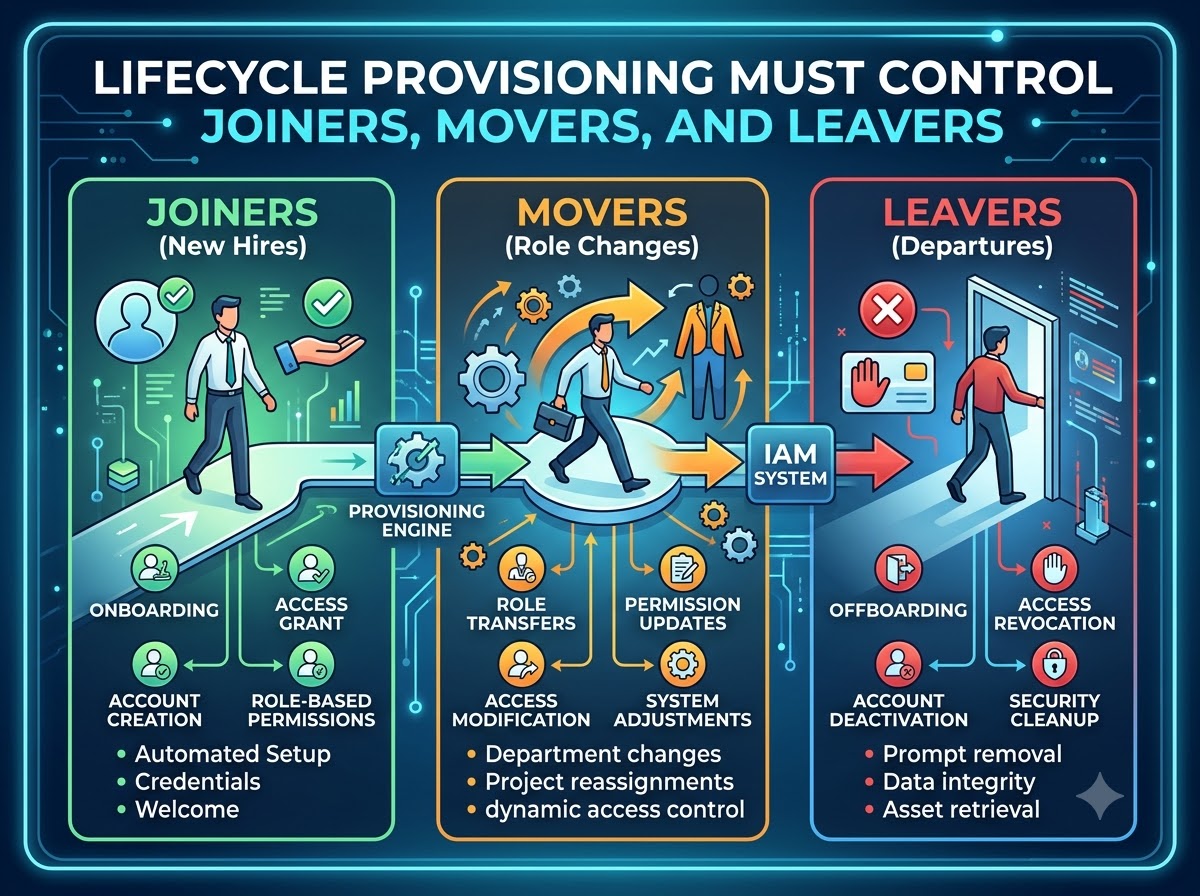
Entra lifecycle integration can create, update, suspend, and deprovision CCA access through SCIM, APIs, or orchestrated workflows. Provisioning should be idempotent and tied to stable identifiers. New users should receive the minimum baseline role; sensitive permissions should not arrive solely because an upstream profile contains an ambitious title or an inherited group.
For movers, CCA should recompute delegated scope, template eligibility, approval routing, and pending work. A manager who moves regions may lose authority over one population and gain another, but historical decisions must retain the context that existed at approval time. Existing sessions and cached claims may need revocation or limited lifetime when authority changes materially.
For leavers, disabling sign-in is only the beginning. CCA should stop new requests, revoke delegated and administrative authority, close or reassign pending approvals, prevent release of staged specifications, and ask BCM whether open production can be cancelled. Historical records remain available to authorized auditors without preserving active user access. This reconciled approach avoids the false assumption that account deactivation automatically stops a physical order already in production.
Conditional Access Strengthens Entry Control—but Does Not Replace CCA Policy
Conditional Access can require multifactor authentication, compliant devices, trusted locations, risk-based controls, or stronger authentication for selected users and applications. These controls materially improve security at sign-in. CCA should respect the enterprise policy and may require additional assurance for sensitive actions such as assigning an administrator, changing a template, approving an executive identity, exporting evidence, or modifying an integration mapping.
Nevertheless, a successful Conditional Access evaluation does not determine whether a title is approved, whether a contractor is eligible, or whether a quantity is commercially justified. CCA still applies business policy after authentication. The architecture therefore combines identity assurance with transaction-specific authorization instead of treating one successful login as a blanket approval.
Privileged Administration Requires Stronger Governance
Business identity platforms contain high-impact capabilities: modifying public-facing templates, changing field mappings, granting request-on-behalf access, approving exceptions, selecting suppliers, exporting data, or altering audit retention. These powers should be separated and tightly controlled. Entra privileged groups, access packages, entitlement management, or just-in-time activation may contribute to the control, but CCA must still define the exact internal capability and capture the business action.
Administrative access should be time-bound where feasible, require strong authentication, follow approval for sensitive roles, and generate alerts for unusual or conflicting changes. Emergency access must be documented and reviewed after use. Service principals require dedicated ownership, least-privilege permissions, certificate or secret rotation, monitoring, and prohibition from interactive use. No integration identity should be able to approve the outcome it creates.
Separation of duties protects against both error and misuse. A template administrator need not approve their own design change. An integration operator need not access supplier pricing. A procurement administrator need not alter legal identity text. CCA records these boundaries as enforceable controls rather than relying on organizational convention.
Guests, Contractors, Acquisitions, and Multiple Tenants
Large organizations rarely operate a single uniform employee population. Entra may include B2B guests, external collaborators, contractors, franchisees, joint ventures, acquired companies, and users synchronized from multiple forests or tenants. A guest object’s presence does not establish who employs the person or whose brand they may represent. CCA can require sponsorship, worker-type evidence, legal-entity assignment, expiration, restricted templates, lower quantities, or explicit denial.
Multi-tenant architectures require clear trust boundaries. The integration should validate allowed issuers and tenants, prevent account confusion, define whether identities may act across subsidiaries, and avoid using mutable email domains as the sole boundary. Acquired populations may operate under transitional brands and policies. CCA can support a controlled migration period with versioned templates, dated exceptions, and explicit ownership rather than granting inherited access to the parent organization’s entire identity environment.
Exceptions Must Be Accountable and Time-Bound
Directory data will not represent every legitimate external identity. A multilingual name, customer-facing title, temporary regional responsibility, acquired-brand presentation, regulated credential, or shared-service role may require a controlled deviation. CCA turns the deviation into a governed case containing the requested value, business reason, affected identity, supporting evidence, policy version, approver, effective date, expiration or review date, and final disposition.
An exception should not be implemented by adding a person to a powerful Entra group or editing an upstream directory value solely to force the printed result. That contaminates identity data and hides the actual decision. CCA preserves the exception where it belongs, limits its scope, and learns from recurring patterns. Valid repeated cases can become approved mappings; inappropriate patterns can be addressed through clearer policy and training.
Integration Engineering Must Fail Safely
An Entra connection may use OpenID Connect or SAML for federation, Microsoft Graph for selected directory data, SCIM or APIs for lifecycle provisioning, and middleware for orchestration. Every route should enter the same CCA decision model. The integration must validate tokens, minimize consent and scopes, protect credentials, handle pagination and throttling, detect replay, monitor latency, and preserve correlation identifiers.
Idempotency prevents duplicate users, approvals, or orders when events retry. Version and sequence handling prevent an older update from overwriting a newer decision. The design should define retry limits, dead-letter handling, reconciliation schedules, alert ownership, break-glass recovery, and behavior during Entra, CCA, BCM, or supplier outages. A successful API response proves transport; it does not prove that an identity is authorized for production.
Data minimization is equally important. CCA should retrieve only the fields required for access and business identity governance. Authentication telemetry, sensitive HR data, unrelated profile attributes, and broad directory exports should not be collected simply because Graph permissions make them available. Purpose, retention, residency, and access must be documented.
Audit Evidence Across Entra, CCA, BCM, and Fulfillment
An authorized reviewer should be able to reconstruct the complete chain: tenant and stable user identifiers, authentication context, application and group assignments used, attribute values and timestamps, eligibility outcome, mapped CCA role and scope, policy and template versions, current and proposed identity, approvals, exception rationale, privileged changes, release timestamp, BCM request, quantity, supplier, cost allocation, shipping status, errors, retries, cancellations, and final disposition.
The evidence supports access certification, HR and directory data quality, brand governance, procurement review, integration operations, internal audit, and incident response. It also creates useful metrics: inactive assignments, excessive privileges, guest exceptions, provisioning latency, role changes, straight-through request rate, prevented unauthorized actions, reprint avoidance, approval time, failed synchronization, cancellation success, and supplier performance. Governance becomes an operating system for improvement, not merely a historical archive.
Implementation Roadmap for an Entra-Connected CCA Program
Phase 1: Define trust, authority, and data boundaries
Identify allowed tenants, account types, authentication assurance, stable identifiers, eligible populations, required attributes, source owners, CCA actions, delegated scopes, privileged roles, approval ownership, retention, and failure behavior. Document the difference between application access and business authority before creating group mappings.
Phase 2: Deploy controlled SSO and baseline access
Begin with one employee population and self-request use case. Enforce the approved tenant and Conditional Access policy, create least-privilege baseline roles, validate field precedence, and deny guest, service, shared, or unsupported identities by default. Make exceptions visible rather than hiding them inside group membership.
Phase 3: Add lifecycle and delegated scope
Provision and deprovision access through controlled automation. Update manager or organizational scope, reroute pending approvals, revoke high-risk sessions when authority changes, and preserve historical decision context. Reconcile Entra assignments with CCA roles on a defined schedule.
Phase 4: Connect BCM execution and test failure scenarios
Release approved specifications to BCM and return production evidence. Test duplicates, stale tokens, removed groups, disabled accounts, guests, tenant changes, late provisioning, out-of-order events, unavailable systems, compromised credentials, rejected exceptions, supplier failures, and cancellation after departure.
Phase 5: Strengthen privileged governance and optimize
Introduce time-bound administration, step-up assurance, access review, separation of duties, exception analytics, and operational metrics. Expand tenants and populations only after the authority model is stable and evidence shows that the control design works.
What Enterprise Buyers Should Evaluate
A buyer evaluating Microsoft Entra ID business card integration should look beyond an SSO checkbox and ask whether the platform turns identity signals into explainable, enforceable authority.
- Does the platform validate tenant, issuer, stable identifiers, account type, and appropriate authentication assurance?
- Can it separate successful authentication, population eligibility, action authorization, identity approval, and commercial execution?
- Are Entra groups and claims mapped to narrow roles and delegated populations with owners, review dates, and safe fallback behavior?
- Can it govern employees, guests, contractors, service identities, acquisitions, and multiple tenants differently?
- Does lifecycle automation revoke authority, reroute pending work, and reconcile open BCM orders after a mover or leaver event?
- Can privileged functions be separated, time-bound, step-up protected, monitored, and audited?
- Are directory attributes governed through field-level precedence, transformation, freshness, privacy, and presentation rules?
- Can one transaction be traced from Entra identity through CCA policy and approval to BCM production and fulfillment?
Buyer-Intent Bridge: From Entra Integration to Identity Control
Organizations searching for an Azure AD or Microsoft Entra ID business card integration often want single sign-on, automatic user setup, current employee data, and less administration. Those are practical benefits, but enterprise value depends on what happens after sign-in. The organization must still establish eligibility, scope request-on-behalf access, govern public-facing data, constrain privileged roles, route exceptions, and stop or reconcile work when identity status changes.
CCA supplies that authority layer. It converts Entra identities, claims, assignments, and lifecycle signals into narrow, policy-based permissions and approved identity specifications. BCM then turns the approved specification into a governed order and returns execution evidence. The combined model provides secure directory-connected efficiency without allowing authentication, group membership, or automation convenience to become uncontrolled identity authority.
Frequently Asked Questions
What is a Microsoft Entra ID business card integration?
It is a governed connection that uses Entra for authentication and selected identity or lifecycle signals while CCA controls eligibility, permissions, public identity policy, approvals, exceptions, and release to BCM for ordering and fulfillment.
Is Microsoft Entra ID the same as Azure Active Directory?
Microsoft Entra ID is the current name for Azure Active Directory. Existing enterprise searches and internal terminology may still use Azure AD, but the governance principles are the same.
Does SSO automatically authorize an employee to order business cards?
No. SSO authenticates the user. CCA separately evaluates whether the user is eligible, what actions and populations are permitted, which identity values are approved, and whether further approval is required.
Can Entra groups control CCA roles?
They can provide useful context or assignments, but CCA should map them to narrow internal roles with explicit scope, ownership, review, and safe handling for stale or conflicting membership.
How are guest and contractor accounts handled?
CCA can deny them by default or apply sponsorship, worker-type validation, restricted templates, limited quantities, expiration, and additional approval. Authentication alone does not establish brand-representation rights.
What happens when an employee leaves?
CCA revokes request and administrative authority, closes or reroutes pending work, blocks unreleased specifications, and reconciles open BCM orders while retaining historical evidence for authorized review.
Does Conditional Access replace CCA approval workflows?
No. Conditional Access strengthens authentication based on risk, device, location, or assurance. CCA approval workflows govern business identity, brand, legal, organizational, and purchasing decisions.
What is the difference between CCA and BCM?
CCA governs digital-identity context, eligibility, permissions, public identity policy, approvals, exceptions, and the approved specification. BCM governs the resulting order, supplier, cost, production, shipping, and fulfillment evidence.
Conclusion: Connect Entra ID Without Confusing Access with Authority
Microsoft Entra ID gives enterprises a powerful foundation for authentication, directory context, application assignment, and identity lifecycle automation. Its value to business card management is greatest when those signals enter a disciplined governance layer. Accounts, groups, claims, attributes, guests, privileged roles, and lifecycle events all require interpretation before they may influence a public-facing identity or a physical transaction.
CCA provides that control plane. It validates identity context, distinguishes authentication from eligibility and authorization, maps fields and roles through policy, constrains privileged access, governs exceptions, reacts to lifecycle change, and preserves linked evidence. BCM executes only the approved result and returns fulfillment status. The outcome is not simply Entra-enabled ordering. It is identity-connected enterprise governance—secure, accountable, explainable, and designed to scale.
Build a Microsoft Entra ID–connected business identity program that strengthens control from sign-in through fulfillment. Explore how Color Card Administrator can govern tenant trust, directory data, eligibility, roles, delegated access, lifecycle events, privileged administration, approvals, exceptions, and audit evidence before Business Card Manager converts an approved identity into ordering and fulfillment.