

Microsoft Dynamics 365–Connected Business Identity Governance

Microsoft Dynamics 365 can hold valuable context about customer-facing employees, accounts, territories, business units, campaigns, and operational responsibilities. Connecting that context to business card management can reduce re-entry, accelerate onboarding, and align external identity materials with the way sales and service teams actually operate. Yet a CRM record is not automatically an approved public identity. It may contain informal titles, temporary assignments, inherited security roles, duplicate users, outdated contact details, or data intended only for internal workflow.
Color Card Administrator (CCA) converts Dynamics 365 signals into governed authority. It determines which system owns each identity field, which legal entity and brand an individual may represent, which role or territory permits a request, when approval is required, how exceptions expire, and whether an identity specification is ready for execution. Business Card Manager (BCM) then manages the approved order, supplier, quantity, cost, production, shipping, and fulfillment evidence.
This separation prevents a convenient integration from becoming an uncontrolled publishing channel. Dynamics 365 contributes customer and operational context; CCA governs identity authority and presentation; BCM governs commercial execution. Together they create a traceable control chain from enterprise data to the physical identity artifact placed in front of a customer.
Why a Dynamics 365 Connection Is an Identity-Governance Question
CRM platforms are designed to help people manage relationships, opportunities, cases, campaigns, and service activity. Their security model answers who can access records and perform application actions. Business identity governance asks a different set of questions: Is the employee eligible to represent this organization? Which legal entity, brand, office, title, phone number, language, or professional designation may appear? Can the employee request only for themselves, or for an entire sales team? Who is accountable when a requested identity differs from authoritative HR, legal, or brand policy?
A Dynamics 365 user may be active because they require access to customer information, but that does not prove eligibility for a business card. A sales territory may be useful for routing an approval but may not be the authoritative source for legal-entity representation. A CRM job title may describe a selling role more effectively than an HR title, yet it may still require policy mapping before external publication. CCA makes these distinctions explicit instead of allowing technical availability to decide business authority.
The core principle is simple: connected data is evidence, not permission. Every imported attribute, role, team, business unit, and event must have a documented purpose, owner, scope, freshness expectation, and safe fallback before it can influence a public-facing identity.
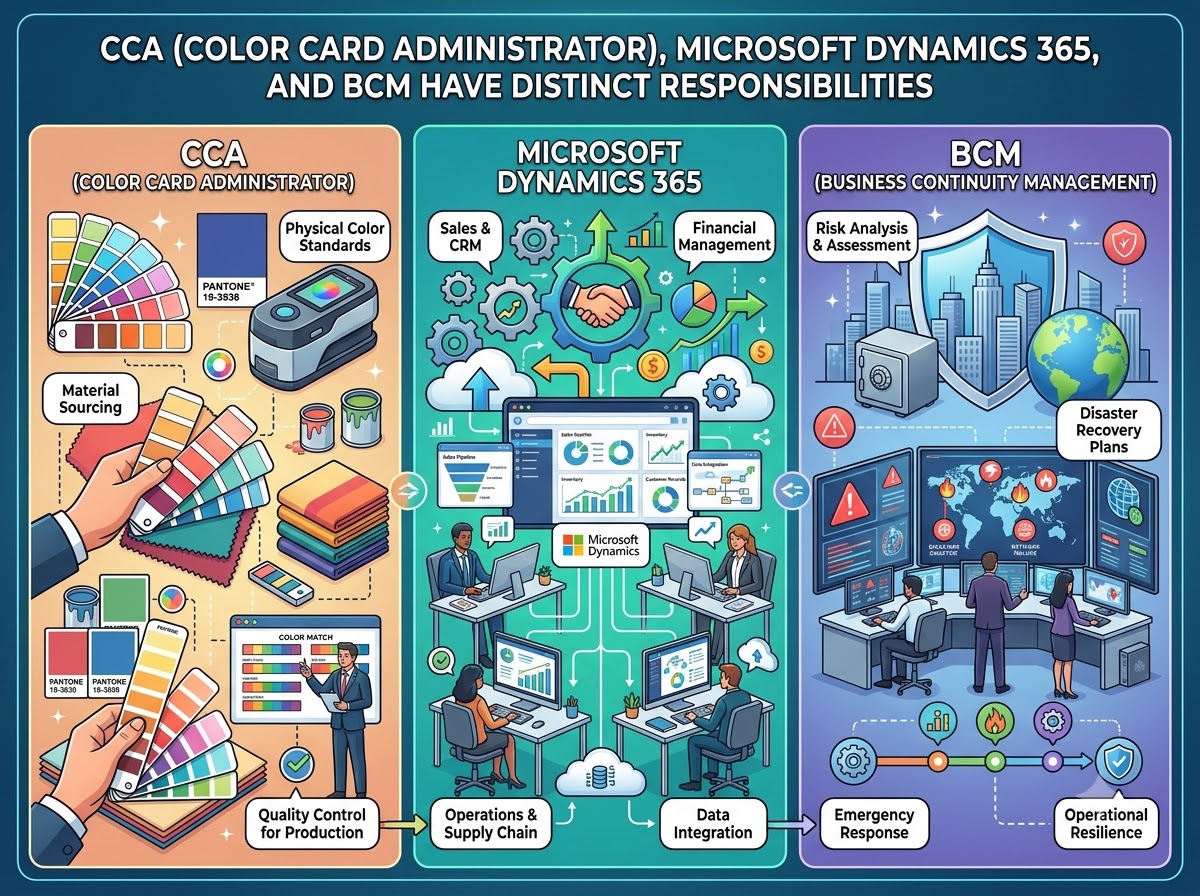
CCA, Dynamics 365, and BCM Have Distinct Responsibilities
Dynamics 365 provides CRM context such as users, teams, business units, territories, accounts, activities, customer-facing responsibilities, and selected profile data. CCA evaluates only the signals needed for governed identity execution. It correlates the user with authoritative workforce identity, applies legal-entity and brand policy, maps allowed external titles, scopes request and approval rights, routes exceptions, versions templates, and preserves the decision record.
BCM begins after CCA releases an approved identity specification. BCM should not invent a title, reinterpret a CRM team, or broaden request-on-behalf authority. It applies ordering controls: quantity, cost center, supplier, shipping destination, production status, reorders, cancellation, and fulfillment reconciliation. Dynamics 365 may receive useful status information, but it should not become the hidden system of record for print policy.
This architecture keeps each platform strong in its intended role. CRM administrators retain responsibility for customer and application data. HR, legal, brand, security, and business owners retain their respective authority. CCA coordinates those decisions. BCM executes the approved outcome.
A Field-Level Authority Model Prevents CRM Data from Becoming Policy
A reliable integration begins with a field-level authority matrix. For every value that may influence a card, CCA records the source of truth, permitted transformations, validation rules, presentation standard, approval owner, effective date, fallback, and audit requirement. The matrix should distinguish data used for correlation or routing from data allowed to appear externally.
Stable user and directory identifiers should correlate the Dynamics 365 user with the enterprise identity record; mutable email addresses should not be the only key.
Names should follow authoritative workforce and cultural naming rules, with a governed route for preferred or professional names.
CRM selling roles or territory labels may inform an external title, but they should map to an approved vocabulary rather than print verbatim by default.
Business unit, account ownership, and team membership can route approval or select a policy, but they do not automatically establish legal-entity or brand authority.
Telephone, mobile, email, social, and web values require publication, privacy, formatting, and regional rules even when they are present in Dynamics 365.
Office, country, language, and market can select templates and compliance content, but should be reconciled with authoritative location and legal data.
When Dynamics 365 conflicts with HRIS, directory, legal-entity master data, or an approved exception, CCA applies documented precedence. It never silently chooses the most recent timestamp or the value most convenient for ordering. Material conflicts are held for accountable review.
Business Units, Teams, and Security Roles Need Narrow Interpretation
Dynamics 365 business units, owner teams, access teams, and security roles are powerful application constructs. They can help establish context, but they should not be copied directly into CCA as broad authority. A security role granting write access to opportunities does not inherently permit executive-title approval. Membership in a regional sales team does not automatically permit a user to order cards for every member or represent every subsidiary in that region.
CCA maps CRM constructs to narrow capabilities: request for self, request for a defined population, review a particular field, approve a specific exception class, or view limited evidence. Each mapping has an owner, scope, condition, and review date. Sensitive roles require direct accountability and, where appropriate, stronger authentication or time-bound activation.
The mapping layer also reduces fragility. CRM roles can change as administrators refine access. By keeping business authority in explicit CCA policy, an application-security adjustment cannot silently grant a new public-identity power. Missing, excessive, conflicting, or stale role information causes a safe hold rather than a permissive guess.
Sales Territories and Customer-Facing Roles Change Frequently
Sales organizations routinely reorganize territories, overlay specialists, named accounts, partner channels, and regional leadership. These changes can affect the correct brand, language, address, telephone number, title, or request population. They can also create time-limited dual responsibilities during handover. CCA evaluates effective dates and separates operational assignment from public representation.
A territory move may justify a new regional template but should not automatically cancel every existing card or create a replacement order. CCA assesses whether the change is material, whether stock remains appropriate, when the new identity becomes effective, and whether an approval or managed replacement is needed. Historical approvals retain the context that existed when they were made.
For cross-border or multi-brand sales teams, CCA can require legal-entity confirmation, restrict template choices, apply local language or regulatory content, and prevent a CRM assignment from creating unauthorized brand representation. This is especially important during acquisitions, channel partnerships, and shared-service arrangements where operational access is broader than external identity rights.
The Governed Request and Release Flow
A controlled Dynamics 365 connection should create a decision flow rather than an automatic print trigger. A typical transaction works as follows:
The user authenticates through the approved enterprise identity route, and CCA correlates the identity to the applicable Dynamics 365 user and workforce record.
CCA retrieves only the necessary CRM context, records source and freshness, and determines the relevant organization, role, territory, population, and policy.
Field-level rules assemble a proposed identity from authoritative sources. CRM values are mapped, normalized, or treated as context according to the authority matrix.
CCA validates eligibility, delegated scope, template, legal entity, external title, contact publication, and applicable approval requirements.
Standard requests can proceed with minimal friction; material changes, conflicts, sensitive identities, and exceptions route to accountable owners.
After every required gate is satisfied, CCA releases a version-controlled identity specification to BCM.
BCM applies quantity, cost, supplier, shipping, production, cancellation, and fulfillment controls, then returns status evidence for reconciliation.
This design supports automation without making every CRM edit an order. A change can be informational, policy-relevant, approval-required, or execution-ready. CCA preserves those states so that enterprise teams can explain why a transaction advanced, paused, changed, or stopped.
Delegated Requests Require Population-Level Control
Sales operations, marketing, executive support, and regional administrators may legitimately request cards for other people. The permission should never be a universal “order for anyone” privilege. CCA scopes delegation by business unit, territory, managerial hierarchy, campaign, geography, legal entity, or named population. It can further limit templates, quantities, fields, effective periods, and exception rights.
Delegation also needs separation of duties. A person who enters a sensitive external title should not necessarily approve it. A CRM administrator should not gain ordering authority solely through technical ownership. A marketing operator may manage a campaign population without changing legal content. CCA records who initiated, modified, reviewed, approved, and released each identity, including when one user acts on behalf of another.
When an employee moves or leaves, delegated rights must be recomputed and pending work rerouted. The system should not rely on a quarterly manual cleanup while former team owners retain access to customer-facing identities.
Approvals Should Follow the Decision, Not the System Boundary
Enterprise approval is rarely a single manager click. Different changes carry different risks. A standard reorder may require no new identity approval. A change to an external title may require management or HR. A new legal entity, brand, regulated designation, or executive identity may require brand, legal, compliance, or leadership review. Quantity and cost may require procurement or budget authority after identity approval.
CCA calculates the route from the proposed change, policy, identity population, risk, and evidence. Approvers see the current value, proposed value, authoritative sources, difference, reason, requester, affected template, and downstream impact. They approve a specific version, not a mutable record that can change after review.
CRM activities or workflow notifications may surface the task, but the authoritative decision remains in CCA. This prevents an email response, closed task, or Dynamics status field from being mistaken for a complete approval record. Escalation, delegation, expiration, rejection, and resubmission remain traceable.
Exceptions Must Be Visible, Limited, and Expiring
Legitimate exceptions arise when a customer-facing title differs from an internal HR title, a bilingual identity is required, a temporary market role is assigned, or an acquired brand remains in use during transition. CCA captures the requested value, business reason, source conflict, supporting evidence, approver, policy version, affected population, effective date, and expiration or review date.
An exception should not be implemented by altering CRM data solely to force a card outcome or by adding the user to a powerful security role. Those shortcuts hide the business decision and may contaminate customer or access data. CCA keeps the decision in the governance layer, limits it to the intended identity and artifact, and automatically returns the case for review when its validity ends.
Exception analytics also reveal policy quality. Repeated valid requests may indicate that approved title mappings or regional templates need improvement. Repeated rejected requests may expose training or access problems. Governance becomes a feedback mechanism rather than a queue of unexplained deviations.
Lifecycle Events Must Reconcile Pending and Physical Work
Dynamics 365 user status, security assignment, territory, team, or business-unit changes may arrive alongside HRIS and directory events. CCA correlates these signals without assuming that any one event tells the entire story. Joiners receive only baseline eligibility until required identity and organizational evidence is complete. Movers trigger recalculation of scope, templates, approvers, delegated access, and pending requests.
For leavers, disabling CRM access is not sufficient. CCA revokes request and approval authority, blocks unreleased specifications, reroutes pending decisions, and asks BCM to stop or reconcile orders already in production. Historical records remain available to authorized reviewers. This closes the gap between digital deactivation and a physical artifact that may already be moving through a supplier.
Event handling should be effective-dated, idempotent, and sequence-aware. A delayed territory update must not overwrite a newer legal-entity decision. A retried webhook must not create a duplicate request. Reconciliation jobs should detect missed events and unresolved differences across Dynamics 365, CCA, BCM, and authoritative workforce systems.
Integration Engineering Must Fail Safely
A Dynamics 365 connection may use Dataverse APIs, approved application identities, event or change mechanisms, middleware, and enterprise identity services. Technical design should minimize scopes, protect secrets or certificates, validate tenant and environment, handle pagination and service protection limits, preserve correlation identifiers, and monitor latency and failure.
CCA should retrieve only the data required for the declared identity-governance purpose. Customer records, opportunity values, private activities, and broad CRM exports should not be collected simply because an integration account can access them. Data minimization, retention, residency, and administrative access must be documented.
Safe failure behavior is part of policy. If Dynamics 365 is unavailable, CCA may use a recently validated value for a low-risk reorder, hold a material identity change, or require accountable review. It must not silently substitute user-entered content or release a specification without required evidence. Transport success proves that data moved; it does not prove that the identity is authorized.
Audit Evidence Must Span Data, Decision, and Fulfillment
An authorized reviewer should be able to reconstruct the full chain: stable user identifiers, Dynamics environment and record references, source values and timestamps, business unit and team context, authoritative workforce values, policy and template versions, current and proposed identity, field transformations, eligibility outcome, delegated scope, approvals, exceptions, release time, BCM request, quantity, supplier, cost allocation, shipping, cancellations, errors, retries, and final disposition.
This evidence serves sales operations, HR, brand, legal, security, procurement, integration operations, and internal audit. It supports questions that siloed logs cannot answer: Which CRM signal influenced the title? Who approved representation of a subsidiary? Was the approver authorized for that population? Did a mover event revoke delegated rights? Was production stopped after departure? Which fulfilled artifact corresponds to which approved policy version?
Operational metrics can then improve the program: source conflicts, stale assignments, exception frequency, delegated-access reviews, straight-through processing, approval cycle time, prevented unauthorized requests, reprint avoidance, event latency, duplicate prevention, cancellation success, and supplier performance.
Implementation Roadmap for Dynamics 365–Connected CCA
Phase 1: define authority and boundaries
Identify the Dynamics environments, business units, teams, roles, territories, and fields relevant to identity governance. Document authoritative sources, legal entities, eligible populations, delegated actions, approval owners, privacy limits, retention, failure behavior, and the boundary between CRM context, CCA authority, and BCM execution.
Phase 2: pilot one controlled population
Begin with a stable customer-facing team and self-service requests. Correlate users through durable identifiers, apply an approved external-title mapping, use one legal entity and template family, and make every source conflict visible. Avoid broad request-on-behalf or automatic production until the decision model is proven.
Phase 3: add delegated scope and lifecycle change
Introduce team or territory-based delegation with narrow permissions, periodic review, and separation of duties. Test joiners, movers, leavers, territory transfers, duplicate users, disabled accounts, stale CRM assignments, and effective-dated changes. Reroute pending work and reconcile open BCM orders.
Phase 4: connect execution and failure recovery
Release versioned specifications to BCM and return fulfillment status. Test retries, out-of-order events, expired credentials, unavailable APIs, throttling, mapping failures, rejected exceptions, supplier errors, and cancellation during production. Define alert ownership and manual recovery without bypassing policy.
Phase 5: expand and optimize
Extend to additional business units, brands, countries, acquired populations, and service teams only after evidence shows that mappings and controls are stable. Use metrics to simplify low-risk paths, strengthen high-risk decisions, retire recurring exceptions, and improve upstream data quality.
What Enterprise Buyers Should Evaluate
A buyer evaluating Microsoft Dynamics 365 business card integration should look beyond a connector logo and ask whether the platform converts CRM context into explainable, enforceable identity authority.
Can it correlate Dynamics users with authoritative workforce identities using durable keys and detect duplicates or conflicts?
Does it govern every printed field through source precedence, transformation, freshness, presentation, and approval rules?
Can business units, teams, roles, territories, and hierarchies be mapped to narrow actions and populations rather than broad access?
Does it separate CRM administration, identity policy, approval authority, procurement control, and supplier execution?
Can it handle customer-facing titles, multi-brand representation, acquisitions, contractors, regional rules, and time-bound exceptions?
Do lifecycle changes revoke delegated rights, reroute pending approvals, and reconcile open production?
Can failures, retries, stale events, and unavailable systems be managed without duplicate or unauthorized orders?
Can one transaction be traced from Dynamics 365 context through CCA policy and approval to BCM fulfillment?
Buyer-Intent Bridge: From CRM Integration to Identity Control
Organizations searching for a Microsoft Dynamics 365 business card integration often want faster employee setup, fewer typing errors, consistent sales-team information, and better enterprise workflow automation. Those are valuable outcomes, but enterprise risk begins where simple synchronization ends. The organization still needs to decide which CRM data is authoritative, who may represent each legal entity, how external titles are approved, what delegated users may do, and how a territory or employment change affects work already in progress.
CCA provides that authority layer. It converts selected Dynamics 365 context into policy-based eligibility, scoped permissions, approved fields, accountable decisions, and a version-controlled identity specification. BCM then converts the approved specification into a governed order and returns production evidence. The result is CRM-connected efficiency without allowing application roles, mutable records, or workflow convenience to become uncontrolled business identity.
Frequently Asked Questions
What is a Microsoft Dynamics 365 business card integration?
It is a governed connection that uses selected Dynamics 365 user, team, business-unit, territory, or role context while CCA controls identity authority, approved fields, permissions, approvals, exceptions, and release to BCM for ordering and fulfillment.
Can Dynamics 365 be the source for employee titles?
It can contribute a customer-facing role or selling context, but CCA should apply documented precedence and an approved external-title mapping. CRM content should not print automatically when HR, legal, or brand policy requires a different authority.
Do Dynamics security roles determine who can approve cards?
Not by themselves. CCA maps relevant CRM signals to narrow internal capabilities with explicit population scope, ownership, review, and separation of duties.
Can sales operations request cards for an entire team?
Yes, when CCA grants time-bound request-on-behalf authority for a defined population and constrains the allowed templates, fields, quantities, and exception rights.
What happens after a territory or business-unit change?
CCA reevaluates brand, legal entity, template, delegated scope, approvers, and pending requests. It distinguishes a data change from a material identity change and avoids creating an automatic replacement order without policy.
How are CRM and HR data conflicts handled?
CCA uses a field-level authority and precedence model. Low-risk transformations may be automated; material conflicts are held for an accountable decision with the evidence preserved.
What is the difference between CCA and BCM?
CCA governs identity context, eligibility, permissions, public-facing data, approvals, exceptions, and the approved specification. BCM governs the resulting order, supplier, cost, production, shipping, and fulfillment evidence.
Conclusion: Connect Dynamics 365 Without Turning CRM Data into Identity Authority
Microsoft Dynamics 365 can add meaningful customer, organizational, and operational context to business identity workflows. Its value is greatest when that context enters a governance layer capable of interpreting it. Users, teams, roles, business units, territories, and profile values are useful signals, but none should become an external identity or physical order without explicit authority.
CCA provides the control plane. It correlates identities, applies field-level precedence, limits delegated scope, separates duties, governs external titles and legal-entity representation, routes exceptions, responds to lifecycle change, and preserves end-to-end evidence. BCM executes only the approved specification and returns fulfillment status. The outcome is not merely CRM-enabled ordering. It is connected enterprise identity governance—controlled, accountable, explainable, and ready to scale across customer-facing teams.