

Enterprise Workflow Intelligence and Governance Automation
Introduction
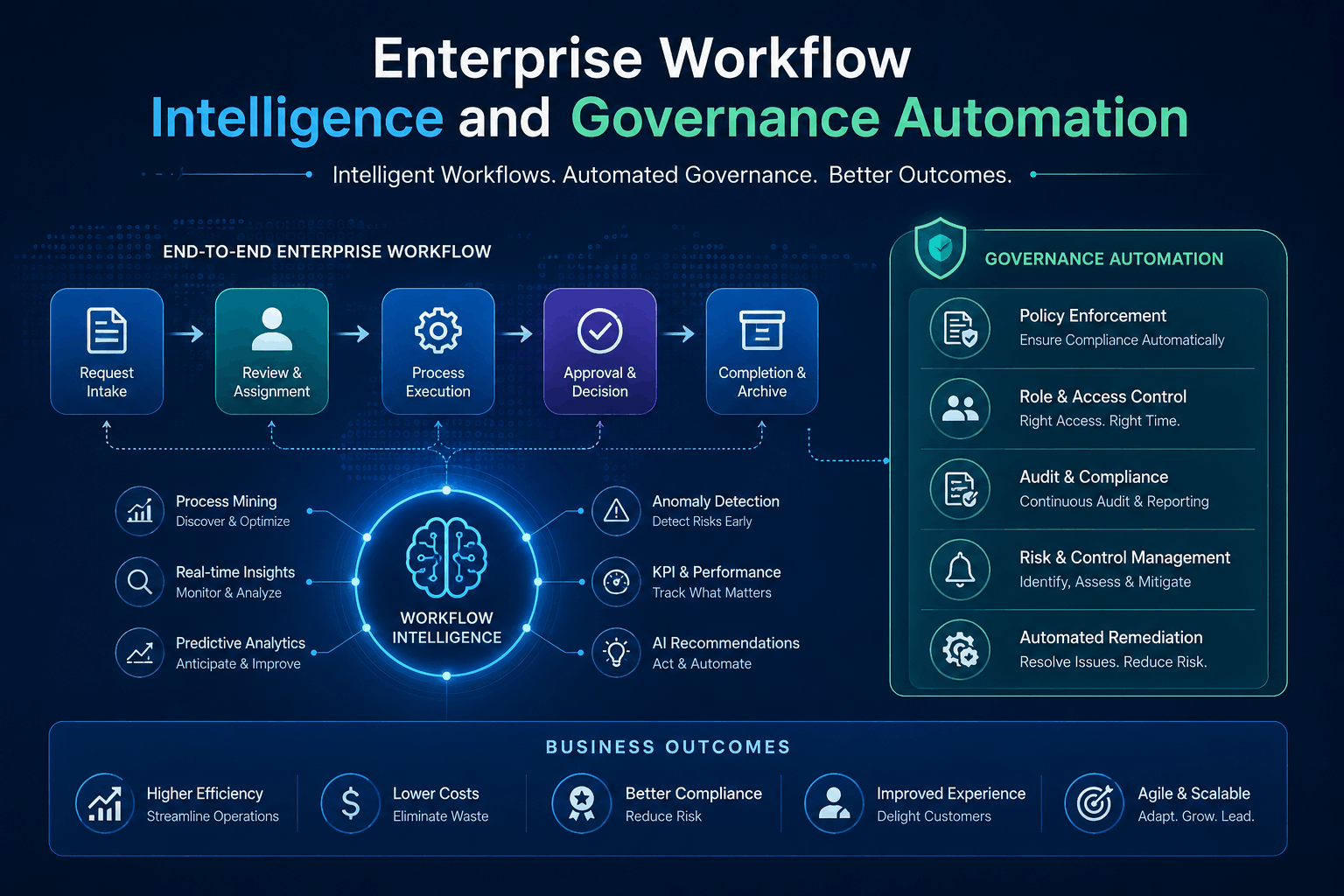
Enterprise workflow intelligence governance automation represents the next stage of operational maturity. Many organizations automate workflows, but far fewer understand whether those workflows are operating effectively across the enterprise. Automation moves work. Intelligence explains how the work behaves across systems, approvals, vendors, onboarding environments, and operational infrastructure.
In identity governance, this distinction is extremely important. A workflow may be automated while still remaining poorly governed. Requests may move quickly through inconsistent approval paths. Vendor activity may be automated but not standardized. Onboarding provisioning may trigger automatically while still relying on outdated or inaccurate identity data.
Workflow intelligence closes this gap by giving organizations visibility into performance, exceptions, policy adherence, operational patterns, and governance consistency. Instead of simply automating operational tasks, enterprises gain insight into how governance infrastructure performs in practice.
This supports CCA’s governance-first approach to business card governance by transforming workflow execution into measurable operational infrastructure.
Why Automation Alone Is Not Enough
Automation is valuable, but it is not the same as governance. Automation can accelerate effective processes, but it can also accelerate fragmented workflows if the operational structure is weak.
If an enterprise automates a poorly designed workflow, the result is often faster inconsistency rather than improved governance.
For example:
- Business card approval workflow systems may bypass required stakeholders
- Procurement coordination may remain disconnected
- Vendor execution may become inconsistent
- Identity data may remain outdated
- Audit visibility may still be limited
These problems are not solved simply because workflows operate automatically.
Governance automation must therefore be paired with workflow intelligence. Organizations need visibility into:
- Which workflows are completed
- Which workflows are delayed
- Which approvals are bypassed
- Which requests generate exceptions
- Which vendors create operational inconsistencies
- Which processes introduce downstream governance risk
Without operational intelligence, enterprises may automate activity without understanding whether governance standards are actually being enforced.
What Workflow Intelligence Measures
Workflow intelligence evaluates how governance systems perform operationally across the enterprise. Instead of focusing solely on task completion, workflow intelligence measures the behavior and quality of operational execution.
Common intelligence metrics include:
- Approval patterns
- Exception frequency
- Processing times
- Routing accuracy
- Vendor alignment
- Workflow completion rates
- Audit completeness
- Governance policy adherence
These operational signals help organizations understand whether governance systems are functioning as intended or whether fragmentation is emerging across workflows and operational teams.
This directly connects to measuring identity governance effectiveness and operational visibility. Organizations do not achieve governance maturity simply by implementing policies or automation. They achieve it when they can continuously measure, evaluate, and improve operational execution.
Workflow Intelligence and Orchestration
Workflow orchestration connects multiple systems into a unified and governed operational environment, while workflow intelligence continuously monitors and analyzes how that environment performs over time.
Together, orchestration and intelligence create infrastructure-level governance.
Organizations that invest in workflow orchestration gain stronger control over:
- Onboarding execution
- Procurement coordination
- Vendor governance
- Approval routing
- Identity lifecycle management
- Operational reporting
Orchestration ensures workflows remain connected across systems, while intelligence ensures those workflows operate consistently and efficiently.
Without orchestration, workflow intelligence remains fragmented because operational activity occurs across disconnected systems. Without intelligence, orchestration may automate workflows without identifying operational weaknesses.
The combination of both creates a scalable governance infrastructure capable of supporting complex enterprise environments.
API Integration as the Foundation
Workflow intelligence depends heavily on data from connected operational systems. API-integrated enterprise business card infrastructure allows governance platforms to understand how HRIS events, procurement activity, approval routing, onboarding workflows, vendor execution, reporting systems, and proprietary backends interact throughout the enterprise. Without API-connected workflow infrastructure, organizations may see activity inside individual systems while missing the broader operational reality across the enterprise ecosystem.
Integrated environments provide visibility into workflow dependencies and operational relationships across infrastructure systems.
Without integration, workflow intelligence becomes incomplete. Organizations may see activity within individual platforms while missing the broader operational reality across the enterprise ecosystem.
For example, an approval workflow may appear complete within one system while procurement execution or vendor fulfillment remains delayed elsewhere.
Integrated governance infrastructure allows enterprises to monitor workflows holistically rather than through isolated operational snapshots.
From Reporting to Operational Intelligence
Traditional reporting primarily describes what has already happened. Workflow intelligence helps organizations understand what is happening operationally in real time, where governance risk is emerging, and how they can continuously optimize workflows beyond historical summaries.
This creates a more proactive form of operational control.
In business card governance environments, workflow intelligence can reveal patterns such as:
- Recurring approval delays
- Frequent template exceptions
- Vendor-specific inconsistencies
- Department-level bottlenecks
- Location-based workflow variations
- Procurement coordination gaps
These insights allow operational leaders to improve governance systems strategically rather than simply reacting to isolated workflow issues after they occur.
As enterprise environments scale, this intelligence becomes increasingly valuable for maintaining operational consistency and governance maturity.
| Capability | Basic Automation | Workflow Intelligence |
|---|---|---|
| Main function | Moves tasks forward | Measures how workflows perform |
| Visibility | Limited to task completion | Tracks patterns, exceptions, delays, and risk |
| Governance value | Executes rules | Evaluates whether rules are working |
| Enterprise fit | Useful for simple workflows | Critical for distributed enterprise operations |
The Role of Governance Platforms
Business Card Solutions can provide the operational foundation for workflow automation, reporting visibility, exception monitoring, governance enforcement, and operational coordination across enterprise environments. Business Card Manager supports the execution layer by connecting centralized ordering, approval routing, HR and procurement coordination, operational visibility, and reporting into one governed workflow environment.
When connected to the broader CCA ecosystem, workflow intelligence supports category-level governance authority by centralizing visibility across onboarding systems, procurement infrastructure, approval workflows, vendor environments, and identity management operations.
Centralized governance platforms improve operational consistency because enterprises can monitor workflow behavior, enforce governance standards, and identify emerging operational risks from a unified infrastructure environment.
Strategic Takeaway
Enterprise workflow intelligence transforms governance automation into a measurable operational capability. It allows organizations to move beyond simple task automation toward an intelligent operational infrastructure capable of supporting scalable governance execution.
Enterprises that measure workflow behavior gain stronger visibility into operational performance, governance consistency, approval efficiency, vendor coordination, and infrastructure-level execution.
Organizations that invest in workflow intelligence can reduce operational risk, improve consistency, strengthen governance maturity, and create more resilient enterprise identity operations.