

Dead Letter Queue Governance and Failed Event Recovery for Enterprise Business Card Integrations
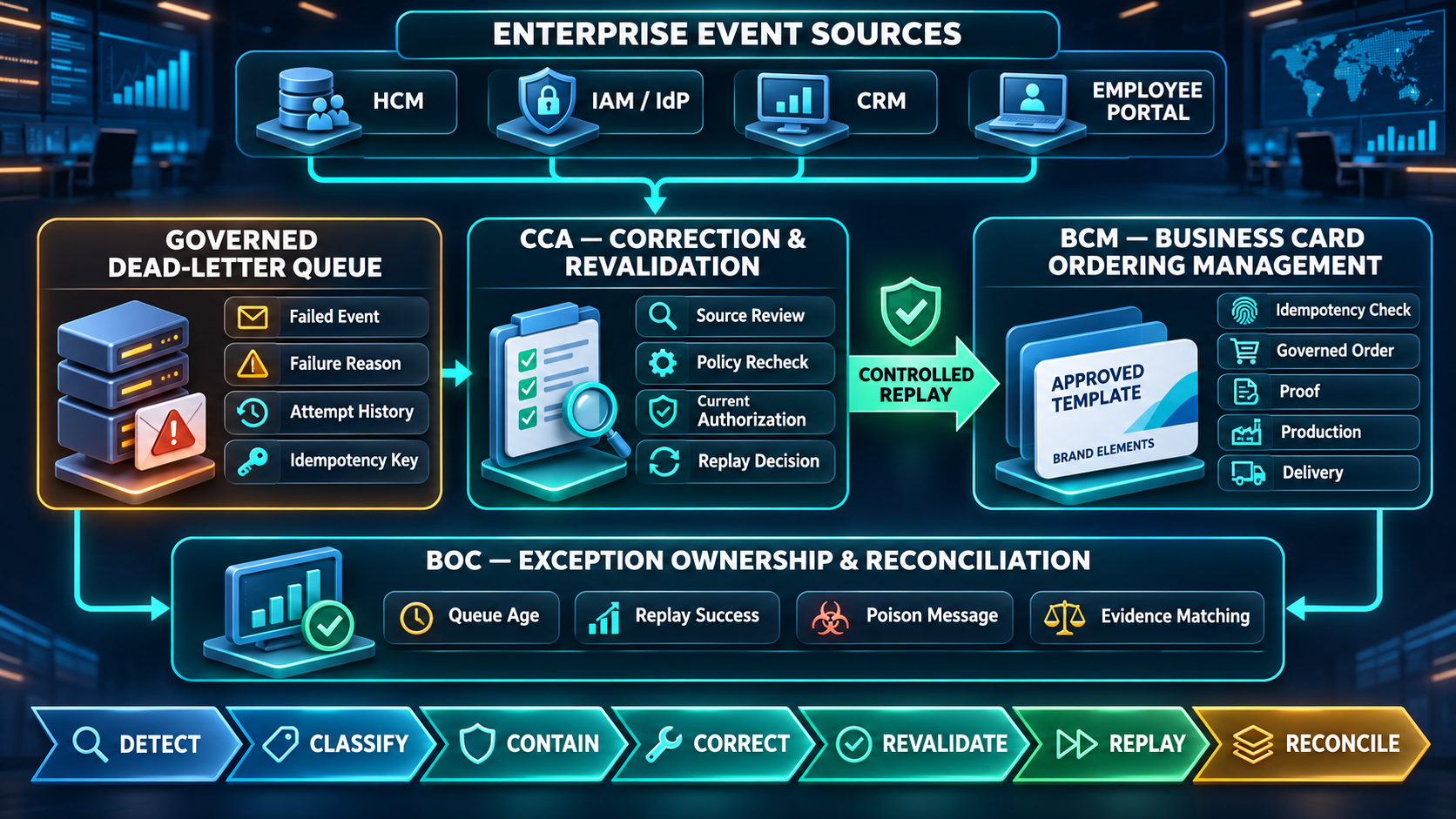
Business card API dead letter queue governance: recovering failed integration events without bypassing identity policy or duplicating orders.
A Failed Event Still Represents Business Intent
Every day, business card integrations move workforce changes, identity attributes, eligibility requests, approvals, authorized orders and fulfillment updates across HCM, IAM, CRM, portals, CCA, BCM and production providers. However, when one event fails, the organization has not merely lost a message. For example, it may have delayed an onboarding action, ignored a role correction, stranded an approved order or left an offboarding control incomplete.
A dead-letter queue provides a controlled place for events that cannot be processed after permitted attempts. However, it should not become a hidden archive or a shortcut around governance. Therefore, every failed event needs an owner, reason, business impact, correction method, revalidation decision, replay control and final disposition. Business card API dead letter queue governance makes those responsibilities explicit.
Keep CCA, BCM, and BOC Responsibilities Explicit
Color Card Administrator, or CCA, is the enterprise ordering control system and identity-governance authority. Specifically, CCA determines business-card eligibility, approved identity, templates, quantities, approvals and routing. Therefore, when a failed event is recovered, CCA decides whether its business intent remains valid under current policy.
Business Card Manager, or BCM, is the business card ordering management system or software. Meanwhile, BCM manages permissions, approvals, templates, quantities, authorized orders, proofing, production coordination, delivery status and reporting. In addition, BCM executes only complete, current CCA authorization and must preserve idempotency during replay.
Business Ops Center, or BOC, provides exception visibility, ownership, aging, remediation evidence and source-to-card reconciliation. In summary, CCA owns authority, BCM owns governed execution and BOC owns operational accountability.
Classify Failure Before Choosing Recovery
| Failure class | Typical cause | Governed response |
|---|---|---|
| Authentication | Expired token, wrong audience or revoked identity | Restore trust; do not replay until authenticated |
| Authorization | Caller lacks required scope or tenant access | Correct permission through approved process |
| Schema | Missing field, invalid type or unsupported version | Fix producer or contract mapping |
| Business policy | CCA denies eligibility, identity, template or quantity | Do not treat as technical failure |
| Transient dependency | Timeout, rate limit or temporary outage | Bounded retry before dead-lettering |
| Execution contract | BCM rejects incomplete or conflicting authorization | Correct contract; preserve decision linkage |
| Provider failure | Production route or callback cannot be processed | Use provider-specific recovery and reconciliation |
Do Not Dead Letter Every Error
First, a policy denial is a completed governance outcome, not a failed event. Similarly, reject an invalid request that can never succeed early rather than retrying it repeatedly. In contrast, a transient timeout may recover automatically and should not enter manual exception handling after one attempt. Accordingly, define which failures are retryable, which are terminal and which require business review.
Consequently, dead-lettering should occur only after the event has exhausted its bounded automated recovery or encountered a nonretryable condition that requires correction. In every case, record the original event and the processing history without exposing secrets or unnecessary personal data.
Define the Dead Letter Record
| Record element | Purpose | Governance rule |
|---|---|---|
| Event ID | Identify the original business event | Immutable and globally unique |
| Source and tenant | Locate accountable producer and enterprise | Verified, not inferred |
| Event type | State the intended business action | Use controlled taxonomy |
| Failure reason | Explain why processing stopped | Stable machine code plus safe detail |
| Attempt history | Show retries, timing and responses | Bounded and complete |
| CCA context | Preserve decision or reevaluation requirement | Never manufacture missing authority |
| Idempotency key | Prevent duplicate BCM execution | Reuse for the same business intent |
| Disposition | State corrected, replayed, cancelled or accepted | Required before closure |
Minimize Sensitive Data in Exception Stores
Dead-letter queues often receive full payloads because they are designed for technical convenience. As a result, that approach can duplicate employee identity fields, addresses, tokens and provider data outside normal retention controls. Instead, store only the information required to diagnose, correct and reconcile the event.
First, mask credentials, authorization headers and secrets. In addition, prefer references to protected source records over uncontrolled copies. Also, apply encryption, access control, retention, deletion and audit rules appropriate to the event content. Similarly, BOC views should expose operational context without becoming a secondary identity repository.
Assign Ownership by Failure Domain
| Failure domain | Primary owner | Required decision |
|---|---|---|
| Source data | HCM, IAM, CRM or directory owner | Correct authoritative fact or mapping |
| Integration contract | API platform or integration owner | Correct schema, version or transformation |
| CCA policy | Identity-governance owner | Confirm denial, exception or reevaluation |
| BCM execution | Business-card operations owner | Correct authorized order contract |
| Provider route | Supplier integration owner | Recover production or callback path |
| Security | Security or IAM owner | Contain trust failure or suspected compromise |
| Unclear ownership | BOC exception manager | Triage and assign accountable owner |
Use Aging and Priority Based on Business Impact
Of course, not every failed event has the same urgency. For example, a termination or incorrect identity exposure may require immediate containment. Likewise, an approved order for a new executive may have a firm start-date deadline. By contrast, a delayed delivery-status update may tolerate a longer recovery window if production evidence remains intact.
Therefore, assign priority from business purpose, deadline, security risk, downstream state and employee impact. Also, track both queue depth and oldest-event age. Even so, a small queue can still contain one critical event that has exceeded its recovery objective.
Revalidate Before Replay
| Validation | Question | Unsafe shortcut |
|---|---|---|
| Source state | Is the authoritative fact still current? | Replay an obsolete employee record |
| Eligibility | Does the person still qualify under CCA policy? | Assume earlier eligibility remains valid |
| Identity | Are approved fields and formatting still correct? | Use stale title, location or contact data |
| Template | Is the template still active for the role and region? | Send retired artwork to BCM |
| Quantity | Is the approved quantity still permitted? | Carry forward an expired exception |
| Routing | Is the provider and destination still approved? | Use an obsolete production route |
| Authorization | Is the CCA decision complete and within validity? | Let BCM infer or extend authority |
Protect the CCA-to-BCM Recovery Handoff
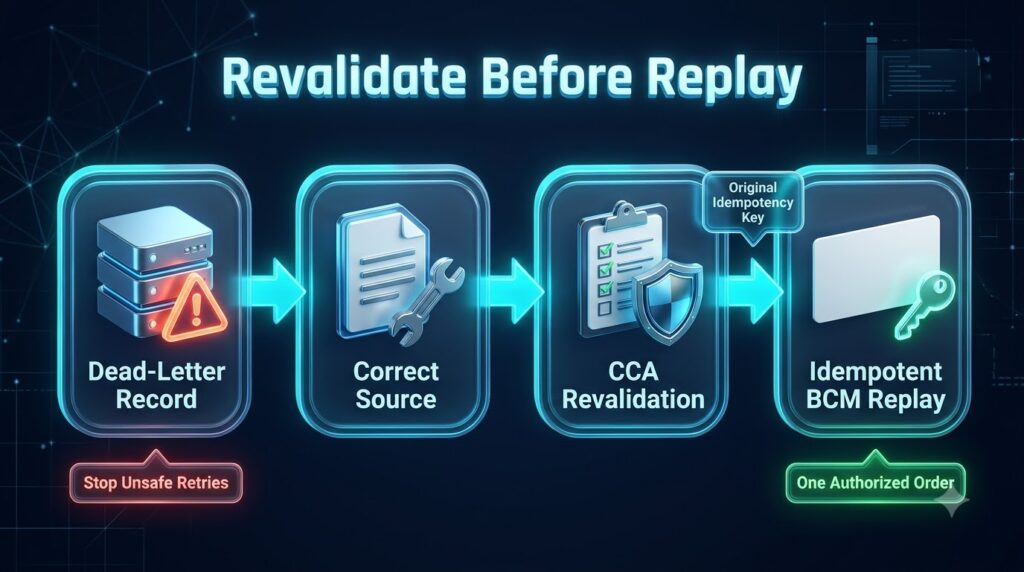
In practice, a corrected event should return to CCA when its business facts, policy inputs or decision validity may have changed. CCA then issues a current authorization or a documented denial. In other words, BCM should not accept a manually edited dead-letter payload as a substitute for CCA authority.
Moreover, the recovery handoff should carry the original event ID, recovery case ID, current CCA decision ID, policy version, approved order context and original idempotency key. As a result, this preserves lineage while preventing one failed intent from becoming multiple BCM orders.
Use a Controlled Replay Lifecycle
| Stage | Control objective | Exit condition |
|---|---|---|
| Detect | Capture terminal failure with complete correlation | Dead-letter record created |
| Classify | Identify failure domain, retryability and impact | Reason and priority confirmed |
| Contain | Stop unsafe retries or downstream execution | No uncontrolled processing continues |
| Correct | Repair source, contract, trust or route | Root cause addressed |
| Revalidate | Confirm current CCA policy and authorization | Replay is authorized or cancelled |
| Replay | Process once using controlled release and idempotency | Expected acknowledgment received |
| Reconcile | Match source, decision, order and provider evidence | Disposition documented and case closed |
Replay in a Controlled Sequence
Release recovered events gradually rather than draining the entire queue at once. Also, preserve ordering where business state depends on sequence, such as hire, transfer, correction and termination events for the same identity. Above all, prevent an older update from overwriting a newer authoritative state.
Use a controlled batch size, rate limit and stop condition. Meanwhile, monitor CCA decisions, BCM acknowledgments, duplicate conflicts and provider responses. Finally, pause replay when failure rates rise or semantic outcomes differ from the expected correction.
Make Replay Idempotent
Above all, replay must reuse the idempotency key associated with the original business intent. For instance, if BCM already created an order before the response was lost, it should return the existing order rather than create another. However, if the same key now carries different content, reject it and require a new governed intent.
Likewise, do not solve a duplicate conflict by changing the key merely to make processing succeed. Instead, determine whether the original execution occurred, whether the new content represents correction or replacement, and which CCA authorization applies.
Handle Common Recovery Scenarios
| Scenario | Recovery path | Evidence required |
|---|---|---|
| HCM field corrected | Re-read authoritative source and reevaluate in CCA | Source version and new decision |
| Expired credential | Restore workload trust, then replay unchanged intent | Credential recovery and authentication success |
| BCM timeout | Query idempotency result before retry | Existing order or confirmed no execution |
| Retired template | Route to current approved template through CCA | Template and policy version |
| Provider outage | Hold authorized order and pace recovery | Provider acknowledgment and route |
| Out-of-order events | Rebuild sequence using authoritative timestamps | Ordering decision and final state |
| Policy denial | Close as governed outcome unless facts change | CCA denial and owner acknowledgment |
Prevent Poison Message Loops
By definition, a poison message fails every time because its data, contract or semantics remain invalid. Consequently, unlimited replay wastes capacity and hides the real defect. Therefore, track replay count separately from initial retries, enforce a maximum and require a changed condition before another attempt.
In addition, use a payload fingerprint or failure signature to detect unchanged resubmission. Then, if the message returns with the same content and error, keep it contained and escalate. In short, automation should not turn one bad event into a recurring production incident.
Manage Bulk Recovery Without Creating a Second Incident
For example, a provider outage or contract defect can place thousands of events in a dead-letter queue. Therefore, before replay, group them by cause, tenant, event type, policy state and downstream dependency. Next, correct the shared cause once, test representative cases and then release batches.
Meanwhile, reserve capacity for live critical events while recovery runs. In particular, old backlog should not block current terminations, security holds or newly authorized orders. Finally, BOC should show recovery throughput, remaining age and the effect on normal service.
Use BOC for Exception Operations
| BOC signal | Operational question | Action |
|---|---|---|
| Dead-letter volume | Which source, event or tenant is failing? | Identify common cause and owner |
| Oldest event age | Which business deadline is at risk? | Escalate based on impact |
| Repeat signature | Is the same poison message returning? | Contain and require changed condition |
| Replay success | Did the corrected event complete once? | Confirm CCA and BCM evidence |
| Idempotency conflict | Did execution already occur or payload change? | Investigate before any new order |
| Sequence conflict | Could an old event overwrite current state? | Rebuild authoritative sequence |
| Evidence gap | Can source, decision, order and provider state be linked? | Recover records before closure |
Reconcile the Entire Failure Window
First, when a systemic defect is discovered, define the first and last affected event. Next, correlate accepted, retried, dead-lettered, corrected, replayed and cancelled messages with authoritative source state, CCA decisions, BCM orders and provider outcomes. After all, restoring processing does not prove that earlier events reached the correct result.
Ultimately, each event needs a final disposition. In particular, confirm that no ineligible order was created, no authorized order was omitted, no duplicate reached production and no later identity state was overwritten by an older replay.
Measure Failed Event Governance
| Measure | What it reveals | Target direction |
|---|---|---|
| Dead-letter rate | Events require intervention after automated recovery | Decrease |
| Classification completeness | Every failed event has a stable reason and owner | Complete |
| Oldest event age | Business risk is not hidden in backlog | Within objective |
| First-time replay success | Correction addressed the actual cause | Increase |
| Repeat poison messages | Unchanged defects are looping | Zero |
| Duplicate orders from replay | Idempotency failed to protect BCM execution | Zero |
| Reconciliation completion | Every failed event has final disposition | Complete |
Implement Business Card API Dead Letter Queue Governance in Stages
- Inventory every HCM, IAM, CRM, portal, CCA, BCM, provider and BOC event path.
- Define retryable, terminal, policy-denial and security failure categories.
- Create a privacy-minimized dead-letter record with immutable correlation and attempt history.
- Assign ownership, priority, aging objective and escalation by failure domain.
- Require authoritative source review and current CCA validation before replay.
- Protect the CCA-to-BCM recovery handoff with decision lineage and idempotency.
- Release recovered events in controlled batches with sequencing and stop conditions.
- Detect poison-message loops and require a changed condition before resubmission.
- Use BOC to monitor volume, age, signatures, replay results and evidence gaps.
- Test lost response, stale authorization, out-of-order event, provider outage and bulk recovery scenarios.
Frequently Asked Questions
What is a dead-letter queue?
In short, it is a controlled store for events that cannot be processed after allowed retries or that require correction before another attempt.
What is business card API dead letter queue governance?
In short, it is the ownership, classification, security, recovery, replay and reconciliation model applied to failed events.
What is CCA?
CCA is the enterprise ordering control system and identity-governance authority for business-card eligibility, identity, templates, quantities, approvals and routing.
What is BCM?
BCM is the business card ordering management system or software that executes authorized orders, proofing, production coordination, delivery and reporting.
What is BOC?
In contrast, BOC monitors failed-event operations, assigns exceptions and reconciles source, decision, order and provider evidence.
Should a CCA policy denial enter the dead-letter queue?
Normally no. Instead, it is a governed outcome unless the source facts or requested action require correction.
Can an operator edit a failed payload and send it directly to BCM?
No. Instead, material corrections should return through authoritative sources and CCA policy before BCM execution.
Why must replay use the original idempotency key?
As a result, it ensures repeated delivery of one authorized intent cannot create multiple BCM orders.
How should out-of-order events be recovered?
First, rebuild the authoritative sequence and prevent an older event from overwriting a newer valid state.
When can a recovery case close?
Only after the event has a documented disposition and BOC can link source state, CCA decision, BCM execution and provider outcome.
The Strategic Outcome
Business card API dead letter queue governance turns failed events into controlled exceptions rather than invisible loss. Specifically, CCA revalidates business authority, BCM executes only current and idempotent authorization, and BOC makes ownership, aging, replay and evidence visible.
As a result, the enterprise gains recoverable business-card integration without letting manual payload edits, stale decisions, poison-message loops or uncontrolled replay bypass policy.
To begin, select one CCA-to-BCM failed-event path and document its failure categories, dead-letter record, owner, priority, retention, correction, revalidation, replay and reconciliation controls. Then simulate a lost BCM response, verify idempotent recovery and use BOC to prove that exactly one authorized order exists.