

Event Ordering Deduplication and State Consistency for Enterprise Business Card Integrations
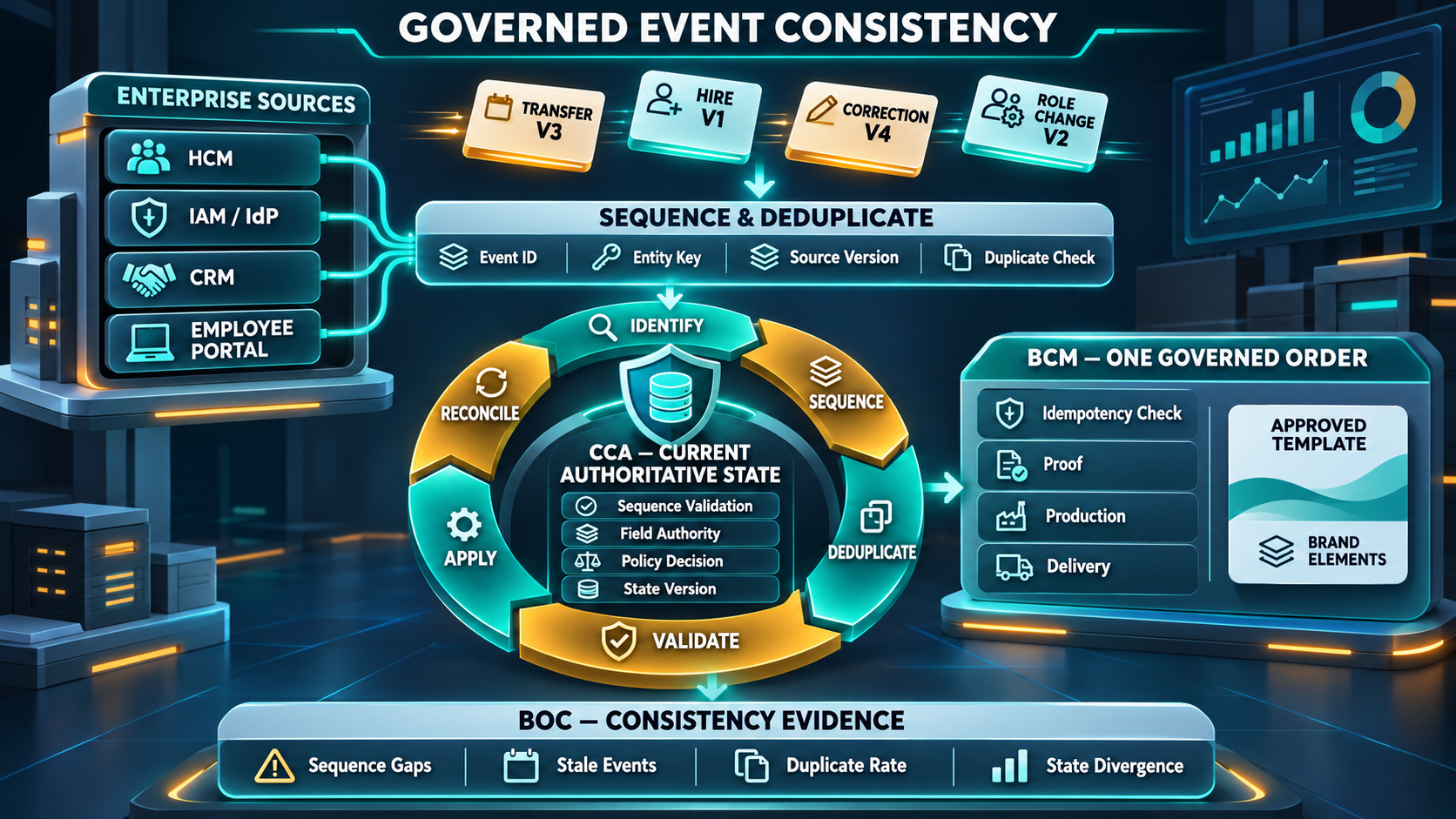
Business card API event ordering governance: keeping workforce changes and governed business card orders in the correct sequence.
Sequence Determines Business Meaning
Enterprise business card integrations receive hire, transfer, promotion, location, legal-entity, identity-correction, reorder and termination events from multiple systems. However, these events do not always arrive in the order in which they occurred. Networks retry, queues partition, batch jobs overlap and independent sources publish different clocks. As a result, if an older event is applied after a newer one, the resulting business card identity can move backward.
Event ordering is therefore a governance concern, and business card API event ordering governance assigns each system a clear role. CCA must evaluate the current authoritative state rather than trust arrival order. Meanwhile, BCM must execute one complete authorized intent without duplicating an order. Finally, BOC must expose sequence conflicts and reconcile the final source, decision, order and provider state.
Keep CCA, BCM, and BOC Responsibilities Explicit
Color Card Administrator, or CCA, is the enterprise ordering control system and identity-governance authority. CCA determines eligibility, approved identity, templates, quantities, approvals and provider routing. In addition, it determines which event represents current business state before issuing authorization.
Business Card Manager, or BCM, is the business card ordering management system or software. BCM manages permissions, approvals, templates, quantities, authorized orders, proofing, production coordination, delivery status and reporting. Therefore, BCM should consume current CCA authorization, preserve idempotency and reject conflicting replays.
Business Ops Center, or BOC, provides sequence visibility, exception ownership and source-to-card reconciliation. CCA owns authoritative interpretation, BCM owns governed execution and BOC owns operational accountability.
Understand Why Events Arrive Out of Order
| Cause | Observed pattern | Governance risk |
|---|---|---|
| Independent producers | HCM and IAM publish related changes separately | Conflicting field authority |
| Network retry | Earlier request is delayed and resent | Old event arrives after new state |
| Partitioned queue | Ordering holds only within one partition | Related identity events cross streams |
| Bulk import | Historical records are emitted together | Creation order differs from effective order |
| Clock variance | Systems assign inconsistent timestamps | Timestamp comparison becomes unsafe |
| Recovery replay | Dead-letter event returns later | Recovered event overwrites current state |
| Duplicate delivery | At-least-once transport repeats message | One intent triggers multiple actions |
Separate Event Time from Processing Time
Event time describes when the business change became effective. Processing time describes when a system received or handled the message. In other words, they are not interchangeable. For example, a delayed transfer event can be processed after a termination even though it became effective earlier. As a result, applying it by arrival time could reactivate an obsolete identity.
To start, capture source version, effective time, publication time and receipt time when available. Above all, prefer a source-controlled version or sequence over unsynchronized wall-clock time. However, when no reliable order exists, rebuild current state from the authoritative source rather than guessing.
Define an Event Identity Model
| Field | Purpose | Control |
|---|---|---|
| Event ID | Identify one published message | Globally unique and immutable |
| Business entity ID | Group events for one worker or identity | Stable across source changes |
| Event type | Describe hire, transfer, correction or termination | Controlled taxonomy |
| Source version | Establish authoritative progression | Monotonic per entity where possible |
| Effective time | State when the business change applies | Source-owned and timezone clear |
| Idempotency key | Identify one requested business action | Stable across retries |
| Correlation ID | Link source, CCA, BCM and provider evidence | Preserved end to end |
Choose the Right Ordering Scope
Admittedly, global ordering across every enterprise event is expensive and unnecessary. In practice, most state conflicts need ordering only for one business entity, such as an employee identity, order or provider job. Partition related events by a stable key so their sequence can be evaluated together.
Therefore, the partition key should match the business invariant. For example, worker ID may be correct for lifecycle state, while order ID is correct for fulfillment events. In contrast, tenant ID alone can serialize too much traffic; email address can change and should not be treated as the durable identity key.
Use State Transitions, Not Blind Updates
| Current state | Incoming event | Governed action |
|---|---|---|
| Prehire | Hire activated | Evaluate eligibility and approved identity |
| Active | Role or location change | Recompute affected fields and template |
| Active | Duplicate unchanged update | Acknowledge without new order |
| Transferred | Older pre-transfer event | Reject or ignore as stale |
| Terminated | Earlier profile correction | Do not reactivate identity |
| Authorized order | Same idempotency key | Return existing BCM outcome |
| Delivered order | Late production event | Record only if state transition is valid |
Make CCA the State Interpretation Authority
CCA should normalize events into a current identity state using field authority, effective dates, source versions and policy. In particular, it should not allow the latest arrival to win automatically. Consequently, when two sources disagree, CCA applies the approved ownership model or routes an exception.
Then, after state resolution, CCA evaluates eligibility, approved fields, template, quantity, approval and routing. Its authorization should carry the source state version and policy version so BCM can verify that the order was derived from a specific, current state.
Protect the CCA-to-BCM State Contract
| Control | CCA responsibility | BCM responsibility |
|---|---|---|
| State version | Issue authorization from resolved current state | Record version with order |
| Decision version | Preserve policy and decision identifiers | Reject incomplete decision context |
| Idempotency | Create stable key for one authorized action | Return existing result for duplicate delivery |
| Validity | Set authorization lifetime and conditions | Do not execute expired state |
| Sequence | Identify superseded decisions where required | Prevent obsolete execution |
| Conflict | Route ambiguous state to exception | Do not infer authority |
| Evidence | Link source events and decision | Link order, proof and provider events |
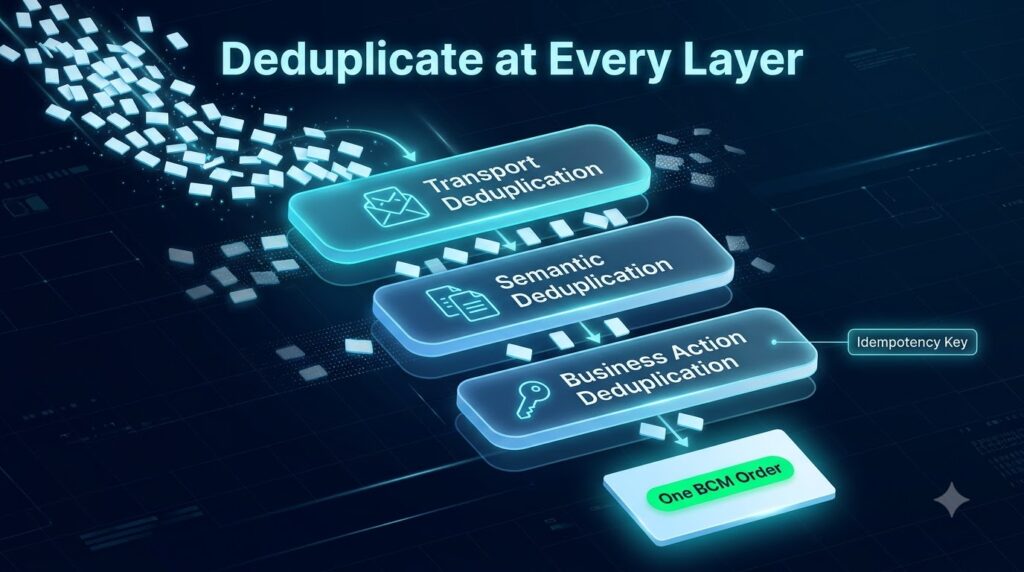
Deduplicate at More Than One Layer
First, transport deduplication removes repeated copies of the same event ID. In addition, semantic deduplication recognizes different events that describe the same unchanged state. Finally, business-action deduplication ensures that repeated delivery of one authorization does not create multiple BCM orders. In short, each layer protects a different failure mode.
However, do not drop an event merely because its payload resembles another. Compare source version, effective state and business intent. For instance, two identical-looking events may represent separate approved reorders; two different payloads may normalize to the same governed identity state.
Apply a Deduplication Matrix
| Duplicate type | Detection key | Required response |
|---|---|---|
| Exact message | Event ID and payload fingerprint | Acknowledge; do not reprocess |
| Transport retry | Event ID or delivery identifier | Return recorded processing result |
| Same state | Entity ID plus normalized state version | No new identity action |
| Same authorization | CCA decision and idempotency key | Return existing BCM order |
| Conflicting reuse | Same key with different content | Reject and investigate |
| Legitimate reorder | New governed intent and new key | Create separate authorized order |
| Provider callback duplicate | Provider event ID and order ID | Record once; preserve final state |
Define Idempotency Retention by Business Risk
An idempotency record must live long enough to cover network retries, queue delays, dead-letter recovery and provider response windows. Otherwise, a retention period that is shorter than the recovery window can allow an old authorized intent to create a second order after its original record expires.
Accordingly, retention should consider order lifecycle, supplier lead time, integration replay policy and audit requirements. In addition, store the key, request fingerprint, CCA decision, BCM order and final response. Protect this evidence with the same tenant and privacy controls as the order itself.
Handle Late and Stale Events Explicitly
First, define a tolerance window for expected delay, but do not use time alone to decide truth. For example, a late event can still be current if the source version is newer. Conversely, a newly arrived event can be stale if it carries an older source version or effective state.
Therefore, when a stale event is detected, record the reason and current superseding version. Do not silently discard events that could reveal a producer defect. Moreover, repeated stale delivery may signal a replay loop, incorrect cursor or broken source checkpoint.
Recover Gaps Without Guessing
| Gap signal | Risk | Recovery |
|---|---|---|
| Missing sequence number | One or more events were not observed | Pause entity and query source |
| Version jump | Current state advanced unexpectedly | Fetch snapshot or missing changes |
| Unknown predecessor | Transition cannot be validated | Rebuild authoritative state |
| Conflicting timestamp | Clock order is ambiguous | Use source version or owner review |
| Lost response | Execution may have succeeded | Query idempotency outcome |
| Late dead-letter replay | Older event returns after newer state | Revalidate and reject if stale |
| Provider gap | Fulfillment state skips expected transition | Query provider and reconcile evidence |
Use Snapshots and Events Together
In essence, events explain how state changed, while snapshots state what is true now. A robust integration can use events for timely processing and authoritative snapshots for recovery and reconciliation. Consequently, when sequence confidence is lost, compare with the current source snapshot before issuing a CCA decision.
However, snapshot reconciliation should not automatically create orders. Instead, it should identify state differences, apply CCA policy and determine whether an identity correction, replacement, reorder or no action is appropriate.
Manage Multi-Source Identity Changes
HCM may own legal name and job title, IAM may own sign-in status, a directory may own office contact data and CRM may own customer-facing role context. As a result, ordering these events by arrival cannot resolve ownership. CCA needs a field-authority model and rules for effective dates, exceptions and approved user input.
Moreover, the resolved state should show which source contributed each approved field. Similarly, when a later event changes a nonauthoritative field, CCA should reject or ignore it rather than treating recency as authority.
Use BOC for Consistency Operations
| BOC signal | Operational question | Action |
|---|---|---|
| Duplicate rate | Which producer or transport repeats events? | Correct retry or cursor behavior |
| Stale event rate | Which source sends obsolete versions? | Investigate source sequencing |
| Sequence gap | Is current state incomplete? | Pause and rebuild from authority |
| Idempotency conflict | Was one key reused with different intent? | Stop execution and investigate |
| State divergence | Do source, CCA and BCM disagree? | Reconcile authoritative version |
| Late replay | Did recovery return an obsolete event? | Revalidate before any action |
| Evidence gap | Can event, decision, order and provider state be linked? | Recover records before closure |
Reconcile Current State End to End
In practice, reconciliation should compare the authoritative source version, normalized CCA identity state, CCA policy decision, BCM order state and provider outcome. In other words, the objective is not merely equal record counts. It is confirmation that the current business identity and every physical order reflect valid authority.
Next, investigate identities with version gaps, unexpected reversions, duplicate orders, conflicting templates or provider states that cannot be traced to one CCA decision. Finally, give each discrepancy an owner and documented disposition.
Measure Event Consistency Governance
| Measure | What it reveals | Target direction |
|---|---|---|
| Event identity coverage | Messages carry stable IDs and correlation | Complete |
| Sequence confidence | Entity state can be ordered or rebuilt | High |
| Duplicate suppression | Repeated delivery does not repeat action | Complete |
| Stale event application | Older state overwrote newer state | Zero |
| Idempotency conflicts | One key was reused for different intent | Zero |
| Duplicate BCM orders | One authorization produced multiple orders | Zero |
| State reconciliation | Source, CCA, BCM and provider state align | Complete |
Implement Business Card API Event Ordering Governance in Stages
- Inventory HCM, IAM, CRM, portal, CCA, BCM, provider and BOC event paths.
- Define stable event, entity, correlation and idempotency identifiers.
- Capture source version, effective time, publication time and receipt time.
- Choose partition and ordering scope around the correct business entity.
- Model valid state transitions and explicitly reject stale reversions.
- Make CCA the authority for current state, field ownership and policy evaluation.
- Protect the CCA-to-BCM contract with state version, decision version and idempotency.
- Define deduplication and retention rules for messages, states, orders and callbacks.
- Use snapshots to recover sequence gaps without automatically creating orders.
- Configure BOC monitoring for duplicates, stale events, gaps, conflicts and divergence.
Frequently Asked Questions
What is business card API event ordering governance?
In short, it is the policy and control model that determines which event represents current business state before action is taken.
What is event deduplication?
In short, it prevents repeated messages, states or authorized intents from causing repeated processing or duplicate orders.
What is CCA?
CCA is the enterprise ordering control system and identity-governance authority for eligibility, identity, templates, quantities, approvals and routing.
What is BCM?
BCM is the business card ordering management system or software that executes authorized orders, proofing, production coordination, delivery and reporting.
What is BOC?
BOC monitors sequence health, owns consistency exceptions and reconciles source, decision, order and provider evidence.
Does the latest arrival always represent current state?
No. Current state should use source authority, version and effective business time rather than arrival order alone.
What is the difference between event ID and idempotency key?
In contrast, event ID identifies one message, while an idempotency key identifies one business action across repeated deliveries.
Can a late event still be valid?
Yes. A late event may carry a newer authoritative version, so lateness alone is not proof of staleness.
How should a sequence gap be recovered?
First, pause action for the affected entity and query the authoritative source or rebuild from a trusted snapshot.
How does BCM prevent duplicate orders?
Specifically, it records the idempotency key with the CCA decision and returns the existing result for repeated delivery of the same intent.
The Strategic Outcome
Business card API event ordering governance prevents delayed, duplicated or recovered messages from moving enterprise identity backward or creating duplicate business card orders. CCA resolves current authoritative state, BCM executes one valid intent, and BOC exposes divergence and closes evidence gaps.
As a result, the enterprise gains reliable business identity execution even when enterprise systems deliver events more than once or out of order.
Select one employee lifecycle event path and document its event ID, entity key, source version, effective time, state transitions, deduplication, idempotency and reconciliation controls. Then test an out-of-order transfer and a repeated order request, confirm CCA preserves current state and verify that BCM creates exactly one authorized order.