

API Rate Limits, Traffic Shaping, and Service Protection for Enterprise Business Card Integrations
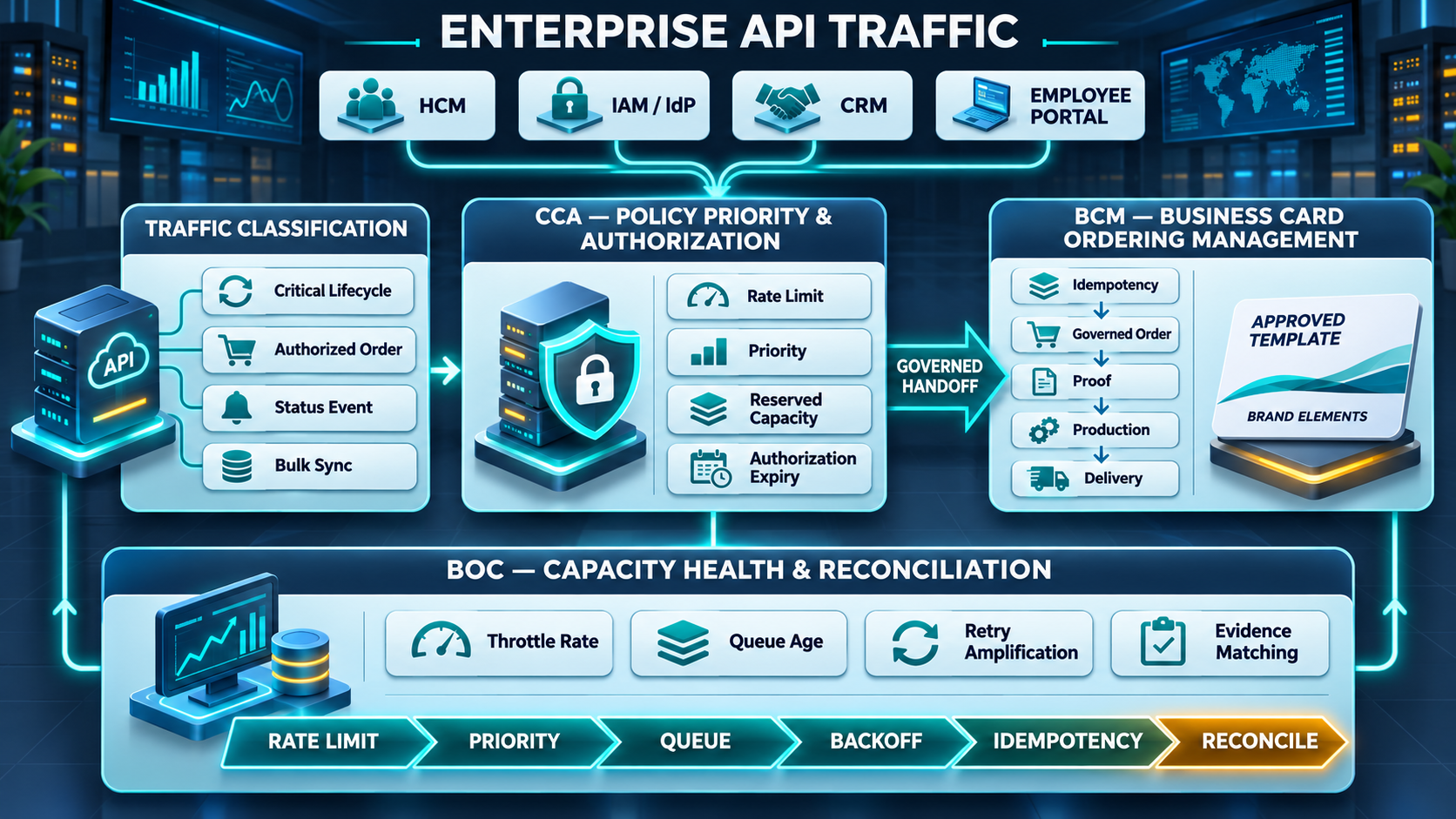
Protecting governed ordering capacity without losing authorized business events.
Service Protection Is Part of Business Governance
Enterprise business card programs receive bursts of events from HCM imports, identity directories, CRM changes, employee portals, bulk onboarding projects and provider callbacks. Without capacity controls, one noisy producer can delay or displace higher-priority work. The result is not merely technical congestion. It can postpone onboarding, duplicate an order, suppress an offboarding control or leave a time-sensitive identity change unresolved.
Rate limiting, traffic shaping and backpressure protect shared services, but they must preserve CCA authority. A rejected or delayed request cannot silently become an ungoverned manual order. The enterprise needs explicit priorities, durable queues, safe retries, idempotency and reconciliation so every authorized business event has a known outcome.
Keep CCA, BCM, and BOC Responsibilities Explicit
Color Card Administrator, or CCA, is the enterprise ordering control system and identity-governance authority. CCA determines business-card eligibility, approved identity fields, templates, quantities, approvals, routing and policy priority. Its service-protection rules should distinguish critical lifecycle events from routine or exploratory traffic.
Business Card Manager, or BCM, is the business card ordering management system or software. BCM manages permissions, approvals, templates, quantities, authorized orders, proofing, production coordination, delivery status and reporting. BCM should accept only complete CCA authorization, enforce idempotency and protect ordering capacity without weakening the decision context.
Business Ops Center, or BOC, provides capacity visibility, exception ownership and reconciliation. BOC correlates limits, queues, retries, decisions, orders and provider events. CCA owns business priority, BCM owns governed execution and BOC owns operational accountability.
Classify Traffic by Business Purpose
| Traffic class | Examples | Governance treatment |
|---|---|---|
| Critical lifecycle | Termination, identity correction, urgent security hold | Reserve capacity and process first |
| Authorized order | Approved new order or governed reorder | Protect capacity and preserve sequence |
| Approval workflow | Approval request, response and escalation | Time-bound queue with clear expiry |
| Status event | Proof, production, shipment and delivery update | Durable ingestion with correlation |
| Bulk synchronization | Scheduled HCM or directory reconciliation | Shape into predictable batches |
| Interactive read | Portal lookup, template preview and eligibility view | Fast limit with graceful degradation |
| Administrative query | Reporting, export and diagnostics | Lower priority and bounded scope |
Define Limits Around Protected Resources
A single global request limit is rarely sufficient. Different operations consume different resources. An eligibility lookup may be lightweight, while rendering a proof, generating a production package or reconciling a large tenant can be expensive. Set limits by caller, tenant, operation, environment and resource cost.
Limits should also reflect business risk. A high-volume source should not consume the same capacity pool used for termination controls or approved orders. Reserve capacity for critical operations and prevent one tenant, connector or batch job from dominating shared infrastructure.
Use Layered Rate Limits
| Layer | Purpose | Example control |
|---|---|---|
| Edge gateway | Reject abusive or malformed traffic early | Per-IP and per-client burst limit |
| Identity | Control each authenticated workload | Per-client token bucket |
| Tenant | Protect fairness across enterprises | Tenant quota and reserved capacity |
| Operation | Reflect different resource costs | Separate read, write, proof and export limits |
| CCA policy | Protect decision evaluation capacity | Priority queue by event class |
| BCM execution | Protect order and production workflows | Concurrent order and proof limits |
| Provider route | Respect downstream supplier capacity | Per-provider pacing and circuit breaker |
Choose an Algorithm That Matches the Workload
Token-bucket controls allow a steady rate with a defined burst, which suits interactive API traffic. Leaky-bucket shaping smooths bursts into a predictable outbound rate. Fixed windows are simple but can create boundary spikes. Sliding windows offer more accurate fairness at greater cost. Concurrency limits protect expensive operations even when request counts remain low.
The algorithm should be documented as part of the integration contract. Producers need to know the sustained rate, burst allowance, concurrency ceiling, reset behavior and response headers. Hidden throttling creates unreliable retry storms and makes capacity planning impossible.
Return Actionable Throttle Responses
| Response element | Meaning | Consumer action |
|---|---|---|
| HTTP 429 | Caller exceeded an applicable limit | Pause and follow retry guidance |
| Retry-After | Earliest reasonable retry time | Schedule bounded retry |
| Limit identifier | Which policy applied | Route to correct operational owner |
| Remaining capacity | Capacity left in the current window | Reduce optional calls before exhaustion |
| Correlation ID | Trace request through CCA, BCM and BOC | Preserve for support and reconciliation |
| Idempotency result | Whether a prior operation already succeeded | Do not create a duplicate order |
| Error category | Throttle, quota, concurrency or provider limit | Apply the correct recovery path |
Preserve CCA Authorization During Delay
An authorization may have a validity window because the approved identity, template, quantity or routing can change. If a request waits in a queue, BCM must verify that the CCA decision is still valid before execution. It should not refresh or reinterpret authorization on its own.
Queue records should carry the decision identifier, policy version, approved order context, idempotency key, priority, creation time and expiry. When authorization expires, route the transaction back through CCA for reevaluation rather than forcing an old decision into production.
Protect the CCA to BCM Handoff
| Control | CCA responsibility | BCM responsibility |
|---|---|---|
| Priority | Assign policy-based business priority | Schedule without overriding authority |
| Authorization | Send complete locked decision context | Validate before order execution |
| Idempotency | Provide stable transaction key | Return the original result for duplicates |
| Expiry | Declare authorization validity | Reject or reevaluate expired work |
| Throttle | Expose safe retry semantics | Avoid repeated order creation |
| Queue | Preserve order intent and correlation | Maintain durable state and sequencing |
| Evidence | Record decision and limit outcome | Record execution and status outcome |
Use Backpressure Instead of Unbounded Queues
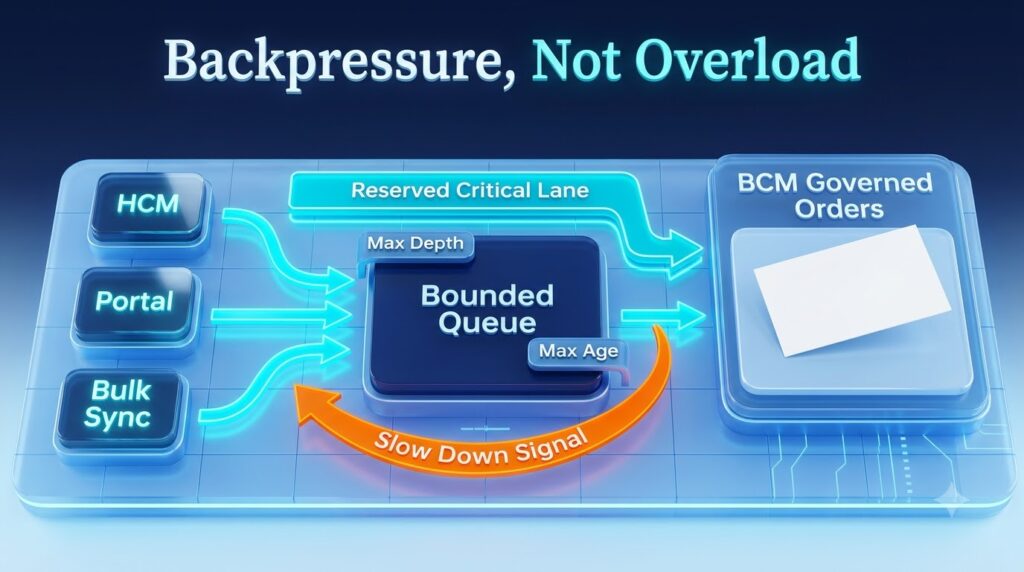
A queue can absorb a short burst, but an unlimited backlog only postpones failure. Set maximum depth, age and processing time. When thresholds are reached, slow producers, reject low-priority requests or redirect bulk work to a scheduled path. Critical events should retain reserved space.
Backpressure must be visible to upstream systems. A source connector should reduce its send rate when CCA signals congestion. A portal should avoid repeated polling when cached eligibility remains valid. A provider callback receiver should durably acknowledge accepted events and reject only when it cannot safely retain them.
Design Safe Retries
Retry only failures that are likely to recover, such as throttling, timeout or temporary dependency unavailability. Do not retry a CCA policy denial, schema violation, invalid credential or expired authorization without correcting the cause. Use exponential backoff, jitter, maximum attempts and an overall deadline.
Retries must reuse the same idempotency key for the same business action. A new key can turn one approved order into multiple orders. Preserve the first request time and correlation ID so BOC can distinguish recovery from a new transaction.
Apply a Governed Retry Matrix
| Result | Retry policy | Governance rule |
|---|---|---|
| Rate limited | Backoff using server guidance | Preserve authorization and idempotency |
| Transient timeout | Bounded exponential backoff with jitter | Confirm prior outcome before retry |
| Dependency unavailable | Retry within business deadline | Open circuit after threshold |
| CCA policy denial | Do not retry automatically | Correct facts or request governed exception |
| Invalid payload | Do not retry unchanged request | Fix producer or mapping |
| Expired authorization | Return to CCA for reevaluation | Never extend authority in BCM |
| Provider rejection | Follow provider-specific remediation | Do not loop without a changed condition |
Use Idempotency as a Business Control
Idempotency is not only a technical convenience. It protects spend, brand integrity and employee experience by ensuring that repeated delivery of one authorized intent does not create multiple physical orders. BCM should store the idempotency key with the authorization, order and response for a defined retention period.
If the same key arrives with different content, BCM should reject it as a conflict. If the original request succeeded but the response was lost, BCM should return the prior outcome. BOC should monitor conflicts and unusual reuse because they can reveal integration defects or unauthorized replay.
Shape Bulk Integrations Before They Reach CCA
Bulk onboarding, reorganizations and directory cleanups can create thousands of changes at once. Separate extraction from execution. Normalize and deduplicate records, identify which changes affect business-card identity, then release eligible events in controlled batches. This reduces unnecessary CCA evaluation and BCM work.
Coordinate bulk windows with provider capacity and business deadlines. A reconciliation run may use lower priority than approved orders but should not be starved indefinitely. Define a completion objective and expose backlog age, not only queue depth.
Use BOC for Capacity Operations
| BOC signal | Operational question | Action |
|---|---|---|
| Throttle rate | Which caller, tenant or operation is limited? | Tune producer or capacity policy |
| Queue depth | Is backlog growing faster than service? | Apply backpressure or add capacity |
| Oldest event age | Are business deadlines at risk? | Escalate priority and owner |
| Retry amplification | Are clients creating a retry storm? | Enforce backoff and jitter |
| Idempotency conflict | Is one key carrying different intent? | Stop and investigate replay |
| Priority inversion | Is low-value work delaying critical events? | Restore reserved capacity |
| Reconciliation gap | Does every accepted event have a disposition? | Recover evidence before closure |
Reconcile Overload Windows
After a capacity incident, identify the start and end of the affected window. Correlate accepted, queued, throttled, expired and failed requests with CCA decisions, BCM orders, provider submissions and return events. A restored API does not prove that every business event was processed correctly.
Each event needs a disposition: completed, safely duplicated, reevaluated, cancelled, corrected or confirmed as never accepted. Pay special attention to lifecycle events that arrived out of sequence and approved orders retried after an ambiguous timeout.
Measure Service Protection Governance
| Measure | What it reveals | Target direction |
|---|---|---|
| Protected-operation availability | Critical lifecycle and order APIs remain usable | High and stable |
| Fairness by tenant | One enterprise does not dominate shared capacity | Balanced |
| Throttle precision | Limits affect intended traffic classes | Increase |
| Oldest queue age | Business work is not hidden in backlog | Within objective |
| Retry amplification | Recovery traffic is controlled | Decrease |
| Duplicate order rate | Idempotency protects execution | Zero |
| Overload reconciliation | Every affected event has disposition | Complete |
Implement Service Protection in Stages
- Inventory every HCM, IAM, CRM, portal, CCA, BCM, provider and BOC API operation.
- Classify traffic by business purpose, priority, cost, tenant and deadline.
- Define sustained rate, burst, concurrency and quota policies for protected resources.
- Reserve capacity for critical lifecycle events and approved orders.
- Publish throttle responses, retry guidance, limits and correlation requirements.
- Protect the CCA-to-BCM handoff with authorization expiry and idempotency.
- Configure durable queues with maximum depth, age and controlled backpressure.
- Implement bounded retries with exponential backoff, jitter and circuit breaking.
- Use BOC to monitor throttles, backlog age, retry amplification and priority inversion.
- Test burst, noisy-neighbor, provider slowdown, ambiguous timeout and recovery scenarios.
Frequently Asked Questions
What is API rate-limit governance?
It is the policy and operating model that controls how much traffic each caller, tenant and operation may consume while protecting authorized business outcomes.
What is traffic shaping?
Traffic shaping smooths bursts and prioritizes work so downstream services receive requests at a safe, predictable rate.
What is CCA?
CCA is the enterprise ordering control system and identity-governance authority for business-card eligibility, identity, templates, quantities, approvals and routing.
What is BCM?
BCM is the business card ordering management system or software that executes authorized orders, proofing, production coordination, delivery and reporting.
What is BOC?
BOC monitors capacity health, owns exceptions and reconciles throttled, queued and retried events with decisions and orders.
Should every request have the same rate limit?
No. Limits should reflect caller, tenant, operation cost, business priority and downstream capacity.
Should a client retry every 429 response immediately?
No. It should follow Retry-After or documented backoff guidance and use jitter to avoid synchronized retry storms.
Can BCM extend an expired CCA authorization?
No. The request should return to CCA for reevaluation because business authority belongs to CCA.
How does idempotency prevent duplicate business cards?
BCM associates repeated delivery of the same authorized intent with one stored order and returns the original result.
What happens after an overload incident?
BOC reconciles every affected request with CCA decisions, BCM orders and provider events until each has a documented disposition.
The Strategic Outcome
Rate-limit governance protects more than API uptime. It preserves business priority, authorization integrity and order uniqueness during bursts and dependency slowdowns. CCA determines which work has authority and priority, BCM executes only complete authorized orders, and BOC exposes capacity risk and closes every affected transaction.
The organization gains resilient business-card integration without allowing high-volume traffic, uncontrolled retries or hidden queues to bypass enterprise policy.
Choose the CCA-to-BCM order path and document its rate, burst, concurrency, priority, authorization expiry, idempotency and retry behavior. Test a controlled burst and ambiguous timeout, verify that BCM creates only one authorized order, and use BOC to reconcile every accepted, throttled and retried request.