

Dead Letter Queue and Replay Governance for Enterprise Business Card API Integrations
Business Card API Dead-Letter Queue and Replay Governance | CCA, BCM, and BOC Failed Event Recovery.
In enterprise business card programs, failed events caused by missing data or policy changes can lead to wrong or duplicate cards. This video explains how Color Card Administrator (CCA), Business Card Manager (BCM), and Business Ops Center (BOC) share governance of failures. Learn to categorize contained failures, use dead-letter queues, keep useful evidence, limit retries, and replay events in a controlled way.
Containing failed events and restoring business card workflows without duplicate or unauthorized orders.
A Failed Event Is Still a Business Transaction
Enterprise business card integrations rely on events from HCM, IAM, CRM, directories, procurement platforms and employee portals. Most events move through the workflow quickly. A small number fail because a dependency is unavailable, a contract has changed, a credential has expired, an identity is incomplete or a downstream acknowledgment never arrives. Those failures cannot be treated as disposable technical noise.
Each event may represent a hire, transfer, role change, approved reorder or termination-sensitive action. If it disappears, an employee may never receive an authorized card. If it is replayed without control, the enterprise may create a duplicate order, revive an obsolete identity or bypass a new policy decision. Dead-letter queue and replay governance gives failed events a controlled lifecycle from containment through final reconciliation.
Keep CCA, BCM, and BOC Responsibilities Explicit
Color Card Administrator, or CCA, is the enterprise policy and orchestration authority for API-connected business card programs. CCA determines eligibility, approved identity, templates, quantities, approvals and provider routing. A replay is not merely a message operation: when facts, policy or timing may have changed, CCA must decide whether the business action remains authorized.
Business Card Manager, or BCM, is the business card ordering management system or software. BCM manages permissions, approvals, templates, quantities, authorized orders, proofing, production coordination, delivery status and reporting. BCM should accept one valid authorization for one intended order and reject an expired, duplicate or incompatible replay.
Business Ops Center, or BOC, provides operational monitoring, exception ownership and reconciliation. BOC identifies failed events, assigns remediation, controls release, correlates replay with downstream state and confirms a final outcome. CCA owns authorization, BCM owns governed order execution and BOC owns operational accountability.
Define the Failure Boundary
| Failure point | Typical condition | Required response |
|---|---|---|
| Source to integration | Missing identifier, invalid event or unavailable endpoint | Reject or quarantine with source evidence |
| Integration to CCA | Schema mismatch, authentication failure or timeout | Contain without assuming a CCA decision |
| CCA decision | Insufficient facts or policy exception | Quarantine for governed resolution |
| CCA to BCM | Authorization contract rejected or acknowledgment missing | Check BCM state before retry |
| BCM execution | Proof, provider or production service failure | Preserve order identity and execution state |
| Provider callback | Duplicate, late or out-of-order status | Normalize and reconcile without reopening order |
| BOC evidence | Expected lifecycle state absent | Investigate the chain before closing |
The failure boundary determines what can be retried safely. A request that never reached CCA differs from a CCA authorization whose BCM acknowledgment was lost. The same error text should never trigger the same recovery action across every stage.
What Belongs in a Dead Letter Queue
A dead-letter queue, or DLQ, is a controlled holding area for messages that cannot complete normal processing after the permitted retry policy. It should hold enough evidence to diagnose and recover the transaction, but it should not become an unrestricted archive of workforce profiles or rendered card artwork.
| DLQ evidence | Purpose | Governance rule |
|---|---|---|
| Correlation and event ID | Link attempts across systems | Stable and unique |
| Source and source version | Identify authoritative input | Preserve origin and observed time |
| Failure stage and class | Choose the correct owner and recovery path | Use normalized categories |
| CCA decision reference | Prove whether authorization exists | Never infer from payload alone |
| BCM order reference | Detect prior execution | Check before any replay |
| Attempt history | Prevent uncontrolled retry loops | Record count, time and result |
| Minimal diagnostic detail | Support resolution | Mask secrets and unnecessary identity |
Separate Retry from Replay
A retry repeats an operation within a short, bounded policy when the business context is assumed to be unchanged. A replay reintroduces a previously failed transaction after delay, intervention or correction. Replay carries greater risk because source facts, employment state, approvals, templates, quantities, delivery information and provider routes may have changed.
Automatic retry is suitable for transient network errors, rate limits and short service interruptions when the operation is idempotent. Replay should require classification, state verification and, where necessary, a new CCA evaluation. Treating every DLQ item as a delayed retry removes the governance boundary exactly when risk is highest.
Classify Failures Before Recovery
| Class | Example | Recovery decision |
|---|---|---|
| Transient | Timeout, temporary 5xx or rate limit | Bounded retry with backoff |
| Contract | Required field, type or version mismatch | Correct producer or adapter; retest |
| Data quality | Missing, stale or conflicting authoritative fact | Remediate source; reevaluate in CCA |
| Policy | Reliable facts do not permit the requested action | Do not replay unchanged request |
| Security | Invalid identity, credential, signature or scope | Contain and investigate |
| State conflict | BCM order already exists or execution advanced | Reconcile; never create a second order |
| Operational | Provider or callback path failed | Resume from confirmed order state |
Failure classification should be deterministic enough for automation and clear enough for operators. The category, stage, severity and owner should explain whether the next action is retry, correction, reauthorization, resume, cancel or investigate.
Use Bounded Retries Before Dead Lettering
Retry policies should define eligible error classes, maximum attempts, backoff, jitter, time limit and stop conditions. They should also respect provider rate limits and system capacity. An unbounded retry loop can amplify an outage, hide a contract defect and create repeated downstream side effects.
Once the threshold is reached, move the message to the DLQ with its attempt history and last confirmed state. Do not continue retrying from both the normal queue and the DLQ. A single operational owner should control its next transition.
Protect Every Side Effect with Idempotency
Idempotency ensures that repeated delivery of the same authorized intent produces one business outcome. The idempotency key should remain stable across network retries and operational replay of the same intent. It should be scoped to the authorized business action rather than generated anew for every transport attempt.
CCA should bind the key to the decision, approved identity, template, quantity and relevant effective state. BCM should persist the key and return the existing order result when the same authorization is received again. If the replay represents a materially new decision, CCA should issue a new authorization and an explicitly related key rather than disguising it as the original transaction.
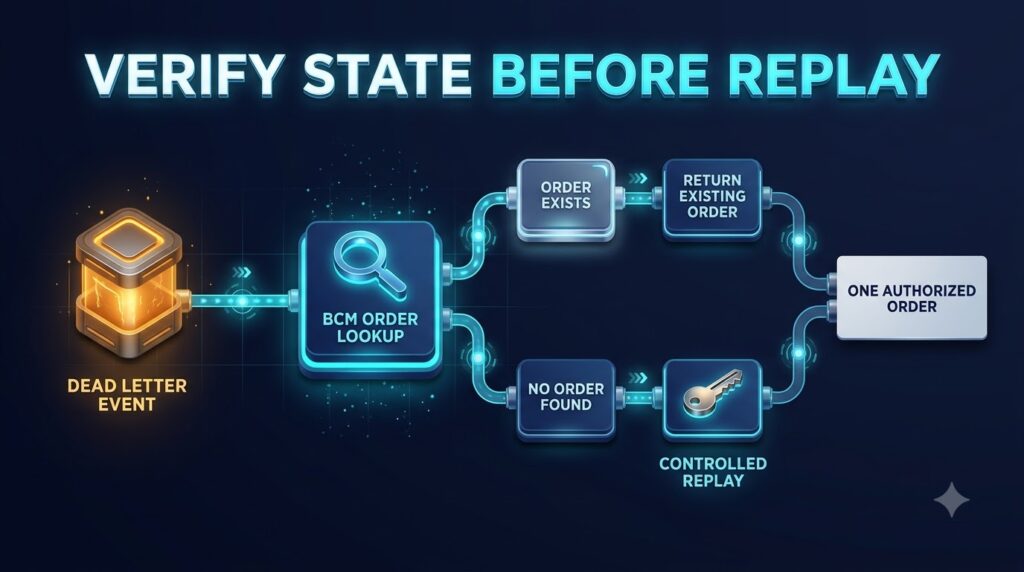
Verify State Before Replaying
| Observed state | Replay risk | Safe action |
|---|---|---|
| No CCA decision | Event may never have been evaluated | Refresh source and evaluate in CCA |
| CCA approved, no BCM receipt | Authorization may be valid or expired | Check expiry and BCM lookup before send |
| BCM acknowledged | A second send may duplicate the order | Return existing order state |
| Proof requested | Order is already active | Resume proof workflow; do not recreate |
| Production started | Changes may be impossible or costly | Escalate operationally; preserve order |
| Cancelled or denied | Replay may override a governed outcome | Require explicit new CCA decision |
| Final delivery confirmed | Transaction is complete | Close duplicate event and reconcile |
State verification should use authoritative system records, not assumptions based on missing callbacks. An acknowledgment can be lost while the order succeeds. The recovery process must ask BCM whether the authorization or idempotency key already has an order before it creates any new execution.
Reauthorize When Business Context Can Change
A delayed event can outlive the decision context that originally made it valid. The employee may have transferred, left the organization or moved to a different legal entity. A template may have been retired, an approval may have expired or a provider route may have changed. Replay should therefore evaluate age and material-change rules.
CCA can reuse an existing authorization only when policy explicitly permits it and the authorization remains valid. Otherwise, it should refresh authoritative facts and create a new versioned decision. The replay record should link the original failure, superseded authorization and new result so BOC can explain the change.
Protect the CCA to BCM Replay Handoff
The replayed handoff should contain the CCA decision ID, policy and template versions, authorization expiry, approved identity, quantity, routing, correlation ID and idempotency key. BCM should validate the contract and determine whether the key is new, already completed or associated with an active order.
BCM must not treat an operator pressing replay as permission to alter identity or quantity. Any material correction returns to CCA. This keeps the business card ordering management system focused on authorized execution while preserving CCA as the authority engine.
Run a Controlled Replay Lifecycle
| State | Control objective | Exit condition |
|---|---|---|
| Dead lettered | Stop normal delivery and preserve evidence | Failure classified |
| Assigned | Give one team operational ownership | Owner and service target recorded |
| Diagnosing | Confirm stage, cause and downstream state | Recovery path approved |
| Remediating | Correct contract, source, credential or dependency | Required validation passes |
| Reauthorizing | Refresh CCA decision when context may have changed | Valid authorization available |
| Replay approved | Confirm idempotency, scope and release authority | Controlled release initiated |
| Monitoring | Track acknowledgments and downstream state | One intended outcome confirmed |
| Reconciled | Link original failure, replay and final result | BOC closes with evidence |
Make Manual Replay a Privileged Action
A replay console can create real business and financial effects. Access should use least privilege, strong authentication and separation between investigation and release where risk warrants it. Operators should see the failure reason, authoritative state, CCA decision and BCM lookup result before release.
Record who approved the replay, which records were included, the filter used, the expected effect and the actual outcome. Bulk replay should require cohort limits, sampling and stop conditions. A free-form resend button without scope and evidence is not an enterprise control.
Control Bulk Replay After an Incident
An outage or deployment defect may place thousands of messages in the DLQ. Restoring all messages at once can overload CCA, BCM, providers or notification services. It can also reproduce the original error at larger scale. Release in measured cohorts ordered by business priority and dependency readiness.
Before each cohort, validate a sample, confirm current CCA policy, estimate downstream capacity and define abort thresholds. BOC should compare selected, released, authorized, deduplicated, ordered, completed and failed counts. Pause when the observed outcome differs from the expected control total.
Preserve Ordering and Event Time
Events may arrive late or out of sequence. A replayed transfer should not overwrite a later termination; a delayed location event should not restore an obsolete template. Preserve source event time, ingestion time, effective time and source version so CCA can determine the correct business state.
When ordering matters, replay the minimum coherent sequence or rebuild state from the authoritative source instead of delivering isolated historical events. CCA should decide from current trusted state unless the workflow explicitly requires historical reconstruction.
Secure the Dead Letter Queue
DLQs often contain the same sensitive fields as production messages plus detailed error information. Encrypt data in transit and at rest, restrict read and replay privileges, mask secrets, control exports and enforce retention. Do not place access tokens, private keys or full rendered artwork in error text.
Use privacy-safe identifiers in dashboards and alerts. Detailed payload access should be limited to approved investigation. Delete resolved content according to purpose while retaining the minimal decision, replay and reconciliation evidence required for accountability.
Use BOC for Recovery Operations
| BOC signal | Operational question | Required action |
|---|---|---|
| DLQ depth and age | Are failures accumulating beyond target? | Escalate owner and capacity response |
| Failure concentration | Is one source, version or endpoint dominant? | Contain systemic cause |
| Retry exhaustion | Are transient policies ineffective? | Review dependency and threshold |
| Replay success | Did released messages reach expected state? | Confirm cohort before continuing |
| Deduplication result | Did BCM return an existing order? | Reconcile without recreating |
| Orphaned authorization | Did CCA approve without final BCM state? | Recover acknowledgment or investigate |
| Final evidence | Can source, decision, order and outcome be linked? | Close only when complete |
Measure Replay Governance
| Measure | What it reveals | Target direction |
|---|---|---|
| DLQ arrival rate | New failures entering containment | Decrease by root cause |
| Oldest message age | Operational backlog and business delay | Decrease |
| Repeat failure rate | Remediation did not fix the cause | Decrease to zero |
| Replay success rate | Approved releases reach intended state | Increase |
| Deduplicated replay count | Duplicate delivery was safely absorbed | Monitor and explain |
| Duplicate order rate | Recovery created an extra order | Zero |
| Reconciliation coverage | Every failed event has a final disposition | Complete |
Implement Replay Governance in Stages
- Map failure boundaries from enterprise source through CCA, BCM, provider callbacks and BOC.
- Define normalized failure classes, severities, owners and permitted recovery actions.
- Configure bounded retry policies with backoff, jitter, limits and stop conditions.
- Design a minimal, secure DLQ evidence model with retention and access controls.
- Bind CCA authorization and BCM order creation to stable idempotency keys.
- Require downstream state lookup and authorization-age checks before replay.
- Create governed remediation, reauthorization, replay approval and audit workflows.
- Configure BOC dashboards for depth, age, concentration, replay and reconciliation.
- Test lost acknowledgments, duplicates, out-of-order events, expired decisions and bulk failures.
- Review controls after API, schema, policy, template, provider or organizational changes.
Frequently Asked Questions
What is a dead letter queue?
It is a controlled holding area for events that cannot complete normal processing after the permitted retry policy.
What is replay governance?
It is the policy, authorization, operational and evidence framework that determines whether and how a failed event may reenter processing.
What is CCA?
CCA is the enterprise policy and orchestration authority that decides whether the business card action remains authorized.
What is BCM?
BCM is the business card ordering management system or software that manages authorized orders, proofing, production coordination, delivery and reporting.
What is BOC?
BOC provides failure monitoring, exception ownership, replay operations and source-to-card reconciliation.
How is retry different from replay?
Retry is a bounded repeat within an unchanged context; replay occurs after containment, delay or intervention and requires greater state verification.
Why check BCM before replay?
The original order may exist even when its acknowledgment was lost. Lookup prevents duplicate production.
When must CCA reauthorize?
CCA should reevaluate when the authorization expired or identity, employment, template, quantity, approval or routing context may have changed.
Can operators edit the payload before replay?
Material identity or order changes should return to the authoritative source and CCA rather than be patched in the replay console.
How should bulk replay be controlled?
Use approved cohorts, samples, capacity limits, abort thresholds and reconciliation counts before expanding release.
The Strategic Outcome
Dead-letter queue and replay governance converts integration failure from an uncertain technical backlog into a controlled business process. CCA confirms authority, BCM protects one-order execution and BOC makes containment, remediation, replay and final disposition visible.
The enterprise gains resilient business card automation without accepting duplicate orders, obsolete identities or untraceable manual recovery as the price of integration.
Select one business card API workflow and simulate a lost acknowledgment after CCA authorization. Confirm that the event enters the correct failure state, BOC can identify its owner, BCM can locate the existing idempotency key and order, and replay cannot create a duplicate. Repeat the test with an expired authorization and a changed workforce record to verify CCA reauthorization.