

API Data Residency and Cross-Border Processing Governance for Enterprise Business Card Integrations
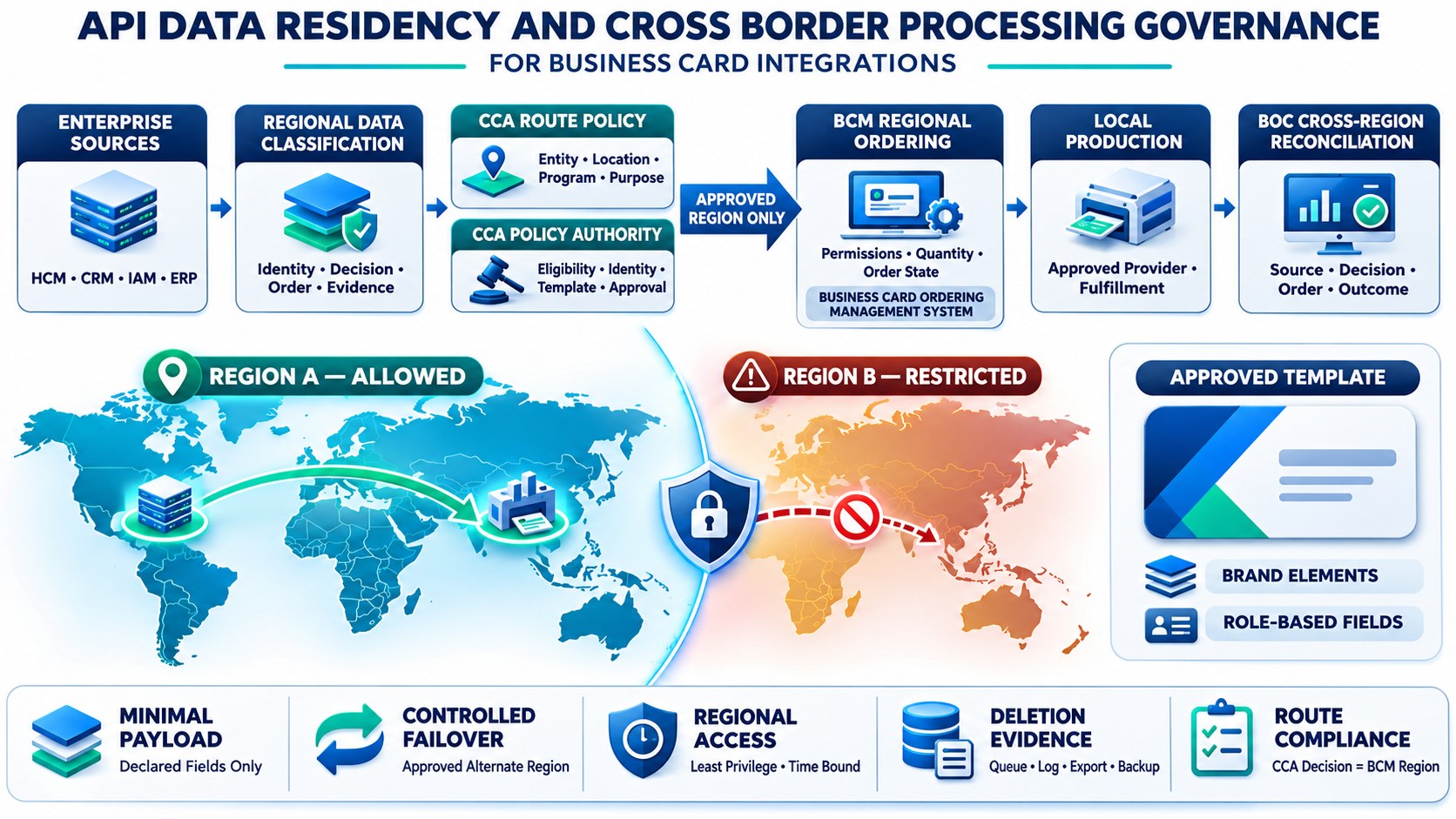
Business card API data residency governance: controlling where governed business identity, ordering, and operational evidence are processed.
Data Location Changes the Control Model
For example, a global business card program may connect workforce systems, identity platforms, procurement tools, employee portals, ordering services, print providers and reporting environments across several regions. In practice, the same transaction can touch multiple infrastructure locations before a card is produced and delivered. As a result, without business card API data residency governance, data can cross a regional boundary through a queue, log, backup, support export or provider callback even when the primary application is configured locally.
Business card API data residency governance defines where each data class may be collected, evaluated, stored, transmitted, supported and deleted. In addition, it defines which technical and business controls must remain in force when a transaction moves between approved regions. However, the objective is not to isolate every system. Instead, it is to make location, purpose and accountability explicit across the governed lifecycle.
Keep CCA, BCM, and BOC Responsibilities Explicit
To begin with, Color Card Administrator, or CCA, is the enterprise policy and orchestration authority for API-connected business card programs. First, CCA determines how trusted facts influence eligibility, public identity, templates, approvals, quantities and provider routing. Therefore, regional policy should be applied within this authority so a source system, portal or provider cannot choose a processing route that bypasses enterprise control.
Second, Business Card Manager, or BCM, is the business card ordering management system or software. Meanwhile, BCM manages permissions, approvals, templates, quantities, authorized orders, production coordination, delivery status and reporting. Finally, Business Ops Center, or BOC, provides cross-region operational visibility, exception ownership and reconciliation across source events, CCA decisions, BCM orders and fulfillment results.
In short, CCA decides the permitted identity and regional route. Then, BCM manages the authorized transaction through execution. Finally, BOC confirms that every regional handoff and final outcome remain visible and explainable.
Build a Regional Data Flow Inventory
| Flow stage | Questions to answer | Evidence |
|---|---|---|
| Enterprise source | Where is the authoritative HCM, CRM, IAM or ERP record held? | System, tenant, region and data owner |
| Integration ingress | Where are APIs, gateways, files or events received? | Endpoint, environment and processing region |
| CCA decision | Where is policy evaluated and decision evidence stored? | Policy region, decision ID and version |
| BCM ordering | Where are order, proof and status records managed? | Order region, state and retention class |
| Production provider | Where are card data and delivery details processed? | Provider location, route and contract |
| BOC operations | Where are alerts, cases and reconciliation evidence stored? | Monitoring region, access and case owner |
| Backup and support | Where do copies, exports and diagnostic artifacts exist? | Storage, support location and deletion rule |
Above all, map the actual path, not only the intended architecture. In addition, include message brokers, content delivery services, identity platforms, observability tools, support systems, email notifications, object storage and disaster-recovery copies. Otherwise, a regional statement that ignores these components is incomplete.
Classify Data Before Applying Residency Rules
| Data class | Business card example | Governance consideration |
|---|---|---|
| Source reference | Worker, account or location identifier | May support correlation without copying the profile |
| Governed identity | Approved name, title, contact and legal text | Public-facing result still requires controlled processing |
| Decision evidence | Eligibility, reason, policy and template versions | Must explain authority without excessive source data |
| Order data | Product, quantity, proof, destination and cost reference | Supports physical execution and financial accountability |
| Fulfillment data | Provider job, shipment and delivery status | May involve local production and logistics systems |
| Operational evidence | Errors, alerts, cases, logs and reconciliation | Can expose data through diagnostics and exports |
| Credentials and keys | Workload identity and trust material | Location, custody and access require security control |
Therefore, residency should be assigned by data class and processing purpose. In contrast, treating all business card information as one category can overrestrict harmless metadata while underprotecting delivery addresses, support evidence or authentication material.
Translate Policy Into Regional Routing
First, a regional routing decision should use declared attributes such as employing entity, approved work location, card program, destination, language, brand, provider capability and governing policy. Then CCA can evaluate these facts and issue a versioned route with the authorized identity and order specification.
Furthermore, the route should be deterministic and auditable. As a result, operators and consumers should not select a region manually unless the workflow explicitly permits it. However, if required regional context is missing or contradictory, hold the transaction for review rather than defaulting to a convenient processing location.
Separate Residency From Availability
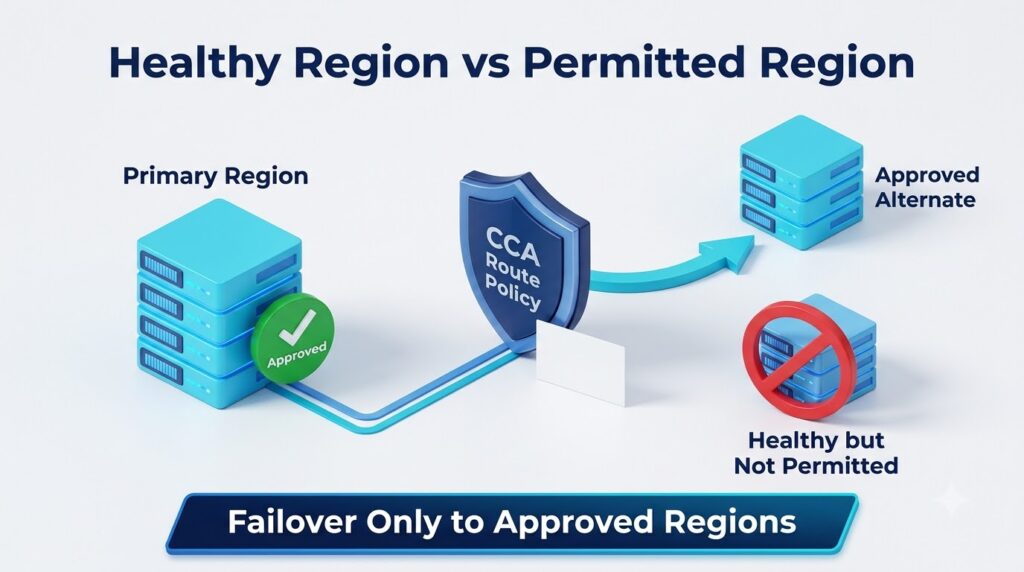
Admittedly, multi-region deployment can improve availability, but automatic failover may move processing into a location that the business has not approved. Resilience design must therefore distinguish a technically healthy region from a policy-permitted region. In other words, a backup path is usable only when the required data class, purpose, access and retention controls have been approved there.
Consequently, when no compliant alternate region exists, the safe response may be to queue, restrict or pause new transactions while preserving status for in-flight work. Therefore, availability targets should reflect this constraint instead of silently widening data movement during an incident.
Apply Controls at Every Cross-Border Boundary
| Boundary control | Purpose | Required evidence |
|---|---|---|
| Authenticated workload | Identify the approved sending and receiving service | Consumer ID, environment and region |
| Field allow list | Transmit only data required for the regional purpose | Schema version and field classification |
| Route policy | Select an approved region and provider path | CCA route decision and policy version |
| Encryption | Protect data in transit and approved storage | Transport and storage control status |
| Access scope | Limit administrators, support and automation | Role, region and access review |
| Retention rule | Expire regional copies according to purpose | Record class, schedule and deletion result |
| Transfer monitoring | Detect unexpected destination or processing | Region telemetry, alert and investigation |
Protect the CCA to BCM Regional Handoff
First, CCA should send BCM a locked authorization containing the approved identity, template, quantity, destination, cost context, decision ID, policy version and regional route. In turn, BCM should reject a transaction whose route, environment or authorization is incompatible with the receiving ordering boundary.
Moreover, BCM must not reroute the order solely because another provider or region is available. Instead, a change that affects production location, delivery commitments, cost, template capability or data handling returns to CCA for policy evaluation. BCM can then manage the newly authorized order state without rewriting the governing decision.
Govern Provider and Fulfillment Locations
Of course, physical production is inherently regional. For instance, the provider may receive artwork or structured card fields, product specifications and an approved destination. Accordingly, provider selection should consider the authorized program, service capability, location, production requirements and contractual data controls.
However, the provider should receive only the information required to produce and deliver the approved card. For example, it does not need complete workforce history, CCA policy logic or approval commentary. In addition, returned proof, production, shipment and delivery events should preserve provider and region references so BOC can reconcile the path.
Control Support and Administrative Access
Similarly, data can cross boundaries when support teams view records, export diagnostics or copy payloads into tickets. Therefore, define which teams may administer each regional environment, what evidence they may access and how emergency access is approved. Use masked diagnostics and stable identifiers whenever full business identity is unnecessary.
Also record privileged access, exports, corrections and deletion actions. In particular, follow-the-sun support should not automatically grant global visibility. Instead, regional access can be escalated through a time-bound, reviewed process when an incident requires it.
Design Regional Logs and Telemetry
| Telemetry item | Preferred content | Regional control |
|---|---|---|
| API gateway log | Consumer, route, status, latency and trace ID | Store in approved monitoring region |
| CCA decision log | Decision ID, result, policy and template versions | Protect reasons and minimize identity fields |
| BCM order log | Authorization ID, order state and idempotency result | Keep order evidence in permitted region |
| Provider event log | Provider reference, normalized state and time | Preserve origin and processing location |
| BOC case | Exception class, owner, action and closure evidence | Restrict detailed evidence by need |
| Security event | Identity, scope, access and anomaly result | Centralize only approved metadata |
| Deletion evidence | Record class, schedule and execution result | Do not retain deleted content |
Likewise, centralized observability does not require copying full payloads into a global log platform. For example, aggregate counts and health indicators may be centralized while detailed regional evidence remains protected and retrievable through controlled access.
Use BOC for Cross-Region Reconciliation
| Reconciliation checkpoint | Minimum evidence | BOC result |
|---|---|---|
| Source to CCA | Source reference, region, version and receipt | Trusted input accounted for |
| CCA decision | Decision, policy, template and approved route | Authority and location explained |
| CCA to BCM | Authorization and receiving region acknowledgment | Governed handoff confirmed |
| BCM to provider | Order, provider and production region | Execution path visible |
| Provider to delivery | Shipment origin, destination and final state | Fulfillment outcome evidenced |
| Exception handling | Case, owner, access and recovery action | Regional issue accountable |
| Retention and deletion | Record class, region and deletion result | Residual copies governed |
Above all, BOC should correlate the complete lifecycle without creating a global copy of every regional payload. Then it can retain privacy-safe identifiers and states, then retrieve protected detail through authorized regional systems when an investigation requires it.
Plan Regional Failure and Recovery
For instance, a regional outage can leave transactions in different states: source event accepted, CCA decision issued, BCM order acknowledged, production started or final evidence delayed. Therefore, recovery must establish the authoritative state before replaying work. In particular, cross-region failover should never create a second order merely because the original region is unavailable.
First, use stable correlation and idempotency identifiers across approved regions. Next, revalidate CCA policy and routing before moving queued transactions. Finally, BOC should separate confirmed in-flight orders from transactions that require a new authorization and should retain the original and replacement route evidence.
Manage Regional Changes as Governed Releases
For example, adding a region, moving an integration gateway, changing a provider or consolidating monitoring can alter the data path even when the API contract stays the same. Therefore, treat the change as a governed release with updated flow maps, policy, security review, contract tests, migration cohorts, rollback conditions and deletion of obsolete copies.
Similarly, a regional exit is not complete until credentials are revoked, queues are drained, storage is deleted or retained under an approved exception, dashboards no longer receive traffic and BOC confirms that open transactions have a final state.
Implement Business Card API Data Residency Governance in Stages
- First, inventory every regional source, endpoint, gateway, queue, CCA service, BCM environment, provider, log and backup.
- Next, classify identity, decision, order, fulfillment, operational and credential data by purpose and sensitivity.
- Then define approved processing, storage, support, backup and deletion regions for each class.
- After that, convert residency rules into deterministic CCA routing and explicit exception behavior.
- Next, apply field allow lists, authentication, encryption, access and retention controls at every boundary.
- In addition, protect the CCA to BCM handoff with region-bound authorization and idempotency.
- Also validate provider production and fulfillment locations against the approved route.
- Furthermore, configure BOC to correlate regional identifiers, states, exceptions and deletion evidence.
- Then test outage, failover, replay, support access, export and regional exit scenarios.
- Finally, review the architecture whenever systems, providers, regions, contracts or policies change.
Measure Regional Governance
| Measure | What it reveals | Target direction |
|---|---|---|
| Mapped data flows | Every regional processing path is known | Complete |
| Undeclared destinations | Traffic reaches an unapproved location | Zero |
| Route compliance | CCA decision matches BCM and provider region | Complete |
| Cross-region access | Support or administration exceeds approved need | Decrease |
| Regional copy age | Queues, logs or exports exceed retention | Decrease to zero |
| Failover integrity | Recovery preserves one authorization and one order | Complete |
| Reconciliation coverage | Regional path and final outcome are evidenced | Complete |
Frequently Asked Questions
What is API data residency governance?
In short, it defines and enforces where integration data may be processed, stored, supported, backed up and deleted.
What is CCA?
In brief, CCA is the enterprise policy and orchestration authority that applies regional rules to identity, approval, quantity and routing decisions.
What is BCM?
Similarly, BCM is the business card ordering management system or software that manages authorized regional orders, fulfillment coordination and reporting.
What is BOC?
Likewise, BOC provides cross-region operational visibility, exception ownership and reconciliation using privacy-safe evidence.
Does data residency mean every system must stay in one country?
Not necessarily. Instead, the approved model depends on data class, purpose, organizational policy, contractual requirements and applicable obligations.
Can an API gateway choose the production region?
Admittedly, it can route technically, but the permitted business route should come from approved CCA policy and transaction context.
Can failover move processing anywhere that is available?
No. Instead, the alternate region must also be approved for the relevant data and purpose.
Should logs be centralized globally?
In general, only approved metadata should be centralized; detailed regional payloads can remain protected in their authorized location.
Can BCM change the region after CCA authorization?
Instead, a material route change should return to CCA for reevaluation before BCM executes it.
How does BOC reconcile regional transactions?
Specifically, it links source, CCA, BCM, provider and delivery identifiers while preserving region and route evidence.
The Strategic Outcome
Business card API data residency governance lets a global enterprise operate one controlled business card program without losing regional accountability. As a result, CCA applies policy and routing, BCM manages authorized regional orders and BOC preserves visibility across every approved handoff.
Consequently, the enterprise gains a location-aware operating model in which each data class has a purpose, each route is authorized, each regional copy has a lifecycle and each final outcome can be reconciled.
To begin, select one cross-region business card workflow and trace the actual path from source through gateways, queues, CCA, BCM, providers, BOC, logs, support tools and backups. Then compare every location with the approved data class and purpose, then correct undocumented routes, global payload copies, unbounded support access and incomplete regional deletion evidence.