

Federated Business Card API Integration
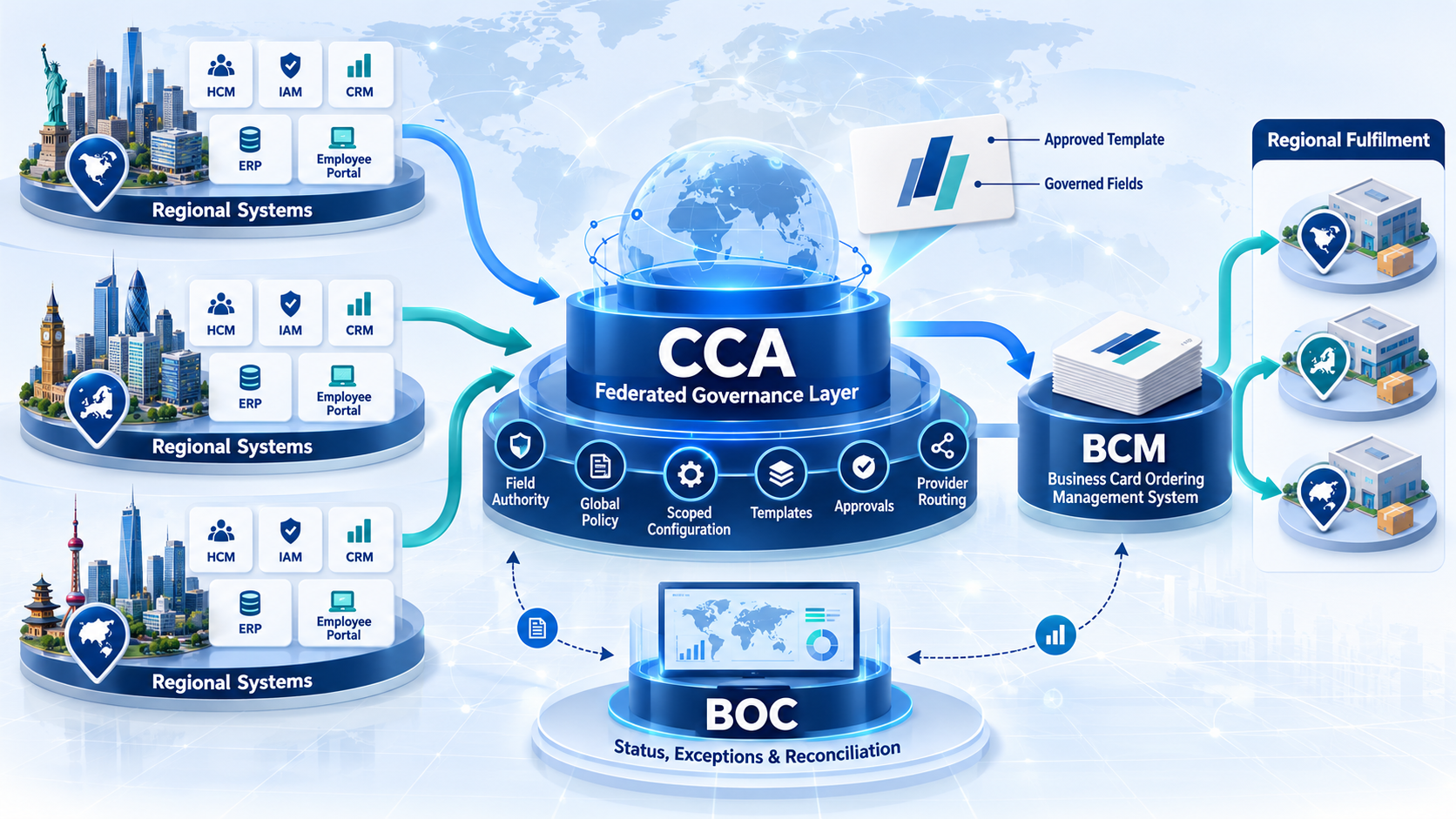
How CCA unifies multiple enterprise systems without forcing one data platform?
The Enterprise Does Not Operate One System
Large organizations rarely have one global HCM, one directory, one ERP and one fulfillment route. Acquisitions retain legacy platforms. Countries use different payroll or identity services. Business units adopt their own CRM environments. Legal entities follow local procurement rules, and regional teams depend on different print and delivery networks. A business card program that assumes one source and one destination cannot reflect this operating reality.
Federated business card API integration solves the problem by connecting multiple authoritative environments to a shared control model. Each system continues to own the data and process for which it is accountable. Color Card Administrator (CCA) becomes the enterprise orchestration layer that interprets those inputs, applies common business card governance and directs each authorized request toward the correct ordering and fulfillment path.
CCA Provides Central Control Without Replacing Local Authority
The purpose of CCA is to centralize enterprise business card administration, governance and identity execution. Its API integration model connects HCM, HRIS, IAM, CRM, ERP, procurement, portals and custom systems while CCA controls permissions, templates, approvals, ordering logic, reporting, production and fulfillment coordination. Central control does not require every business unit to migrate to the same operational application.
Instead, CCA creates a stable policy boundary. Local systems submit approved facts through governed interfaces. CCA normalizes the context, identifies the relevant program and applies enterprise rules. The result is one explainable authorization that downstream ordering software can execute. This protects shared standards while allowing the surrounding technology landscape to remain federated.
What Federated Integration Means
| Federated dimension | Local variation | CCA control |
|---|---|---|
| Workforce systems | Different HCM or HRIS platforms by entity | Common identity, eligibility and lifecycle rules |
| Access systems | Regional directories and identity providers | Consistent request, approval and administration permissions |
| Customer systems | Multiple CRM instances or sales structures | Approved customer-facing identity context |
| Financial systems | Different ERP, cost-center and purchase-order models | Normalized spend and authorization constraints |
| User channels | Employee portals, service catalogs and native CCA access | The same governed choices across entry points |
| Ordering operations | Different programs, templates and approval structures | One decision model with scoped configuration |
| Fulfillment networks | Regional printers, currencies, carriers and service levels | Controlled provider routing and normalized status |
Separate Global Policy from Scoped Configuration
A federated model works when the enterprise distinguishes rules that must be universal from settings that may vary by scope. Global policy can require authoritative identity data, approved templates, traceable approvals, idempotent order creation and final reconciliation. Regional configuration can select a language, legal address format, paper specification, tax treatment, fulfillment provider or delivery service.
CCA should evaluate both layers as one decision. A local configuration cannot override a protected global rule, while a global rule should not erase legitimate regional requirements. Every decision records the policy version, configuration scope and effective date so an auditor can understand why a particular identity, template, approval route and provider were selected.
Use a Canonical Integration Contract
Connecting several systems directly to several ordering environments creates an expanding matrix of custom mappings. A canonical CCA contract reduces this complexity. Every source describes the business event in a common form, even when the source fields and codes differ. Adapters translate local schemas into the shared contract; they do not recreate eligibility or ordering policy.
| Contract element | Purpose | Federated requirement |
|---|---|---|
| Source identity | Names the sending application and tenant | Unique registration and accountable owner |
| Business subject | Links the worker, role or approved request | Stable enterprise or scoped identifier |
| Event and effective time | Explains what changed and when it applies | Ordered evaluation across time zones and sources |
| Organization context | Identifies entity, business unit, location and program | Explicit scope rather than inferred routing |
| Candidate fields | Provides approved values and provenance | Field-level authority and transformation rules |
| Financial context | Provides cost object, budget or purchasing reference | Translation to the appropriate local model |
| Correlation key | Links source, CCA decision, BCM order and outcome | End-to-end uniqueness and reconciliation |
Resolve Field Authority Across Systems
Federation increases the likelihood that more than one system contains a value for the same card field. A directory may contain a preferred display name, HCM a legal employment record, CRM a market-facing role and a local portal a delivery preference. CCA needs a field-authority matrix that names the controlling source for each field, the allowed transformation and the conditions for an exception.
Authority should be determined by business meaning, not by technical arrival order. The newest value is not necessarily the approved value. When an authoritative system is unavailable or two valid sources conflict, CCA should hold the transaction, apply an approved fallback or route it to a named reviewer. Silent substitution weakens both identity integrity and auditability.
Create Scoped Policy and Routing Keys
| Routing key | Governance use | Example decision |
|---|---|---|
| Legal entity | Selects accountable program and financial rules | Apply the entity-approved ordering path |
| Country or region | Controls language, address, tax and provider options | Use an in-region fulfillment route |
| Business unit | Applies permitted brands and approval hierarchy | Select the appropriate controlled template family |
| Employment type | Determines eligibility and lifecycle behavior | Allow, deny or require review |
| Role or title group | Constrains title presentation and quantity | Use role-based content and order limits |
| Cost center | Connects the order to financial accountability | Validate and pass the approved charge reference |
| Service level | Balances urgency, policy and provider capacity | Select a permitted production and delivery tier |
BCM Executes the Authorized Order
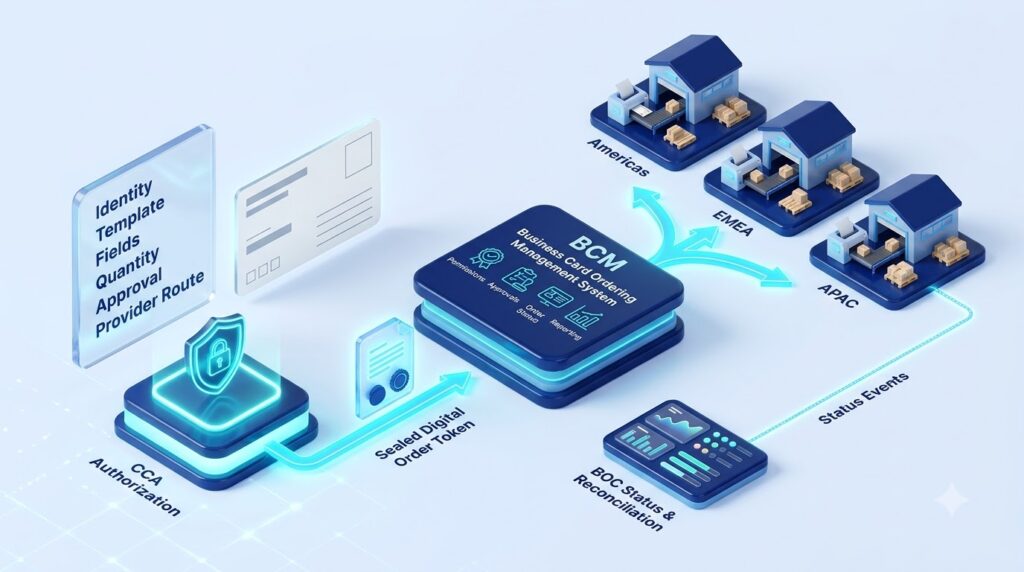
BCM is the business card ordering management system or software within the connected CCA ecosystem. After CCA determines the authorized identity, program, template, fields, quantity, approval route and provider path, BCM manages the controlled transaction. It supports permissions, approvals, templates, quantities, order creation, order status and reporting.
In a federated environment, BCM must receive a locked, correlated authorization rather than an ambiguous collection of source attributes. The BCM order preserves the CCA decision and the scope under which it was made. This prevents a regional ordering workflow from changing global controls and prevents a central process from ignoring valid local configuration.
Route to Regional Production Without Losing Visibility
A multinational enterprise may need several production and fulfillment providers because of geography, delivery time, customs, language, currency or regulatory requirements. CCA can govern provider eligibility and routing while adapters translate the authorized order into provider-specific formats. Provider differences should remain behind the controlled routing boundary.
Return events must be normalized into a common lifecycle: accepted, proof required, approved, in production, shipped, delivered, held, failed or cancelled. Business Ops Center (BOC) can make status, exceptions and reconciliation visible across regions. The enterprise should be able to compare outcomes without forcing every provider to use the same internal vocabulary.
Design for Acquisitions and Divestitures
Federated integration is especially valuable during organizational change. An acquired company can retain its HCM and ERP while CCA maps its people, entities, brands and cost structures into a controlled business card program. The enterprise can establish global protections first, then migrate local processes according to risk and readiness rather than delaying governance until every system is consolidated.
Divestitures require the reverse discipline. Access, policy scope, templates, integrations, pending approvals, provider routes and reporting permissions must be separated by an effective date. A well-designed federation boundary makes these dependencies visible and reduces the risk that a departing entity retains ordering authority or brand assets.
Secure Every Tenant and Integration Boundary
| Control | Federated risk addressed | Expected implementation |
|---|---|---|
| Consumer registration | Unknown or shared system identities | One registered client, owner and purpose per integration |
| Scoped authorization | Cross-entity access or administration | Limit programs, entities, regions and actions |
| Credential isolation | One compromise affecting every connection | Separate secrets or managed identities with rotation |
| Data minimization | Unnecessary transfer of personal data | Allow only fields required for the governed decision |
| Tenant-aware idempotency | Duplicate orders across sources or regions | Namespace stable business transaction keys |
| Signed event validation | Forged or replayed provider callbacks | Verify source, integrity, time and replay window |
| Evidence partitioning | Inappropriate cross-region visibility | Apply retention and access rules by scope |
Coordinate Change Across the Federation
Schema, mapping, policy, template and provider changes do not occur at the same speed. CCA should manage these versions independently and record their combination for each transaction. An HCM adapter can move to a new schema without forcing an immediate template change. A regional provider can change while other destinations continue on the existing route.
Use compatibility testing and staged rollout by source, entity, program and region. A pilot should represent the affected workflow, including approval and fulfillment. Stop conditions should cover unexpected field changes, policy divergence, duplicate order risk, provider-state uncertainty and missing evidence. Rollback must restore a known governed configuration, not merely an earlier endpoint.
Implement Federated Integration in Stages
- Inventory every source system, tenant, business entity, user channel, BCM program and fulfillment route.
- Classify which policies are global and which configurations may vary by region or entity.
- Assign authoritative ownership for identity, organization, customer-facing and financial fields.
- Define the canonical CCA event, decision, order, status and reconciliation contracts.
- Create scope keys for entity, region, business unit, program, template and provider.
- Register each API consumer with a named owner, narrow permissions and isolated credentials.
- Build source adapters that translate data without duplicating business card policy.
- Configure CCA decisions and connect one representative BCM ordering workflow.
- Add a regional production route and normalize its returned lifecycle events.
- Test conflicts, duplicates, late events, outages, configuration changes and cross-scope access.
- Pilot one bounded population, reconcile every outcome and then expand by controlled waves.
Measure Federation Quality
| Measure | What it reveals | Desired direction |
|---|---|---|
| Source coverage | Eligible populations connected through approved interfaces | Increase to planned scope |
| Policy consistency | Transactions evaluated under required global controls | Complete coverage |
| Local-fit accuracy | Orders using the correct regional configuration | Increase toward complete accuracy |
| Cross-scope denial | Attempts correctly blocked outside authorized scope | Complete enforcement |
| Duplicate prevention | Repeated events producing no extra physical order | One hundred percent |
| Status normalization | Provider events mapped to common lifecycle states | Complete coverage |
| Reconciliation completeness | Transactions linked from source through delivery | Complete before closure |
| Onboarding lead time | Time to connect a new entity, source or provider | Decrease with reusable contracts |
Frequently Asked Questions
What is federated business card API integration?
It connects multiple enterprise source and fulfillment environments to one shared CCA governance model while each system retains its appropriate authority.
Why not consolidate every system first?
Consolidation can take years or may never be practical. CCA can establish governed business card execution while the surrounding landscape remains diverse.
What is the purpose of CCA?
CCA centralizes administration, identity governance, policy, templates, approvals, routing and evidence for enterprise business card programs.
What is BCM?
BCM is the business card ordering management system or software that manages permissions, approvals, templates, quantities, orders and reporting.
Does CCA become the master source for employee data?
No. HCM, IAM, CRM, ERP and other systems remain authoritative for their domains. CCA governs how approved facts become card actions.
How are regional differences supported?
CCA applies protected global policy together with scoped configuration for language, entity, address, purchasing and fulfillment requirements.
How does the model prevent duplicate orders?
Stable correlation and idempotency keys link repeated delivery attempts to one governed business transaction and one BCM order.
Can different print providers be used?
Yes. CCA can route authorized orders by region or program while normalizing returned production and delivery status.
How are data conflicts resolved?
A field-authority matrix, effective-date rules and accountable exception workflow determine the approved value.
What should be onboarded first?
Choose a representative but bounded entity that exercises identity, approval, financial, BCM and fulfillment controls end to end.
The Strategic Outcome
Federation allows enterprise technology diversity without allowing governance diversity to become uncontrolled. Local systems remain authoritative. CCA translates their approved facts into one business card control model. BCM executes the authorized order, regional providers produce and deliver it, and BOC makes outcomes and exceptions visible across the operating landscape.
The enterprise gains a repeatable way to onboard acquisitions, regions, platforms and providers without recreating business card rules in every integration. Identity accuracy, brand control, approval accountability, financial context and audit evidence remain consistent even as the surrounding systems change.
Select two business units that use different HCM, ERP or fulfillment systems and compare their business card journeys. Identify which facts must remain local, which policies must be shared and which configurations may vary. Use CCA to define the common decision model, BCM to execute the governed orders and normalized events to reconcile both outcomes.