

API Data Minimization and Retention Governance for Enterprise Business Card Integrations
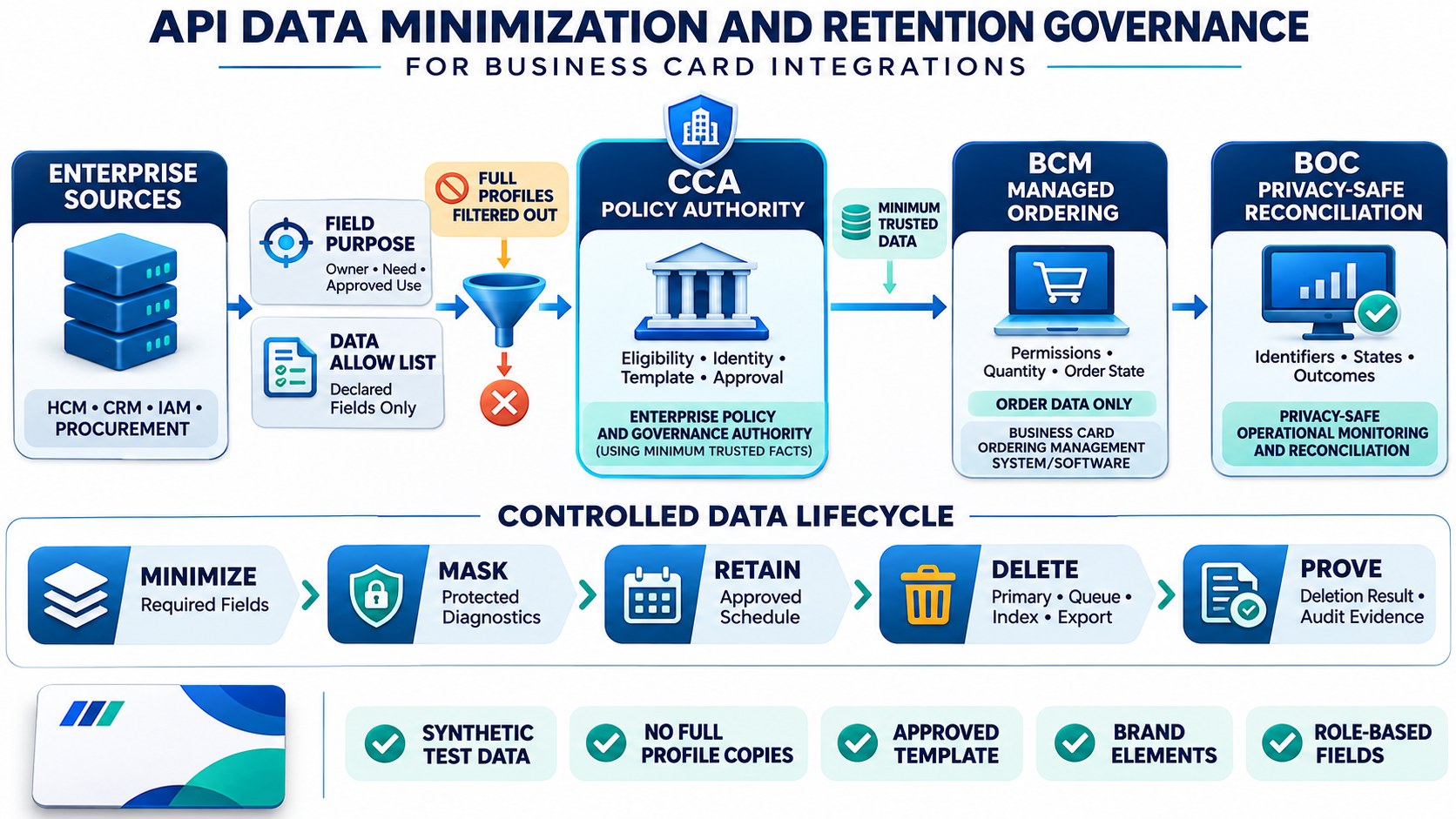
Using only the business identity data required for governed decisions, ordering, and evidence.
Business Card Data Still Requires Governance
Business card information is intended for professional use, but that does not make every workforce attribute appropriate for an integration. HCM, CRM, identity, procurement and directory systems can expose far more information than a business card program needs. Copying complete profiles into staging tables, logs, queues and support tools creates avoidable privacy, security and operational risk.
Data minimization and retention governance establishes which fields are necessary, why they are used, where they may travel, how long each record remains available and how deletion is proved. The goal is not to erase evidence prematurely. It is to retain the minimum information needed for current decisions, authorized ordering, operational recovery, reconciliation and legitimate audit requirements.
Keep CCA, BCM, and BOC Responsibilities Explicit
Color Card Administrator, or CCA, is the enterprise policy and orchestration authority for API-connected business card programs. CCA determines which trusted facts may influence eligibility, approved identity, templates, quantities, approvals and routing. It should request only the context required for those decisions and reject undeclared fields rather than becoming another uncontrolled employee-data repository.
Business Card Manager, or BCM, is the business card ordering management system or software. BCM manages permissions, approvals, templates, quantities, authorized orders, fulfillment coordination and reporting. BCM needs the approved card specification and transaction context, not the entire source-system record. Business Ops Center, or BOC, provides operational visibility, exception ownership and reconciliation using identifiers, states and controlled evidence.
This separation reduces duplication. Source systems retain their authoritative records, CCA retains decision evidence, BCM retains managed-order evidence and BOC retains the operational case needed to explain and close exceptions.
Start With a Field Purpose Register
| Field category | Approved purpose | Minimization question |
|---|---|---|
| Stable worker reference | Correlate source events and governed decisions | Can a nonmeaningful identifier replace descriptive data? |
| Active status and effective date | Determine current eligibility | Is historical employment detail unnecessary? |
| Approved public name | Build the authorized external identity | Does policy require legal-name data at all? |
| Published title or role | Select permitted customer-facing identity | Can unrelated job history be excluded? |
| Legal entity and brand | Resolve template and legal text | Are corporate attributes limited to the selected program? |
| Work location and contact | Populate approved card fields and delivery context | Can home and emergency contact data be blocked? |
| Cost and approval references | Route authorization and financial evidence | Can salary, bank and tax data remain excluded? |
Every accepted field should have an owner, definition, allowed source, business purpose, permitted recipients, transformation rule, sensitivity, retention state and deletion requirement. If no owner can explain why a value is required, remove it from the contract.
Separate Source Facts From Published Identity
An HCM job title is not automatically the approved title printed on a card. A legal name may differ from the permitted published name under enterprise policy. A location record may contain building, payroll and home-work information that should not appear in the ordering process. CCA translates trusted facts into a governed business identity without copying unrelated context.
Store the provenance and version needed to explain the decision. Do not retain full upstream objects merely to prove that one approved field existed. A field-level reference, source version or controlled snapshot may provide sufficient evidence with less exposure.
Use Data Allow Lists at Every Boundary
| Boundary | Allow-list control | Blocked risk |
|---|---|---|
| Source to integration | Accept only declared fields and versions | Bulk profile copying |
| Integration to CCA | Submit minimum policy context | Unnecessary workforce exposure |
| CCA to BCM | Send locked approved card and order values | Downstream access to source-system detail |
| BCM to provider | Send only production and delivery requirements | Supplier receives internal governance data |
| BCM or provider to BOC | Return identifiers, states and exception evidence | Full payload duplication in operations |
| Logs and traces | Record metadata, hashes and redacted diagnostics | Sensitive values spread through telemetry |
| Exports and reports | Limit columns, audience and purpose | Persistent uncontrolled copies |
An allow list is stronger than a deny list because new source fields remain excluded by default. Schema changes should require review before additional attributes become available to CCA, BCM, BOC or a provider.
Minimize Data in Requests and Events
Inbound requests should contain the smallest context needed to identify the subject, evaluate policy and correlate the result. If CCA can retrieve an authoritative value through an approved reference, the event may carry the reference and change type rather than a complete employee profile.
Outbound events should report a governed state change without repeating the full card specification. Subscribers can receive the event identifier, resource identifier, state, version, timestamp and permitted reason, then retrieve current details through an authorized API when necessary. This pattern reduces copies in gateways, queues and webhook receivers.
Keep Test Data Synthetic
Development, testing and demonstrations should use synthetic identities, generic templates and nonproduction addresses. Copying production HCM extracts into test may expose employees to teams, vendors and retention practices that were never approved for operational data.
If a defect cannot be reproduced without real data, use a controlled diagnostic process: minimize the record, mask unnecessary fields, restrict access, record the purpose, set a short expiry and verify deletion. A support ticket should reference protected evidence rather than embed complete payloads.
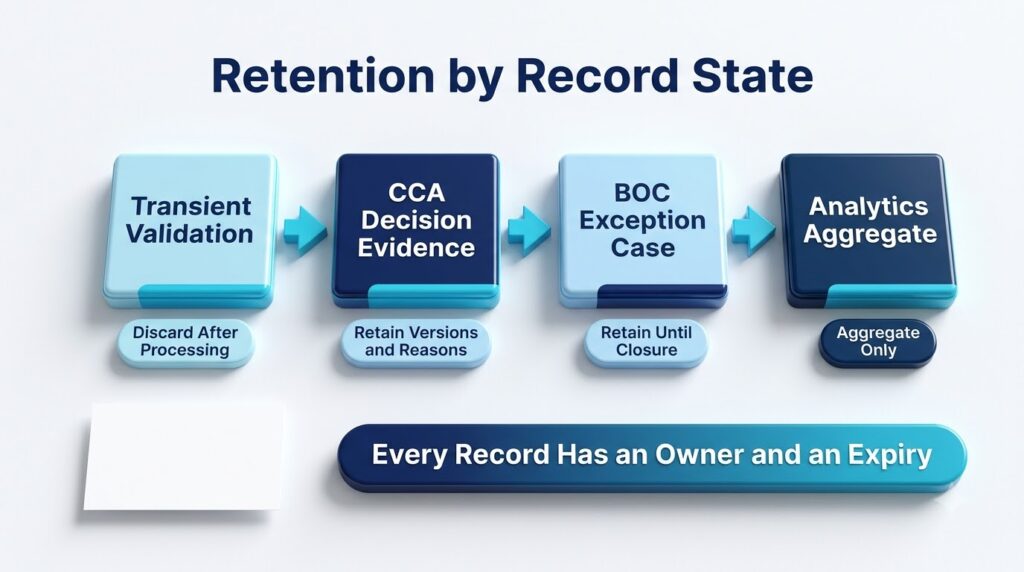
Design Retention by Record State
| Record state | Why it exists | Retention approach |
|---|---|---|
| Transient validation | Validate schema, source and completeness | Discard immediately after safe processing unless failed |
| Pending decision | Wait for required fact or approval | Retain minimum context until resolved or expired |
| CCA decision evidence | Explain eligibility, identity and policy outcome | Retain identifiers, versions, reasons and approval evidence |
| BCM managed order | Operate proof, production, shipping and reporting | Retain approved order and lifecycle evidence |
| BOC exception case | Investigate mismatch, failure or uncertainty | Retain controlled evidence until closure and review period |
| Audit history | Demonstrate authorized action and final outcome | Retain according to approved business and legal schedule |
| Analytics aggregate | Measure performance and control effectiveness | Prefer deidentified or aggregated measures |
A single retention period for every record is rarely appropriate. The enterprise should distinguish active workflow data, retry payloads, failed messages, logs, support evidence, completed orders, audit history and analytical aggregates. Each state needs an owner, start event, expiry event and deletion method.
Control Failed Payloads and Dead Letters
Failed messages often contain more data than successful transactions because teams preserve the complete payload for troubleshooting. A dead-letter queue can therefore become a long-lived shadow database. Store only the minimum recoverable context, encrypt it, restrict access and define a short review deadline.
Before replay, verify that the request remains valid and that BCM did not already create an order. After successful recovery or authorized closure, remove the payload according to the applicable schedule while retaining privacy-safe evidence of the classification, action and outcome.
Make Logs Useful Without Copying Card Data
| Telemetry need | Preferred evidence | Avoid |
|---|---|---|
| Trace transaction | Correlation, request and decision identifiers | Names and full card content |
| Explain authorization | Policy version, outcome and controlled reason code | Complete workforce profile |
| Diagnose mapping | Field name, validation rule and masked sample | Raw unredacted payload |
| Confirm BCM execution | Order identifier, state and idempotency result | Duplicate production file |
| Monitor provider | Job, shipment and normalized status references | Unneeded recipient detail |
| Prove access | Consumer identity, scope, time and action | Credential material |
| Measure performance | Latency, counts, outcomes and exception classes | Row-level identity export |
Logs should enable correlation and diagnosis without becoming a copy of every request and response. Masking must occur before data reaches broadly accessible telemetry. Search indexes, backups and exported log archives must follow the same retention and deletion controls.
Protect the CCA to BCM Handoff
CCA should issue BCM a locked authorization containing only the approved business identity, template, quantity, delivery context, cost reference, decision identifier, policy version and approval evidence needed for managed ordering. BCM should not receive unrelated HCM, CRM or directory fields.
If a permitted value is missing, BCM should reject or hold the transaction with a controlled error. It must not retrieve additional source data or let an operator substitute ungoverned identity content. The correction returns to CCA and the authoritative source boundary.
Minimize Provider and Delivery Data
Production providers require card artwork or structured production values, product specifications and fulfillment instructions. They do not need the employee record, CCA policy logic, approval comments or unrelated corporate data. Provider contracts and interfaces should state the allowed data and prohibit reuse outside fulfillment.
Delivery addresses may be business locations, centralized facilities or approved destinations. Where personal delivery is permitted, treat the address as restricted fulfillment data, disclose it only to the necessary parties and remove it when the approved retention purpose ends.
Use BOC for Privacy-Safe Reconciliation
| Reconciliation question | Minimum evidence | BOC outcome |
|---|---|---|
| Did the source event reach CCA? | Source reference, version and receipt time | Event accounted for |
| What did CCA authorize? | Decision ID, outcome, policy and template versions | Authority explained |
| Did BCM create one order? | Authorization ID, idempotency result and order ID | Duplicate prevented |
| Was the approved specification executed? | Order version and provider acknowledgment | Execution matched |
| Was delivery confirmed? | Shipment and delivery state reference | Outcome evidenced |
| Was an exception resolved? | Case class, owner, action and closure reason | Operational accountability |
| Was expired data removed? | Record class, deletion job and result | Retention control proved |
BOC should correlate records using stable identifiers instead of copying complete payloads into every case. Operators can retrieve protected details through authorized systems when investigation requires them. The case record should show what happened, who acted and why closure is justified.
Handle Deletion as a Controlled Operation
Deletion must cover primary databases, queues, search indexes, temporary files, object stores, exports and eligible backups according to the approved design. A record disappearing from the application screen does not prove disposal. Use automated expiry where possible and monitor failed deletion jobs.
Preserve only the evidence required to show that deletion occurred: record class, governing schedule, deletion time, execution result and exception reference. Do not keep the deleted content in the deletion log. Legal holds or contractual obligations should suspend disposal only for the defined scope and duration.
Manage Access to Retained Evidence
Retention does not imply broad access. Separate administrative, operational, audit and analytical roles. Apply least privilege, environment separation, export controls and periodic access certification. Sensitive evidence should not be downloadable simply because a user can view an order status.
Record who viewed, exported, corrected or deleted protected data. Privileged access and break-glass use should be time bound, reviewed and linked to an approved purpose. Ownership changes should trigger access review and transfer of retention responsibilities.
Implement Minimization and Retention in Stages
- Inventory every field crossing source, CCA, BCM, provider and BOC boundaries.
- Record the owner, business purpose, recipient, sensitivity and retention state for each field.
- Remove undeclared fields and enforce allow lists in schemas and mappings.
- Replace complete payload copies with stable references, versions and controlled reason codes.
- Use synthetic data in development, testing, demonstrations and documentation.
- Define retention schedules for transient data, decisions, orders, exceptions, logs and aggregates.
- Protect failed payloads with short deadlines, restricted access and owned recovery.
- Automate expiry and deletion across databases, queues, files, indexes and exports.
- Use BOC identifiers and privacy-safe evidence for reconciliation and exception closure.
- Test access, export, deletion, recovery and legal-hold behavior before production rollout.
Measure Data Governance
| Measure | What it reveals | Target direction |
|---|---|---|
| Field necessity coverage | Every transmitted attribute has an approved purpose | Complete |
| Unexpected fields | Payload contains undeclared attributes | Zero |
| Synthetic test coverage | Nonproduction work avoids real identity data | Increase to complete |
| Expired records | Data remains beyond its schedule | Decrease to zero |
| Deletion success | Eligible records are removed across stores | Complete |
| Sensitive log findings | Telemetry contains prohibited values | Decrease to zero |
| Reconciliation coverage | Minimal evidence still proves the outcome | Complete |
Frequently Asked Questions
Is business card data personal data?
It can identify a person and reveal organizational context, so enterprises should apply appropriate privacy, security and retention controls.
What is CCA?
CCA is the enterprise policy and orchestration authority that determines the minimum trusted data needed for governed business card decisions.
What is BCM?
BCM is the business card ordering management system or software that manages authorized orders, fulfillment coordination and reporting.
What is BOC?
BOC provides privacy-safe operational evidence, exception ownership and reconciliation across connected systems.
Should CCA copy the complete HCM profile?
No. It should receive only the approved facts required for eligibility, identity, template, approval and routing decisions.
What should a webhook contain?
Usually stable references, state, version, timestamp and permitted reason rather than the full card or employee profile.
Can failed payloads be retained indefinitely for support?
No. They need restricted access, an owned recovery purpose and a defined expiry or authorized exception.
How can logs remain useful after minimization?
Use correlation identifiers, versions, reason codes, masked diagnostics and controlled links to protected evidence.
Does deleting an application record remove every copy?
Not necessarily. Deletion design must address queues, indexes, files, exports and eligible backups.
How does BOC reconcile without full payloads?
It links authoritative identifiers, versions, states and outcomes, retrieving protected detail only when an authorized investigation requires it.
The Strategic Outcome
Data minimization and retention governance let the enterprise connect HCM, CRM, identity, procurement and fulfillment systems without turning the business card workflow into another uncontrolled employee-data store. CCA uses minimum trusted facts, BCM receives only the authorized order specification and BOC preserves privacy-safe operational evidence.
The organization reduces exposure while improving clarity. Every field has a purpose, every retained record has a lifecycle, every deletion has evidence and every final outcome remains explainable.
Select one active business card integration and trace every field from its source through staging, CCA, BCM, providers, BOC, logs, queues and exports. Remove values without an approved purpose, assign retention states to the remaining records and test that expiry and deletion complete without destroying required decision, order or reconciliation evidence.