

Business Card API Deprecation and Migration Governance
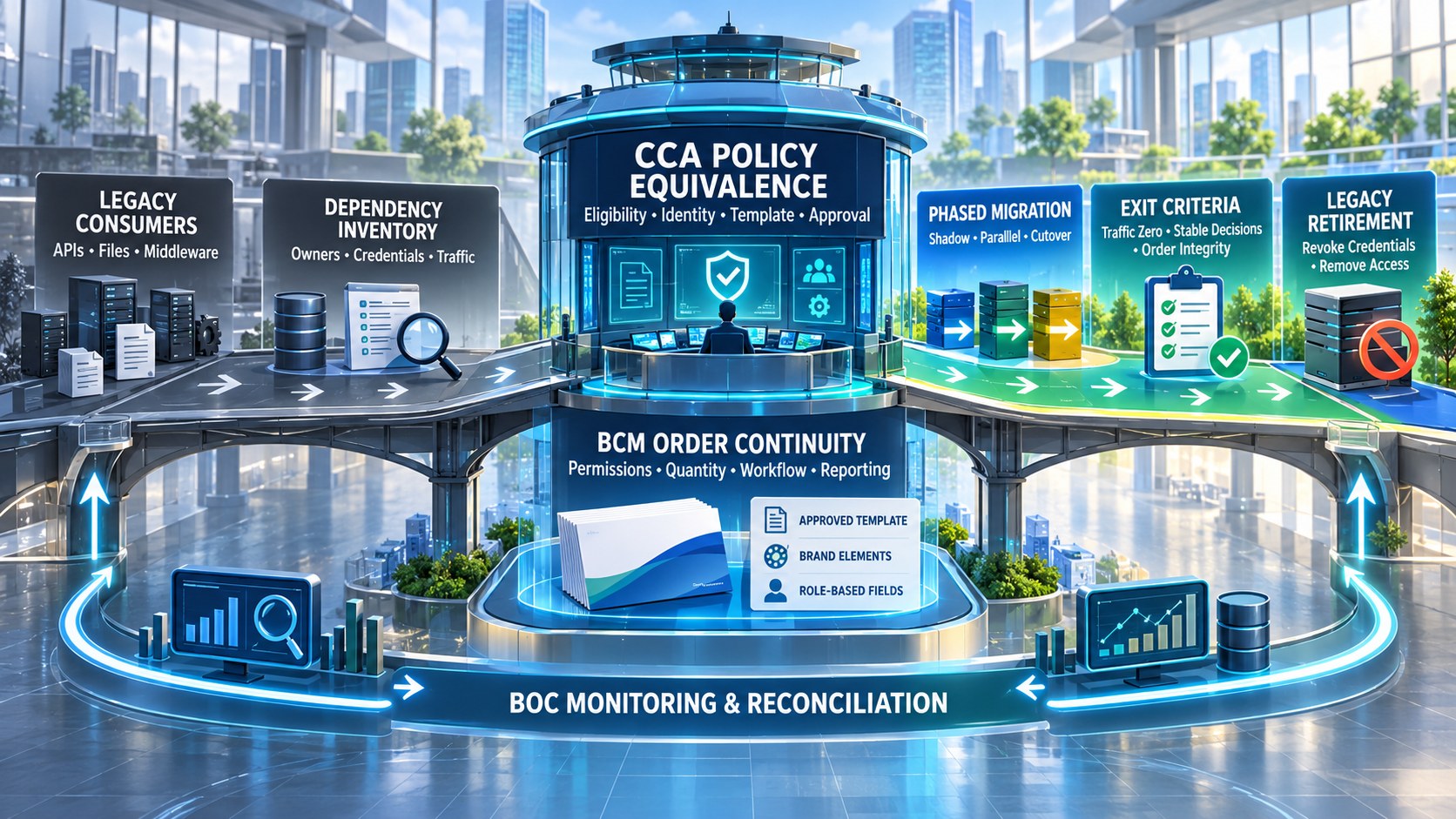
Retiring legacy interfaces without weakening CCA control or BCM ordering continuity.
Retirement Is a Governance Event
Over time, enterprise integrations eventually reach a point where an API version, middleware route, file feed, authentication method or provider interface needs replacement. At first, the technical team may view the change as an endpoint migration. However, the business card program experiences it as a governance event because the transition can change identity inputs, eligibility outcomes, template selection, approvals, ordering behavior and evidence.
In contrast, a controlled retirement does more than announce an end date. Instead, it identifies every consumer, maps each dependency, proves that the replacement preserves CCA decisions, confirms that BCM continues to manage authorized orders and removes the legacy path only after production evidence shows the migration is complete. As a result, this protects continuity without allowing old interfaces to become permanent exceptions.
Keep the Purpose of CCA at the Center
Color Card Administrator is the enterprise orchestration and governance layer for API-integrated business card programs. In practice, CCA receives approved data and events from enterprise systems, applies centralized eligibility, identity, template, permission, approval, quantity and routing rules, and authorizes controlled execution. Therefore, migration must preserve this authority even when the transport, source system or integration platform changes.
BCM is the business card ordering management system or software. It then manages permissions, approvals, templates, quantities, orders and reporting for authorized transactions. Business Ops Center, or BOC, provides operational visibility, exception handling and reconciliation. As a result, a migration is successful only when the new path produces the same approved governance and managed ordering outcomes, or when the business has explicitly approved an intentional difference.
Know What Is Being Deprecated
| Retirement target | Typical reason | Migration risk |
|---|---|---|
| API version | Breaking contract, unsupported technology or security change | Consumers cannot preserve required data or behavior |
| Authentication method | Credential standard or security policy changes | Access fails or legacy privileges remain active |
| Middleware route | Platform consolidation or architecture modernization | Transformation and retry behavior changes |
| File integration | Move from scheduled batches to APIs or events | Timing, completeness and effective dates differ |
| Source system | HCM, CRM, ERP or directory replacement | Field authority and identifiers shift |
| Provider interface | Supplier or fulfillment model changes | Order and status semantics no longer match |
| Local workaround | Manual upload or ungoverned direct ordering | Hidden dependency bypasses CCA policy |
Create a Complete Consumer Inventory
In many cases, the first migration risk is an unknown consumer. For example, a legacy interface may support production automation, a regional batch process, a reporting extract, a support utility or a locally maintained script. In addition, network traffic can reveal active usage, but it may miss seasonal or event-driven consumers. Therefore, combine telemetry with system ownership, access records, documentation, service accounts and stakeholder confirmation.
First, for each consumer, record the business journey, owner, environment, interface version, credential, data scope, volume, schedule, failure impact and migration decision. Then classify the consumer as migrate, replace, retire or investigate. Do not declare discovery complete while high-risk traffic or unidentified credentials remain unexplained.
Map Dependencies Beyond the Endpoint
| Dependency | Questions to answer | Required record |
|---|---|---|
| Identity key | Does the replacement use the same stable subject and organization identifiers? | Crosswalk and collision rules |
| Field meaning | Are names, types, values and effective dates equivalent? | Authority and transformation map |
| Event behavior | Are ordering, replay and late-arrival rules preserved? | Sequence and idempotency model |
| CCA policy | Which decisions depend on the retiring input or route? | Policy impact and version map |
| BCM workflow | Which order states, approvals or reports use the legacy path? | State transition impact |
| Provider status | Are production and delivery events normalized consistently? | Status and correlation map |
| Operations | Which alerts, dashboards, runbooks and retention rules change? | Operational transition plan |
Define the Target Contract Around Business Meaning
Generally, a migration should not begin by copying an old payload into a new endpoint. Instead, start with the business facts and decisions that the integration must support. Then define each field, event, identifier, timestamp, error condition and status in terms that CCA, BCM and operations can use consistently. In addition, remove unused data rather than carrying historical clutter into the target contract.
The target should make authority visible. For example, HCM may own worker status and organizational facts, a directory may own approved contact data, ERP may own cost allocation and CCA owns the rules that determine how those facts influence the business card program. Consequently, if the legacy route embedded policy inside transformation code, move that policy into controlled CCA decisions instead of recreating hidden logic.
Preserve CCA Policy Equivalence
In short, policy equivalence means that representative inputs produce the approved eligibility, identity, template, permission, approval, quantity and provider-route outcomes before and after migration. However, it does not require identical implementation. Instead, it requires explainable consistency for every journey that should remain unchanged and explicit approval for every intended difference.
| CCA decision | Migration validation | Failure signal |
|---|---|---|
| Eligibility | Compare allow, deny and review results across populations | Unexpected change in eligible subjects |
| Identity fields | Compare values, transformations, locks and exceptions | Different public identity or override behavior |
| Template | Compare entity, region, language and version selection | Wrong or retired design selected |
| Permission | Compare requester, delegate, approver and administrator scope | Privilege expands or valid access disappears |
| Approval | Compare route, escalation, expiry and separation of duties | Order advances without required authority |
| Quantity | Compare defaults, thresholds and exception behavior | Order exceeds or falls below approved rule |
| Provider route | Compare product, location and service-level selection | Order reaches an unauthorized execution path |
Protect BCM Ordering Continuity
Above all, CCA should continue to send BCM a complete, authorized order specification throughout the migration. Specifically, the specification includes the subject, business key, program, approved fields, template, quantity, approval state, provider route, policy version and correlation identifier. Moreover, a new integration path must not force BCM to reinterpret source facts or choose among unapproved outcomes.
Next, test how in-flight orders behave at the cutover boundary. For example, a requester may create a request on the legacy path, and an approver may approve it after the new path activates. Similarly, a provider status may return after the old endpoint stops accepting new work. Therefore, define which version owns each transaction, how teams correlate updates and when a legacy order becomes read-only rather than disappearing from operational reporting.
Choose the Right Coexistence Pattern
| Pattern | Best use | Essential controls |
|---|---|---|
| Shadow evaluation | Compare new CCA decisions without creating orders | Identical input, no execution and explained differences |
| Dual read | New service reads both sources during data transition | Authority priority and conflict handling |
| Dual publish | Producer sends equivalent events to old and new routes | One executable path and duplicate prevention |
| Parallel versions | Consumers migrate independently during a fixed window | Version routing, telemetry and retirement deadline |
| Phased population | Move by entity, region, program or user cohort | Explicit assignment and cross-wave reconciliation |
| Scheduled cutover | All consumers move in one controlled event | Freeze, prechecks, rollback and support coverage |
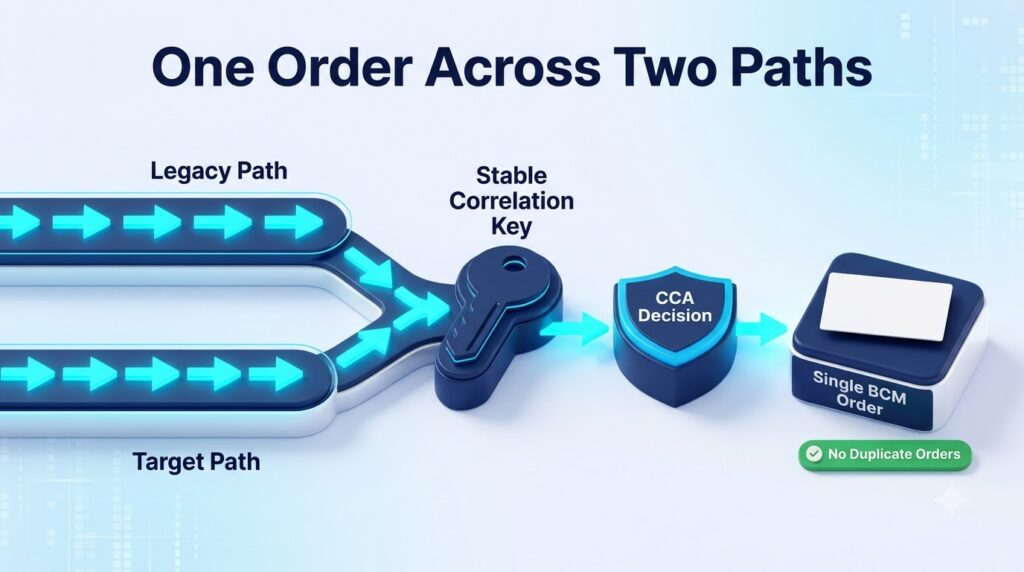
Avoid Duplicate Orders During Parallel Operation
However, parallel processing creates a serious physical risk: the same workforce event or request can reach both paths and create two orders. Therefore, use a stable business correlation key that survives version changes. Then CCA should make one governed decision for the business action, and BCM should enforce idempotent creation or update behavior using the approved correlation identifier.
In addition, test replay, concurrency, retries, delayed events and manual resubmission. In addition, a migration dashboard should distinguish duplicated messages from duplicated business transactions. Consequently, if the organization cannot prove single-order behavior, run the new path in nonexecuting shadow mode until the control is reliable.
Migrate Credentials and Access Deliberately
Moreover, new interfaces often introduce a different identity model, scope or secret lifecycle. Therefore, create the target workload identity with least privilege, test it in nonproduction and establish accountable ownership for rotation and revocation. Likewise, do not reuse a broad legacy credential merely to accelerate migration.
Similarly, the old credential should remain active only for the documented coexistence window. Meanwhile, monitor its usage, restrict it from new functions and revoke it as part of the retirement checklist. Finally, verify that teams have removed or reassigned all service accounts, certificates, tokens, firewall rules, webhook secrets and emergency access paths. In short, a deprecated API with an active credential is not retired.
Design Migration Tests Around Risk
| Test family | Purpose | Example |
|---|---|---|
| Contract | Prove producers and consumers understand the target schema | Required fields, unknown values and errors |
| Policy equivalence | Compare CCA decisions across old and new paths | Eligible, denied, review and exception populations |
| Ordering continuity | Prove BCM states and approvals remain controlled | Draft, hold, approval, submission and cancellation |
| Reliability | Challenge retry, replay, timing and recovery | Duplicate and out-of-order events |
| Security | Verify workload identity, scope and tenant boundaries | Unauthorized record and action attempts |
| Fulfillment | Prove provider statuses correlate through transition | Production, shipment, delivery and rejection |
| Retirement | Prove old endpoints and credentials no longer work | Blocked call, revoked token and no residual traffic |
Set Evidence Based Exit Criteria
However, a migration deadline is not proof that a legacy interface can be removed. Instead, exit criteria should combine consumer readiness, production traffic, CCA decision consistency, BCM order integrity, reconciliation, support readiness and security closure. Therefore, define the observation window and the evidence owner before migration begins.
| Exit criterion | Evidence | Retirement decision |
|---|---|---|
| Consumer migration | Teams migrate or formally retire every approved consumer | No unexplained legacy dependency |
| Traffic closure | Legacy calls and credentials show no expected production use | Usage is zero for the observation window |
| Decision stability | New-path CCA outcomes match approved expectations | No unresolved material variance |
| Order integrity | BCM shows no migration-related duplicates or missing orders | Managed transaction continuity proven |
| Operational readiness | Alerts, runbooks and support ownership cover the target | New path can be sustained |
| Security closure | Teams revoke legacy identities, secrets and network access | No one can reactivate the old path informally |
| Evidence retention | Historical records remain searchable and explainable | Audit continuity preserved |
Execute Cutover with Controlled Decision Points
First, before cutover, freeze unrelated policy and interface changes, confirm backups and exports, validate target credentials, test rollback actions and communicate the support window. Then, at activation, record the exact time, contract version, CCA policy version, consumer assignments and responsible approvers. As a result, this creates a defensible boundary for troubleshooting and evidence.
Next, during observation, compare source receipt, validation, CCA decisions, BCM order creation, approvals, provider acceptance and reconciliation. In addition, establish stop conditions for authorization errors, duplicate orders, unexplained denials, missing statuses or audit gaps. If the threshold is crossed, hold new execution or return the affected population to the approved legacy route while protecting in-flight orders.
Retire the Legacy Path Completely
In practice, retirement includes more than returning an error from the old endpoint. Therefore, remove routing, schedules, credentials, service accounts, certificates, secrets, firewall rules, transformation jobs, queues and support automation that exist only for the legacy path. Afterwards, archive the contract, policy map, migration evidence and operating history according to retention requirements.
Next, update architecture diagrams, data inventories, runbooks, disaster recovery plans, vendor records and ownership directories. Also mark the old version as retired in documentation and monitoring. Ultimately, a complete retirement reduces attack surface, licensing cost, support burden and the chance that a future team quietly reconnects an uncontrolled route.
Use BOC to Reconcile the Transition
Meanwhile, BOC can provide operational visibility across the migration by correlating source events, CCA decisions, BCM orders and fulfillment outcomes. Then segment dashboards and exceptions by interface version, consumer, population and cutover wave. As a result, this helps teams separate ordinary business exceptions from migration-related failures.
Finally, after retirement, continue targeted reconciliation for the agreed observation period. In particular, confirm that late provider events still attach to historical orders, no new legacy traffic appears and exception volumes return to the expected baseline. Ultimately, the final migration record should show who accepted continuity and when legacy access was removed.
Implement Migration Governance in Practical Stages
- First, define the retirement target, business reason, accountable owner and final deadline.
- Next, inventory consumers, credentials, traffic, schedules, data, policies and operational dependencies.
- Then design the target contract around authoritative data and governed CCA decisions.
- Also map policy equivalence and intentional differences for every in-scope journey.
- Next, define BCM transaction ownership, in-flight order handling and idempotency controls.
- Then select the coexistence pattern, migration waves, stop conditions and rollback actions.
- Then run contract, policy, ordering, security, reliability and fulfillment tests.
- After that, migrate consumers with version-level telemetry and BOC reconciliation.
- Then verify evidence-based exit criteria before blocking the legacy path.
- Finally, revoke access, remove infrastructure, archive evidence and complete post-retirement monitoring.
Measure Migration Quality
| Measure | What it proves | Target direction |
|---|---|---|
| Consumer coverage | Every dependency has an owner and disposition | Complete before retirement |
| Policy variance | New-path CCA decisions differ from approved expectations | Zero unresolved material variance |
| Duplicate order rate | Parallel processing preserves one business transaction | Approach zero |
| Legacy traffic | Consumers continue to use the retiring route | Decrease to zero |
| Credential closure | Legacy identities and secrets remain active | Zero after retirement |
| Reconciliation latency | Teams detect and resolve migration exceptions quickly | Decrease |
| Support stability | Target-path incidents remain within acceptable baseline | Stable through observation |
Frequently Asked Questions
What is business card API deprecation and migration governance?
In short, it is the controlled process for replacing and retiring an integration while preserving CCA decisions, BCM ordering continuity, security and evidence.
Why is CCA central to migration?
In fact, CCA is the governance and orchestration layer that determines how enterprise facts may authorize business card identity and ordering.
What is BCM?
BCM is the business card ordering management system or software that manages permissions, approvals, templates, quantities, orders and reporting.
How long should a deprecation window last?
In general, it should reflect consumer complexity, business risk and support capacity, with a published deadline and measurable exit criteria.
Is zero legacy traffic enough to retire an API?
No. The enterprise must also confirm consumer disposition, policy stability, BCM order integrity, security closure and retained evidence.
Can old and new versions run in parallel?
Yes, when teams control version routing, execution ownership, correlation, duplicate prevention and a fixed retirement date.
How are duplicate business card orders prevented?
In short, use a stable correlation key, one governed CCA decision and idempotent BCM transaction handling across retries and versions.
What happens to in-flight orders at cutover?
In general, define which version owns each transaction and keep late approvals and provider statuses correlated to the original managed order.
When should legacy credentials be revoked?
Revoke them immediately after the business accepts the exit criteria and verify that no production dependency or emergency path still requires them.
What proves migration success?
Ultimately, a correlated evidence chain shows that the target path preserved approved CCA decisions, BCM orders and fulfillment outcomes while legacy access was removed.
The Strategic Outcome
Overall, deprecation and migration governance lets the enterprise modernize integrations without trading continuity for control. In this model, source systems remain authoritative for their domains, CCA remains the centralized decision authority and BCM continues to manage complete, authorized business card orders. Meanwhile, BOC provides the evidence needed to explain and reconcile the transition.
In addition, the organization retires hidden dependencies, unnecessary credentials and unsupported interfaces while preserving historical accountability. As a result, future integrations become easier to change because ownership, contracts, versions, correlation and exit criteria are part of the operating model rather than an emergency project concern.
First, select one legacy business card interface and create its retirement record. Then identify consumers, credentials, authoritative data, CCA policies, BCM states, provider events and operational evidence. Finally, define the target contract, coexistence pattern, migration tests, exit criteria and access-removal plan before publishing the deprecation date.