

Business Card API Release Governance
Mastering Business Card API Release Governance: Change Integrations Safely and Keep Control With CCA
In enterprise integrations, a successful first transaction is not the finish line, because changes to source systems and APIs can quietly weaken policies. This video explains how CCA keeps approved changes tied to their intended outcomes, with teams coordinating across Business Card Manager, testing changes thoroughly and monitoring after every release.
Controlling versions, policy changes, deployment and rollback through CCA.
A Successful Integration Still Needs Release Governance
In practice, an enterprise business card integration is not finished when the first production transaction succeeds. For example, source systems change fields, identity platforms revise claims, procurement teams adjust controls, brand owners publish new templates and fulfillment providers update interfaces. Consequently, without a release discipline, each change can weaken the policy boundary that the integration should create.
In short, business card API release governance connects change approval to technical delivery and operational proof. In particular, it establishes which versions may run, how teams evaluate compatibility, which CCA policies a change affects, what BCM ordering behavior must remain stable, how teams test releases and how the organization will recover if production outcomes differ from the approved design.
Keep CCA at the Center of Every Release
Color Card Administrator is the enterprise orchestration and governance layer for API-integrated business card programs. In practice, CCA receives approved facts and events from enterprise systems, applies centralized identity, eligibility, template, permission, approval, quantity and routing rules, and authorizes controlled execution. A release must therefore preserve more than interface connectivity. It must preserve the meaning and authority of every CCA decision.
BCM is the business card ordering management system or software. It then manages permissions, approvals, templates, quantities, orders and reporting after CCA has established the authorized outcome. Business Ops Center, or BOC, supports status visibility, exception management and reconciliation. Therefore, release governance keeps these responsibilities explicit so a source-system or API change cannot silently bypass policy or alter ordering behavior.
What Can Change in a Business Card API Service
| Change domain | Examples | Primary risk |
|---|---|---|
| Source data | Field name, allowed value, effective date or object model | CCA receives a different fact or loses authority context |
| Authentication | Credential, token lifetime, certificate or identity claim | Access fails or exceeds approved scope |
| Interface contract | Endpoint, payload, schema, event or status code | Transactions fail or systems misread them |
| CCA policy | Eligibility, template, approval, quantity or provider route | Authorized outcome changes |
| BCM workflow | Order state, approval action, retry or cancellation behavior | Managed order no longer matches the decision |
| Provider execution | Product, proof, production, shipment or delivery event | Teams cannot control or reconcile the physical outcome |
| Operations | Alert, dashboard, report, support route or retention rule | Failures become invisible or evidence is incomplete |
Create a Governed Release Object
First, treat each planned change as a controlled release object rather than a collection of tickets. Then give it an identifier, accountable owner, business purpose, affected requirements, interface versions, CCA policy versions, BCM workflow changes, data migrations, test evidence, deployment window, rollback conditions and acceptance authority. As a result, the release object becomes the common record for business, architecture, security, operations and fulfillment teams.
A release may contain multiple technical components, but it should still describe one coherent business outcome. If a source schema update and a CCA policy change must become effective together, the release record should state that dependency. However, if teams can deploy them independently, the record must state their compatibility boundaries and sequencing.
Classify Change Before Choosing the Release Path
| Change class | Typical example | Required treatment |
|---|---|---|
| Nonbehavioral | Documentation or observability improvement | Review, targeted validation and normal deployment |
| Compatible interface | Optional field or additive status value | Contract test, consumer verification and monitored release |
| Policy change | New eligibility rule or approval threshold | Business approval, regression testing and effective dating |
| Breaking interface | Required field removal or semantic change | New version, migration window and consumer transition |
| Security change | Scope, credential or signing requirement | Security approval, access testing and revocation plan |
| Execution change | BCM state or provider routing behavior | End-to-end test, reconciliation and rollback readiness |
| Emergency change | Production defect or security exposure | Expedited approval with retrospective evidence review |
Version the Contract and the Decision
API versioning alone does not explain why CCA authorized an order. The enterprise should version the interface contract and the CCA policy decision separately. Specifically, the interface version describes the shape and transport of data. In contrast, the policy version identifies the eligibility, field, template, approval, quantity and routing rules applied at a specific effective time.
Next, store both versions with the correlation identifier and BCM order. As a result, an auditor or support team can reconstruct historical behavior even after rules or schemas have changed. It also makes parallel migration safer: two interface versions may temporarily feed the same policy, or teams may test a new policy against the current interface before activation.
Design Compatibility as a Business Control
| Compatibility question | Release requirement | Evidence |
|---|---|---|
| Can the producer add a field? | Consumers ignore unknown optional fields safely | Contract test and consumer result |
| Can a value set expand? | CCA has an explicit rule for new or unknown values | Negative and review-path test |
| Can a field become required? | All producers supply a valid authoritative value | Coverage report and migration result |
| Can event order change? | Processing remains deterministic for late events | Sequence and replay tests |
| Can a status be renamed? | BCM and BOC normalization remains stable | Status mapping and reconciliation |
| Can a policy version overlap? | Effective-time rules select one explainable decision | Boundary-time test and decision log |
Use Consumer Driven Contract Testing
For instance, a provider may confirm that its API conforms to a schema while the CCA integration still fails to obtain a required business meaning. Therefore, consumer-driven contract tests capture what CCA actually depends on: the required fields, allowed formats, identity context, error behavior, event identifiers and timing assumptions needed to make a governed decision.
Then run these tests in the delivery pipeline and against a representative nonproduction environment. In addition, include valid payloads, missing fields, unknown values, duplicate events, delayed events, permission failures and rate limits. The test result should reference the release and affected requirement so a contract failure blocks deployment rather than becoming an undocumented production exception.
Validate CCA Policy and BCM Behavior Together
A release test should prove the complete decision-to-order chain. CCA must select the expected program, fields, template, permission, approval path, quantity and provider route. Similarly, BCM must create or update the correct managed transaction, prevent unauthorized execution, preserve the authorized specification and expose the expected order state.
In addition, test denial and review outcomes with the same care as successful orders. For example, an ineligible subject should create no executable order. Similarly, a high-risk or incomplete request should enter a controlled hold with a named owner. Likewise, replayed events should not create duplicate BCM orders. Finally, cancellation and reprint behavior should retain a clear connection to the original decision and release version.
Build a Release Evidence Matrix
| Release gate | Approval question | Required evidence |
|---|---|---|
| Scope | Is the business outcome and affected journey clear? | Release record, requirements and owners |
| Architecture | Do teams know the contract, dependency and compatibility impacts? | Version map and impact assessment |
| Governance | Has the business approved and effective-dated CCA policy changes? | Policy diff and business signoff |
| Execution | Does BCM preserve the authorized ordering behavior? | State tests and correlated order records |
| Security | Are identity, scope, secrets and data minimized? | Security test and credential plan |
| Operations | Can teams detect, explain and recover from failure? | Alerts, runbook and rollback rehearsal |
| Acceptance | Does production evidence prove the intended outcome? | Release validation and accountable signoff |
Separate Environments Without Losing Fidelity
Development, test, staging and production environments should isolate credentials, tenants, data and execution while preserving the behaviors that matter. Therefore, test environments need representative schemas, policy configurations, BCM state transitions and provider responses. Synthetic or masked identities should replace unnecessary personal data, but test values must still exercise regional, entity, role and approval differences.
Teams should control configuration promotion like code. Record who changed a CCA rule, who approved the version, which environment received it and when it became effective. Above all, avoid recreating critical policies manually in production. Otherwise, where automated promotion is not available, use peer review, exported configuration evidence and post-deployment verification.
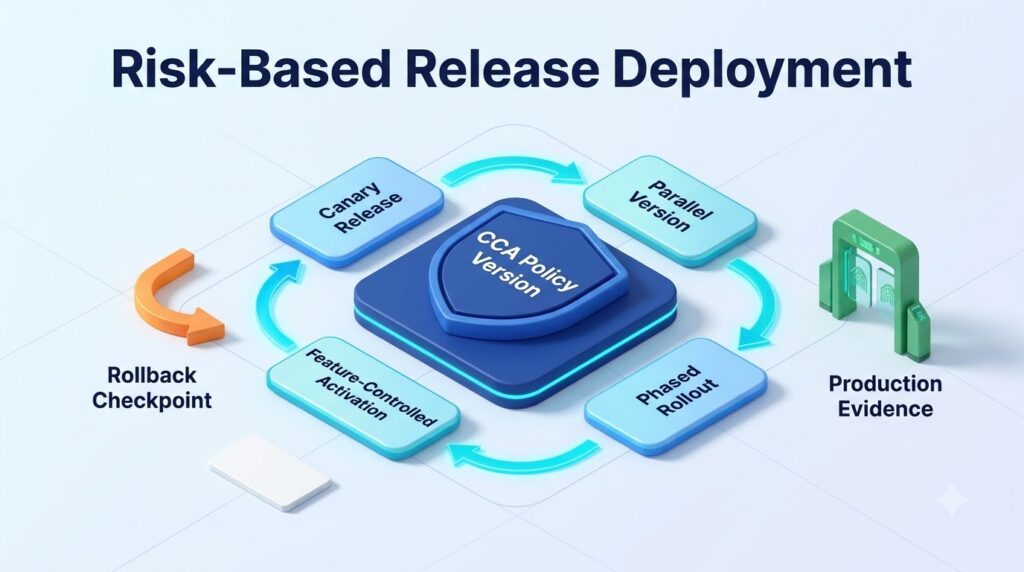
Choose a Deployment Strategy Based on Risk
| Strategy | Best use | Control requirements |
|---|---|---|
| Scheduled cutover | Low-complexity change with a clear maintenance window | Prechecks, communications and rollback checkpoint |
| Canary release | Teams can limit behavior to a safe population or program | Population controls, comparison metrics and stop rule |
| Parallel version | Consumers need time to migrate from a breaking contract | Defined overlap, reconciliation and retirement date |
| Feature-controlled activation | Code can deploy before policy or workflow activation | Restricted flag ownership and auditable activation |
| Phased rollout | Regions, entities or providers can move independently | Wave criteria, dependency map and consistent evidence |
| Emergency release | Delay creates greater security or operational risk | Narrow scope, expedited authority and retrospective review |
Define Rollback Before Deployment
Rollback is a business decision as well as a technical action. For example, reverting code may not reverse a CCA decision that BCM already received or a card that already reached production. The release plan must distinguish reversible configuration, replayable events, held orders, submitted orders and physical fulfillment. Therefore, each state needs a safe recovery action and an accountable owner.
Next, define measurable rollback triggers such as authorization errors, unexplained denial increases, duplicate orders, reconciliation gaps, provider rejection rates or missing audit evidence. In addition, preserve the failed release data for analysis. If rollback would cause greater inconsistency, stop new execution, hold affected BCM orders and reconcile existing transactions before resuming.
Monitor the Release as an End to End Service
However, a healthy API response does not prove a healthy business card service. Monitor the complete chain: source event receipt, validation, CCA decision, BCM order creation, approval timing, provider acceptance, production status, shipment, delivery and reconciliation. Then segment the results by release version, policy version, program, region and provider so change-related patterns become visible.
Moreover, BOC can surface operational status, exceptions and evidence across the chain. In addition, during the release observation window, compare the new version with the approved baseline. Then investigate unusual changes in eligibility, template selection, approval volume, order duplication, fulfillment errors and unresolved states before teams declare the release stable.
Manage Emergency Changes Without Abandoning Governance
Urgency may justify a shorter approval route, but it should not remove accountability. For example, an emergency release needs a named incident, a limited objective, authorized decision maker, known risk, test evidence appropriate to the time available, deployment record and recovery plan. Moreover, access should remain least-privileged and temporary permissions should expire.
Afterwards, complete the missing analysis after service is stable. Then update requirements, contract versions, CCA policy records, BCM workflow documentation, tests and operational runbooks. Finally, a retrospective should identify why normal controls were insufficient and whether a permanent design change is needed.
Implement API Release Governance in Practical Stages
- First, create one release record that connects the business outcome, requirements and accountable owners.
- Next, inventory affected producers, consumers, schemas, events, CCA policies, BCM states and providers.
- Then classify compatibility, security, policy, execution and operational risk.
- Version the interface contract and CCA decision model independently.
- In addition, define consumer-driven contract tests and end-to-end governance scenarios.
- Then select the deployment pattern, observation window, stop conditions and rollback actions.
- Promote approved configuration and code through isolated environments with evidence.
- Afterwards, verify source, CCA, BCM, provider and BOC correlation after production activation.
- Obtain accountable acceptance only after teams confirm business and operational outcomes.
- Finally, retire old versions and update traceability, runbooks and support ownership.
Measure Release Governance Quality
| Measure | What it indicates | Target direction |
|---|---|---|
| Change success rate | Releases achieve the intended outcome without recovery | Increase |
| Rollback readiness | High-risk releases have tested safe recovery actions | Complete before deployment |
| Contract test coverage | Teams verify CCA dependencies before promotion | Complete for critical interfaces |
| Policy traceability | Orders retain the CCA policy and contract versions used | Complete correlation |
| Duplicate order rate | Replay and concurrency controls remain effective | Approach zero |
| Reconciliation latency | Teams detect and resolve release-related mismatches quickly | Decrease |
| Legacy version exposure | Consumers remain on retiring interfaces | Decrease to zero by deadline |
Frequently Asked Questions
What is business card API release governance?
In short, it is the controlled process for approving, versioning, testing, deploying, monitoring and recovering changes across a CCA-governed business card service.
Why is CCA central to release governance?
CCA is the governance and orchestration layer that converts enterprise facts into authorized business card decisions, so its policy behavior must remain controlled through every release.
What is BCM?
BCM is the business card ordering management system or software that manages permissions, approvals, templates, quantities, orders and reporting.
Is API versioning enough?
No. Enterprises must also version policy, configuration, ordering behavior and operational evidence to explain the business outcome.
What makes an API change breaking?
In general, a change is breaking when an approved producer or consumer can no longer preserve the required meaning, behavior or control without modification.
Should policy changes use the same release process as code?
Yes. They may follow a different deployment mechanism, but they need impact review, approval, testing, effective dating and evidence.
How should duplicate events be tested?
Replay the same correlation identifier and test concurrent delivery. As a result, CCA and BCM should produce one explainable managed transaction.
Can a release be rolled back after an order reaches production?
The software can change, but physical execution may not be reversible. The plan must define holds, cancellations, reconciliation and recovery by order state.
What should be monitored after release?
In particular, monitor the source-to-decision-to-order-to-delivery chain, including authorization, duplicates, approvals, provider responses, exceptions and reconciliation.
When can an old API version be retired?
Retire it after all approved consumers migrate, evidence confirms stability, teams remove dependencies and the announced retirement conditions apply.
The Strategic Outcome
API release governance allows an enterprise to change its business card ecosystem without weakening centralized control. In this model, source applications remain authoritative for their data, CCA remains authoritative for governance decisions and BCM continues to manage only complete, authorized orders. Meanwhile, BOC evidence helps operations prove that the released service performs as intended.
Overall, the result is safer modernization, faster diagnosis and a clearer path for adding systems, policies, regions and providers. Each release becomes an explainable business change supported by technical evidence rather than an isolated deployment that the organization must trust on assumption.
Select the next planned business card integration change and build a release record before implementation begins. Then map its requirements, contract and policy versions, CCA decisions, BCM states, tests, deployment pattern, rollback actions and evidence. Finally, use that release as the operating standard for future API and policy changes.