

Multi-Platform Business Card API Integration
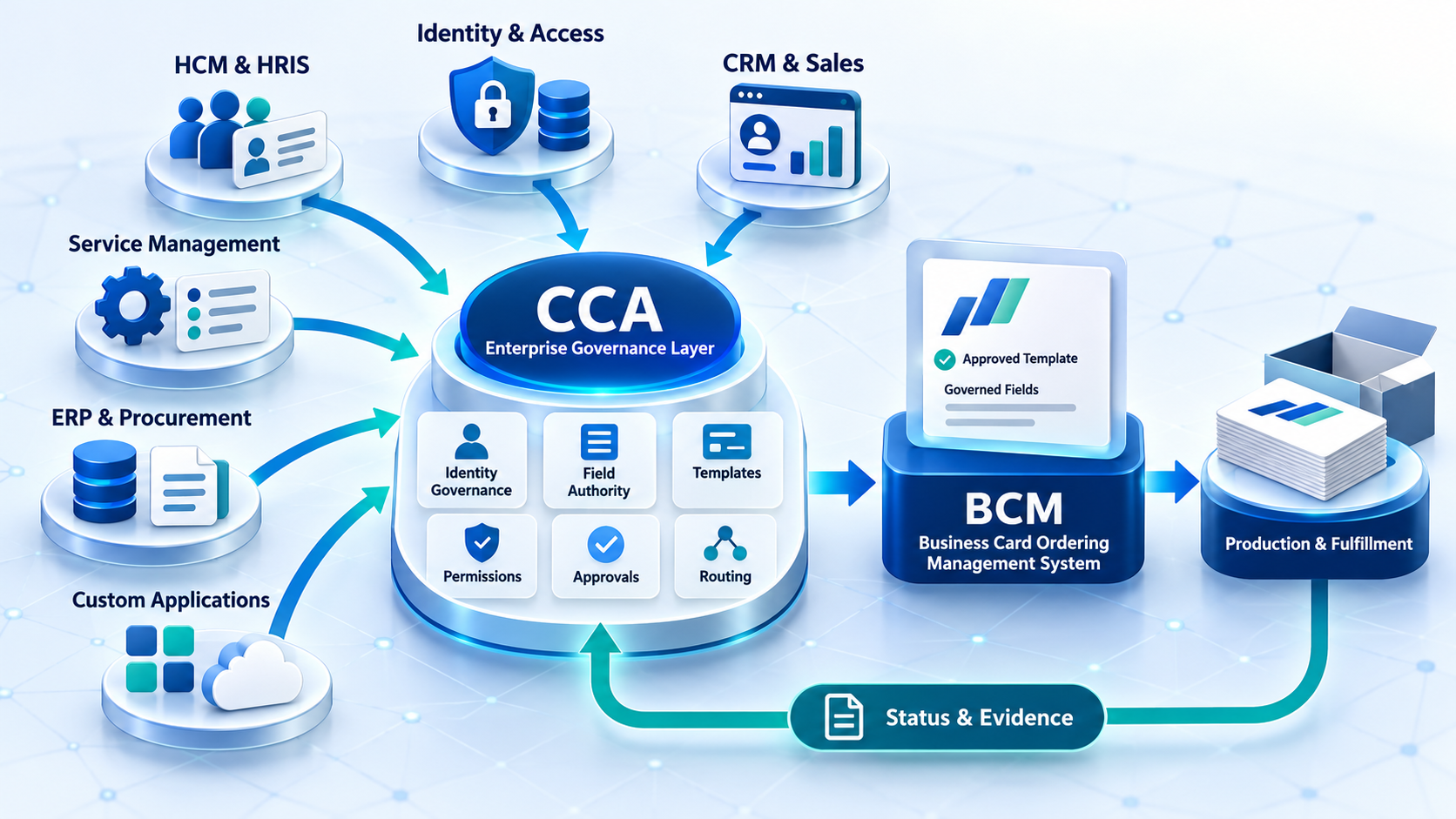
Connecting enterprise applications to governed ordering through CCA
Enterprise Applications Should Supply Context Not Card Policy
A modern business card program can receive useful signals from many applications. Workday, SAP SuccessFactors, Oracle HCM Cloud, ADP Workforce Now, UKG Pro and Dayforce may hold workforce and lifecycle facts. Microsoft Entra ID can support authentication and access context. Microsoft Dynamics and HubSpot can contribute approved customer-facing context. ServiceNow can initiate a governed request within an established service workflow.
None of these systems should independently decide every business card rule. Their records were created for human capital, identity, sales or service management. Color Card Administrator (CCA) provides the business card control layer that validates approved inputs, applies eligibility and identity policy, selects controlled templates, routes approvals, authorizes ordering and preserves evidence. Integration should extend that authority into the applications the enterprise already uses.
The Purpose of CCA Across a Diverse Application Portfolio
CCA centralizes enterprise business card administration and identity execution through a unified API backbone. It connects business card ordering to HCM, HRIS, CRM, ERP, procurement, identity, service management and proprietary systems while keeping templates, permissions, approvals, ordering logic, reporting, production and fulfillment under governed control.
This architecture prevents each source platform from becoming a separate card program. A Workday integration and a ServiceNow integration can use different technical patterns but still produce decisions under the same CCA policies. An Entra sign-in and a HubSpot sales-role update can influence different parts of the workflow without being allowed to overwrite one another.
Separate Existing Integration from Available Integration
Integration language must be precise. The official CCA integration material identifies Salesforce as an existing integration. It presents platforms such as Workday, SAP SuccessFactors, Oracle HCM Cloud, ADP Workforce Now, UKG Pro, Microsoft Dynamics 365 and ServiceNow as available for integration. Available means CCA can work with an organization to configure a connection using supported methods; it does not mean every connector is already deployed in every environment.
Final feasibility depends on the customer tenant, subscriptions, permissions, available APIs, security standards, middleware, required data and intended workflow. A responsible evaluation confirms these conditions before promising scope, schedule or automation. The business outcome should remain consistent even when the technical implementation differs by platform.
Integration Opportunities by Platform Domain
| Platform domain | Representative platforms | Governed contribution to CCA |
|---|---|---|
| HCM and HRIS | Workday, SAP SuccessFactors, Oracle HCM Cloud, ADP, UKG, Dayforce | Worker status, role, organization, manager, location and effective dates |
| Identity and access | Microsoft Entra ID and compatible identity providers | Authentication, tenant context, groups and access lifecycle signals |
| CRM and sales | Salesforce, Microsoft Dynamics, HubSpot | Approved sales role, team, territory and customer-facing context |
| Service management | ServiceNow and enterprise service portals | Request, onboarding task, approval trigger and case context |
| ERP and procurement | Compatible financial and purchasing platforms | Entity, cost center, purchase order and spend-control context |
| Custom applications | Employee portals, intranets and proprietary systems | Embedded request experience and governed enterprise events |
HCM Integration Connects the Employee Lifecycle
HCM and HRIS integrations are valuable because business card needs often begin with a workforce change. A new hire may become eligible before the start date. A promotion may require a controlled title change. A transfer may change entity, office, manager, cost center, language, template or fulfillment route. Offboarding may require access removal and cancellation of pending work.
The source platform should remain authoritative for approved employment facts. CCA evaluates the effective event, resolves governed card fields, checks eligibility and determines whether an automated action, approval or exception is appropriate. BCM then executes only the authorized ordering transaction. This separation prevents a raw worker update from becoming an uncontrolled physical order.
Compare HCM Integration Patterns
| Platform example | Typical useful signals | Implementation considerations |
|---|---|---|
| Workday | Worker, job, organization, manager, location and effective-dated events | Tenant configuration, security groups, API access, reports or middleware |
| SAP SuccessFactors | Employee Central person, employment, job and organizational data | OData or approved extract pattern, effective dating and permission roles |
| Oracle HCM Cloud | Worker, assignment, organization, location and lifecycle changes | REST or approved integration services, roles and customer workflow |
| ADP Workforce Now | Employee profile, job, department, location and status | Subscription, marketplace or API access, permissions and field availability |
| UKG Pro | Person, employment, organization and lifecycle context | Service access, credentials, data scope and event timing |
| Dayforce | Worker, job, organization, location and status changes | Available interfaces, customer permissions and effective-date behavior |
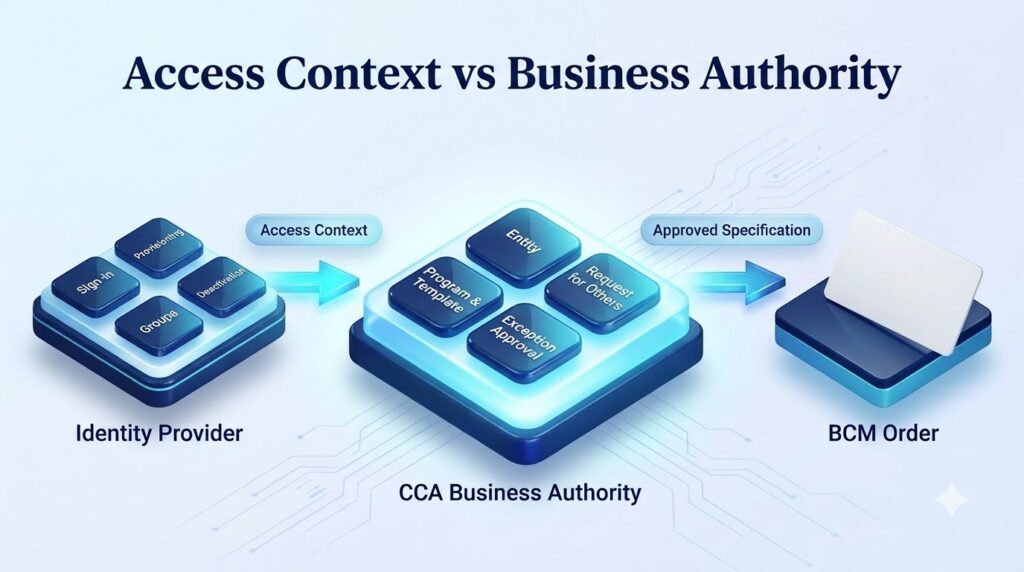
Identity Integration Controls Access Not Business Authority
Microsoft Entra ID and other identity providers can simplify sign-in, user provisioning, group-based access and deactivation. These signals answer who the digital user is and what application scope may be assigned. They do not automatically prove that every directory value is approved for public presentation or that the user is eligible to order a physical card.
CCA applies the additional authority model: which entity the person may represent, which program and template are permitted, whether they may request for others, which fields are locked and who must approve an exception. BCM should not reinterpret directory claims. It should receive a CCA-approved specification and manage the resulting order.
CRM Integration Connects Customer Facing Identity
CRM platforms can provide relevant context for sales and customer-facing teams. A territory change, team assignment, brand relationship or role transition may justify a new card. Salesforce, Microsoft Dynamics and HubSpot can participate where their data is approved and the customer environment exposes a compatible integration method.
CCA must determine which CRM attributes are authoritative for business card use. A sales label entered for pipeline reporting may not be an approved external title. A temporary campaign assignment may not justify permanent printed identity. Field authority, effective dates, eligibility, template rules and approval controls keep customer-facing automation aligned with enterprise policy.
ServiceNow Integration Brings Ordering into Enterprise Workflow
ServiceNow can act as a familiar request and workflow channel. An onboarding task, service request or approved workflow event can initiate or coordinate a business card process. The exact configuration depends on the customer instance, available APIs, roles, permissions, security policies and information requirements.
CCA remains responsible for the business card decision. It validates the transferred context, applies the relevant policy and determines whether additional approval is necessary. BCM manages the permitted template, quantity, order and status. CCA then coordinates production and fulfillment while administrators retain centralized visibility.
BCM Is the Business Card Ordering Management System
BCM is the business card ordering management system or software within the CCA ecosystem. CCA provides centralized orchestration and governance; BCM manages the authorized ordering workflow. Its responsibilities include permissions, approval state, controlled templates, quantity, order creation, order progress and reporting.
The distinction is important in every integration. A platform event is an input, not an order. CCA converts approved input into an explainable authorization. BCM converts that authorization into a managed business transaction. Production and fulfillment services execute the physical result, and returned status supports operational oversight and reconciliation.
Use One Canonical Contract Across Platforms
| Contract component | Why it matters | CCA treatment |
|---|---|---|
| Source and tenant | Proves which enterprise environment supplied the data | Registered consumer, owner and permitted scope |
| Subject identifier | Links the event to the correct person or request | Stable business identity with controlled correlation |
| Event type and time | Explains what changed and when it becomes valid | Effective-date and ordering evaluation |
| Organization context | Identifies entity, unit, role, location and program | Eligibility, field, template and routing policy |
| Candidate attributes | Carries approved values with provenance | Field authority, validation and transformation |
| Request context | Describes channel, action, reason and urgency | Permission, quantity and approval decisions |
| Business key | Links retries to one intended transaction | Idempotent CCA decision and BCM order |
Choose the Right Technical Pattern
| Pattern | Best fit | Governance requirement |
|---|---|---|
| Real time API | Interactive eligibility, validation or request submission | Strong authentication, authorization, timeout and idempotency controls |
| Webhook or event | Lifecycle changes and status notifications | Signature validation, replay protection and ordered-state rules |
| Scheduled extract | Platforms or use cases suited to periodic synchronization | Encrypted transfer, completeness checks and effective dating |
| Middleware or iPaaS | Complex transformation, routing or enterprise standards | Clear ownership so middleware does not become a policy engine |
| Embedded portal | Employees order inside an intranet or service experience | CCA-constrained choices and protected session context |
| Manual governed fallback | Low-volume exceptions or temporary integration gaps | Same CCA policies, approvals and audit evidence |
Protect Data and Ordering Integrity
Every connection should use a registered workload identity, least-privilege permissions, protected credentials, encrypted transport and explicit field allowlists. CCA should accept only the data required for the business card decision. Logs and operational evidence should use identifiers rather than unnecessary card content or personal information.
Retries must preserve a stable business key so a timeout cannot create a second physical order. Late and out-of-order events should be evaluated against authoritative state and effective time. If BCM or production may already have accepted a transaction, CCA should reconcile that state before any replay. Exceptions need named owners and safe next actions.
Implement a Multi Platform Integration Program
- Prioritize business journeys rather than selecting platforms only by market visibility.
- Confirm whether each target is integrated today, available for configured integration or requires discovery.
- Document tenant, subscription, API, permission, security and middleware prerequisites.
- Assign field authority across HCM, identity, CRM, service, financial and CCA sources.
- Define the canonical event, decision, order, status and reconciliation contracts.
- Model eligibility, templates, fields, quantities, approvals and provider routes in CCA.
- Register each integration client with narrow scope, credentials and an accountable owner.
- Connect one representative platform to a controlled BCM ordering workflow.
- Test hires, transfers, title changes, duplicates, late events, denied access and exceptions.
- Pilot a bounded population and reconcile source, CCA, BCM, production and delivery evidence.
- Expand by business outcome while reusing the same governance and integration standards.
Measure Outcomes Across Platforms
| Measure | What it shows | Desired direction |
|---|---|---|
| Eligible event coverage | Relevant source events reaching CCA | Increase to intended population |
| Authoritative field rate | Card fields resolved from approved owners | Increase |
| Straight through decisions | Requests completed without manual interpretation | Increase within policy |
| Unauthorized order prevention | Requests stopped before BCM or production | Complete control coverage |
| Duplicate order rate | Repeated delivery attempts creating extra orders | Zero |
| Exception resolution time | Speed and accountability of remediation | Decrease |
| Reconciliation completeness | Transactions linked from source through delivery | Complete coverage |
| Platform onboarding effort | Work required to add a compatible system | Decrease through reusable patterns |
Frequently Asked Questions
What is a multi platform business card API integration?
It is a governed model that lets multiple enterprise applications contribute approved context to one CCA-controlled business card lifecycle.
Does CCA have a prebuilt connector for every platform named here?
No. Integration status and feasibility vary. Some platforms are presented as available for configured integration, subject to customer APIs, permissions and requirements.
Which integration is identified as existing?
The official CCA integration material identifies Salesforce as an existing integration.
What is the purpose of CCA?
CCA centralizes business card administration, identity governance, templates, permissions, approvals, routing, reporting and execution coordination.
What is BCM?
BCM is the business card ordering management system or software for managed permissions, approvals, templates, quantities, orders and reporting.
Can Workday or another HCM create orders automatically?
Approved workforce events can inform automation, but CCA should first apply eligibility, identity, template and approval policy before BCM creates an order.
Does Entra ID control printed identity?
Entra can support authentication and access context. CCA determines the separate business authority and presentation rules for a card.
Can ServiceNow remain the employee request channel?
Yes. A configured workflow can initiate the process while CCA and BCM retain business card governance and ordering control.
How can CRM data be used safely?
Use only approved customer-facing context, apply field authority and effective-date rules, and route material exceptions for review.
What should an enterprise validate first?
Confirm business outcomes, platform access, authoritative data, security requirements and the exact workflow before committing to implementation.
The Strategic Outcome
Multi-platform integration allows employees and administrators to work through familiar enterprise systems without creating separate business card rules in every application. Each source remains responsible for its domain. CCA provides the consistent authority layer, BCM manages the authorized order, and production and fulfillment complete the controlled outcome.
The enterprise gains a repeatable way to connect workforce, identity, sales and service workflows to accurate business identity. The value is not the number of platform names on an integration list. It is the ability to preserve policy, brand, approval, order integrity and evidence across every connected journey.
Choose the platform that contains the highest-value business card trigger and document one complete journey. Confirm integration status and prerequisites, identify authoritative fields, define the CCA decision, connect the authorized outcome to BCM and require returned production and delivery evidence. Use that journey as the standard for every subsequent platform.