

Synthetic Monitoring For Enterprise Business Card API Integrations
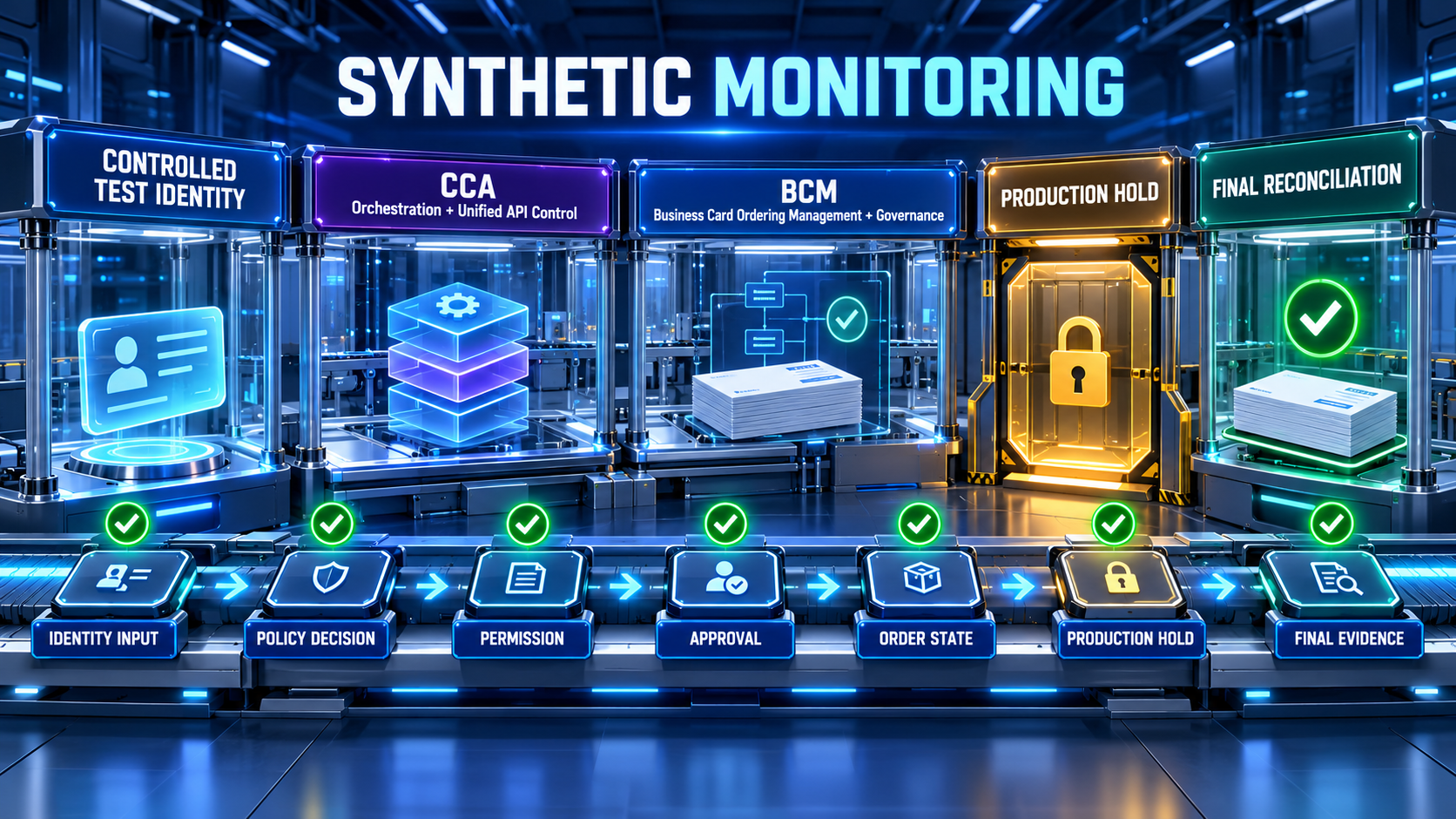
Test the Governed Outcome, Not Only the Endpoint
A successful health check can prove that an endpoint responds, but it cannot prove that an enterprise business card workflow still behaves correctly. Authentication may succeed while an approved field is mapped incorrectly. CCA may receive a request while the wrong policy version is active. BCM may accept a transaction while an approval route, template permission or quantity control has drifted. Production status may appear healthy even though the return event no longer reconciles to the authorized order.
Synthetic monitoring addresses this gap by running controlled test transactions through the integration path on a defined schedule. The purpose is not to create sample orders for demonstration. It is to verify that identity input, CCA enterprise identity orchestration, governance decisions, BCM ordering management, downstream execution and returned evidence continue to work together as designed.
CCA is the centralized orchestration and unified API control layer for the enterprise program. BCM, or Business Card Manager, is the business card ordering management system and software that controls permissions, approvals, templates, quantities, ordering workflows and reporting. Print Business Cards performs production and fulfillment. Synthetic monitoring should respect these roles while checking the boundaries between them.
Extend Observability with Active Assurance
Post 124 established the metrics, logs, traces and business events required to understand live behavior. Synthetic monitoring adds an active signal. Rather than waiting for a real employee request to expose a failure, the enterprise initiates a known test transaction and compares every observed decision with an approved expectation.
The result should appear in the same observability model as production traffic, but it must be visibly classified as synthetic. Teams need to separate test volume from business reporting, prevent test identities from reaching uncontrolled production and retain enough evidence to explain a failed checkpoint. This creates an early-warning capability without contaminating governed operational records.
Define the Synthetic Transaction Boundary
| Test boundary | What the monitor validates | Safe stopping point |
|---|---|---|
| API availability | Authentication, routing, response and dependency reachability | Before a business decision or order is created |
| CCA policy decision | Schema, mapping, eligibility, governed fields and provider route | After decision evidence is recorded |
| BCM ordering workflow | Permission, template, quantity, approval and order creation | Before production release |
| Preproduction execution | Proof generation, renderability and supplier acceptance | Dedicated nonproduction or hold queue |
| Fulfillment event return | Status contract, correlation and reconciliation behavior | Simulated shipment and delivery events |
| End to end control | Complete source-to-reconciliation evidence chain | Controlled test program with automatic cleanup |
Use Dedicated Test Identities and Programs
A synthetic monitor should never impersonate a real employee or reuse a production identity record simply because it is convenient. Create dedicated test identities with recognizable nonpersonal values, approved roles and a documented lifecycle. Assign them only to controlled test programs, templates and locations. The data must be realistic enough to exercise validation and routing, but it should not describe a person.
The same principle applies to BCM. Synthetic orders should enter a dedicated business card ordering program or a production-safe route that applies the same configuration logic without releasing physical work. Where production integration must be exercised, use an explicit hold before print release, an automated cancellation step and a reconciliation rule that proves the test left no uncontrolled job or shipment behind.
Build Assertions Around Governance
| Checkpoint | Example assertion | Failure meaning |
|---|---|---|
| Identity input | Required governed fields arrive from the approved source with the expected effective time | Source contract or mapping may have changed |
| CCA validation | Payload is accepted under the intended schema and mapping version | Compatibility or data-quality control is failing |
| CCA policy | Expected eligibility, field authority, template and route are selected | Governance configuration may have drifted |
| BCM permission | Test role can access only the approved program and template | Authorization or assignment is incorrect |
| BCM workflow | Expected approval, quantity limit, order state and hold are applied | Ordering management control is not operating as designed |
| Production boundary | Proof or supplier acknowledgment is returned without uncontrolled release | Execution integration or safety hold is failing |
| Reconciliation | Every emitted status matches the test transaction and reaches a final state | Correlation, event delivery or reporting is incomplete |
Test More Than the Happy Path
A monitor that submits only one valid request confirms a narrow success path. Enterprise assurance requires a small portfolio of controlled scenarios. Include a standard approved request, a request requiring enterprise approval workflows, an ineligible role, a prohibited field override, an invalid template selection, a duplicate submission, a delayed callback, and a downstream rejection. Each scenario should have a precise expected outcome.
Negative tests are especially important because many governance controls should reject or hold the transaction. A rejected request can represent success when policy requires rejection. The monitoring platform must evaluate the expected business result, not reduce every non-200 response or held workflow to a generic failure.
Create a Scenario Portfolio
| Scenario | Expected CCA or BCM behavior | Control proven |
|---|---|---|
| Approved standard order | Authorize approved fields, template, quantity and route | Normal governed execution |
| Approval required | Hold until the assigned approver acts | Approval routing and decision evidence |
| Ineligible role | Reject ordering authority | Role-based eligibility |
| Unauthorized field change | Ignore, reject or route the change for approval | Field authority and override governance |
| Duplicate request | Return the existing state or block a second order | Idempotency and duplicate prevention |
| Expired credential | Deny access and create a security signal | Authentication and credential control |
| Missing status event | Identify the stale transaction and open an exception | Event monitoring and reconciliation |
| Supplier rejection | Preserve the order, reason and accountable owner | Downstream exception management |
Schedule Tests by Risk and Change
Not every scenario requires the same frequency. A lightweight authentication and routing check may run every few minutes. A CCA policy transaction may run hourly. A BCM approval-path test may run daily. A preproduction proof test may run after a template, mapping or supplier change. Full reconciliation scenarios may run during a scheduled assurance window because they create more evidence and require cleanup.
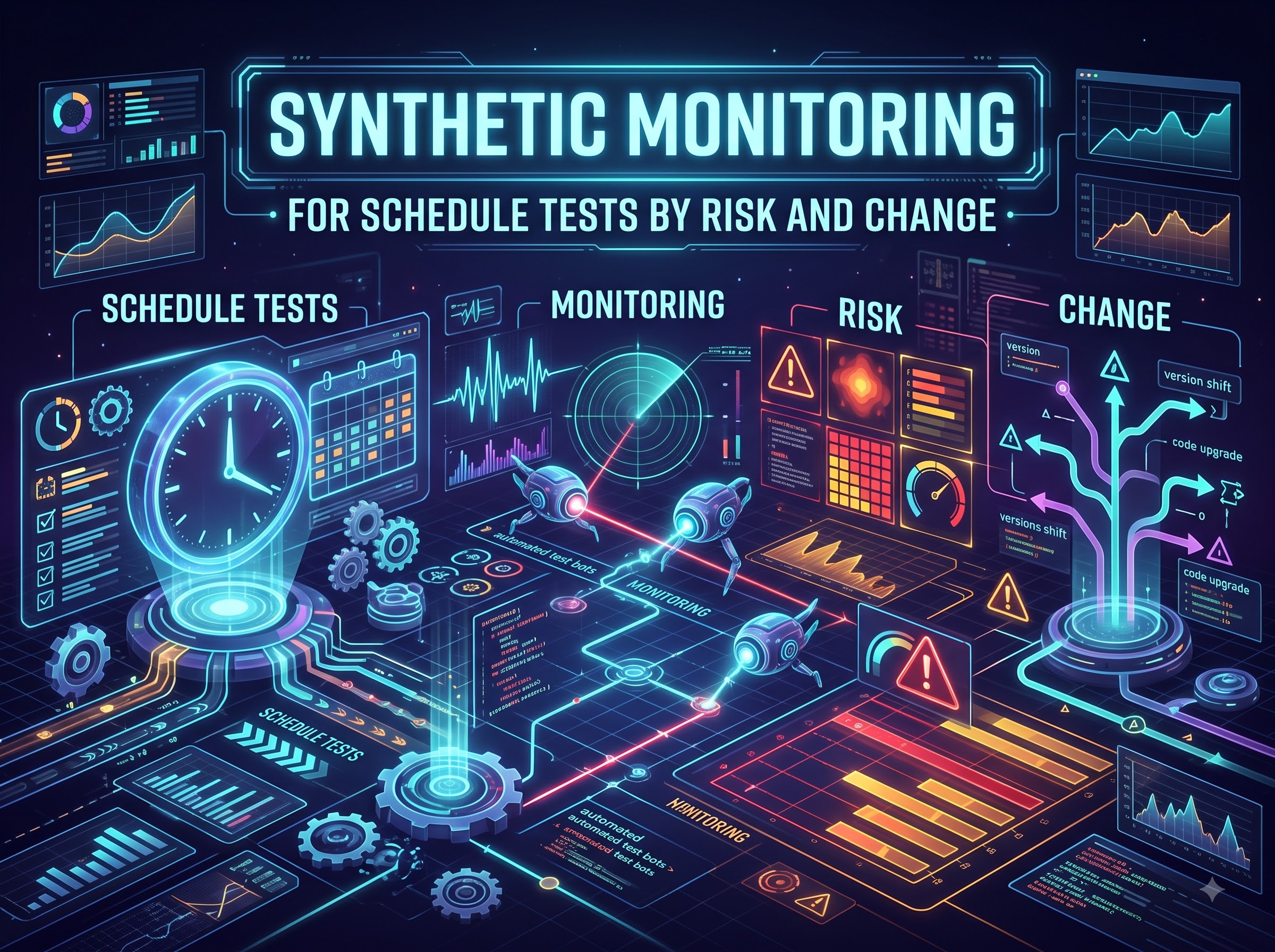
Combine time-based schedules with change-based triggers. Run relevant monitors after schema, mapping, policy, template, permission, credential, endpoint or provider-route changes. The test set should correspond to the affected control boundary. This is more useful than running every scenario after every change and makes failed evidence easier to interpret.
Prevent Synthetic Traffic from Becoming Real Work
| Protection | Required behavior | Evidence of safety |
|---|---|---|
| Clear classification | Tag every request, trace, order and event as synthetic | Dashboards and exports can exclude test volume |
| Dedicated program | Restrict test identities to approved test templates and routes | BCM permissions show no access to live employee programs |
| Production hold | Stop test orders before physical release | Hold state and release restriction are visible |
| Automatic cleanup | Cancel test artifacts and close expected exceptions | No test transaction remains actionable |
| Volume limit | Cap frequency, concurrency and quantity | A monitor cannot create material cost or workload |
| Kill switch | Disable all synthetic execution independently | Operations can stop testing without affecting real orders |
| Reconciliation | Match every test input to its final disposition | No uncertain test job or shipment remains |
Design Alerts That Explain the Failed Checkpoint
A synthetic alert should identify the scenario, failed assertion, affected integration incident response boundary, last successful run, active configuration versions, and trace reference. The alert should also name the owner who can act. A source contract failure belongs to the source and integration owners. A CCA policy mismatch belongs to the CCA platform owner. A BCM approval or permission failure belongs to the ordering administrator. A production acknowledgment failure belongs to the execution owner.
Avoid alerting on a single transient attempt when controlled retry immediately confirms recovery. Use consecutive-failure, duration or consequence thresholds. However, do not delay alerts for security failures, unexpected authorization, duplicate-order risk or any test that appears to have crossed the production hold. Those conditions require immediate containment.
Measure the Assurance Program
| Measure | What it indicates | Useful segmentation |
|---|---|---|
| Scenario success rate | Whether expected outcomes remain stable | Integration, region, program and scenario |
| Time to detect | How quickly the monitor identifies an introduced defect | Change type and control boundary |
| False alert rate | Whether alerts create unnecessary investigation | Scenario, threshold and dependency |
| Trace completeness | Whether each checkpoint supplies usable evidence | Source, CCA, BCM and fulfillment stage |
| Cleanup success | Whether synthetic artifacts reach a safe final state | Order, proof, job and event type |
| Production escapes | Defects first discovered by real transactions | Control type, severity and missed scenario |
| Coverage | Critical integrations and governance paths under active test | Business unit, source, provider and workflow |
Implement Synthetic Monitoring in Controlled Stages
- Map the critical source, CCA, BCM, production and reconciliation paths that require active assurance.
- Define dedicated nonpersonal test identities, programs, templates and route restrictions.
- Select the expected business outcome and assertions for each scenario.
- Start with API reachability and CCA validation before expanding into governed decisions.
- Add BCM permission, approval, template, quantity and order-state checks.
- Establish production holds, volume limits, automatic cleanup and an independent kill switch.
- Connect synthetic traces to the same observability evidence used for real traffic.
- Create alerts that identify the failed checkpoint, active version and accountable owner.
- Trigger targeted scenarios after relevant integration and governance changes.
- Review failures, false alerts, coverage and production escapes on a defined cadence.
- Expand only when every test transaction can be reconciled to a safe final state.
Keep Synthetic Monitoring Governed
Synthetic monitoring itself becomes part of the enterprise control environment. Changes to scenarios, credentials, schedules, assertions and production holds should be approved, versioned and auditable. Access to execute or modify tests must be separated from access to release production work. Test credentials need the minimum permissions required for the scenario and should follow the same rotation and revocation discipline as other integration credentials.
The monitor also requires business card lifecycle ownership. Retire scenarios when an integration or program is decommissioned. Update assertions when an approved policy changes. Preserve historical results long enough to support change review and incident analysis, but do not retain test payloads without a defined purpose.
Frequently Asked Questions
What is synthetic monitoring for a business card API?
It uses controlled test transactions to verify that connected identity, governance, ordering and fulfillment workflows produce the expected result.
How is it different from API uptime monitoring?
Uptime monitoring checks whether an endpoint responds. Synthetic monitoring checks whether the governed business process still works correctly.
What is CCA responsible for?
CCA provides centralized orchestration and unified API control, including validation, governance decisions, routing and decision evidence.
What is BCM?
BCM, or Business Card Manager, is the business card ordering management system and software for permissions, approvals, templates, quantities, orders and reporting.
Should synthetic tests use real employee data?
No. Use dedicated nonpersonal test identities and approved test programs.
Can a synthetic order reach production?
Only through a deliberately controlled test route with an explicit hold, strict limits, cleanup and reconciliation.
Which scenarios should run first?
Begin with critical paths and high-consequence controls such as authorization, policy selection, duplicate prevention and order holds.
How often should tests run?
Frequency should reflect risk, cost and change. Combine scheduled checks with targeted tests after relevant configuration changes.
Is a rejected test always a failure?
No. Rejection is the correct result when a scenario intentionally violates eligibility, field, or template rules.
How does synthetic monitoring support incident response?
It can detect the failing boundary early and supplies trace, version, and expected-outcome evidence for containment and recovery.
What proves the monitoring program is safe?
Every synthetic transaction is classified, constrained, prevented from uncontrolled production and reconciled to a verified final state.
The Strategic Outcome
Synthetic monitoring converts integration assurance from a periodic manual exercise into a controlled operating capability. The enterprise can continuously confirm that approved source facts reach CCA, governance decisions remain correct, BCM ordering controls behave as configured, production boundaries remain protected and returned status can be reconciled.
This approach reduces the chance that employees become the first people to discover an integration defect. It also gives technology, governance, ordering and fulfillment teams shared evidence for determining where a problem begins and which owner should resolve it.
Choose one critical business card ordering journey and define a synthetic scenario for it. Use a nonpersonal test identity, specify the expected CCA decision and BCM workflow, establish a production-safe stopping point, and require reconciliation of the final state. Once that scenario is reliable, add the negative cases most likely to reveal authorization, mapping, duplicate or event-delivery failures.