

Resilience Testing For Enterprise Business Card API Integrations
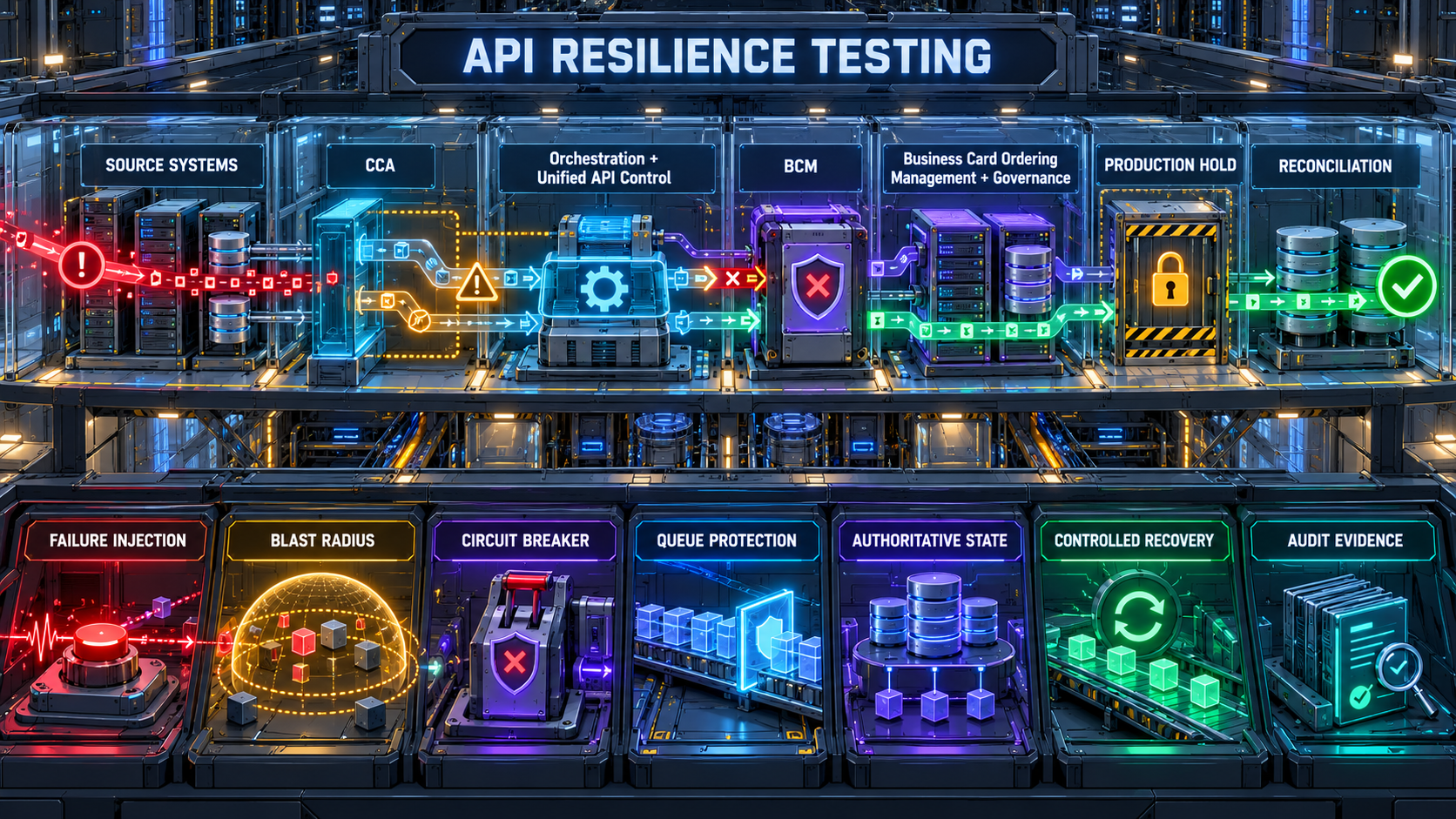
Proving that governed ordering remains safe when connected systems fail.
A Resilient Integration Fails Safely
Enterprise resilience is not demonstrated by avoiding every technical failure. It is demonstrated by preserving identity accuracy, authorization, ordering control, and evidence when a failure occurs. An unavailable source system, expired credential, delayed event, overloaded queue, or unreachable print service should not cause an unauthorized business card, an uncontrolled duplicate order, or an uncertain production state.
Resilience testing deliberately introduces a bounded failure and observes how the complete program responds. CCA remains the centralized orchestration and unified API control layer. It validates incoming context, applies governance, selects the approved route, and records decision evidence. BCM, or Business Card Manager, is the business card ordering management system and software that manages permissions, approvals, templates, quantities, ordering workflows, and reporting. Enterprise Business Cards Governance handles production and fulfillment. The test must confirm that each layer protects its responsibility and that the handoffs between layers remain recoverable.
Move from Synthetic Success to Controlled Failure
Post 125 established synthetic monitoring with controlled test identities and known expected outcomes. Post 126 advances the assurance model by changing the operating conditions around those tests. Instead of asking only whether the approved journey succeeds, resilience testing asks what happens when authentication fails, latency increases, messages arrive twice, callbacks arrive out of order, or a downstream service becomes unavailable.
The objective is not to create dramatic outages. It is to test one hypothesis within a controlled blast radius. Each exercise needs an approved scope, a measurable expected response, an independent stop mechanism, protected production boundaries, and a reconciliation plan. The safest exercise is the smallest one that can prove the control behavior under review.
Map Failure to the Governed Chain
| Boundary | Controlled disruption | Expected safe behavior |
|---|---|---|
| Source systems | Late, missing, conflicting, or malformed event | CCA rejects, quarantines or waits without inventing identity data |
| Authentication | Expired token, revoked credential or unavailable identity provider | Access is denied and no order path opens |
| CCA integration control | Schema mismatch, mapping defect, latency or routing failure | Affected traffic is isolated and decision evidence remains intact |
| BCM ordering management | Approval delay, permission mismatch, duplicate request or queue backlog | Order remains held, unique and governed |
| Production interface | Timeout, rejection or uncertain acknowledgment | Production is paused until authoritative state is established |
| Status return path | Duplicate, delayed or out-of-order callback | Events are ordered, deduplicated and reconciled |
| Reporting | Unavailable dashboard or incomplete export | Transaction controls continue and evidence is recoverable |
Write a Test Hypothesis Before Injecting Failure
A resilience exercise should begin with a precise statement: if a named dependency fails in a defined way, the program will preserve a specific business control and recover within an approved condition. For example, if BCM does not acknowledge an order request before the timeout, CCA will not create a second physical order without first establishing the authoritative downstream state.
The hypothesis separates useful testing from uncontrolled experimentation. It identifies the dependency, failure mode, affected cohort, control expected to activate, evidence required, recovery decision, and acceptable residual risk. It also prevents teams from treating a technically successful retry as proof when the business outcome remains uncertain.
Create a Resilience Scenario Portfolio
| Scenario | Expected response | Primary control proven |
|---|---|---|
| Source event delay | Queue safely, display age and preserve effective-time order | Event sequencing and stale-data protection |
| Credential revocation | Reject immediately and alert the owning team | Least privilege and access containment |
| CCA validation failure | Quarantine only affected payloads with an explainable reason | Schema and data-quality governance |
| BCM timeout | Check authoritative order state before retry | Duplicate-order prevention |
| Approval service delay | Keep the transaction pending without bypassing approval | Workflow integrity |
| Print API rejection | Hold the order and preserve production-ready evidence | Safe downstream exception handling |
| Duplicate callback | Process once and retain the repeated-event record | Idempotent event handling |
| Out-of-order delivery status | Apply valid state transitions and flag conflicts | Lifecycle integrity and reconciliation |
Control the Blast Radius
Resilience tests must be isolated by test identity, business card program, template, region, route, provider, or transaction cohort. Begin in a nonproduction environment where the same contracts and controls can be exercised. When a production-path test is necessary, use dedicated synthetic identities, strict volume limits, a BCM program that cannot access live employee templates, and an explicit hold before production release.
Every exercise needs a kill switch that operates independently of the component being tested. If the test affects queues or callbacks, teams also need a drain and cleanup plan. The test owner must know how to stop new injections, identify in-flight transactions, restore normal routing, and prove that no test artifact remains eligible for physical production or shipment.
Protect Physical Order Integrity
| Risk | Required safeguard | Closure evidence |
|---|---|---|
| Duplicate physical order | Idempotency key plus authoritative BCM state check | One approved order and no second production job |
| Wrong identity or template | CCA field authority and template-policy assertion | Decision record matches approved test expectation |
| Approval bypass | BCM hold that cannot be released by the failure path | Approval evidence exists before release |
| Uncertain supplier acceptance | Production hold until acknowledgment is reconciled | Supplier job state is confirmed or cancelled |
| Orphaned test order | Automated cleanup with exception ownership | Final cancellation or controlled completion recorded |
| Test shipment | Dedicated nonfulfillment destination or simulated event route | No carrier handoff or delivery remains possible |
Test Retry Replay and Idempotency Together
Retries are necessary for temporary failures, but they can become dangerous when the downstream system completed work before the caller received confirmation. A resilience test should reproduce timeout-after-acceptance conditions, not only clean connection failures. The expected behavior is to query or reconcile the authoritative order state before sending another create request.
Replay testing should preserve the original business transaction key while recording a new delivery attempt. CCA must distinguish a repeated message from a new request. BCM must return or retain the existing governed order rather than creating another one. Production and fulfillment callbacks must also tolerate repeated delivery without advancing the order twice.
Validate Back Pressure and Queue Recovery
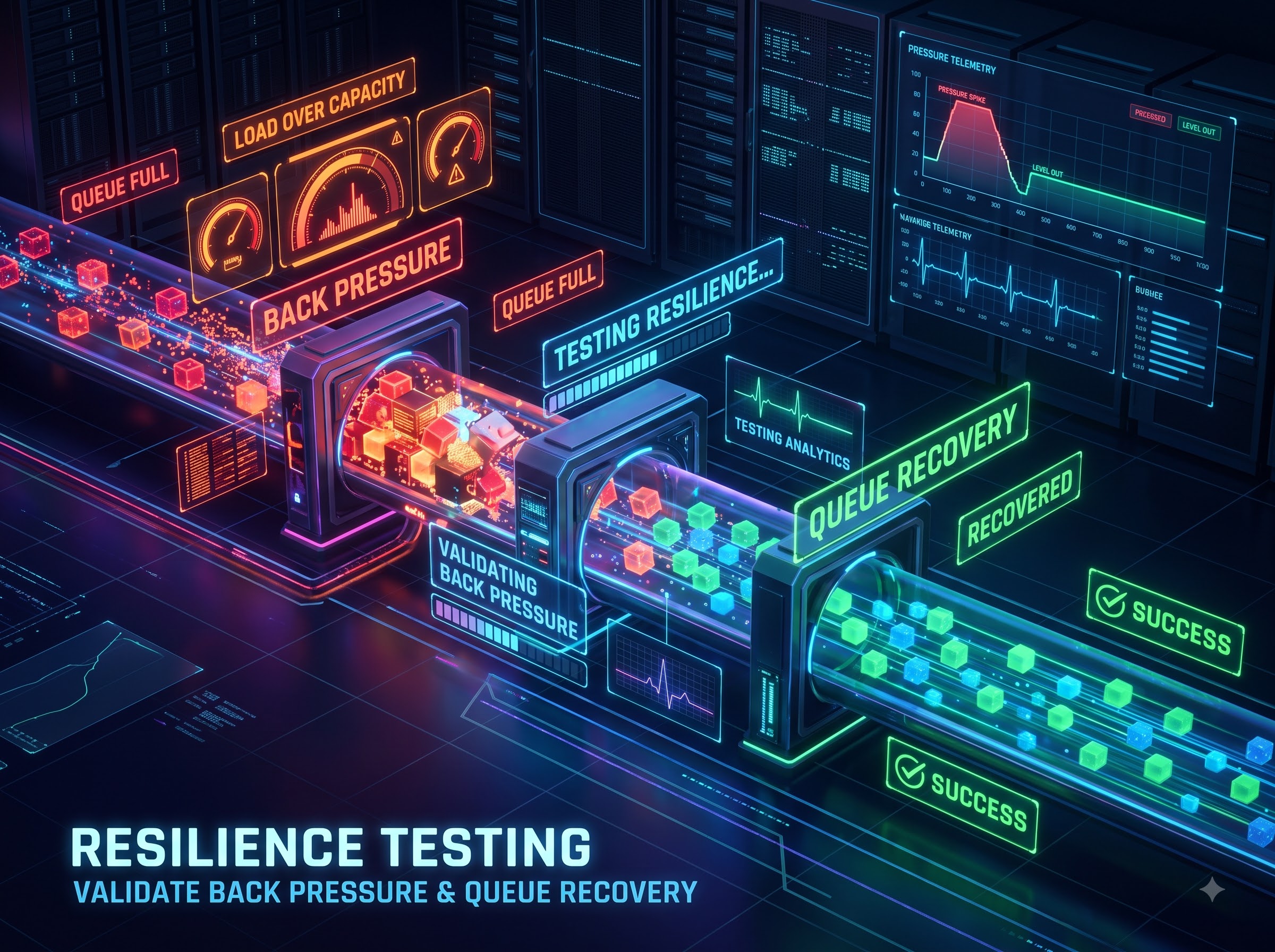
When a dependency slows down, unlimited retries can intensify the failure. Resilience and Error Recovery testing should confirm rate limits, queue thresholds, circuit breakers and back-pressure behavior. New transactions may need to wait while the system protects existing work. The test should show how queue age becomes visible, how priority is assigned and when an operational owner must intervene.
Recovery must not release an entire backlog at once. Use paced draining, concurrency limits and a pilot cohort. Confirm that the oldest valid business events retain their intended effective order, expired requests are handled by policy and each released item still passes current CCA and BCM governance controls.
Define Degraded Operating Modes
| Mode | Permitted activity | Prohibited activity |
|---|---|---|
| Read only | View existing orders, decisions and evidence | Create, approve or release new orders |
| Intake and hold | Accept valid requests into a controlled queue | Send to BCM or production before dependencies recover |
| Governance only | Validate and decide within CCA | Create a downstream order without confirmed connectivity |
| BCM hold | Create a governed order in a protected state | Release proof or production |
| Manual exception | Resolve a named transaction with dual control | Use an informal bypass for broad volume |
| Reconciliation only | Receive and match status evidence | Retry creation while downstream state is uncertain |
Use Observability as the Evidence Layer
The metrics, logs, traces, versions and business events described in Post 124 should prove each resilience hypothesis. Evidence must show the injected condition, the control that activated, the scope affected, the user-visible outcome, the recovery action and the reconciled final state. A test that cannot be explained from evidence is not a completed assurance exercise.
Keep resilience traffic clearly identified so dashboards do not distort business volumes. At the same time, avoid a completely separate telemetry path that hides differences from production behavior. The test should use the real observability model while applying tags and access controls that make its purpose and scope unmistakable.
Establish Stop Conditions and Decision Rights
| Condition | Immediate action | Decision owner |
|---|---|---|
| Test crosses approved cohort | Stop injection and isolate affected traffic | Exercise lead and CCA owner |
| Order reaches production unexpectedly | Hold production and reconcile every test transaction | BCM and production owners |
| Personal data appears in test evidence | Stop collection and protect the evidence set | Privacy and security owner |
| Duplicate order risk becomes uncertain | Disable retry and establish authoritative state | BCM administrator |
| Monitoring becomes unavailable | End the exercise because control behavior cannot be proven | Observability owner |
| Recovery exceeds approved window | Escalate and move to incident response | Incident commander and business sponsor |
Implement Resilience Testing in Controlled Stages
- Identify the business card integration paths whose failure could affect identity, authorization, ordering or production.
- Write a measurable hypothesis for one failure mode and one expected control response.
- Select dedicated synthetic identities, programs, templates and routes with no uncontrolled production access.
- Confirm observability, correlation, stop controls, owners and reconciliation before the exercise begins.
- Start with nonproduction latency, rejection and credential scenarios.
- Add timeout-after-acceptance, duplicate event and out-of-order callback conditions.
- Test queue growth, back pressure, circuit breaking and paced recovery.
- Exercise BCM holds and production-boundary safeguards with strict volume limits.
- Reconcile every test transaction to an authoritative final state.
- Convert findings into owned control improvements and repeat the failed scenario.
- Expand production-path testing only after the smaller blast radius is consistently safe.
Measure Resilience by Business Outcome
| Measure | Meaning | Desired direction |
|---|---|---|
| Detection time | Time from injected failure to a reliable signal | Shorter without noisy alerts |
| Containment time | Time to isolate the unsafe boundary | Shorter with narrow scope |
| Control preservation | Percentage of tests maintaining identity, policy and ordering safeguards | Consistently complete |
| Recovery time | Time to restore trusted governed processing | Within approved objective |
| Reconciliation completeness | Transactions with an authoritative final state | One hundred percent |
| Duplicate production | Extra physical orders caused by recovery behavior | Zero |
| Residual exceptions | Test items still requiring manual ownership | Zero before closure |
Frequently Asked Questions
What is business card API resilience testing?
It is the controlled introduction of failure conditions to verify that identity, governance, ordering, production and reconciliation remain safe.
How is it different from synthetic monitoring?
Synthetic monitoring confirms expected workflows continuously. Resilience testing changes a dependency or operating condition to prove safe failure and recovery behavior.
What is CCA responsible for?
CCA provides centralized orchestration and unified API control, including validation, governance decisions, routing and decision evidence.
What is BCM?
BCM, or Business Card Manager, is the business card ordering management system and software for permissions, approvals, templates, quantities, orders and reporting.
Should resilience tests use real employee data?
No. Use dedicated nonpersonal test identities and restricted test programs.
Can these exercises run in production?
Only after lower environments are proven and with a narrow cohort, independent stop control, production hold and complete reconciliation.
Why test timeout after acceptance?
Because the downstream order may exist even when the caller did not receive confirmation, creating duplicate risk during retry.
What is a safe degraded mode?
It is a predefined state that permits limited controlled activity while prohibiting actions whose authorization or outcome cannot be trusted.
When should a test become an incident?
When scope escapes, production integrity becomes uncertain, protected data is exposed or recovery exceeds the approved boundary.
What proves successful recovery?
Trusted processing resumes and every test transaction has an authoritative reconciled final state.
How often should resilience tests run?
Run them after material architecture or control changes and on a risk-based schedule for critical integration paths.
The Strategic Outcome
Resilience testing proves that the CCA ecosystem protects enterprise business card governance during disruption. Source failures do not invent identity data. CCA failures do not bypass policy. BCM failures do not create uncontrolled or duplicate orders. Production uncertainty triggers a hold rather than an assumption. Recovery ends with reconciliation, not merely restored connectivity.
This creates a stronger basis for scaling integrations across workforce systems, identity platforms, enterprise applications, and fulfillment providers. The organization can change and expand the ecosystem with evidence that failure behavior is designed, bounded, and governable.
Select one critical integration dependency and write a resilience hypothesis for it. Define the controlled failure, expected CCA and BCM response, production safety boundary, stop condition, evidence and reconciliation rule. Run the smallest safe exercise, correct any weakness, and repeat it until the governed outcome is predictable.