

API Observability For Enterprise Business Card Ordering
API Availability Is Not the Same as Business Visibility
An API can return successful responses while the enterprise business card program is moving toward the wrong outcome. A request may authenticate correctly but carry an outdated location. A policy decision may complete but select an incorrect template. An order may be accepted by the business card ordering platform but remain stalled before production. A shipment event may arrive without enough context to reconcile it to the approved request. Technical uptime alone cannot show whether the business process remains trustworthy.
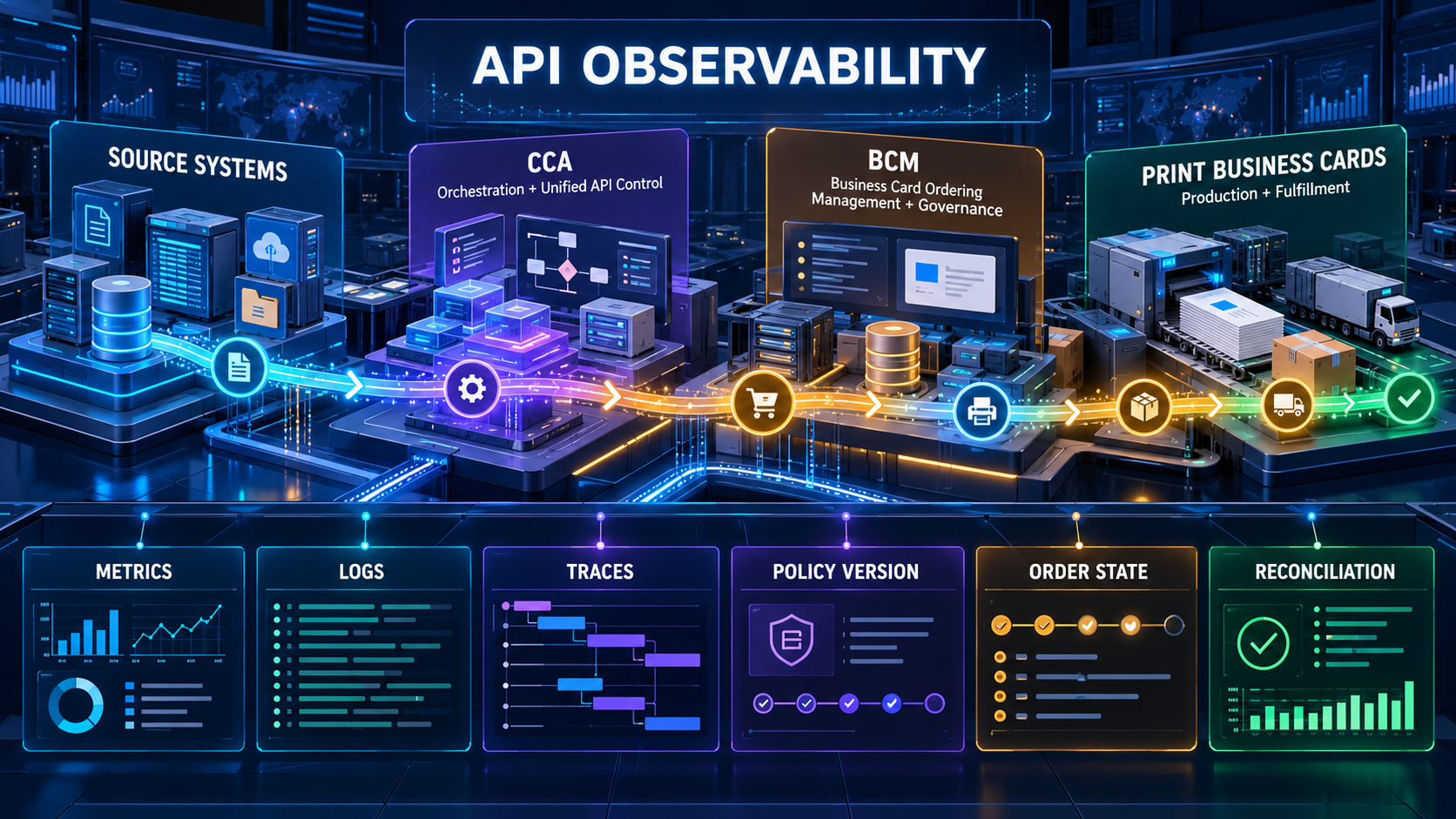
API observability connects technical behavior to the purpose of the Color Card Administrator ecosystem. CCA provides centralized workflow orchestration and unified API control for enterprise business card programs. It receives approved identity and organizational context, applies governed rules, coordinates downstream actions, and preserves decision evidence. BCM, or Business Card Manager, is the business card ordering management system and software that manages permissions, approvals, templates, quantities, ordering workflows, and reporting. Print Business Cards performs production and fulfillment. Observability must make this full chain understandable without weakening its control boundaries.
From Incident Response to Continuous Operating Insight
Post 123 established how to detect, contain, recover, and reconcile an integration incident. Post 124 moves the same discipline into normal operations. The objective is to identify deterioration before it becomes an incident, explain why a transaction reached its current state, and provide evidence that lets the correct owner act quickly.
Observability is therefore an operating capability, not a dashboard project. It requires consistent identifiers, meaningful business events, controlled logs, service and workflow measures, version context, exception ownership and retention rules. The design must help technology, governance, business card administration, and fulfillment teams answer the same question from their own responsibility boundary without exposing unnecessary personal information.
Observe the Complete Governed Transaction
| Layer | What should be visible | Why it matters |
|---|---|---|
| Source systems | Source owner, event type, effective time, delivery result and approved record reference | Confirms the business fact and its timing |
| CCA API control | Consumer, schema, validation, mapping, policy version, decision and route | Explains how CCA interpreted and governed the request |
| BCM ordering management | Permission, template, approval, quantity, order state and exception | Proves the order was created under approved controls |
| Production and fulfillment | Proof, job, batch, shipment, delivery and disposition events | Connects authorization to physical execution |
| Reporting and reconciliation | Final state, unmatched event, duplicate check, owner and closure evidence | Shows whether the enterprise can trust the outcome |
Build One Correlation Model Across Multiple Systems
Every platform will retain its own transaction identifiers, and those identifiers should not be replaced by a single universal number. Instead, CCA should establish a correlation model that links the source event, API request, enterprise procurement governance decision, BCM order, production job and returned status. The linkage allows a support analyst to move across the chain without copying complete identity payloads into every log.
A useful correlation record includes a business transaction key, trace identifier, system-specific reference, attempt number, policy or configuration version and event timestamp. The model must distinguish a repeated delivery attempt from a new business request. That distinction is essential when retries, asynchronous callbacks and physical production can otherwise create duplicate orders.
Separate Telemetry from the Business Record
Telemetry explains system behavior; the governed business record proves the approved outcome. Logs, metrics and traces should not become an uncontrolled duplicate database of employee identity. Observability data should reference protected records through stable identifiers and include only the minimum attributes required for diagnosis, performance measurement and accountability.
The authoritative identity fields, approval evidence and order content remain within their controlled systems. Operational telemetry records what happened: which component processed the request, which version was active, how long the step took, what state transition occurred and whether the next expected event arrived. This separation improves both privacy and troubleshooting quality.
Use the Three Signals with Business Context
| Signal | Technical purpose | Business card context |
|---|---|---|
| Metrics | Measure rates, duration, saturation and error patterns | Order volume, approval age, queue delay, rejection rate and unmatched fulfillment status |
| Logs | Record discrete processing and decision events | Validation outcome, policy explanation, template route, hold reason and ownership change |
| Traces | Follow a request across services and asynchronous boundaries | Source event through CCA, BCM, production, shipment and reconciliation |
| Business events | Represent meaningful governed state changes | Eligible, approved, ordered, proofed, produced, shipped, delivered, cancelled or reconciled |
Measure Service Health and Control Health
Service health describes whether APIs and infrastructure are responding within expected limits. Control health describes whether the program is producing authorized, accurate, and reconcilable outcomes. Both are necessary. Low latency cannot compensate for the wrong template, and perfect policy decisions cannot help if orders remain indefinitely in a downstream queue.
| Measurement family | Examples | Management question |
|---|---|---|
| API reliability | Availability, latency, timeout rate, retry rate and authentication failure | Can approved traffic move safely? |
| Data quality | Schema rejection, missing field, invalid value and source conflict | Can CCA trust and interpret the input? |
| Governance execution | Eligibility outcome, override rate, policy version and approval duration | Are enterprise rules operating as designed? |
| BCM workflow | Order creation rate, duplicate prevention, queue age and exception backlog | Is ordering management controlled and progressing? |
| Fulfillment | Proof age, production time, shipment event delay and delivery exception | Is authorized output moving to completion? |
| Reconciliation | Unmatched event, uncertain state, stale transaction and closure age | Can the enterprise prove the final outcome? |
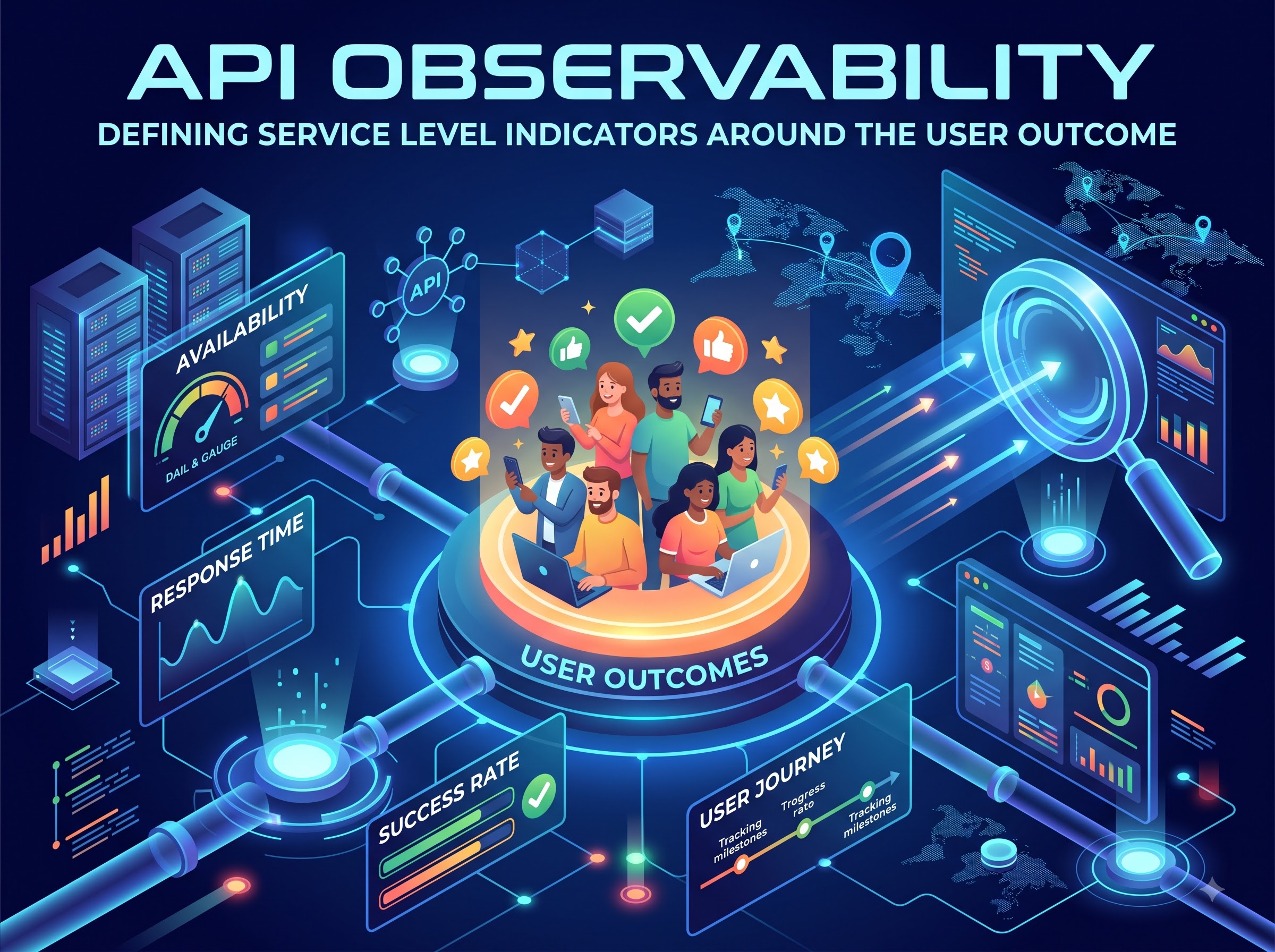
Define Service Level Indicators Around the User Outcome
Traditional service indicators should be translated into meaningful approval workflow software commitments. Instead of measuring only API response time, measure the time from an approved source event to a CCA decision, from authorization to a BCM order, from approval to production release, and from shipment to reconciled delivery. Segment results by legal entity, region, program, integration route, and priority without creating labels that expose personal information.
Targets must reflect control quality as well as speed. A fast but unauthorized order is a failure. A deliberately held order may be evidence that governance is working. Dashboards should distinguish healthy waiting, such as a valid approval step, from abnormal waiting caused by a broken dependency or missing event.
Design Dashboards for Decisions
| Audience | Required view | Action supported |
|---|---|---|
| Enterprise integration team | API dependencies, latency, errors, retries, versions and trace coverage | Repair technical degradation and validate recovery |
| CCA platform owner | Validation, mappings, policy decisions, routing and configuration changes | Protect orchestration and unified API control |
| BCM administrator | Permissions, approvals, templates, quantities, order states and holds | Manage the business card ordering workflow |
| Business and brand owner | Program health, approved exceptions, override patterns and outcome trends | Confirm policy and brand controls remain effective |
| Production and fulfillment | Proof, job, batch, shipment, delivery and exception queues | Move authorized work and resolve physical outcomes |
| Security and privacy | Access anomalies, credential use, data minimization and retention | Protect the integration and its evidence |
Alert on Consequence Rather Than Noise
An alert should identify a meaningful risk, the affected scope and the owner expected to respond. Alerting on every failed request creates fatigue because transient failures may already be handled by controlled retry. More useful conditions combine rate, duration and consequence: a growing approval backlog, repeated policy rejection after a deployment, successful API calls without corresponding BCM orders, production acknowledgments without final status or a sudden change in template selection.
Alerts also need suppression and grouping rules. One dependency failure can produce thousands of similar symptoms. The response system should create a single accountable incident with the impacted integrations, cohorts and transactions attached. High-risk conditions, including suspected unauthorized ordering or uncertain duplicate production, require immediate containment rather than another dashboard notification.
Make Configuration Versions Visible
Observability loses explanatory power when teams cannot identify the versions active at the time of execution. Each trace should record the relevant schema, mapping, policy, template-routing & HCM and CRM API integration configuration versions. Deployment markers should appear alongside performance and outcome trends so a change can be correlated with a shift in rejections, approvals, order creation or fulfillment behavior.
Version visibility also supports rollback. The operator can compare the last known good state with the active state and determine whether the problem belongs to application code, integration configuration, governance policy, BCM administration or a production dependency. That distinction reduces recovery time and prevents unnecessary changes to systems that are behaving correctly.
Protect Privacy and Security in Observability
| Control | Implementation principle | Risk reduced |
|---|---|---|
| Data minimization | Log identifiers, states, and controlled metadata instead of full card content | Unnecessary duplication of personal and business identity data |
| Access control | Restrict views by operational role and separate sensitive evidence | Broad access to diagnostic and transaction information |
| Credential hygiene | Never record secrets, tokens, or authentication headers | Credential disclosure through logs and exports |
| Retention | Set evidence periods by operational, legal and audit need | Indefinite storage without a defined purpose |
| Integrity | Use protected timestamps, immutable audit events and controlled time synchronization | Altered or unreliable incident evidence |
| Export governance | Control dashboard downloads and support attachments | Untracked copies outside governed systems |
Implement API Observability in Controlled Stages
- Define the business outcomes and control failures that the enterprise must be able to explain.
- Map the source, CCA, BCM, production, fulfillment, and reconciliation boundaries.
- Create a correlation model that links local identifiers without copying full identity payloads.
- Standardize business events and state transitions across synchronous and asynchronous paths.
- Instrument metrics, logs, and traces with configuration and policy-version context.
- Establish service and control indicators for accuracy, authorization, timeliness, and reconciliation.
- Build role-specific dashboards that lead to clear operational decisions.
- Create consequence-based alerts with ownership, grouping, escalation, and containment actions.
- Apply privacy, access, retention, and export controls to all observability evidence.
- Test the model through normal transactions, controlled failures, replay and incident exercises.
- Review measures regularly and retire signals that do not support a decision or control.
Use Observability to Improve Integration Economics
Good observability reduces the cost of operating connected business card programs. Support teams spend less time assembling evidence from disconnected systems. Product and integration owners can locate the failing boundary sooner. Governance teams can distinguish valid holds from operational defects. Operational reconciliation teams can focus on true exceptions rather than reviewing every transaction manually.
It also improves change confidence. Before and after a release, teams can compare validation, decision, approval, order, and fulfillment behavior using the same measures. The enterprise can expand to new source systems, business units, or print routes without losing visibility into the controls that make the program manageable at scale.
Frequently Asked Questions
What is business card API observability?
It is the ability to understand the technical and governed business state of a transaction across source systems, CCA, BCM, production, fulfillment and reconciliation.
How is observability different from monitoring?
Monitoring reports known conditions. Observability combines evidence so teams can explain unexpected behavior and determine why the transaction reached its current state.
What is CCA responsible for?
CCA provides centralized orchestration and unified API control, applying enterprise governance to connected business card ordering workflows.
What is BCM?
BCM, or Business Card Manager, is the business card ordering management system and software that controls permissions, approvals, templates, quantities, orders and reporting.
Should logs contain employee card details?
No. Operational logs should use identifiers and minimal diagnostic metadata. Governed identity content should remain in the systems responsible for protecting it.
Why is correlation important?
It links the source fact, CCA decision, BCM order, production job and fulfillment result without replacing each system’s local transaction record.
Which measures matter most?
Measure both service health and control health, including reliability, data quality, policy execution, approval flow, order integrity, fulfillment and reconciliation.
How should retries appear?
Each attempt should be visible, linked to the original business transaction and distinguished from a new request so duplicate production can be prevented.
Who owns API observability?
Ownership is shared. Integration teams own technical telemetry, CCA owners govern orchestration evidence, BCM administrators own ordering workflow visibility and fulfillment teams own production status.
How does observability support incident response?
It supplies the scope, trace, version, authoritative state and evidence needed to detect, contain, recover and reconcile an incident.
Can observability improve enterprise buying decisions?
Yes. Buyers can evaluate whether a platform explains governed outcomes across the entire ordering lifecycle rather than offering only endpoint uptime statistics.
The Strategic Outcome
API observability turns an integration network into an operable enterprise control system. Source systems remain accountable for approved facts. CCA makes orchestration, validation, governance decisions and routing visible. BCM protects the managed ordering workflow. Print Business Cards and fulfillment services return production and delivery evidence. Reconciliation confirms the final state.
With these responsibilities visible, the organization can detect deterioration early, investigate without reconstructing the process manually, protect personal data, resolve exceptions at the correct boundary, and prove that each business card order followed approved enterprise controls.
Select one live business card integration and trace a representative transaction from source event to final delivery. Record which identifiers, versions, decisions, timings, and status events are currently visible. Any point that cannot be explained from controlled evidence is an observability gap. Assign an owner and prioritize gaps that affect authorization, duplicate prevention, production control, or final-state reconciliation.