

Integration Incident Response For Enterprise Business Card Ordering
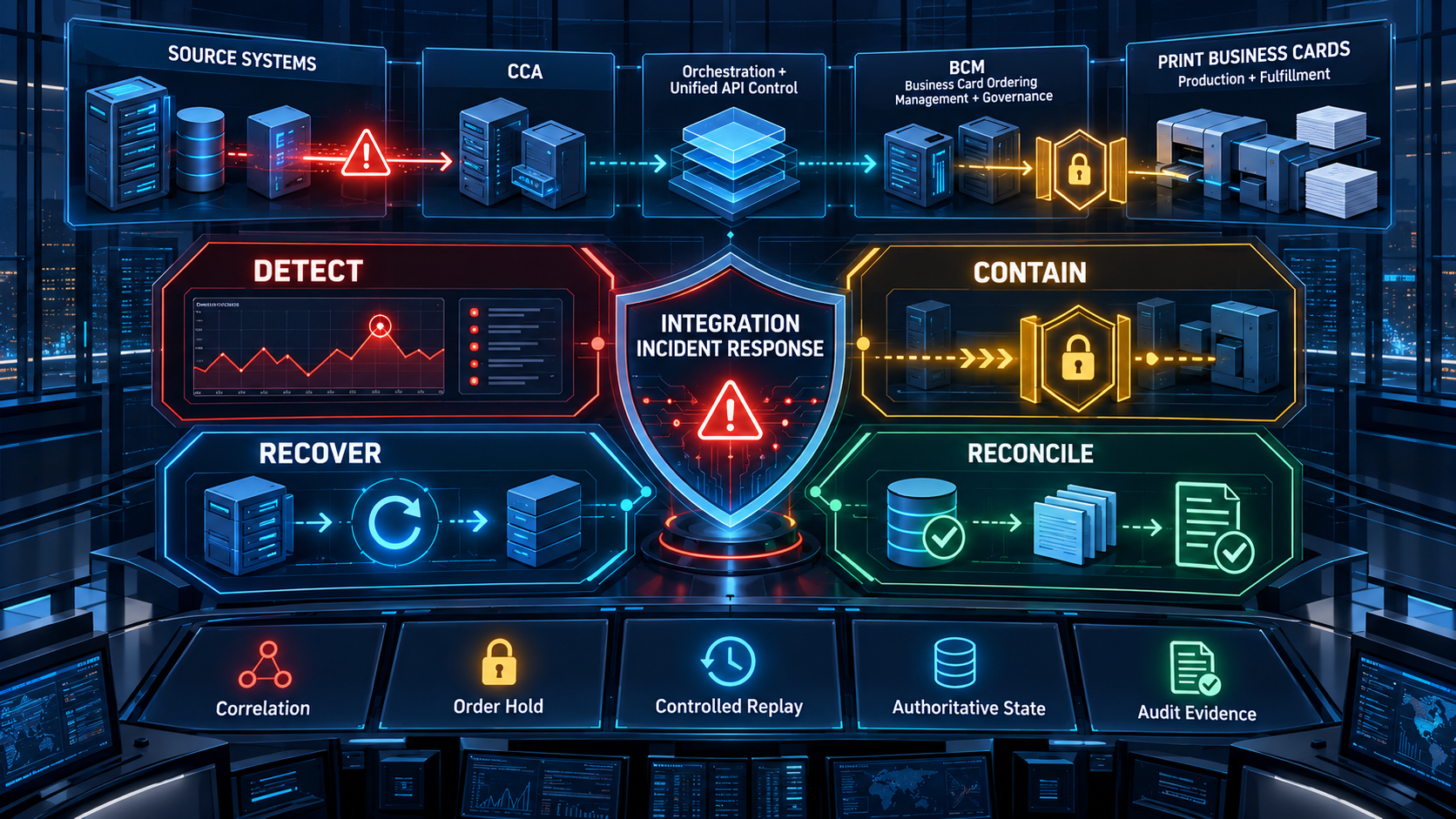
Containing failures while preserving governed identity and order integrity.
An Integration Incident Is a Business Control Event
A production integration incident is not defined only by an unavailable endpoint. It may be an accepted record carrying incorrect identity data, a policy decision that [the system] applied to the wrong population, an approval that stops moving, a repeated BCM order, a production status that never returns, or a delivery result that [the team] cannot reconcile. The operational question is not simply whether the API is responding. It is whether the enterprise can still trust the identity, authorization, order, and outcome.
The Color Card Administrator website describes a connected enterprise procurement governance model spanning ordering, printing, approvals, governance, reporting, and system integration. CCA provides the orchestration and unified API control layer. Business Card Manager, or BCM, is the business card ordering management system and governance software for permissions, approvals, ordering control, and reporting. Print Business Cards provides production and fulfillment. Incident response must preserve these responsibilities while restoring the complete chain.
Continue the Controlled Production Sequence
Post 121 qualified integration readiness. Blog post 122 moved the approved model into production through a controlled cutover. Post 123 addresses the next operating requirement: what happens when live execution no longer matches the expected state. A mature response isolates the smallest unsafe boundary, protects unproduced orders, and preserves evidence before changes make the original condition difficult to reconstruct.
The response model must be designed before an incident occurs. Owners need shared severity criteria, decision rights, containment methods, evidence sources, communications routes, recovery tests and reconciliation rules. Without that structure, teams may restart traffic quickly while leaving duplicate, incorrect or untracked card orders behind.
Map the Incident to the Controlled Chain
| Control point | Typical symptom | Primary integrity question |
|---|---|---|
| Enterprise source | Wrong, missing, late or conflicting workforce or business data | Is the authoritative fact correct and effective? |
| CCA integration control | Rejected payload, failed transformation, routing defect or policy mismatch | Did CCA receive and interpret the approved context? |
| BCM ordering management | Permission, approval, template, quantity or duplicate-order anomaly | Was the order authorized and governed correctly? |
| Production and fulfillment | Proof, production, shipment or delivery failure | Was the authorized output produced and delivered correctly? |
| Status and reporting | Missing, delayed, duplicated or contradictory event | Can the enterprise prove the final transaction state? |
Classify Severity by Business Consequence
Technical urgency should be combined with business impact. A short outage that safely queues requests may be less severe than a healthy endpoint producing unauthorized orders. Severity must consider the affected population, identity accuracy, policy bypass, duplicate-production risk, exposure of protected data, shipment state and the ability to reconstruct evidence.
| Severity | Business consequence | Required posture |
|---|---|---|
| Critical | Unauthorized identity, broad policy bypass, security exposure or uncontrolled production | Immediately isolate traffic or production and activate executive and security ownership |
| High | Material ordering or fulfillment error affecting an important cohort | Contain the affected program and reconcile every transaction |
| Moderate | Degraded workflow with a safe manual control or delayed processing | Limit scope, monitor closely and repair within an approved window |
| Low | Cosmetic, reporting or isolated issue with no order-integrity impact | Track through normal operations and verify closure evidence |
Detect Incidents from Control Evidence
Detection should combine technical signals with business controls. Monitor authentication failures, schema rejection, latency, queue age, retry volume and event-delivery health, but also watch for changes in eligibility decisions, approval duration, template selection, order volume, duplicate prevention, production holds, shipment outcomes and reconciliation gaps.
Use stable correlation identifiers across source records, CCA decisions, BCM requests, production orders and returned status. A single identifier does not replace local transaction IDs; it links them. The evidence should show when each control point accepted, rejected, transformed, approved, produced or reported the transaction without storing unnecessary employee data in operational identity governance logs.
Contain the Smallest Unsafe Boundary
The best first action is rarely to disable the entire enterprise program. Containment should match the proven scope of risk: a source event type, legal entity, location, template, approval route, integration consumer, BCM program, or production batch. Narrow containment preserves safe service while stopping the path that can no longer be trusted.
Containment must also protect orders already in motion. Pausing new submissions does not stop a job that has entered production. Teams should know which states they can safely hold, which require production intervention, and when they must manage a shipment or delivery exception outside the API path.
Use an Incident Containment Matrix
| Incident pattern | Immediate containment | Evidence to preserve |
|---|---|---|
| Authoritative data defect | Pause affected records or event type; correct data at source | Original value, effective date, source owner and impacted decisions |
| Credential or access concern | Revoke or rotate the affected credential and isolate its scope | Consumer identity, scopes, access history and change record |
| CCA mapping or policy defect | Disable the affected version or route and restore the last approved configuration | Payload, mapping version, policy version and decision explanation |
| BCM permission or workflow defect | Suspend the affected program, template or approval route | User role, permission result, approval path and order state |
| Duplicate or uncertain order | Hold downstream production and reconcile all identifiers | Request keys, retries, acknowledgments and production status |
| Production or delivery defect | Hold the affected batch, template or destination path | Released proof, job state, carrier event and disposition |
| Missing status evidence | Stop unsafe retries and establish authoritative order state | Last confirmed event, expected event, timestamps and reconciliation owner |
Diagnose Without Breaking the Evidence
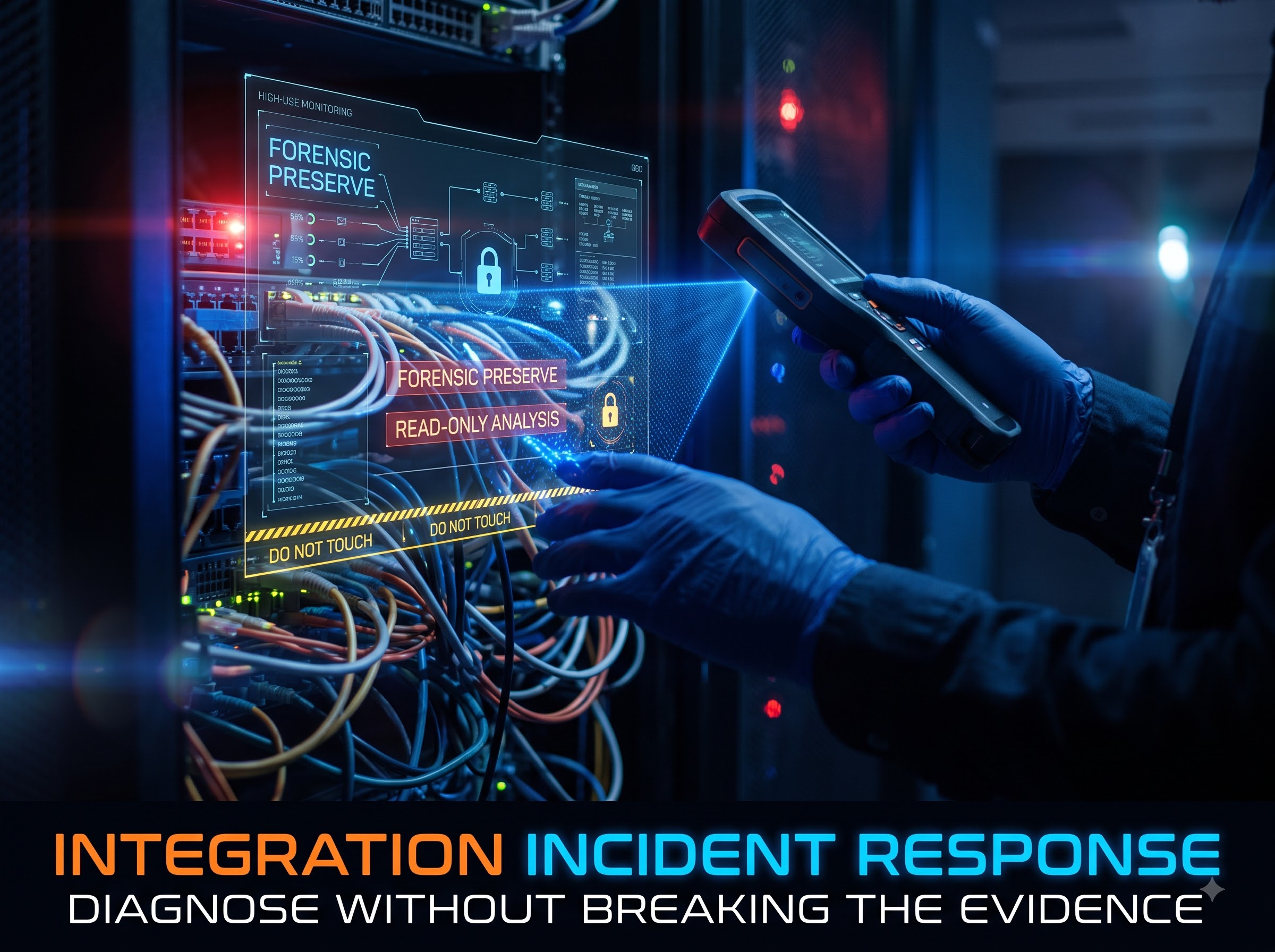
Diagnosis should reconstruct the transaction before changing it. Start with the authoritative source record and effective time. Follow the correlation path through the received payload, validation, CCA decision, BCM workflow, order creation, production release, and returned status. Compare actual versions with the versions approved for production.
Avoid uncontrolled replay during diagnosis. A message that appears lost may have completed after the caller timed out. Replaying it without an idempotency check can create a second physical order. Confirm the authoritative state at the downstream boundary before deciding whether to retry, compensate, cancel, or reconcile.
Recover Through a Controlled State Transition
Recovery is not merely restoring connectivity. It is moving the affected records from an uncertain or unsafe state into a verified state. Define the correction source, authorized recovery action, expected downstream effect, and evidence that proves completion. Use a pilot recovery cohort before releasing a large backlog.
When records must be replayed, preserve their original business effective time and use new operational attempt metadata. The system should distinguish a corrected business event from a repeated delivery attempt. BCM must continue to apply current approved ordering controls unless enterprise governance mesh explicitly authorizes a historical rule for the recovery.
Reconcile Orders Before Declaring Recovery
| Reconciliation question | Evidence source | Closure condition |
|---|---|---|
| Was each source record received once? | Source delivery log and CCA intake record | Every in-scope record is accepted, rejected or deliberately excluded |
| Was the correct decision applied? | CCA policy and decision evidence | Eligibility, fields, template and route match approved policy |
| Was each order created once? | BCM request and order records | No missing or duplicate authorized order remains |
| Was output produced correctly? | Proof, production job and fulfillment evidence | Correct content, quantity, destination and job disposition |
| Did final status return? | Event, shipment and reporting records | Delivered, cancelled, failed or held state is authoritative |
| Are exceptions owned? | Incident record and action log | Every unresolved item has an owner, due date and risk treatment |
Communicate by Decision Need
Incident communication should help each stakeholder act. Executives need the business consequence, affected scope and decision required. HR or source owners need the records and fields requiring correction. Brand governance and BCM administrators need affected templates, permissions and approval routes. Production teams need job and batch identifiers. Security needs access, exposure and containment evidence.
Avoid distributing complete employee payloads when a correlation identifier and minimal field evidence will suffice. Use a consistent incident timeline with confirmed facts, open hypotheses, current containment, next decision and accountable owner. State clearly when an order is uncertain; do not translate uncertainty into an unsupported assurance.
Define Incident Roles and Decision Rights
| Role | Primary accountability | Decision authority |
|---|---|---|
| Incident commander | Coordinates scope, timeline, owners and decisions | Sets response cadence and escalates business risk |
| CCA platform owner | Protects integration, policy and control-layer integrity | Disables or restores affected CCA configuration |
| BCM administrator | Protects permissions, approvals, ordering and reporting | Holds an unsafe program or ordering route |
| Source system owner | Corrects authoritative facts and lifecycle events | Approves source correction and controlled resend |
| Production and fulfillment owner | Controls proof, production, shipment and delivery actions | Holds, cancels or resumes affected output |
| Security and privacy owner | Assesses credentials, exposure and data handling | Requires isolation, rotation or formal notification |
| Business sponsor | Owns consequence, priority and accepted residual risk | Approves constrained service or major recovery decision |
Learn Without Weakening Control
A post-incident review should explain both the initiating failure and the controls that allowed or limited its consequence. Identify why detection occurred when it did, whether containment matched the actual boundary, whether decision rights were clear, and whether reconciliation could prove every final order state.
Improvements may belong in source validation, CCA mapping, policy tests, BCM configuration, idempotency behavior, production controls, status events, monitoring or operational visibility ownership. Assign each action a due date and verification method. An incident is not closed merely because the original symptom has stopped.
Integration Incident Response Roadmap
- Define business-impact severity criteria across identity, policy, ordering, production, and reporting.
- Assign incident, CCA, BCM, source, production, security, and sponsor decision rights.
- Establish correlation and evidence across every control point in the transaction chain.
- Create narrow containment methods for integrations, cohorts, programs, templates and production batches.
- Document authoritative-state checks before retry, replay, cancellation or compensation.
- Test recovery with a representative cohort before releasing a larger backlog.
- Reconcile source records, CCA decisions, BCM orders, production jobs and final status.
- Communicate confirmed consequence, containment and decision needs without excess personal data.
- Exit response only when order state is authoritative, and the team owns residual exceptions.
- Complete corrective actions and prove that the updated controls detect or prevent recurrence.
Frequently Asked Questions
What is a CCA integration incident?
It is any production condition that makes the identity, governance decision, order, or fulfillment outcome unavailable, incorrect, unauthorized, or uncertain.
What is BCM in incident response?
BCM is the business card ordering management system and governance software whose permissions, approvals, ordering controls, and reporting must remain protected.
Is every API outage a critical incident?
No. Severity depends on business consequence, affected scope, order integrity, security and recoverability.
Can the full business card program stay available?
Often yes. Narrow containment can isolate an affected source, cohort, program, template, route or batch while safe paths continue.
Why are retries risky?
A timed-out request may already have created a physical order. An uncontrolled retry can produce a duplicate.
What is the authoritative order state?
It is the verified state that the team/the system establishes from BCM, production, and fulfillment evidence rather than an assumption that someone bases on the caller response.
When should production be held?
When authorization, content, quantity, destination, duplicate status or final order state cannot be trusted.
What proves recovery?
End-to-end reconciliation showing the correct source fact, CCA decision, BCM order, production outcome and final status.
Should incident logs contain complete employee data?
No. Preserve the minimum evidence required, using identifiers and controlled access rather than duplicating full profiles.
When is an incident closed?
When service is stable, every affected transaction has an authoritative state, residual exceptions are owned and corrective actions are tracked.
The Strategic Outcome
A mature incident-response model protects the purpose of the CCA ecosystem during failure. Enterprise systems remain the source of approved facts. CCA preserves policy and integration authority. BCM protects ordering management and governance. Print Business Cards controls production and fulfillment. Reconciliation proves what ultimately happened.
This operating model prevents a technical recovery from creating a business-control failure. The enterprise can restore service while maintaining identity accuracy, approval accountability, brand integrity, order certainty and audit-ready evidence across the complete business card program.
Use one recent integration scenario to test the incident model before the next production change. Trace how the organization would detect the issue, isolate the affected scope, protect BCM orders, hold production where necessary, restore trusted execution and reconcile every final state. Convert any missing evidence or unclear decision right into a named corrective action.