

The Enterprise Governance Mesh: Connecting Identity, Policy, Vendors, and Operations Through a Unified Control Layer
Introduction
Digital enterprises rarely fail because they lack technology. They struggle because governance remains fragmented across applications, departments, regions, and service providers. Every new cloud platform, integration, and workflow introduces another operational control point, making it increasingly difficult to maintain consistency, accountability, and compliance.
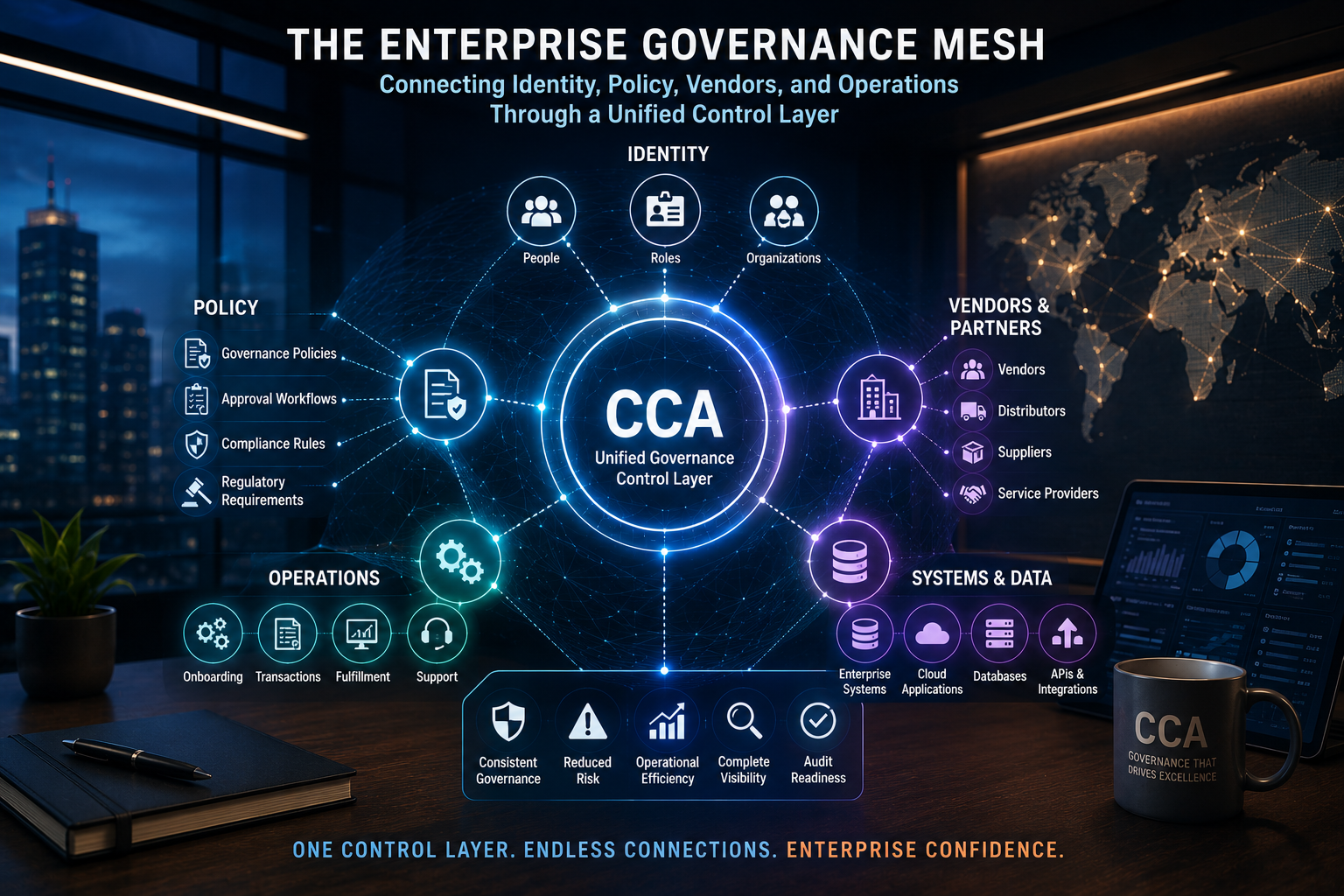
An enterprise governance mesh addresses this challenge by connecting every operational component through centralized governance rather than isolated application logic. Instead of allowing each system to define its own policies, approvals, and lifecycle rules, governance becomes an enterprise service shared across the organization. Color Card Administrator (CCA) represents this governance-first philosophy by providing an infrastructure layer that orchestrates business identity execution, vendor governance, approval workflows, lifecycle management, and operational intelligence.
Why Fragmented Governance Limits Enterprise Growth?
As organizations expand globally, different business units often create independent operational practices. Regional approval hierarchies differ, vendors follow inconsistent processes, branding standards drift, and compliance obligations become increasingly difficult to audit. While each individual system may function correctly, the enterprise loses visibility across the complete operational landscape.
Centralized governance eliminates these inconsistencies by ensuring every operational action follows common enterprise policies regardless of where the request originates.
The Governance Mesh Concept
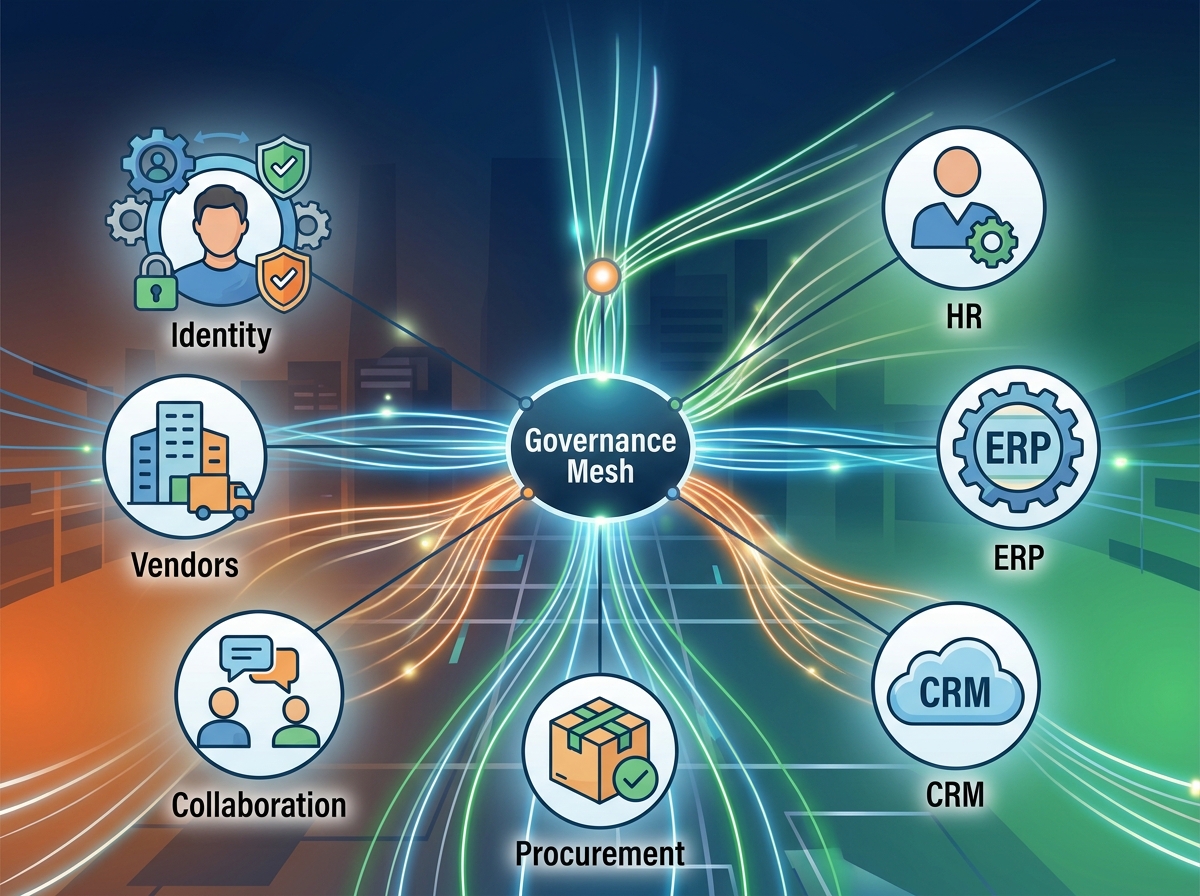
A governance mesh is not another application. It is an enterprise-wide control fabric that connects identity systems, HR platforms, ERP solutions, CRM environments, procurement systems, collaboration tools, and external vendors through standardized governance services. Identity becomes the common reference point, policies become reusable business rules, and workflows become orchestrated instead of isolated.
CCA as the Enterprise Control Layer
CCA applies governance before execution. Every request is validated against enterprise policy, routed through standardized approval workflows, monitored through audit trails, and reported through centralized dashboards. Business identity governance, vendor orchestration, delegated administration, branding control, lifecycle automation, and API integrations operate as coordinated enterprise capabilities instead of disconnected features.
This infrastructure-first approach allows organizations to preserve investments in existing enterprise applications while introducing consistent governance across the entire technology ecosystem.
Business Outcomes
Organizations implementing a governance mesh achieve faster onboarding, improved operational transparency, stronger compliance, reduced administrative effort, better vendor accountability, consistent business identity execution, simplified audits, and more reliable executive reporting. Governance becomes a competitive advantage because it enables growth without increasing operational complexity.
Implementation Roadmap
Begin with authoritative identity sources, establish enterprise governance policies, classify approval models, integrate core platforms, automate lifecycle events, standardize vendor interactions, and create executive dashboards that continuously measure governance maturity. A phased implementation allows organizations to improve governance without disrupting ongoing business operations.
Looking Ahead
Future enterprises will depend on autonomous workflows, AI-assisted decisions, and intelligent orchestration. These innovations require trusted identity, standardized policy enforcement, and complete operational traceability. Organizations that establish governance-first architecture today will be able to adopt future technologies with greater confidence and significantly lower operational risk.
Conclusion
Enterprise governance should be designed as shared infrastructure rather than embedded independently inside each application. Color Card Administrator (CCA) enables organizations to build a governance mesh that unifies identity, workflows, policies, vendors, and operational intelligence into one enterprise control layer, delivering scalable governance for modern digital enterprises.