

Controlled Integration Cutover For Enterprise Business Card Ordering
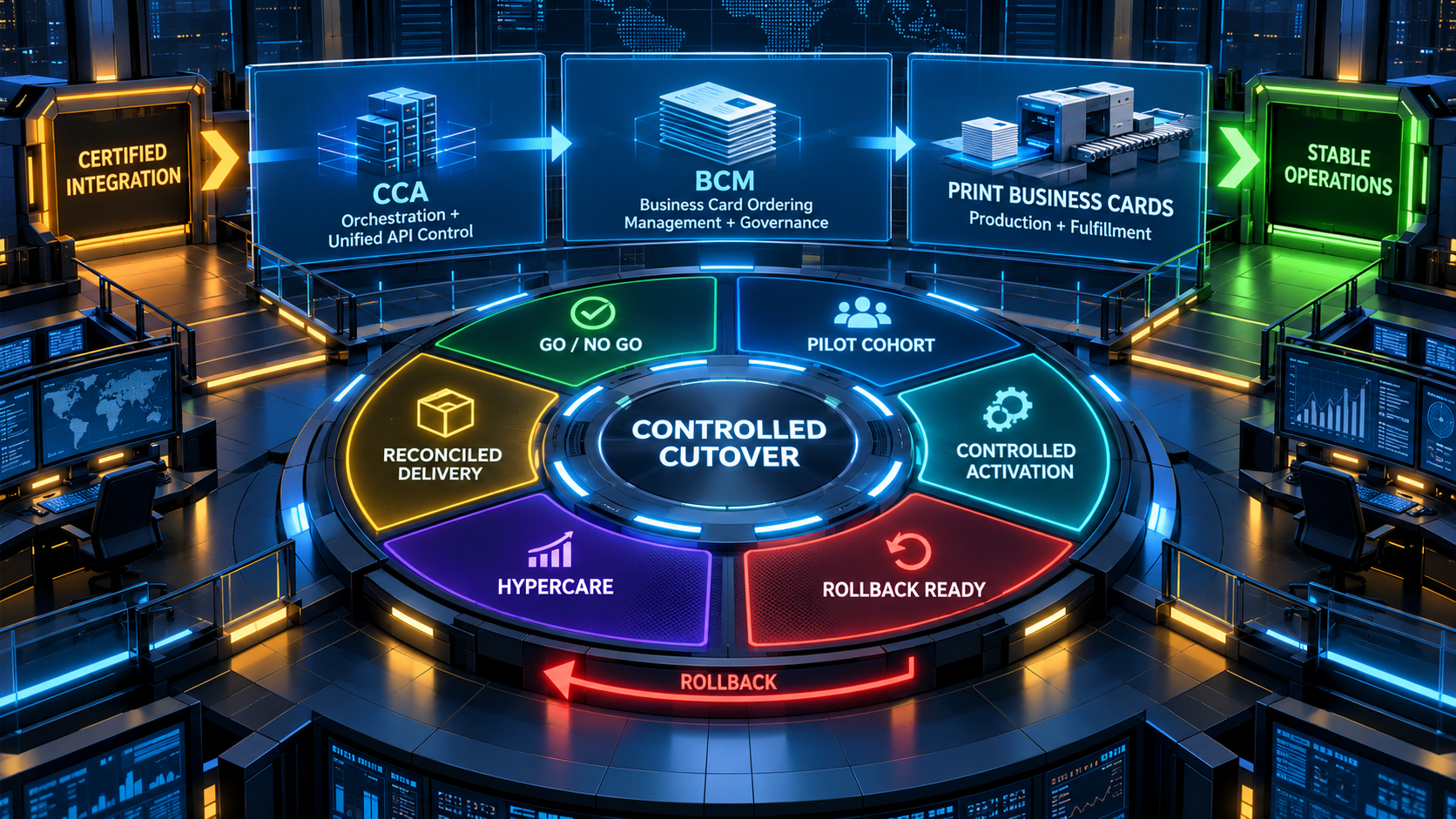
Moving a qualified CCA integration into production without losing governance.
The Cutover Is a Governance Event
A technically successful connection is not yet a production-ready business card program. Cutover changes who can submit data, which users can order, which templates and approval routes apply, and when an authorized transaction may enter production. That makes launch a governance event as much as a technical release.
Color Card Administrator describes an API-connected enterprise category in which ordering, printing, approvals, governance, reporting, and system integration work together through a controlled ecosystem. CCA provides the workflow orchestration and unified API control layer. Business Card Manager, or BCM, is the business card ordering management system and governance software that applies permissions, approvals, ordering control and reporting. Print Business Cards provides the production and fulfillment engine. A safe cutover protects this division of responsibility from the first live transaction.
Begin Where Integration Readiness Ends
Post 121 established the readiness gate: business purpose, connection feasibility, source authority, governance rules, testability, and production support must be resolved before launch. Post 122 begins after those conditions have evidence. The task is to move approved configuration, mappings and credentials into production while preserving the decisions already certified.
The cutover plan should name the exact source systems, programs, brands, legal entities, locations, templates and user populations entering scope. It should also state what remains out of scope. An enterprise launch is easier to control when the first production boundary is explicit rather than implied by whichever records happen to arrive.
Preserve the Website Aligned Operating Model
| Layer | Production responsibility | Cutover safeguard |
|---|---|---|
| Enterprise source systems | Provide approved workforce, identity, organizational or financial context | Release only validated records and events within the approved scope |
| Color Card Administrator | Coordinate governance, policy and integrations through the API control layer | Activate only approved mappings, routes and decision context |
| Business Card Manager | Operate business card ordering, permissions, approvals, controls and reporting | Prevent unapproved users, templates, quantities or routes from creating orders |
| Print Business Cards | Execute production and fulfillment for authorized output | Accept only released orders and return production and delivery status |
| Enterprise operations | Monitor outcomes, exceptions, support and reconciliation | Own decisions, incidents and evidence throughout stabilization |
Define a Production Go or No Go Gate
The release authority should decide from evidence, not schedule pressure. Every control that matters after launch needs a named test result, owner, and disposition. A conditional approval should identify the residual risk, compensating control, expiry date and person authorized to accept it.
| Gate domain | Required evidence | No go condition |
|---|---|---|
| Scope | Approved users, systems, programs, locations and launch window | Production population or boundary is unclear |
| Data | Reconciled mappings, required fields, identifiers and conflict rules | Unresolved authority or material data-quality failure |
| Governance | BCM permissions, approvals, templates, quantities and budgets tested | A user can bypass an approved rule |
| Technical | Production endpoints, credentials, network access and observability verified | Connectivity or authentication is uncertain |
| Execution | Test order reaches controlled production and status returns correctly | Ordering, fulfillment or evidence chain is incomplete |
| Operations | Support roster, escalation, rollback and communications approved | No accountable owner for a foreseeable failure |
Separate Configuration from Activation
Configuration and activation should not be treated as the same step. The team can install production mappings, roles, approval routes, and templates in a disabled or restricted state, review them against the release package and then activate them through a controlled decision. This creates time to detect environment differences without exposing the full population.
Use version identifiers for the source mapping, CCA policy, BCM workflow, and template set. Record the exact versions approved for release. If a later incident occurs, operations can distinguish a source-data problem from a policy change, ordering configuration issue or template deployment error.
Control the First Live Data
The first production payload should be deliberately selected. Use a small approved cohort that represents the real operating model without exposing the entire enterprise. Include more than the easiest user: validate at least one normal path and the important variations in role, location, entity, approval authority and funding context.
Do not copy uncontrolled test data into production. Production activation should use authorized records, production identifiers and the minimum fields required for the governed workflow. The organization should load historical records only when the business purpose, retention treatment and reconciliation method are clear.
Choose an Activation Pattern
| Pattern | Best fit | Control consideration |
|---|---|---|
| Pilot cohort | A new integration or complex enterprise program | Limits exposure while proving the full CCA to BCM to fulfillment chain |
| Phased rollout | Multiple regions, brands, entities or source systems | Activates one controlled segment at a time with explicit entry criteria |
| Parallel verification | Replacement of a manual or legacy process | Compares decisions and outputs without allowing duplicate production |
| Scheduled switch | A stable, fully certified narrow workflow | Requires precise change freeze, monitoring and rollback authority |
| Feature controlled activation | Capability can be enabled by program or population | Separates deployment from release and supports rapid containment |
Protect BCM Ordering During Transition
BCM is not merely a handoff to a printer. It is the business card ordering management system and governance software within the CCA ecosystem. During cutover, BCM must continue to enforce who may order, which card program and template are available, what fields can change, whether approval is required, what quantity is permitted, and how the transaction is reported.
The transition plan must prevent two paths from authorizing the same order. If a legacy channel remains temporarily available, define which population uses each channel and how the system detects duplicates. Stable request identifiers, idempotent submission behavior, production-state checks, and reconciliation protect against repeated messages becoming repeated print orders.
Validate Production and Fulfillment in the Live Chain
A cutover is not successful when an API returns a positive response. The enterprise must verify that the approved business identity reached BCM, the correct governance observability decision was applied, the authorized order entered Print Business Cards, and production and delivery status returned to the expected reporting path.
Inspect the physical or approved production proof for template, content, language, finish, quantity, destination, and packaging rules. Confirm that rejected, held, and failed orders remain visible and cannot silently disappear. This closes the loop between digital authorization and the business card that is actually produced.

Design Rollback and Containment Before Launch
| Failure class | Immediate containment | Recovery decision |
|---|---|---|
| Incorrect source data | Pause affected cohort or event type | Correct at the authoritative source and replay only approved records |
| Policy or permission defect | Disable the affected rule or ordering path | Restore the last approved CCA and BCM configuration |
| Duplicate or uncertain order | Hold downstream production and reconcile identifiers | Resume only after order state is authoritative |
| Template or content defect | Remove the affected template from availability | Republish the approved version and revalidate proof |
| Status return failure | Continue only if execution can be reconciled safely | Restore events or use a controlled evidence-recovery process |
| Broad security concern | Revoke credentials and isolate the connection | Require security approval before reactivation |
Operate a Structured Hypercare Period
Hypercare is a temporary operating mode with increased observation and faster decisions. It should have a defined start, end, and exit criteria. During this period, integration, CCA administration, BCM operations, production and enterprise stakeholders review the same evidence rather than maintaining separate informal reports.
Track record acceptance, policy decisions, approval timing, order creation, duplicate prevention, production status, delivery completion, reconciliation, and exception closure. Segment results by source, program, entity, location and template so that a localized defect does not appear to be a platform-wide issue.
Cutover Roles and Decision Rights
| Role | Cutover accountability | Decision authority |
|---|---|---|
| Business sponsor | Confirms scope, outcome, and acceptable residual risk | Authorizes launch or business pause |
| CCA program owner | Protects policy, platform configuration and integration boundary | Approves CCA production activation |
| BCM administrator | Validates ordering permissions, approvals, templates and reporting | Stops an unsafe ordering path |
| Integration lead | Owns endpoints, mappings, events, credentials and observability | Pauses or restores technical traffic |
| Production and fulfillment owner | Confirms released orders and status evidence | Holds production when output is uncertain |
| Support and security owners | Manage incidents, access, escalation and communications | Contain risk and approve secure recovery |
Measure Stabilization Rather Than Activity
A large count of processed records does not prove the new operating model is stable. Measure the percentage of in-scope records accepted, governed decisions completed, approvals resolved within target, orders created once, correct templates used, production statuses returned, deliveries reconciled and exceptions closed with accountable evidence.
Exit hypercare only after results remain within approved thresholds for a defined period, no critical defect is open, support ownership is active, and the enterprise identity procurement can operate routine exceptions without the launch team. Transfer the final configuration, runbook, known limitations and decision history into normal service ownership.
Controlled Cutover Roadmap
- Freeze the approved scope, source systems, programs, populations, templates and launch window.
- Confirm the go or no go evidence and record every accepted residual risk.
- Install production configuration without broadly activating users or data flows.
- Verify endpoints, credentials, observability, support routing and change controls.
- Activate a representative pilot cohort with duplicate prevention and production holds available.
- Trace approved records through CCA policy, BCM ordering, production, fulfillment and status return.
- Reconcile every pilot transaction and correct defects at their accountable source.
- Expand in controlled phases only after the prior cohort meets entry and exit criteria.
- Operate hypercare with shared measures, daily decisions and documented incident ownership.
- Transfer the stable service to normal operations with a final runbook and evidence package.
Frequently Asked Questions
What is a CCA integration cutover?
It is the controlled transition of an approved integration, governance configuration and operating model into production use.
Why is cutover more than an API release?
It activates identity data, permissions, approvals, ordering rules, templates, production, and reporting across one enterprise workflow observability.
What is BCM during cutover?
BCM is the business card ordering management system and governance software that enforces permissions, approvals, ordering control and reporting.
Should the whole enterprise launch at once?
Usually not. A pilot or phased activation limits exposure and produces evidence before broader expansion.
What should the first live cohort include?
A small authorized group representing the important roles, locations, entities, approval routes and funding contexts.
Can a successful API response confirm launch success?
No. The approved identity, governance decision, order, production outcome, delivery status and reporting evidence must be verified end to end.
How are duplicate print orders prevented?
Use stable request identifiers, idempotent submissions, controlled retries, production-state checks and reconciliation.
When should rollback occur?
Rollback or containment should occur when [the team/the organization] cannot assure identity integrity, governance, security, order certainty, or production correctness.
What is hypercare?
It is a time-limited period of elevated monitoring, rapid decision-making, and shared review after production activation.
When is cutover complete?
When approved stability thresholds are met, critical defects are closed, operations own the service, and the final evidence package is accepted.
The Strategic Outcome
A controlled cutover converts integration readiness into dependable enterprise operation. Source systems contribute approved context, CCA coordinates the governed control layer, BCM manages ordering and policy enforcement, and Print Business Cards executes authorized production and fulfillment. The enterprise can prove that the first live transaction followed the same rules tested before launch.
This approach supports the core purpose described by the CCA website: connecting business card ordering, approvals, governance, reporting, system integration, production and fulfillment without breaking enterprise control. Launch becomes a measured transfer of authority rather than an uncontrolled technical switch.
Before approving production, require one shared cutover package containing the scope, release versions, go or no-go evidence, pilot cohort, rollback plan, decision owners, hypercare measures, and exit criteria. If the team cannot observe or contain any part of the CCA to BCM to fulfillment chain, keep that capability outside the production boundary until the team proves it.