

API Schema Registry and Contract Governance For Enterprise Business Card Integrations

A Schema Registry Must Protect the Purpose of CCA
An enterprise business card integration connects systems that describe people, roles, locations, legal entities, cost structures, templates, approvals, and fulfillment in different ways. Without a governed contract, each connection can invent its own field names and assumptions. The result is not merely inconsistent data. It can create inconsistent authority over the business identity governance that appears on a card.
Color Card Administrator (CCA) is the enterprise authority for eligibility, trusted identity fields, approved templates, quantities, approval paths, and ordering rights. Business Card Manager (BCM) is the business card ordering management system or software that executes valid CCA-authorized orders. Business Ops Center (BOC) provides operational evidence, exception management, and contract-health visibility. A schema registry should make these responsibilities explicit and machine-enforceable.
A Registry Is More Than a File Store
A folder of JSON or XML files records syntax, but it does not necessarily govern meaning. A useful registry gives every contract an owner, lifecycle state, version, compatibility rule, intended consumer, sensitivity classification, and approval history. It connects fields to authoritative sources and policy decisions, rather than treating them as neutral labels.
The registry should cover request and response schemas, event envelopes, webhook payloads, authorization artifacts and shared error models. It should also capture the non-schema constraints that affect behavior: required headers, scopes, idempotency keys, correlation identifiers, rate limits and ordering guarantees. These elements together form the real contract.
Establish a Canonical Business Identity Vocabulary
| Domain concept | Canonical meaning | Authority question | CCA use |
|---|---|---|---|
| Worker status | Current workforce relationship and permitted lifecycle state | Which workforce source owns status? | Eligibility and revocation |
| Business name | Approved display identity for the card program | Which source or approval can set it? | Locked card field |
| Role and title | Governed organizational representation | Is it source-controlled or approval-controlled? | Template and field policy |
| Legal entity | Organization accountable for the identity and spend | Which entity identifier is authoritative? | Program and compliance scope |
| Location | Approved office, region or delivery context | Which location registry is trusted? | Template, language and routing |
| Card program | Approved rules, design and ordering parameters | Who assigns program membership? | Eligibility and template set |
| Order authorization | Immutable approved intent for BCM execution | Which CCA decision created it? | Ordering boundary |
Define Field Contracts with Governance Metadata
A field definition needs more than name and data type. Record its business description, source of authority, allowed transformations, format, sensitivity, nullability, validation rule, policy role, display permission, and retention treatment. If a field may be overridden, identify who can approve the override and whether the value is locked into the CCA authorization.
For example, a title field may accept text technically, but the governance contract should state whether it comes from HCM, whether abbreviations are allowed, which languages are supported, whether users may propose a change, and which approver owns the exception. This prevents consumer teams from interpreting an open string as unrestricted self-service.
Separate Source Schemas from the Canonical Model
HCM, IAM, CRM, and procurement workflow intelligence platforms should not become the permanent public contract of CCA. Use adapters to map each source schema into a canonical CCA model. The mapping should identify the source field, transformation, authority ranking, default behavior, rejected conditions, and data-quality evidence.
This separation limits upstream change. A source system can rename or restructure a field without forcing every downstream consumer to change, provided the canonical meaning remains stable. It also prevents a CRM attribute from silently replacing an HCM-controlled value simply because both are labeled title or department.
Govern the Schema Lifecycle
| Lifecycle state | Purpose | Allowed use | Required evidence |
|---|---|---|---|
| Draft | Develop and review a proposed contract | Local and isolated sandbox only | Owner, purpose and initial schema |
| Candidate | Validate compatibility and CCA semantics | Shared test and certification | Automated tests and policy scenarios |
| Approved | Permit controlled production adoption | Named approved consumers | Architecture, security and governance approval |
| Deprecated | Support migration away from a contract | Existing consumers only | Replacement, deadline and telemetry |
| Retired | Prevent new business processing | Historical evidence only | Closure decision and residual-call monitoring |
Run Compatibility Checks Before Human Review
Automated comparison should detect removed or renamed fields, type changes, newly required fields, narrowed patterns, changed enumeration values, event-envelope differences, and incompatible authorization claims. Classify the change using the policy established in Post 118. A clean structural comparison is necessary, but it is not sufficient.
CCA also needs semantic checks. A change to a default, authority source, validation threshold, or status meaning can alter eligibility or approval even when the schema remains structurally compatible. Run versioned synthetic scenarios and compare CCA enterprise decisions, locked fields, and BCM authorization outputs before a candidate can be approved.
Make Validation Layered and Explainable
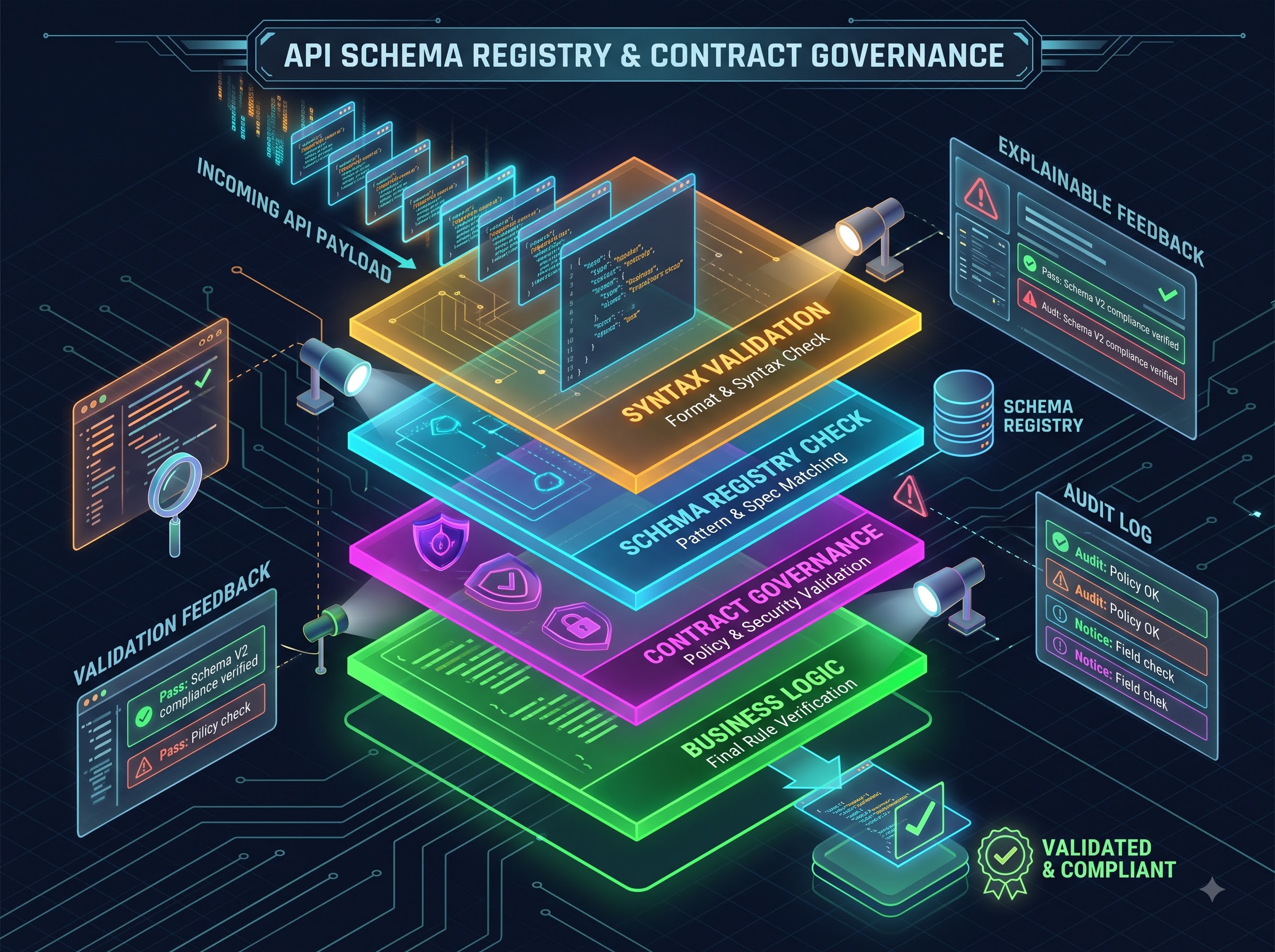
| Validation layer | Question answered | Failure outcome |
|---|---|---|
| Syntax | Is the document structurally valid for the declared schema? | Reject with stable contract error |
| Identity | Is the caller, tenant and environment permitted? | Reject before data processing |
| Data quality | Are required values complete, formatted and internally consistent? | Return correctable data issue |
| Authority | Did each governed value come from an approved source or override? | Open exception or deny |
| Policy | Is the subject eligible for the requested program and action? | Deny or require approval |
| Authorization | Is approved intent complete, scoped, locked and unexpired? | Do not issue BCM handoff |
| Execution | Does BCM receive an intact valid authorization exactly once? | Reject, reconcile or recover |
Protect the CCA to BCM Contract
The most important contract is not the raw order payload. It is the authorization boundary between CCA and BCM. CCA should issue an immutable authorization artifact containing the approved tenant, subject reference, program, template, governed fields, quantity, destination rules, expiry, environment and correlation. BCM validates the artifact rather than reinterpreting source-system data.
Register the authorization schema separately from public request schemas and apply stricter change control. A consumer update must not allow a field approved under one schema to be altered under another. If BCM introduces a new execution capability, CCA must first define when [an approver] may authorize that capability and how the system will record its evidence.
Register Events and Webhook Contracts
Events need governed schemas because they drive approvals, status updates, operational reconciliation and downstream automation. Register a stable envelope for event ID, tenant, event type, occurred time, schema version and correlation. Define which fields are authoritative facts, which are descriptive context and which must never trigger a new order.
Consumers should subscribe to approved event types and supported schema versions. Signature verification, replay protection, idempotency and delivery behavior remain part of the contract even when they are not represented inside the payload. BOC should correlate publication, delivery, retry, dead-letter handling and consumer acknowledgement.
Use Contract Tests at Every Boundary
| Boundary | Contract test | Governance assertion |
|---|---|---|
| Source to adapter | Known source payload maps to canonical fields | Authority and transformations are correct |
| Adapter to CCA | Canonical request validates by declared schema | Tenant and environment remain isolated |
| CCA decision | Synthetic scenario produces expected outcome | Eligibility, approvals and locked fields are correct |
| CCA to BCM | Authorization validates and altered payload fails | Only approved intent can create an order |
| BCM to BOC | Status and exception events preserve correlation | Operational evidence is complete |
| CCA to subscriber | Webhook validates, verifies and replays safely | No duplicate business action occurs |
Control Schema Promotion Across Environments
Promote the same reviewed schema artifact from sandbox to certification and production. Do not recreate it manually in each environment. Bind the artifact to an immutable digest and inject only approved environment-specific references such as endpoints, keys and tenant identifiers. Production should reject an unapproved or modified schema digest.
Promotion evidence should include automated compatibility results, governance-scenario results, security review, named approvers, eligible consumers, and rollback instructions. BOC should show which production deployments use each approved schema and whether any consumer is still sending a deprecated version.
Measure Contract Health
| Measure | What it reveals | Governance response |
|---|---|---|
| Validation failure rate | Consumers sending incomplete or incompatible data | Correct mapping or clarify contract |
| Unknown field or enum use | Schema drift or unsupported behavior | Review compatibility and consumer tolerance |
| Authority exceptions | Values arriving from unapproved sources | Fix ownership or govern override |
| Deprecated-version traffic | Migration exposure by consumer and tenant | Escalate or approve time-bound exception |
| BCM authorization rejection | Broken handoff, expiry or payload alteration | Contain and reconcile |
| Webhook schema failures | Subscriber incompatibility or signature issue | Pause, retry or migrate safely |
| Schema lead time | Delay from draft to approved production use | Improve review without bypassing controls |
Implementation Roadmap
- Inventory public APIs, internal handoffs, events, webhooks, authorizations and shared error models.
- Define canonical business identity concepts and assign an accountable owner to each governed field.
- Document source mappings, transformations, authority ranking, override policy and sensitivity metadata.
- Create draft, candidate, approved, deprecated and retired lifecycle states with permitted uses.
- Automate structural compatibility checks and semantic CCA decision comparisons.
- Register the CCA to BCM authorization contract under stricter approval and integrity controls.
- Build consumer-driven contract tests for HCM, IAM, CRM, procurement, portal and event connections.
- Promote immutable schema artifacts across environments through a production-readiness gate.
- Use BOC to monitor validation failures, migration progress, exceptions and residual traffic.
- Retire unused contracts, credentials and subscriptions while preserving required decision evidence.
Frequently Asked Questions
Why does a business card API need a schema registry?
It gives enterprise teams one governed source for contract structure, field meaning, ownership, validation, compatibility and lifecycle status across connected systems.
Is an OpenAPI file enough?
It is an important specification, but governance also requires authority metadata, policy meaning, lifecycle state, approval evidence, events, authorization contracts, and operational constraints.
What is the canonical CCA model?
It is the stable enterprise representation that CCA uses to evaluate business identity and ordering authority independently of any one HCM, IAM, CRM, or procurement schema.
What is BCM in this architecture?
Business Card Manager (BCM) is the business card ordering management system or software. It executes valid CCA-authorized order intent and should not reinterpret source data.
Can a structurally compatible change still be unsafe?
Yes. A default, authority source, validation rule, or status meaning can change a CCA decision even when the payload remains valid.
Should webhook schemas be registered?
Yes. Register event envelopes, data schemas, signatures, subscriptions, replay behavior and correlation expectations.
Who approves a production schema?
Approval should include the accountable API owner plus architecture, security and business identity governance roles appropriate to the change.
How does BOC support schema governance?
BOC provides validation trends, exception ownership, deployment evidence, migration status, webhook health, and residual deprecated traffic.
How are schemas promoted safely?
Promote an immutable, reviewed artifact through testing and certification, then allow production only for the approved digest and named consumers.
When can a schema be retired?
When active consumers and subscriptions have migrated, the team has proven BCM and event boundaries, the team has closed or governed exceptions, and the team can monitor residual calls.
The Strategic Outcome
A governed schema registry reduces integration ambiguity before it becomes an identity or ordering defect. Enterprise teams share stable definitions, understand who owns each value, and know which purpose an approver/the organization approves each contract for. Automated checks accelerate safe change, while semantic tests protect the CCA decisions that matter to the business.
The model preserves the core purpose of the CCA website. CCA remains the authority for business card identity and ordering rights. Business Card Manager remains the business card ordering management software that executes approved intent. BOC provides operational evidence and exception visibility. The registry connects these layers without allowing a schema to become an alternate source of authority.
Select one active business card integration and trace every field from source schema to canonical CCA concept, decision rule, authorization artifact and BCM execution. Identify fields with no owner, transformations with no test and contracts with no lifecycle state. Register and govern those gaps before onboarding another consumer.