

API Recovery Orchestration For Enterprise Business Card Ordering
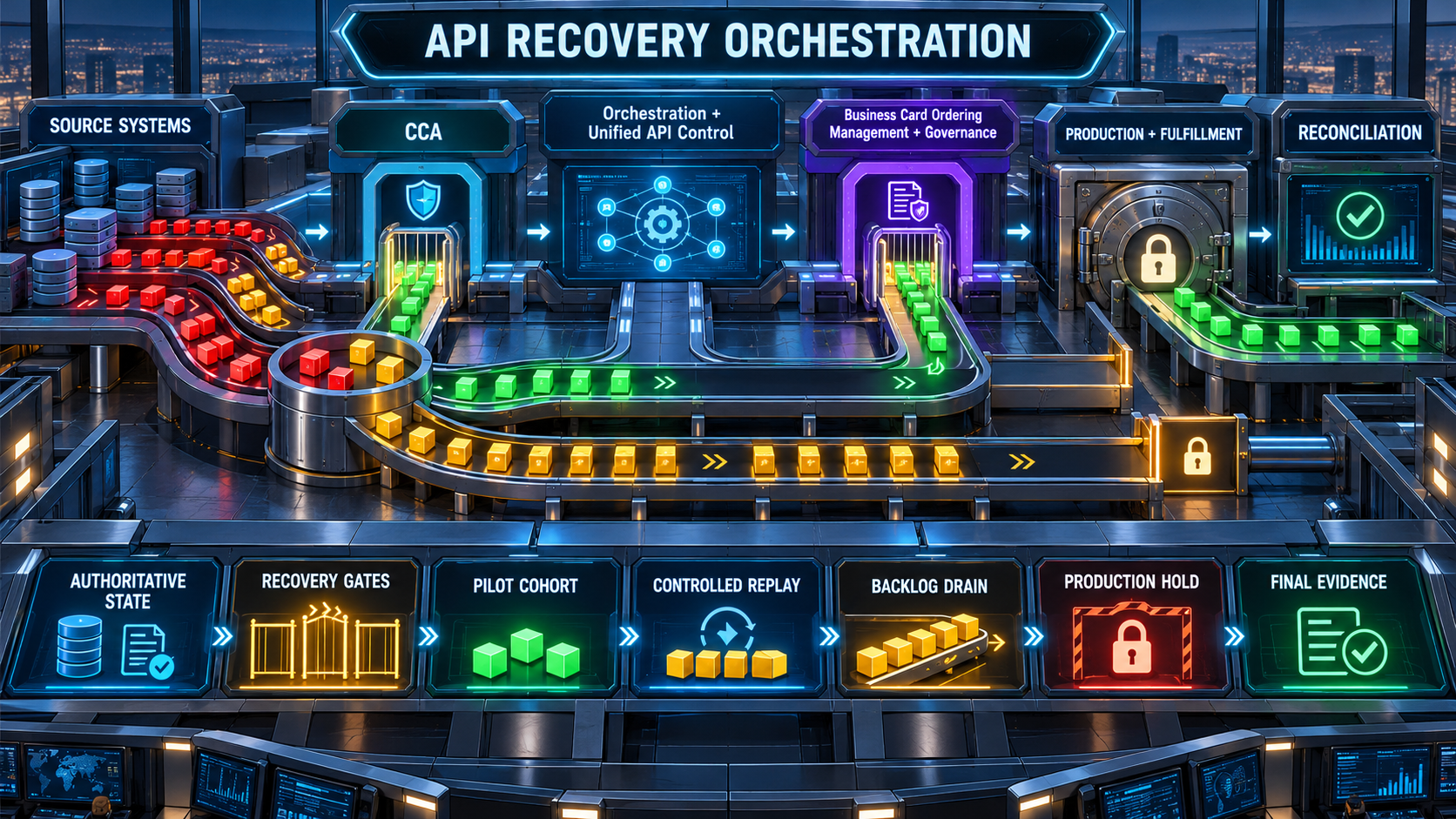
Recovery Must Restore Trust Not Only Traffic
When an integration returns to service, the safest action is rarely to release every queued request immediately. Some transactions may already have reached BCM. Others may be waiting for approval, accepted by a print service, partially fulfilled or represented by a delayed callback. Restoring traffic before establishing these states can turn a temporary outage into duplicate orders, unauthorized production and unreliable reporting.
API recovery and workflow orchestration coordinates the decisions required to move each affected transaction from uncertain or paused status into a trusted final state. CCA provides the centralized orchestration and unified API control layer. It interprets approved identity context, applies policy, controls routing and preserves decision evidence. BCM, or Business Card Manager, is the business card ordering management system and software for permissions, approvals, templates, quantities, ordering workflows and reporting. Print Business Cards performs production and fulfillment. Recovery must preserve these responsibilities while reconnecting the complete chain.
A recovery plan should exist before the incident. It must define recovery classes, state checks, ordering gates, replay rules, pilot cohorts, stop conditions, evidence and decision ownership. Without this structure, teams often optimize for endpoint availability while the business card program remains exposed to duplication, stale identity, bypassed approval or mismatched fulfillment state.
Classify the Recovery Population
| Transaction class | Typical condition | Required action |
|---|---|---|
| Not received | Source has the record but CCA has no accepted intake evidence | Resend through the approved interface |
| Rejected safely | CCA rejected the request with a known validation reason | Correct the authoritative source or approved mapping |
| Decision complete | CCA created a valid decision but BCM has no order | Confirm the route and submit once with the original business key |
| Order uncertain | CCA timed out while BCM may have accepted the request | Query authoritative BCM state before retry |
| Order held | BCM created the order but approval or production release is paused | Revalidate controls before controlled release |
| Production uncertain | Supplier acknowledgment or job state is incomplete | Hold and reconcile before any new production request |
| Final state missing | Order completed but return evidence did not reconcile | Recover status without recreating the order |
Establish the Authoritative State First
Recovery begins by determining what each system can prove. The source system proves the approved business fact and effective time. CCA proves validation, policy, field authority and routing. BCM proves permission, approval, order identity and managed workflow state. Production and fulfillment records prove proof, job, shipment and delivery status. No single API response should replace this evidence chain.
Use the correlation model to link source event, CCA decision, BCM order, production job and returned status. When two records conflict, the recovery team should follow predefined field and state authority rather than selecting the most recent timestamp. A later event can be delayed, duplicated or based on stale information.
Select the Correct Recovery Action
| Observed state | Safe recovery action | Unsafe shortcut |
|---|---|---|
| No intake evidence | Resend once with the original transaction key | Create a new request with a different key |
| Validation rejected | Correct the source or approved transformation, then resubmit | Edit the payload manually without source accountability |
| CCA decision exists | Reuse the approved decision if still valid or deliberately reauthorize | Apply an unknown current or historical policy |
| BCM order exists | Resume or reconcile the existing governed order | Create a replacement order automatically |
| Approval pending | Restore the approved route and retain pending status | Bypass approval to clear the backlog |
| Production accepted | Recover job and shipment state | Submit a second production request |
| Status missing | Request or replay status evidence | Recreate the business transaction |
Recover in Dependency Order
The sequence should follow control dependencies rather than system convenience. Restore identity and organizational sources before processing dependent events. Confirm authentication and credential health before reopening consumers. Validate CCA schemas, mappings, policy versions and routes before releasing decisions. Confirm BCM permissions, approvals, templates and holds before enabling order submission. Restore production connectivity only when the system can distinguish existing jobs from new requests.
Finally, restore status return and reconciliation. A program is not fully recovered while completed orders remain invisible to reporting or while fulfillment events cannot be matched. If a return path is unavailable, the enterprise vendor governance may operate in a constrained mode, but the decision and residual risk should be explicit.
Use Recovery Gates
| Gate | Evidence required | Release decision |
|---|---|---|
| Source readiness | Authoritative data is current and event ordering is understood | Allow the approved source cohort |
| CCA readiness | Schema, mapping, policy and routing versions are verified | Permit governed decisions |
| BCM readiness | Permissions, approvals, templates, quantities and holds are correct | Permit managed order creation |
| Production readiness | Existing job state is reconciled and provider route is stable | Permit proof or production release |
| Return path readiness | Callbacks, correlation and status ordering are healthy | Permit normal lifecycle automation |
| Reporting readiness | Exceptions and final states are visible to accountable owners | Exit constrained operations |
Release a Pilot Cohort Before the Backlog
A recovery pilot should be small enough to inspect but representative enough to test the affected path. Select controlled transactions across the relevant source, legal entity, program, template, approval route and provider. Avoid using only the simplest case when the disruption affected multiple workflow branches.
For each pilot item, confirm the source fact, CCA decision, BCM order, production outcome and final status. Compare expected and observed state before widening the cohort. If a control fails, stop the release, preserve evidence and return to the last trusted gate. A successful endpoint response is not sufficient evidence for expansion.

Control Replay and Backlog Drain
Replay should preserve the original business transaction identity while recording a new delivery attempt. This allows CCA and BCM to recognize work that already exists. Backlog drain should be paced by concurrency, queue age, business priority and downstream capacity. Large bursts can overload a recently restored dependency and recreate the disruption.
The recovery controller should separate records that can be retried automatically from records requiring review. Any transaction with uncertain BCM or production state should remain held until authoritative evidence is available. Expired, superseded or no-longer-eligible requests should follow current enterprise procurement governance rather than being released merely because they were once queued.
Apply Current Policy Deliberately
| Change during outage | Recovery question | Governed treatment |
|---|---|---|
| Employee role changed | Is the original eligibility decision still valid? | Reauthorize if policy requires current role |
| Location changed | Which address and template are authoritative now? | Use field authority and effective-date rules |
| Approval owner changed | Can the pending decision continue under the old route? | Transfer through an approved workflow |
| Template version changed | Should queued work use historical or current artwork? | Apply the documented version policy |
| Quantity rule changed | Is the prior approved quantity still permitted? | Retain or reapprove according to governance |
| Provider route changed | Can the original provider complete existing work safely? | Separate in-flight jobs from new routing |
Protect Production and Fulfillment
Physical production makes recovery materially different from a purely digital workflow standardization. A timeout does not prove that a job was not created. A missing shipment callback does not mean that a package was not handed to a carrier. Recovery must query and reconcile downstream state before any action that could create a second physical output.
Use holds at the BCM, proof and production boundaries. Release them separately. Confirm card content, quantity, destination, job identity and provider acknowledgment before production resumes. If a job cannot be proven, assign an exception owner and disposition; do not hide uncertainty inside a generic recovered status.
Define Stop Conditions
| Condition | Required response | Owner |
|---|---|---|
| Duplicate order detected | Pause the cohort and reconcile all related keys | BCM administrator |
| Unexpected policy decision | Stop CCA release and compare configuration versions | CCA platform owner |
| Production state uncertain | Maintain the production hold | Production owner |
| Queue growth exceeds capacity | Reduce release rate or reopen the circuit breaker | Integration owner |
| Status events conflict | Pause lifecycle automation for affected records | Reconciliation owner |
| Personal data appears in recovery logs | Restrict evidence and correct logging | Security and privacy owner |
Implement Recovery Orchestration in Controlled Stages
- Inventory the transaction states that can exist across source systems, CCA, BCM, production and fulfillment.
- Define authoritative state and recovery action for each class before an outage occurs.
- Establish correlation identifiers, version evidence and accountable owners.
- Create recovery gates for sources, authentication, CCA, BCM, production, return events and reporting.
- Separate automatic retries from transactions requiring authoritative-state review.
- Build a representative pilot cohort and explicit stop conditions.
- Restore dependencies in control order and validate each gate.
- Release the pilot, reconcile every result and compare it with the expected outcome.
- Drain the backlog gradually with rate, concurrency and downstream-capacity controls.
- Keep uncertain orders and production jobs held until evidence supports disposition.
- Exit recovery only when all transactions have a final state or an owned exception.
Measure Recovery by Integrity
| Measure | What it proves | Target direction |
|---|---|---|
| Authoritative-state coverage | Affected transactions with verified current state | Complete coverage |
| Pilot success rate | Representative transactions completing as expected | Stable before expansion |
| Duplicate prevention | Recovery attempts that do not create extra orders | One hundred percent |
| Backlog drain rate | Safe throughput after restoration | Within dependency capacity |
| Reconciliation completeness | Transactions with source-to-outcome evidence | Complete before closure |
| Residual exception age | Time unresolved items remain without disposition | Declining to zero |
| Recovery regression | Failures introduced during restoration | Zero high-consequence defects |
Frequently Asked Questions
What is API recovery orchestration?
It is the controlled sequencing of state validation, service restoration, replay, release and reconciliation across connected systems.
Why is restarting traffic not enough?
Because some transactions may already exist in BCM or production even when the caller did not receive confirmation.
What is CCA responsible for?
CCA provides centralized orchestration and unified API control, including validation, governance decisions, routing and decision evidence.
What is BCM?
BCM, or Business Card Manager, is the business card ordering management system and software for permissions, approvals, templates, quantities, orders and reporting.
What is authoritative order state?
It is the verified BCM and downstream state supported by order, production and fulfillment evidence.
Should queued requests use current policy?
The organization must define this deliberately. Material identity or eligibility changes may require reauthorization.
Why use a pilot cohort?
It proves the restored path with limited risk before a larger backlog is released.
Can replay use a new transaction key?
Normally no. Preserving the business key helps prevent duplicate orders and links attempts to the original transaction.
When should production remain held?
Whenever authorization, content, quantity, destination, job identity or existing production state is uncertain.
When is recovery complete?
When normal processing is stable and every affected transaction has a reconciled final state or an owned exception.
The Strategic Outcome
Recovery orchestration protects the purpose of the CCA ecosystem after disruption. Source systems remain accountable for business facts. CCA restores controlled interpretation and routing. BCM preserves authoritative ordering state and business card governance. Production resumes only after existing work is understood. Reconciliation proves the final outcome.
This model prevents a fast technical restart from becoming a business-control failure. The enterprise can recover at scale while protecting identity accuracy, approval accountability, brand integrity, physical-order certainty and audit-ready evidence.
Choose one recent outage or near miss and classify every possible transaction state across CCA, BCM and production. Define the authoritative evidence, safe recovery action and release gate for each class. Test the sequence with a small synthetic cohort before relying on it during a live disruption.