

API Data Contracts and Schema Governance For Enterprise Business Card Ordering
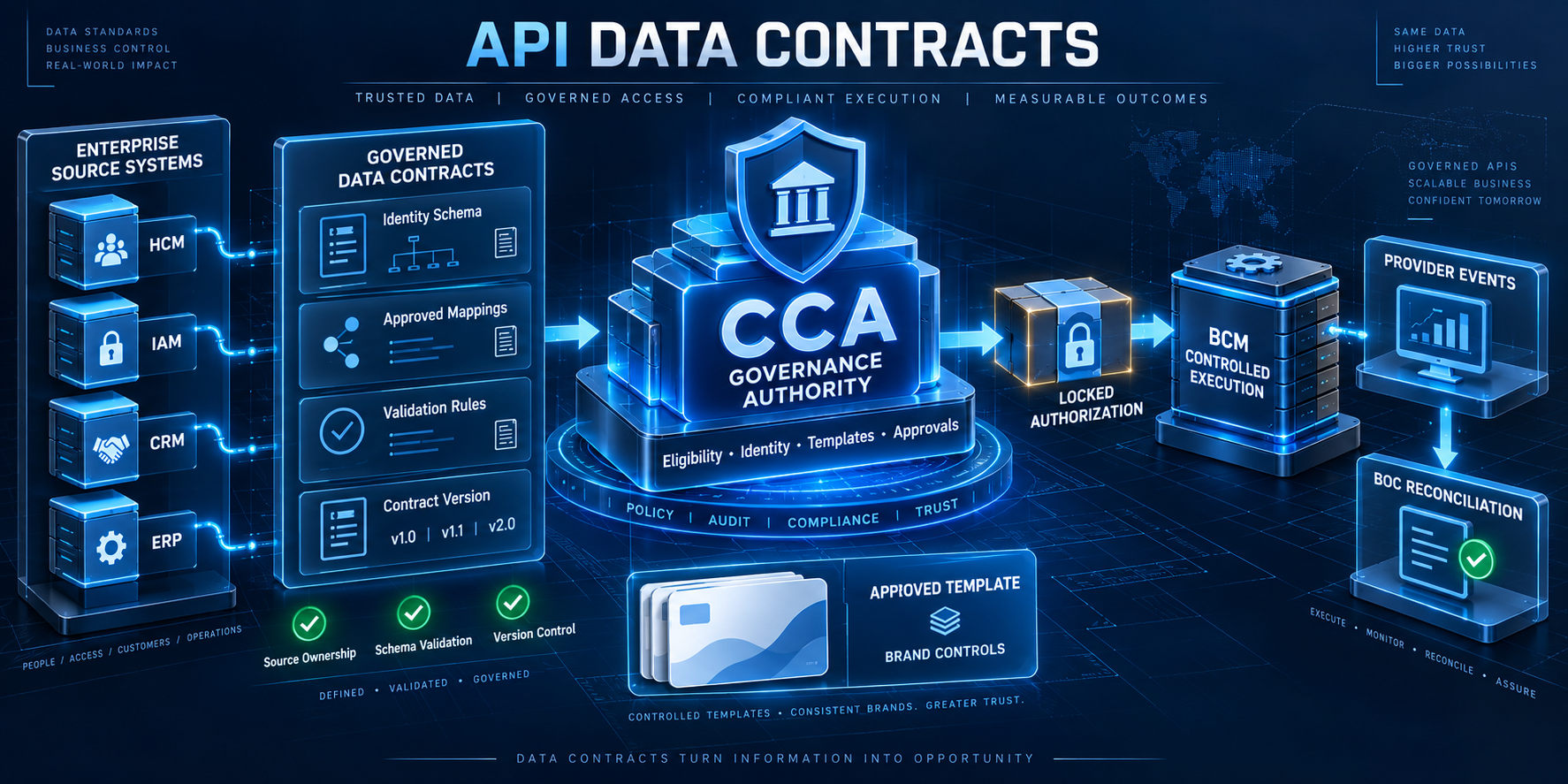
Standardizing connected data without transferring authority away from CCA. An enterprise model for reliable field decisions, order events, and change.
A Shared Schema Must Preserve CCA Authority
Enterprise business card ordering connects HCM, IAM, directories, CRM, procurement, employee portals, Color Card Administrator (CCA), Business Card Manager (BCM), print providers and Business Ops Center (BOC). Each system represents people, locations, roles, cost centers, and orders differently. Without explicit data contracts, integration teams fill gaps with local mappings, defaults and transformations that can quietly change the identity or ordering decision.
A data contract defines the structure, meaning, ownership, validation, and lifecycle of information exchanged between systems. It does not decide whether an employee may order a card or which design applies. CCA retains authority for eligibility, approved identity fields, templates, approvals, quantities, destinations, provider routing, and exceptions. BCM executes the locked authorization, while BOC reconciles events and operationalizing identity governance outcomes. Schema governance must reinforce these boundaries.
Why Field Matching Is Not Enough
Two systems may both expose a field called title while assigning it different meanings. One may hold the payroll position, another a directory display title and another a customer-facing role. Mapping the fields by name can produce technically valid but unauthorized content. Similar ambiguity affects preferred name, office, legal entity, department, phone format, card program and delivery location.
The contract must identify the business definition, authoritative source, permitted transformations, data classification, validation rules and CCA policy use for every governed field. If a value is absent or contradictory, the response should follow policy rather than a connector-specific fallback. Integration should transport meaning consistently, not manufacture authority.
The Contract Layers for Governed Ordering
| Contract layer | What it defines | CCA governance requirement | Failure response |
|---|---|---|---|
| Identity input | Workforce and organizational facts offered to CCA | Source ownership freshness and permitted transformation for each field | Hold deny or route conflict according to policy |
| Decision response | Eligibility template fields approvals limits and routing selected by CCA | Versioned decision reason expiry and immutable authorization reference | Consumer must not infer or replace missing authority |
| BCM command | Production-ready order derived from the CCA authorization | Exact identity template quantity destination and integrity value | Reject incompatible or expired authorization |
| Provider exchange | Supplier payload and normalized status events | No downstream change to approved business values | Create operational exception and preserve raw evidence |
| Oversight event | Exception recovery and reconciliation information for BOC | Stable links to decision order provider and accountable owner | Keep transaction open until evidence supports closure |
Create a Canonical Business Vocabulary
A canonical vocabulary gives connected teams one governed definition for concepts such as card program, identity field, template, approval route, quantity limit, delivery destination, provider route, decision, authorization, order, production job, shipment, exception, and reconciliation. It reduces point-to-point interpretation while allowing adapters to translate local system formats.
Canonical does not mean that every source must store identical fields. It means each exchange maps to a controlled meaning. A local office code can map to a CCA location identifier, but the mapping must be owned, versioned, and tested. A provider-specific production state can map to a normalized identity lifecycle management event, but the raw event must remain available for evidence and troubleshooting.
Govern Identity Fields by Source and Purpose
| Field domain | Authoritative input example | CCA decision | Contract rule |
|---|---|---|---|
| Employee identity | HCM or governed directory record | Selects permitted display fields for the card program | Consumer input cannot overwrite source-controlled values |
| Role and organization | HCM role business unit and legal entity | Determines eligibility template approval and policy scope | Normalize codes but preserve source and effective date |
| Location | Approved location master and assignment | Controls address block language provider and delivery rules | Separate workplace identity from shipping destination |
| Contact channel | Governed directory or approved enterprise source | Permits formats and visibility by program | Reject unapproved free text and unsupported formats |
| Brand and template | CCA-managed program and template catalog | Selects versioned design and allowed fields | Template identifiers are references not editable artwork |
| Spend context | Procurement cost center entity and accounting dimensions | Applies approval and ordering constraints | Validate ownership status and effective dates before execution |
Separate Input Facts from Governed Decisions
A strong API design separates the facts a consumer provides from the authority CCA returns. A portal may submit the authenticated subject, intended card program and relevant source references. CCA retrieves or validates authoritative data, evaluates policy and returns a versioned decision. The consumer should not submit a complete card object that appears ready for production and expect CCA merely to approve it.
The response should distinguish allowed fields from resolved values, required approvals, constraints, expiration and reason codes. BCM should receive only an executable authorization after all conditions are satisfied. This separation prevents client applications from treating interface convenience as permission to choose identity or brand content.
Design the Locked Authorization Contract
The CCA authorization is the governed boundary between decision and execution. It should contain a decision identifier, authorization version, card program, approved identity values, template identifier and version, quantity, destination, provider route, approval evidence, policy version, issue time, expiration, idempotency context and integrity value. BCM should store the package as immutable business authority.
BCM may add execution identifiers, proof references, production status, shipment and cost evidence. It should not repair or enrich approved fields from another source. A material change to identity, template, quantity, destination or provider routing requires CCA re-evaluation and a new authorization version. This makes contract boundaries operationally enforceable.
Use Validation in the Correct Layer
| Validation type | Where it belongs | Example | Safe result |
|---|---|---|---|
| Structural | API gateway or service boundary | Required property type format length and enumeration | Reject malformed request without state change |
| Referential | CCA integration and governed master data | Known program location template cost center and provider | Reject or hold unknown and inactive references |
| Semantic | CCA authority layer | Role is eligible location permits template and quantity is within policy | Return governed allow deny hold or approval outcome |
| Execution | BCM and provider adapter | Authorization current artwork compatible address serviceable | Accept execution or return correlated rejection |
| Lifecycle | BOC and event normalization | State transition possible event matched and outcome evidenced | Normalize safely or create owned exception |
Make Optionality Explicit
Optional fields are a major source of ambiguity. Optional in the transport schema may mean not required for every card program, not available from every source, or unknown at this stage. Those meanings are different. Contracts should explain when a field may be omitted, whether null is distinct from absent, which defaults are allowed and whether absence blocks authorization.
CCA should determine the business consequence of missing governed data. A missing fax number may be acceptable, while a missing legal entity or unresolved office assignment may require a hold. Consumers and BCM should not invent placeholder content. Error and decision responses should provide stable reason codes without exposing unnecessary personal or policy details.
Version Contracts Without Fragmenting Governance
Contract evolution is inevitable as programs add fields, regions, approval rules, and provider capabilities. Compatible additions can often be introduced without a new major version when consumers are required to ignore unknown fields. Removing properties, changing meaning, narrowing allowed values, or changing required behavior needs deliberate versioning and migration.
The enterprise identity procurement should publish ownership, compatibility rules, support windows, deprecation notices, consumer inventories, and retirement criteria. CCA policy and template versions are separate from the API version: a stable API can return a new governed policy decision, while a new API version does not authorize a consumer to use a retired template or obsolete rule.

Contract Change Lifecycle
- Document the business need and identify the affected consumers sources CCA policies BCM mappings providers events and reports.
- Classify the change as additive compatible behavior-changing or breaking and identify governance impact.
- Update the canonical definition ownership classification examples validation and compatibility rules.
- Review the change with CCA governance integration security data privacy BCM and BOC owners.
- Publish a machine-readable schema and human-readable guidance with version effective date and migration window.
- Run consumer contract tests source-to-CCA decision tests locked-authorization tests and provider-event tests.
- Deploy through controlled environments while monitoring validation failures field use and outcome differences.
- Migrate consumers and adapters without allowing local aliases or defaults to become permanent authority.
- Retire the old contract only when usage evidence exceptions rollback readiness and reconciliation confirm safety.
Test Meaning as Well as Structure
Schema validation can confirm that a property is a string and still miss that it contains the wrong kind of title. Contract testing should include representative decisions: eligible and ineligible roles, multiple legal entities, transfers, temporary assignments, multilingual templates, missing sources, conflicting locations, approval thresholds, expired authorizations and provider-specific routing. Expected CCA outcomes should be explicit.
Consumer tests should confirm that unknown response fields do not break processing, reason codes are handled safely and no local rule overrides CCA. BCM tests should confirm that the locked authorization maps exactly to the proof and order. Provider tests should verify normalized events, duplicate handling and reconciliation. Negative tests often reveal enterprise procurement governance drift earlier than happy paths.
Detect Schema Drift Before It Becomes Card Drift
Schema drift occurs when a producer changes values, meaning or structure without a coordinated contract change. A new HCM code, renamed location, expanded title length or provider status can pass through integration while producing a wrong business outcome. Validation metrics, unknown-value alerts, source profiling and decision-distribution monitoring should identify drift quickly.
Observability from Post 106 should connect a drift signal to affected decisions and orders. BOC should identify any authorizations, proofs or provider jobs created during the exposure window and reconcile their outcomes. If physical cards may be affected, the response should include containment, owner assignment, correction rules and evidence rather than only a connector patch.
Protect Contract Registries and Examples
Schema repositories, mapping catalogs and example payloads are part of the control environment. They may expose internal identifiers, policy structure and personal data if copied from production. Examples should be synthetic and privacy-safe. Access, approval, change history, signing, retention and publication rights should be defined.
Machine-readable schemas should be generated or validated through the delivery pipeline so deployed behavior matches the approved contract. Manual documents remain valuable for definitions and governance intent, but they should not diverge from executable validation. Every release should link code, schema, tests, approvals and effective version.
Ownership Across the CCA BCM BOC Model
| Owner | Contract responsibility | Must not do |
|---|---|---|
| CCA governance | Own business definitions decision semantics policy references authorization and governed errors | Delegate eligibility template or approval meaning to consumers |
| Integration platform | Own transport standards schema publication compatibility gateways and telemetry | Create business defaults that alter CCA outcomes |
| Source data owner | Own authoritative field quality codes freshness and effective dating | Change meaning without contract review |
| BCM operations | Own execution mapping proof order fulfillment and correlated rejection | Edit the locked authorization to make an order pass |
| Provider adapter | Own supplier translation normalized events and raw evidence linkage | Treat provider fields as authority over identity or brand |
| BOC operations | Own exception schemas recovery evidence and reconciliation closure | Close mismatches without accountable evidence |
Security Privacy and Audit Requirements
| Control area | Contract requirement | Evidence |
|---|---|---|
| Identity and access | Authenticated consumers scoped capabilities and service ownership | Client ID owner scopes environment and access review |
| Data minimization | Only fields needed for decision execution or evidence | Field purpose classification source retention and masking |
| Integrity | Versioned schemas signed authorization and immutable identifiers | Schema hash decision ID authorization hash and event history |
| Change control | Reviewed definitions compatibility migration and rollback | Approval tests effective date consumer status and retirement |
| Privacy | Synthetic examples protected logs restricted exports and deletion rules | Test-data source access record retention and deletion evidence |
| Audit | Traceable source decision order provider and reconciliation contracts | Versions owners timestamps outcomes and exception closure |
Measures for Contract Governance
Track schema-validation failures, unknown enumerations, deprecated-version traffic, unmapped fields, default use, source freshness, contract-test coverage, consumer migration progress, CCA decision changes, BCM mapping rejects, provider-event mismatches, exception age and reconciliation coverage. Segment results by API version, consumer, source, card program, region and provider.
Measure governed outcomes, not only conformance. A perfectly valid payload can still produce an incorrect card if definitions or ownership are wrong. Review the percentage of orders linked to a current authorization, fields whose provenance is complete, material changes tested end to end and exceptions closed with evidence. These measures show whether the contract is protecting CCA purpose.
Implementation Roadmap
- Inventory current schemas mappings payloads events defaults code lists and undocumented transformations across every integration.
- Define the canonical vocabulary and assign owners for identity decision authorization execution provider and oversight concepts.
- Create field-level contracts for meaning source purpose classification validation optionality transformation and effective dating.
- Separate consumer input facts from CCA decision responses and formalize the locked authorization contract for BCM.
- Publish versioning compatibility deprecation migration and retirement standards with a consumer registry.
- Implement structural referential semantic execution and lifecycle validation in the correct layers.
- Automate schema and consumer contract testing with governed positive, negative, boundary, and change scenarios.
- Connect validation drift and migration telemetry to API observability alerts BOC exceptions and reconciliation.
- Secure contract repositories, examples, pipelines, and privileged mapping changes with auditable approvals.
- Review contract health outcome measures, recurring drift, and cross-system ownership on a regular cadence.
Frequently Asked Questions
What is a business card API data contract?
It defines the structure, meaning, ownership, validation, security and lifecycle of data exchanged in a governed card-ordering integration.
Does a canonical schema replace CCA policy?
No. The schema standardizes communication. CCA still decides eligibility, identity fields, templates, approvals, quantities and routing.
Can consuming portals provide card-ready identity data?
They can provide permitted facts and references, but CCA should validate authoritative sources and return the governed decision.
Why must the CCA authorization be immutable?
It is the boundary between governance and execution. Downstream edits would break the link between the approved decision and physical card.
Are optional fields always safe to omit?
No. Optionality depends on program and policy. CCA determines whether absence is acceptable, requires approval or blocks authorization.
How should breaking changes be handled?
Use a reviewed version, migration window, consumer inventory, end-to-end tests, monitoring and evidence-based retirement.
What is schema drift?
It is an uncoordinated change in structure, values or meaning that can alter decisions or orders even when integrations remain online.
What role does BOC play?
BOC owns contract-related exceptions, recovery evidence, affected-transaction review and final reconciliation.
The Strategic Outcome
Governed data contracts let enterprises connect many systems without creating many interpretations of business identity. Sources provide controlled facts, CCA turns those facts into an authoritative decision, BCM executes the locked authorization, providers return normalized evidence and BOC closes the operational visibility record. Each boundary has a clear meaning, owner, and failure response.
This preserves the core purpose of the CCA website as the centralized administrative and governance layer for enterprise business card programs. APIs make CCA available inside the systems employees and operations teams already use, while schema governance ensures that integration extends authority rather than redistributing it.
Choose one high-volume card program and trace ten fields from their authoritative sources through CCA, BCM and the provider payload. For each field, identify its definition, owner, transformation, version, validation and exception behavior. Any field whose meaning or authority changes silently across the path should become a contract-governance priority.