

API Observability For Enterprise Business Card Ordering
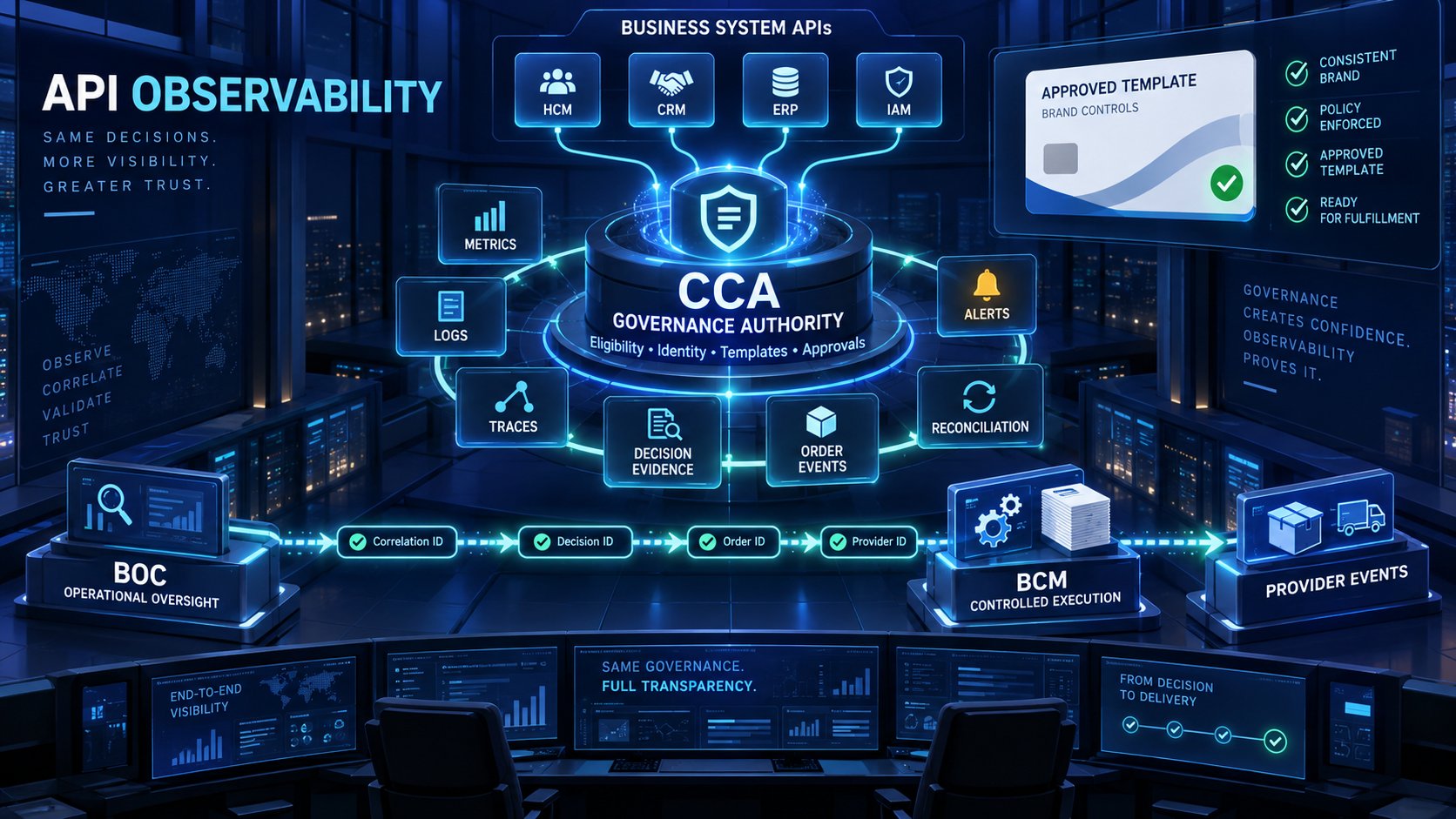
Seeing integration health while preserving CCA governance authority. An enterprise model for metrics, traces, alerts, evidence, and accountable outcomes.
Observability Must Explain the Business Transaction
Enterprise business card ordering crosses identity systems, employee portals, integration gateways, Color Card Administrator (CCA), Business Card Manager (BCM), print providers and delivery services. Traditional infrastructure monitoring can show that an endpoint responded or a queue is growing, but it may not answer the questions that matter to the enterprise: Was the requester eligible? Which identity source supplied the approved fields? Which template and policy versions were applied? Did BCM execute the exact authorization? Did the provider produce and deliver the expected order?
API observability should connect technical behavior to governed business meaning. CCA remains the authority for eligibility, identity data, card programs, templates, approvals, quantities, destinations, and provider routing. BCM executes the immutable authorization. Business Ops Center (BOC) monitors exceptions and reconciles operational evidence. The observable record must preserve this separation so that teams can diagnose failure without weakening authority.
Monitoring Is Only One Part of Observability
Monitoring reports known conditions through predefined dashboards and alerts. Observability provides enough structured evidence to investigate conditions that were not predicted. In a connected card program, both are necessary. Operations needs alerts for high error rates and delayed provider events, while governance needs the ability to reconstruct a single transaction across systems and explain why it reached its final state.
An observable architecture combines metrics, logs, traces, and governed business events. Metrics show scale and trends. Logs describe component activity. Traces connect a request across service boundaries. Business events record authoritative decisions and state changes. None of these should become a second system of record; they should reference CCA decisions, BCM orders, and provider outcomes through stable identifiers.
The Observable Evidence Chain
| Layer | Question answered | Required evidence | Primary owner |
|---|---|---|---|
| Consumer and gateway | Who called which capability and was access valid? | Consumer ID scope API version request time correlation ID and result class | Platform team |
| Source systems | Which authoritative facts were available and current? | Source reference field provenance freshness and validation result | Data owner |
| CCA authority | Why was this card request allowed denied held or routed? | Decision ID policy and template versions approvals expiry and reason code | CCA governance owner |
| BCM execution | Did execution match the locked authorization? | Order ID authorization hash proof production and fulfillment states | BCM operations |
| Provider network | What happened in production shipping and delivery? | Provider job normalized events timestamps tracking reference and exceptions | Supplier operations |
| BOC oversight | Was every exception owned and the outcome reconciled? | Case owner actions due dates evidence match closure and residual risk | BOC operations |
Use Stable Identifiers Across Every Boundary
A correlation identifier should follow the request from its entry point through CCA, BCM and the provider adapter. It is not enough on its own. The evidence chain should also include a CCA decision identifier, authorization version, idempotency key, BCM order identifier, and provider job identifier. These identifiers answer different questions and should never be collapsed into a single mutable field.
Every retry, asynchronous message, webhook, and exception should retain the relevant identifiers. When a provider event arrives late or without a direct internal reference, the adapter should match it through an approved mapping and preserve the raw reference. Operators should not infer relationships from a person name, email address, or card text. Transaction identifiers are more reliable and reduce unnecessary exposure of personal data.
Measure CCA as an Authority Service
CCA observability should cover more than uptime. The enterprise identity procurement needs to know whether policy evaluation is current, authoritative sources are reachable, templates are valid, approval dependencies are responsive, and decisions are being issued within their intended service levels. It should distinguish allowed, denied, held, expired, and exception-routed outcomes without treating a policy denial as a technical error.
Useful CCA measures include decision latency, decision availability, source-data freshness, policy evaluation failures, template-resolution failures, approval wait time, authorization expiry, exception volume, and decisions by governed reason. Sudden changes in eligibility or template selection may signal a source or policy issue even when every API call returns successfully.
Trace the Governed Request End to End
- Create a correlation identifier at the trusted entry point and propagate it through synchronous calls, asynchronous messages, and provider adapters.
- Record the authenticated consumer service identity, requested capability, API version and authorization result without logging secrets.
- Reference authoritative source records through protected identifiers and capture freshness validation and conflict outcomes.
- Attach the CCA decision identifier policy version template version approval state expiration and reason code to the trace.
- Bind the immutable authorization and its integrity value to the BCM order identifier and execution states.
- Map provider acknowledgments, production events, shipments and delivery evidence to the BCM order without changing CCA business values.
- Create a BOC exception when a transition is missing contradictory late or outside its service objective.
- Close the trace only when the outcome is reconciled to the CCA decision or an explicitly owned residual exception remains.
Define Business State, Not Just HTTP Status
A successful HTTP response can still represent a held request, a pending approval or an accepted command whose physical result is unknown. Conversely, a validation rejection can be the correct governed outcome. Dashboards should therefore use canonical business states alongside technical statuses: received, authenticated, evaluating, awaiting approval, authorized, rejected, expired, submitted, accepted, in production, shipped, delivered, failed, uncertain and reconciled.
State transitions should be validated. An order should not move from submitted directly to delivered without the required evidence, and an expired authorization should not return to executable status without CCA re-evaluation. Impossible transitions, duplicate completion events and regression to an earlier state should create observable exceptions rather than silently rewriting history.
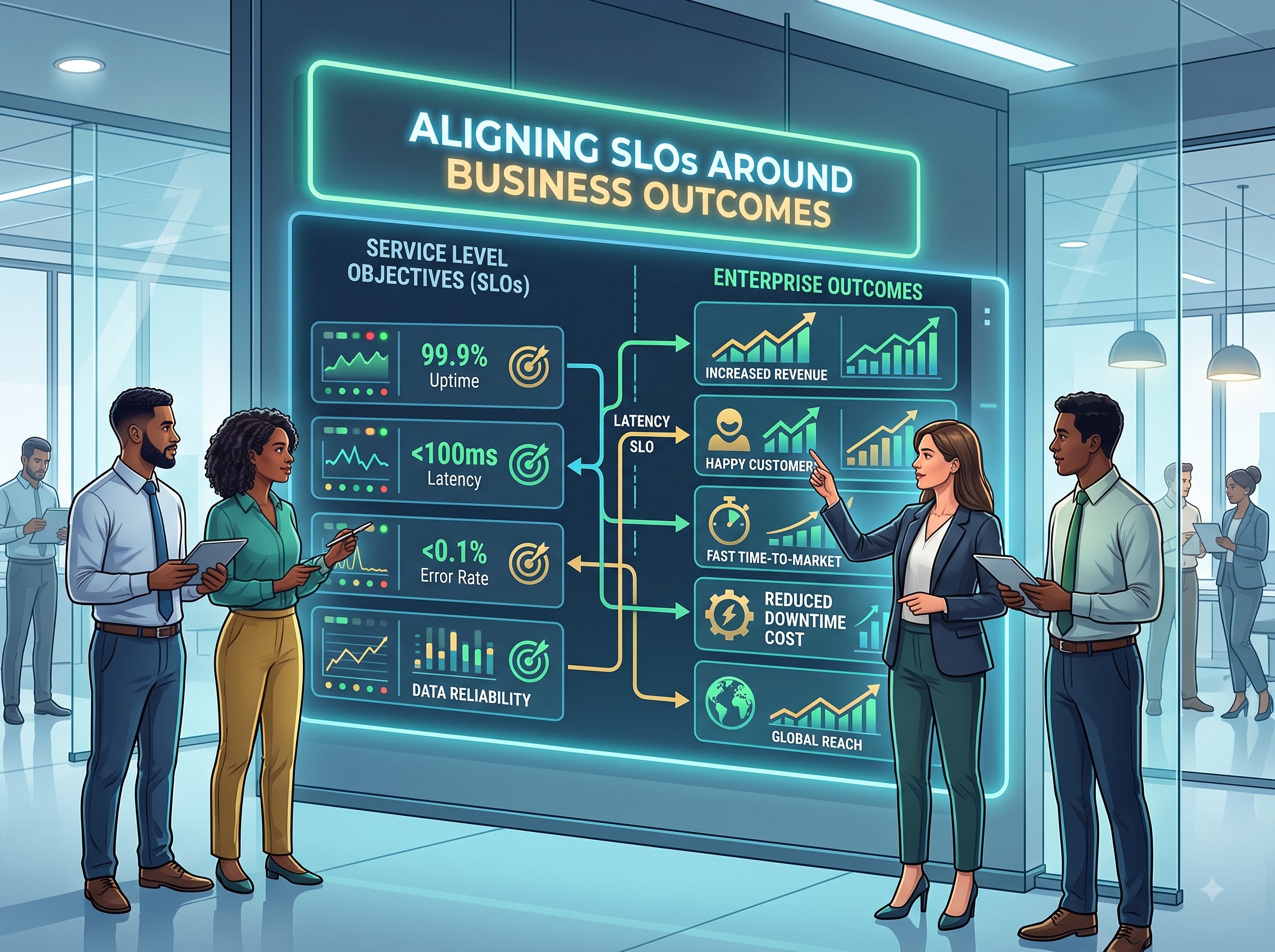
Build Service Level Objectives Around Enterprise Outcomes
| Service objective | Illustrative measure | Governance guardrail | Escalation signal |
|---|---|---|---|
| CCA decision service | Percentage of valid evaluations completed within target time | Denials and policy holds are not counted as technical failures | Latency or availability breaches by consumer or region |
| Approval progression | Time from request to approved denied or expired state | No approval is fabricated to improve completion rate | Aging by approver route and business unit |
| BCM acceptance | Time from valid authorization to durable order acknowledgment | One authorization produces no more than one intended order | Uncertain acceptance or idempotency conflict |
| Provider visibility | Completeness and timeliness of normalized lifecycle events | Missing status never becomes assumed completion | Event gap production stall or delivery ambiguity |
| Reconciliation | Percentage of material orders matched to decision and outcome | Exceptions remain open until evidence supports closure | Unmatched orders costs or provider records |
Alert on Risk Not Noise
An alert should identify a condition that requires action, the affected capability, its business impact, and the owner. Repeated transient errors that recover within policy may belong in metrics rather than paging. A small number of duplicate physical orders, unauthorized transitions, or expired authorizations reaching BCM may justify immediate escalation even when the overall error rate is low.
Alerts should group related symptoms under a transaction or dependency incident. They should include safe diagnostic context such as correlation identifiers, versions, and state history, while linking protected evidence through controlled access. Each alert needs a runbook, severity, response objective, escalation route, and closure requirement. Alert volume without ownership is merely another queue.
Protect Logs, Traces, and Telemetry
Observability data can expose employee identity, office location, cost allocation, internal architecture and access patterns. Collection should follow data minimization. Logs should avoid full card payloads, tokens, approval comments, addresses and contact details. Protected identifiers can connect telemetry to authorized records when investigation requires it.
Access must be role-based and separated between platform operations, CCA enterprise governance mesh, security, supplier operations and audit. Retention should reflect operational, contractual and regulatory needs rather than an assumption that more history is always better. Export, search, and correlation activity should itself be auditable, particularly when it can reveal individual employee information.
Observe Asynchronous Queues and Webhooks
Queue depth alone cannot show whether work is healthy. Teams need queue age, oldest message, processing latency, retry count, dead-letter volume, authorization expiry risk, and consumer lag. A message that remains queued beyond the validity of its CCA authorization must not be replayed automatically. Observability should flag the need for re-evaluation before execution.
Webhook monitoring should report signature failures, duplicates, out-of-order delivery, unmapped provider states, and missing expected events. Duplicate delivery is normal in many event systems and should be handled idempotently. A missing event may require a provider-status query, but the result should be captured as recovery evidence rather than used to rewrite the original event history.
Connect Observability to Post 105 Recovery Controls
Resilience controls cannot operate safely without visibility. Idempotency requires evidence that a prior operation exists. Controlled retries require a classified error and an elapsed-time budget. Queue replay requires current authorization and prior-execution checks. Provider recovery requires knowledge of whether the supplier accepted the original request. Enterprise workflow observability supplies this evidence and defines how the architecture should act on it.
The relationship also works in reverse. Recovery activity must be visible as part of the same transaction. A retry should not appear as a new business request, and a reroute should not hide the original provider failure. BOC should be able to follow the initial condition, recovery decision, actions, replacement execution if any, final outcome, and reconciliation evidence.
Dashboards for Different Enterprise Owners
| Audience | Primary view | Decisions supported |
|---|---|---|
| CCA governance | Decision outcomes policy versions template resolution approval aging and exceptions | Whether authority rules and governed programs are operating as intended |
| Integration operations | Traffic latency errors traces queues dependencies and API versions | Where degradation occurs and which consumers are affected |
| BCM operations | Authorization acceptance order states proofs production and fulfillment | Whether approved work is executing without duplication or alteration |
| BOC oversight | Uncertain transactions missing events exception ownership aging and reconciliation | Which outcomes need intervention and whether evidence is complete |
| Security and audit | Access denials integrity failures privileged queries changes and evidence retention | Whether controls remain effective and investigations are supportable |
| Executive owner | Service objectives high-impact exceptions duplicate prevention and governed completion | Whether integration reliability is protecting brand spend and control |
Test Whether Telemetry Can Answer Real Questions
Observability should be validated through investigation exercises, not only dashboard reviews. Select a request that was denied, one that waited for approval, one retried after a timeout, one with a delayed provider event, and one reconciled after an exception. Ask teams to reconstruct each journey using the permitted tools and confirm that the evidence leads to the same authoritative outcome.
Testing should also inject missing correlation headers, duplicated messages, clock skew, trace sampling, malformed provider events, and telemetry-service degradation. The API-Connected business card workflow must not depend on telemetry being available to enforce CCA policy. When telemetry is incomplete, the transaction should retain safe states and the evidence gap should become visible rather than being mistaken for success.
Security, Privacy and Audit Requirements
| Control area | Observability requirement | Evidence |
|---|---|---|
| Identity | Authenticated service and operator identities for telemetry access | Identity role purpose, environment and review record |
| Minimization | Structured safe fields with payload masking and prohibited-data rules | Schema classification filters tests and sampling policy |
| Integrity | Immutable decision and order references protected from downstream editing | Decision ID authorization hash state history and signatures |
| Segregation | Views restricted by operational governance security and supplier roles | Access policy approvals queries exports and periodic review |
| Retention | Defined periods for metrics logs traces events and exception evidence | Data class storage location expiry deletion and legal basis |
| Change | Versioned dashboards alerts schemas SLOs and collectors | Owner approval tests deployment date rollback and review |
Measures That Connect Reliability to Governance
Track API availability and latency, but pair them with decision completeness, source freshness, authorization expiry, approval aging, idempotency conflicts, duplicate orders prevented, queue age, trace completeness, provider-event completeness, uncertain transaction age, exception time to owner and reconciliation coverage. Segment measures by consumer, capability, region, legal entity, card program and provider.
The strongest measures show whether technical behavior preserved the authorized business outcome. Examples include the percentage of BCM orders linked to a current CCA decision, the percentage of material provider events matched to an order, the number of state transitions rejected as invalid and the percentage of exceptions closed with reconciliation evidence. These measures turn observability into a governance control.
Implementation Roadmap
- Map the complete request path across consumers gateways source systems CCA BCM provider adapters and BOC.
- Define canonical identifiers states reason codes event schemas and ownership for each stage.
- Instrument CCA decisions with policy template approval expiry and source-provenance references.
- Propagate correlation decision authorization order and provider identifiers through every supported transport.
- Establish structured logging tracing metrics and business events with privacy-safe field rules.
- Define service level indicators and objectives that separate technical failures from governed denials and holds.
- Create owner-specific dashboards alerts severity models runbooks and escalation routes.
- Connect queues retries idempotency provider recovery and reconciliation to the same evidence chain.
- Test investigation scenarios telemetry gaps impossible transitions and end-to-end outcome reconstruction.
- Review measures access retention alert quality recurring exceptions and governance coverage on a regular cadence.
Frequently Asked Questions
What is business card API observability?
It is the ability to understand technical health and reconstruct the governed journey from an enterprise request through CCA authorization, BCM execution, provider fulfillment and BOC reconciliation.
How is observability different from monitoring?
Monitoring reports anticipated conditions. Observability combines metrics, logs, traces and business events so teams can investigate both known and unexpected behavior.
Should a policy denial count as an API failure?
No. A valid CCA denial or hold is a governed business outcome. Technical metrics should distinguish it from an unavailable or defective decision service.
What identifiers should be propagated?
Use a correlation ID plus distinct CCA decision, authorization version, idempotency, BCM order and provider job identifiers.
Can logs contain full business card data?
They generally should not. Use minimized structured fields and protected references so investigations do not unnecessarily expose personal information.
What should BOC monitor?
BOC should focus on uncertain states, missing or contradictory events, exception ownership, recovery activity, and final reconciliation.
Can observability replace CCA controls?
No. Telemetry explains behavior but does not grant eligibility, approval or ordering authority. CCA remains the control layer.
How does this relate to API resilience?
Observability supplies the evidence needed for safe retries, idempotency checks, queue replay, provider recovery, and exception closure.
The Strategic Outcome
API observability gives the enterprise more than system visibility. It creates a defensible line from authoritative workforce facts to the CCA decision, from the locked authorization to BCM execution, and from provider events to the reconciled outcome. Teams can diagnose faults, improve service levels and resolve exceptions without treating operational access as permission to change business identity.
This model protects the core purpose of the CCA website. CCA remains the centralized administrative authority for enterprise business card programs, while APIs extend governed ordering into connected systems. Observability proves that integration has preserved eligibility, identity, brand, approval, spend and routing controls at scale.
Select one recent business card order and ask the integration, CCA, BCM and BOC owners to reconstruct it from initial request to delivery. If they cannot explain the authority, versions, transitions, exceptions and final reconciliation through stable identifiers, establish the observable evidence chain before adding more integrations.