

UKG-Connected Business Identity Governance
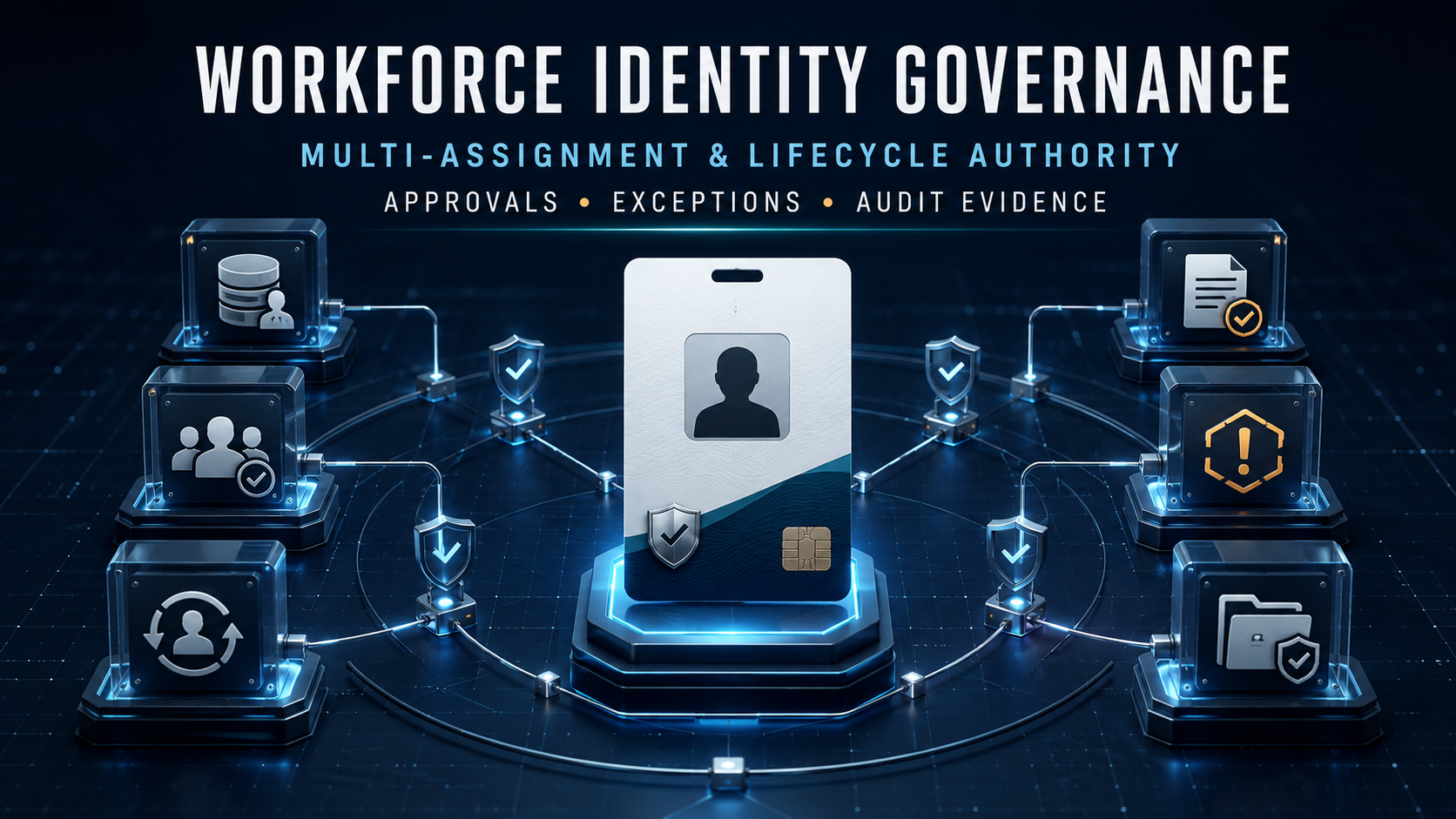
UKG platforms can provide important workforce context such as worker identity, employment status, job, department, company, location, manager, cost center, worker type, and lifecycle changes. These facts can improve the accuracy and timing of enterprise business card programs. Yet a connection to UKG does not, by itself, determine what the enterprise should publish, who may request or approve a card, when a changed identity becomes valid, or whether an approved identity should proceed to production.
Color Card Administrator (CCA) supplies that missing authority layer. CCA receives only the UKG data permitted for the use case, validates its source and scope, applies enterprise identity governance and brand policy, maps workforce context to templates and permissions, routes genuine exceptions to accountable owners, and preserves the evidence behind each outcome. Business Card Manager (BCM) then converts the approved identity specification into ordering and fulfillment. The separation prevents a workforce update from becoming an uncontrolled print instruction.
The result is a governable path from workforce event to public business identity. Standard cases can move efficiently because policy has already resolved them. Ambiguous titles, organizational conflicts, future changes, contingent-worker cases, access exceptions, and unusual commercial requests receive targeted review. Every released outcome remains traceable to the source data, policy version, acting user, approval, template, and downstream order.
Why UKG Connectivity Is an Identity-Governance Issue
A business card is a public enterprise identity artifact. It can display a person’s name, external title, company or legal entity, division, location, phone number, email address, credential, language, and brand. UKG may be authoritative for designated workforce facts, but those facts were often created for employment administration, workforce management, payroll, scheduling, or reporting—not automatically for external publication.
An internal job description may be accurate but unsuitable as a customer-facing title. A work location may not be the address approved for external use. A supervisor relationship may help route an approval without conferring permanent administrative rights. A worker can have multiple assignments, locations, or organizational relationships that cannot be collapsed safely into one card. Even a technically correct UKG value can require policy interpretation before it becomes part of the enterprise’s external identity.
CCA governs that interpretation. It coordinates HR, brand, legal, identity, security, operations, and procurement governance authority at the field and decision level. This prevents integration from accelerating errors: a future transfer does not publish early, an inactive worker does not retain requester access, a temporary assignment does not overwrite a permanent identity without policy, and a raw workforce label does not bypass approved external-title standards.
A Governed Architecture for UKG and CCA
A resilient UKG integration separates the system of workforce record, the authority engine, the execution workflow, and the evidence layer. The exact technical pattern will depend on whether the enterprise uses UKG Pro, UKG Ready, another UKG deployment, approved APIs, scheduled files, middleware, or managed integration services. The governance model should remain stable even when the transport or configured data model changes.
The architecture should establish five clear boundaries:
- UKG remains authoritative for the designated workforce and organizational facts owned there; CCA does not become a shadow HR system.
- CCA determines how permitted source facts may influence public identity, template eligibility, permissions, approvals, exceptions, and release timing.
- Accountable reviewers decide only the exceptions or judgments assigned to their function, using the source and policy context required for the decision.
- BCM executes the approved specification through ordering and fulfillment without silently rewriting governed identity or authority decisions.
- The audit record connects source data, transformations, policy version, approvals, template version, order, supplier, quantity, cost allocation, and fulfillment status.
This design supports data minimization. CCA should receive only the fields required for identity decisions, access scope, routing, cost allocation, or evidence. Sensitive payroll, benefits, timekeeping, attendance, or other workforce details that do not serve the business identity governance use case should remain outside the integration boundary.
Establishing Field-Level Authority
The implementation should begin with an authority matrix, not a connector configuration. For each field, the enterprise must name the authoritative source, permitted transformations, policy owner, fallback behavior, exception owner, effective-date rule, retention requirement, and downstream use. That matrix prevents convenience from turning one upstream platform into an unquestioned source for every business card decision.
Names and preferred-name presentation
UKG may contain legal, preferred, known-as, or localized name values according to the enterprise configuration. CCA should apply the organization’s policy for external display, regional script, punctuation, capitalization, privacy, and regulated populations. A user should not be able to substitute an unverified name simply because an order form provides a free-text field. When an exception is allowed, CCA should preserve the source value, proposed presentation, approver, rationale, and scope.
Job, position, and external title
Internal jobs and positions frequently support compensation, scheduling, hierarchy, or workforce reporting. They may be too technical, abbreviated, or sensitive for customer-facing use. CCA maps trusted job context to an approved external-title library. Standard mappings can proceed under policy; unmapped, elevated, localized, or self-authored titles can be routed to HR, management, brand, legal, or compliance as appropriate.
Company, department, business unit, and cost center
Organizational values can drive brand eligibility, template family, approver scope, supplier rules, and reporting. They should not be treated as interchangeable labels. CCA can distinguish the employing company from the public-facing brand, the department from the business unit, and the cost center from the identity shown on the card. It can block combinations that would misstate the organization or apply a brand outside its authorized scope.
Location, worksite, and contact information
A workforce location may represent a worksite, pay location, scheduling unit, remote designation, or internal code rather than a publishable postal address. CCA should translate approved location context through governed address and contact tables. Remote workers can receive the correct regional or company address without exposing a home location, while country-specific phone, address, and language formats remain controlled.
Manager and responsibility context
Manager, supervisor, HR, location, and organizational relationships can help identify the right reviewer, but the existence of a relationship should not grant unrestricted authority. CCA should evaluate the current relationship, population, entity, geography, decision type, delegation window, and fallback owner. This avoids routing a request to a former manager, an out-of-scope administrator, or a supervisor whose operational responsibility does not include identity approval.
Workforce Changes Require Time-Aware Control
UKG-connected data can expose hires, rehires, promotions, transfers, location changes, manager changes, status changes, and terminations according to the enterprise configuration and integration method. CCA must distinguish when a change was received, when it becomes effective, when public identity may change, and when production should occur. These dates are related, but they are not necessarily the same.
A future promotion may be staged and reviewed before its effective date, yet its new title should not appear publicly too early. A transfer may require advance production lead time while preserving the current card until the authorized release point. A rescinded or corrected event should invalidate the staged identity rather than leaving a stale order in motion. During reorganizations and mass changes, controlled batch evaluation is safer than hundreds of independent manual edits.
Time-aware governance also reduces waste. Not every workforce update requires a reprint. A manager change may alter approval routing without affecting the card. A department change may influence reporting but not external presentation. A company, brand, legal disclosure, title, or public contact change may require immediate or scheduled reissue. CCA classifies the materiality of the event and applies the defined response rather than treating every changed field as a production trigger.
Governing the Employee Lifecycle
New hires and pre-hires
A new-hire record can support advance preparation, but eligibility should depend on status, start date, role, location, worker type, completeness, and business need. CCA can stage the identity, apply the correct template, identify missing authoritative values, and prevent premature release. Any pre-hire access should be narrowly scoped, time-bound, and separated from ordinary employee permissions.
Promotions, transfers, and organizational changes
A promotion or transfer can change title, company, brand, location, approver, cost center, supplier, language, and template eligibility at once. CCA evaluates the combined identity impact so that obsolete elements from the previous assignment do not survive. If only one component is unresolved, the system can isolate that exception without forcing reviewers to reapprove facts already settled by policy.
Multiple jobs, assignments, and work locations
Workforce-heavy organizations may have employees with multiple responsibilities, facilities, or reporting relationships. The integration must not assume that one record can always be flattened into one external identity. CCA can apply primary-assignment rules, permitted secondary-role policies, separate card profiles, and accountable review when the appropriate external representation is ambiguous. The decision should be deliberate and auditable rather than an accidental consequence of record order.
Contingent, seasonal, and temporary populations
Employees, contractors, seasonal workers, temporary staff, franchise participants, and partners may have different eligibility, branding, sponsorship, quantity, and expiration requirements. CCA evaluates worker type and current status through explicit policy. Temporary entitlement can expire automatically, and exceptions can require a sponsor, end date, business justification, and restricted template rather than inheriting permanent employee rules.
Termination and offboarding
A termination or inactivation event should remove access, stop unapproved pending work, and prevent new execution according to policy. It should not erase the evidence behind completed decisions and orders. CCA separates deprovisioning from retention, enabling prompt access control while preserving the historical record required for audit, operational reconciliation, and commercial reporting.
Role-Based Access and Delegated Administration
Workforce context can inform scope, but authentication and authorization should remain governed through the enterprise identity architecture. CCA can combine UKG attributes with directory groups, application roles, and policy-defined scopes so users perform only the actions required by their responsibility.
- Employees may request or review their own governed identity within the fields and quantities permitted by policy.
- Managers may approve for a current reporting population without receiving template, supplier, or global-administration rights.
- Location or regional coordinators may act only for approved sites, countries, entities, or worker groups.
- HR administrators may resolve workforce-data exceptions without gaining authority over brand standards or purchasing rules.
- Brand, legal, procurement, and identity administrators retain distinct authority over the decisions they own.
Delegation should be attributable, limited by purpose and population, time-bound, and recertified. When an administrator changes role or location, CCA should recalculate scope rather than preserving an orphaned entitlement. Emergency access should be exceptional, monitored, and reviewable, with the acting identity and reason preserved.
Approval Orchestration Without Approval Fatigue
The purpose of integration is not to create a longer approval chain. It is to automate decisions that policy has already resolved and send the remaining judgment to the right authority. A request using an approved name, mapped title, eligible template, valid location, authorized requester, standard quantity, and permitted cost center may proceed with minimal intervention.
A self-authored or elevated title may require HR and brand review. A new company-and-brand combination may require legal approval. A contingent-worker request may require a sponsor and expiry. A rush quantity or supplier exception may require procurement. A role or access conflict may require omnichannel identity governance. Conditional routing strengthens accountability because each reviewer receives the precise issue they own rather than a generic request to approve everything.
Notifications may be delivered through email or collaboration tools, but the authoritative decision should remain inside the governed workflow. The record should include source values, proposed display values, triggered policy, previous relevant decisions, effective date, downstream impact, reviewer identity, timestamp, rationale, and decision version.
Exceptions, Data Quality, and Conflict Resolution
Enterprise workforce data is rarely perfect. A worker may have an unmapped job, missing public phone, conflicting location, unavailable manager, duplicate relationship, future transfer, expired delegation, or preferred name outside an established rule. A mature integration anticipates these conditions and classifies them rather than sending every failure back to the employee.
Source-data defects should return to the accountable UKG or HR data owner. Identity-policy exceptions should go to HR, brand, legal, or compliance. Access problems should go to identity governance. Quantity, supplier, budget, and rush exceptions should go to procurement or operations. Technical failures should enter monitored retry and reconciliation queues. The business card workflow must not become an informal mechanism for correcting the workforce system.
Where sources conflict, a predefined authority matrix should determine which value wins or whether execution pauses. Manual override should require a reason, accountable approval, defined scope, and expiry where appropriate. CCA should retain both the source value and the approved transformation so an auditor can reconstruct what changed, who authorized it, and why.
Integration, API, and Security Governance
The technical connection can use only the UKG interfaces and integration services approved for the enterprise’s product, tenant, licensing, and architecture. Regardless of transport, it should use least-privilege service identities, protected credentials, encryption, explicit field scopes, controlled schedules, volume limits, idempotency, monitored retries, reconciliation, and a documented response to source unavailability. Partial failures must be visible; the system should not silently publish stale identity data.
Security begins with minimization. Only data necessary for identity, access scope, routing, cost allocation, or evidence should cross the boundary. Logs should avoid unnecessary personnel detail. Administrative visibility should follow role and organizational scope. Retention should align with the purpose of the record and enterprise policy. Service credentials should never grant broader workforce-system access than the integration requires.
The operating model must also account for configuration change. Renamed jobs, reorganized departments, retired locations, new companies, altered custom fields, connector upgrades, and source schema changes can all produce business failures even when a technical response succeeds. Versioned mappings, controlled testing, release management, monitoring, and reconciliation keep the governance model aligned with the upstream environment.
Audit Evidence and Operational Reporting
A governed program should be able to explain why a specific identity was approved and produced. Evidence should include the source worker and organizational records used, effective timing, integration event or request, validation and mapping results, policy version, requester and acting-on-behalf context, approvers and timestamps, exception rationale, template version, approved specification, order details, supplier, quantity, cost allocation, fulfillment status, and any cancellation or error.
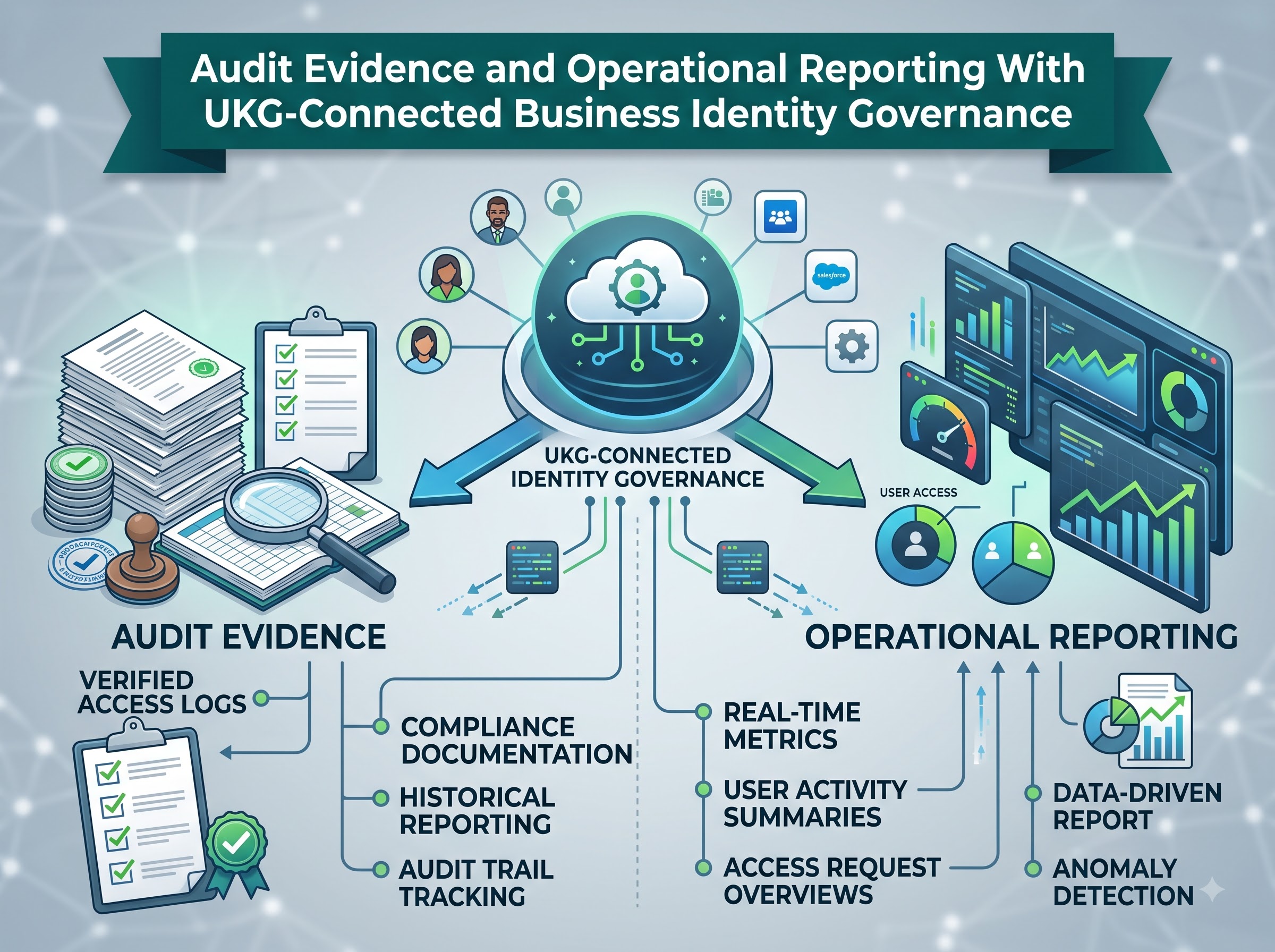
Reporting should extend beyond order volume. Leaders can examine missing or conflicting source fields, unmapped jobs, delayed approvals, override patterns, dormant delegated access, reprints caused by lifecycle timing, supplier variance, cost by company or location, requests stopped by offboarding, and integration failure rates. These measures reveal whether the enterprise is improving the control system rather than simply moving transactions faster.
A Practical Implementation Roadmap
Phase 1: Define authority and scope
Inventory each identity attribute, lifecycle event, role, decision, and downstream control. Name the authoritative source and owner. Decide what CCA must receive, what must remain outside the boundary, what may be transformed, and which exceptions require judgment. Establish the CCA authority and BCM execution separation before configuring the integration.
Phase 2: Map workforce data to identity policy
Map the permitted UKG worker, employment, job, organization, company, department, location, manager, worker-type, and cost-center attributes to controlled CCA fields. Define how multiple roles, temporary assignments, transfers, rehires, custom fields, and regional variations are interpreted. Establish external-title standards, template eligibility, timing rules, materiality thresholds, fallbacks, and exception owners.
Phase 3: Secure and validate the connection
Configure minimum scopes, service ownership, credential management, monitoring, retries, duplicate handling, and reconciliation. Test incomplete records, future changes, corrections, unavailable approvers, source outages, unmapped codes, terminated users, unauthorized actors, multiple assignments, and simultaneous organizational changes—not only the happy path.
Phase 4: Connect governed execution
Release only the approved identity specification into BCM. Confirm that supplier, quantity, cost allocation, purchase, and fulfillment rules remain distinct from identity approval. Return order and fulfillment status to the evidence trail without allowing downstream convenience to overwrite the governed source or policy decision.
Phase 5: Measure and improve
Review exception volume, override reasons, source-data defects, approval cycle time, unnecessary reprints, access-recertification findings, integration failures, and reconciliation gaps. Use the evidence to improve UKG data quality, mappings, identity policy, and guidance. Expand automation only where the authority and exception model remains reliable.
What Enterprise Buyers Should Evaluate
A platform should be evaluated on governance capability, not simply on whether a UKG logo or connector appears in a catalog. Buyers should ask whether the solution can interpret their configured workforce model, preserve lifecycle context, constrain administrative scope, separate external identity from raw HR labels, and maintain the boundary between policy authority and ordering execution.
- Can the platform distinguish authoritative UKG facts from approved external identity presentation?
- Can it handle hires, promotions, transfers, temporary assignments, multiple jobs, reorganizations, and terminations with appropriate timing?
- Can company, department, location, manager, worker type, and cost center drive templates, permissions, approvals, suppliers, and reporting without being conflated?
- Can standard cases proceed under policy while genuine exceptions reach the accountable function?
- Can delegated administration be limited by population, entity, geography, role, purpose, and time?
- Can source defects, policy exceptions, access issues, commercial exceptions, and technical failures be separated and owned?
- Can the enterprise reconstruct the complete decision from UKG source context through CCA approval, BCM order, and fulfillment?
- Can the integration operate with data minimization, least privilege, monitored credentials, reliable retries, reconciliation, and versioned mappings?
Buyer-Intent Bridge: From UKG Integration to Governed Identity Execution
Organizations searching for a UKG business card integration often face visible operational problems: employees retype information, titles vary by requester, workforce changes arrive late, location updates are missed, approvals are inconsistent, and inactive users retain access. Connecting UKG data can reduce these symptoms, but connectivity alone does not decide how workforce facts should become public identity.
CCA supplies the authority layer. It determines which sources are trusted, which transformations are permitted, when a change is valid, who may act, what requires approval, how conflicts are resolved, and what evidence must remain. BCM then carries the approved identity into ordering and fulfillment. Together, the systems create a controlled path from workforce event to business identity execution without collapsing HR authority, brand governance, access control, purchasing, and supplier operations into one uncontrolled transaction.
Frequently Asked Questions
What is a UKG business card integration?
It is a controlled connection that uses permitted UKG workforce and organizational data to support business card identity decisions and workflows. In an enterprise model, it must preserve source authority, lifecycle timing, access rules, approvals, exceptions, security, and audit evidence—not merely prefill an order form.
Does this governance model apply to both UKG Pro and UKG Ready?
Yes at the governance level. Product capabilities, data objects, configuration, licensing, and integration methods may differ, so the technical design must be validated for the enterprise’s specific UKG environment. The core control model—field authority, minimization, timing, scoped access, exceptions, evidence, and separated execution—remains applicable.
Does UKG become the source for every field on a business card?
No. UKG may be authoritative for designated worker, employment, job, organization, manager, location, or cost-center context. Brand, legal, identity, local operations, and procurement may govern other fields and decisions. CCA coordinates these authorities rather than assigning universal control to one system.
Can a UKG job change automatically generate a new card?
It can trigger evaluation, but automatic production is not always appropriate. CCA can assess effective timing, external-title mapping, employee eligibility, inventory, template impact, business need, and approval requirements before releasing a specification into BCM.
How does CCA handle employees with multiple jobs or locations?
CCA can apply primary-assignment rules, approved secondary-role policies, separate identity profiles, and exception review where the appropriate external representation is ambiguous. It does not rely on arbitrary record order or flattening that could publish the wrong organization, title, or contact information.
How are contingent and seasonal workers controlled?
Worker type, status, sponsor, organization, purpose, and duration can drive distinct eligibility, template, quantity, access, and expiry rules. Exceptions can require accountable sponsorship and a defined end date rather than inheriting permanent employee entitlements.
What is the difference between CCA and BCM?
CCA is the authority engine. It governs data use, identity policy, permissions, approvals, exceptions, and evidence. BCM is the conversion and workflow engine that takes an approved specification into ordering and fulfillment. This separation prevents operational convenience from weakening enterprise control.
Does the integration require all UKG workforce data?
No. A well-governed integration uses data minimization and receives only the attributes needed for identity decisions, access scope, routing, cost allocation, or audit. Unrelated payroll, benefits, scheduling, attendance, and other sensitive workforce data should remain outside the business card environment.
Conclusion: Turn UKG Workforce Context Into Governed Business Identity
UKG can provide a strong foundation of workforce and organizational facts. That value is weakened if data is copied directly into an ordering process without controls for external presentation, lifecycle timing, access, exceptions, purchasing, and evidence. Connectivity should place judgment at the correct policy boundary, not remove it.
CCA turns permitted UKG context into governed business identity. It applies field-level authority, interprets lifecycle events, coordinates accountable approvals, limits delegated administration, resolves exceptions, and preserves the record behind every approved outcome. BCM then executes the approved specification through controlled ordering and fulfillment. This authority-first architecture allows automation to improve speed and accuracy while strengthening enterprise governance.
Build a governed UKG integration
Connect permitted workforce and organizational data to controlled identity policy, scoped permissions, accountable approvals, exception handling, and business card execution. Explore CCA’s enterprise governance capabilities and define the authority, timing, and evidence model behind every identity outcome.